BANKSY
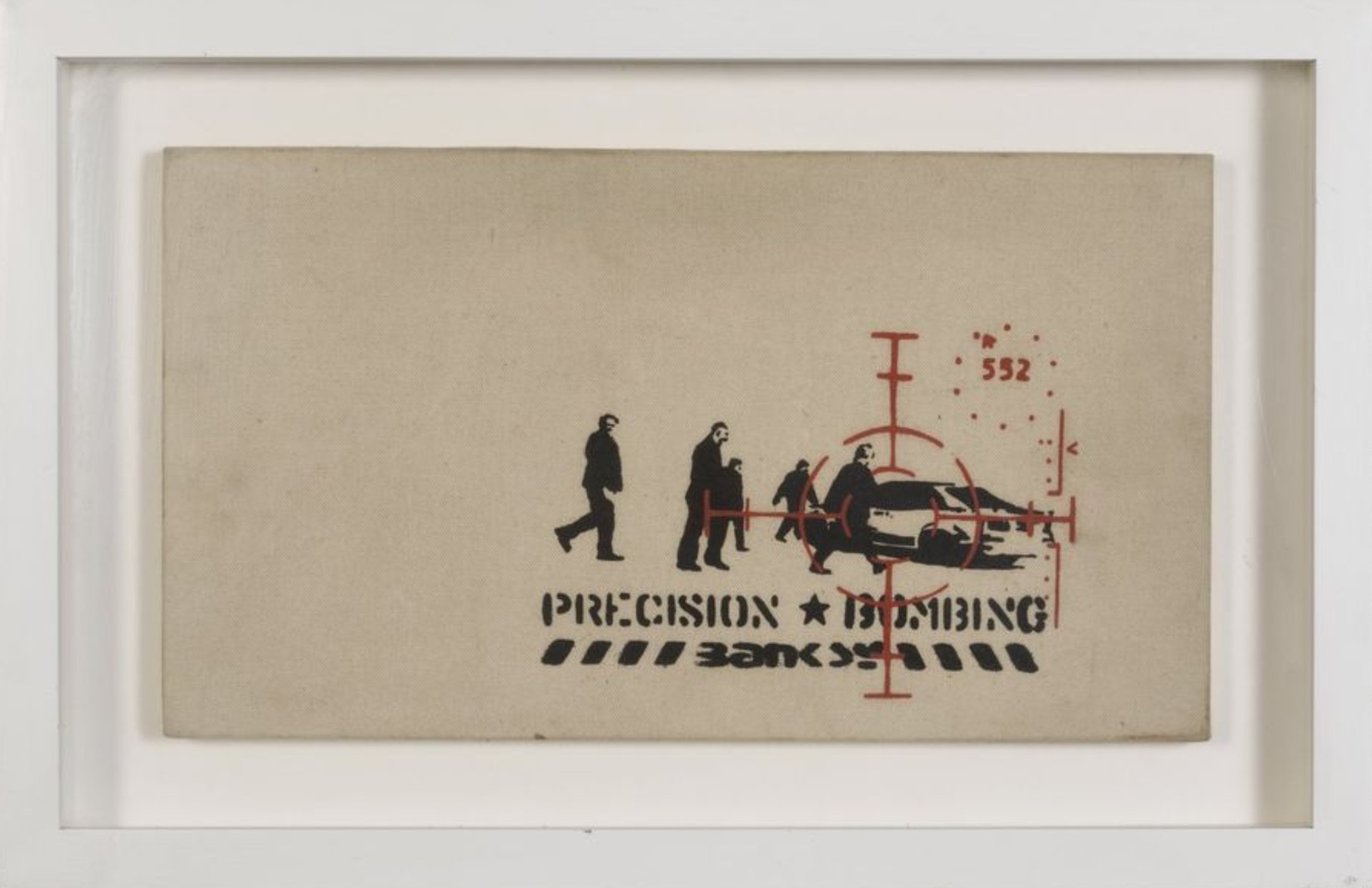
Precision Bombing, 2000
Stencil spray-paint on buff canvas laid on board
With various test stencils on the reverse
26×46 cm (10-1/4 x 18-1/8 inches)
Signed in stencil
Provenance
Private Collection, England (acquired directly from the artist)
Private Collection, England (acquired directly from the previous owner)
Dreweatts, London, 14 October 2008, Lot 11
Private Collection, England (acquired from the above sale)
Bonhams, London, 21 September 2011, Lot 25
Private Collection
Bonhams, London, 28 January 2015, Lot 25
Private Collection
Auction History
| Digard Auction 21 October 2019 Est.: EUR 90,000 – 150,000 | Price Realized EUR 234,000 / USD 260,780 BANKSY (Britannique, né en 1975) – Lot 64 |
REPEAT SALE
| Bonhams London 28 January 2015 Est.: GBP 20,000 – 30,000 | Price Realized GBP 40,000 / USD 60,665 |
REPEAT SALE
| Bonhams London 21 September 2011 Estimates Not Communicated | Price Realized GBP 20,000 / USD 27,670 Bonhams : Precision Bombing |
Catalogue Note
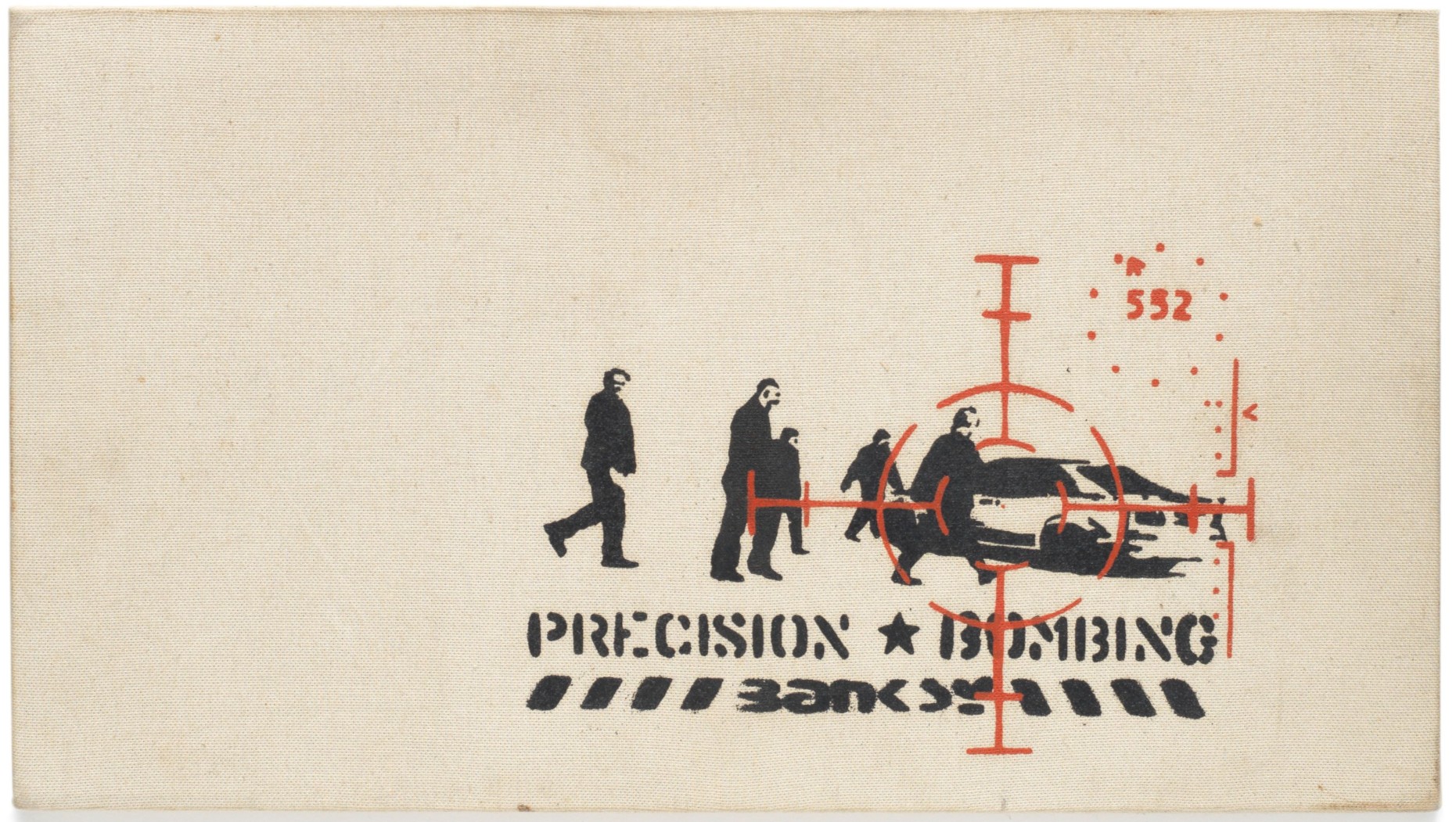
Precision Bombing is one of Banksy’s earliest and most uncompromising statements on the illusion of modern warfare. Reduced to its essential graphic elements, the composition depicts an ordinary street scene interrupted by the vivid red crosshairs of a military targeting system. Executed with remarkable precision, the elaborate targeting reticle dominates the composition, its crisp geometry and technical complexity standing in stark contrast to the loosely rendered silhouettes of the civilians below. The title itself is deeply ironic. Rather than suggesting surgical accuracy, Banksy reminds us that beneath the sanitized language of “precision strikes” lie ordinary lives reduced to anonymous coordinates.
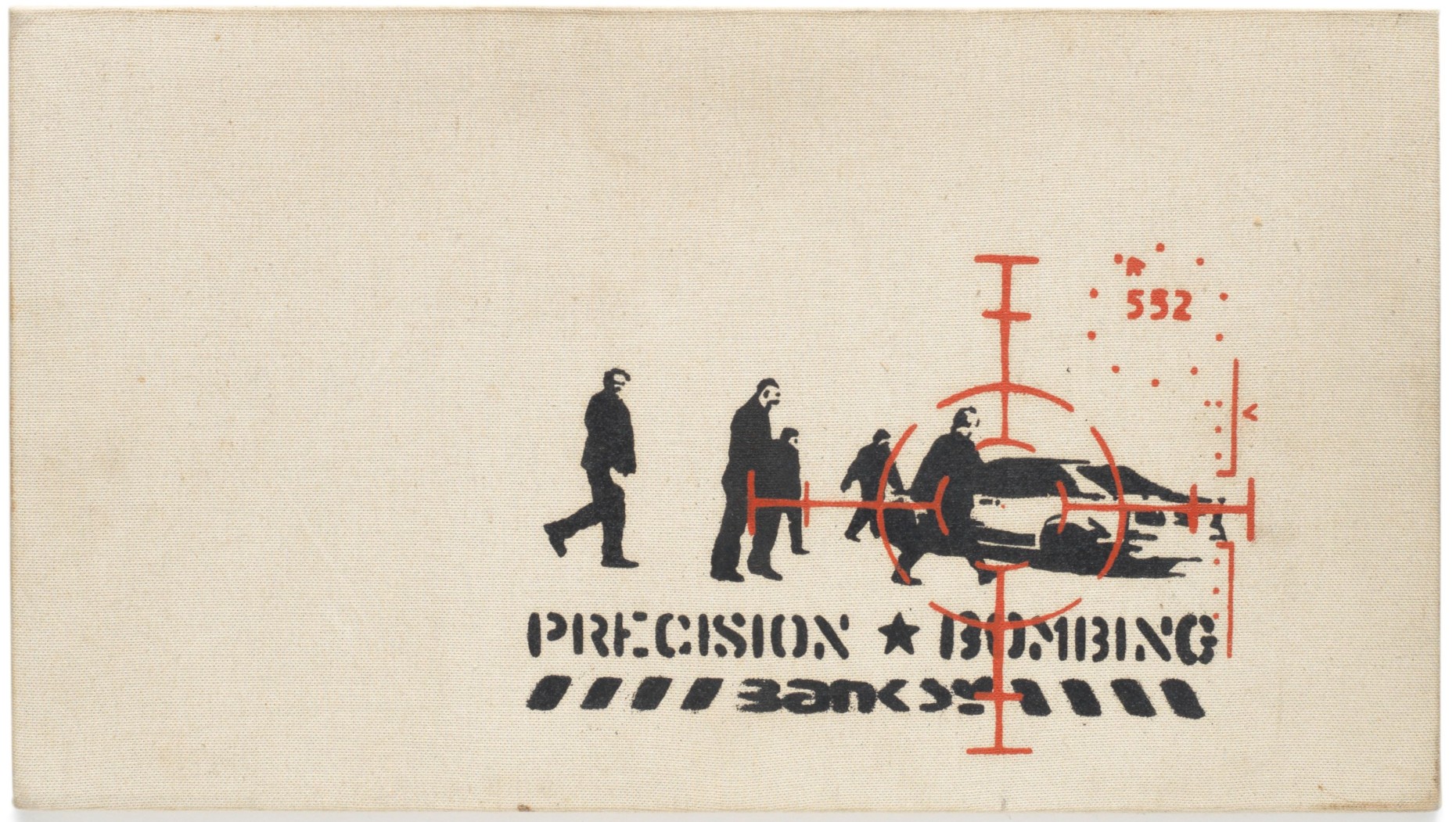
The meticulous rendering of the targeting system is no accident. Banksy deliberately devotes greater visual precision to the machinery of war than to its human subjects, exposing the unsettling reality that modern conflict often values technological accuracy more highly than the individual lives caught within its sights. The clean, calculated lines of the military optics become a visual metaphor for the detached bureaucracy of contemporary warfare, where destruction is planned with mathematical exactitude while its human consequences remain blurred and distant.
Created in 2000, the work belongs to a pivotal moment in Banksy’s career, when his instantly recognizable visual vocabulary was beginning to emerge. Here, military iconography is stripped of its spectacle and transformed into a stark symbol of bureaucratic violence. The restrained composition, with its vast expanse of empty canvas, further reinforces the vulnerability and isolation of the figures below, emphasizing how easily ordinary civilians disappear within the detached logic of military strategy.
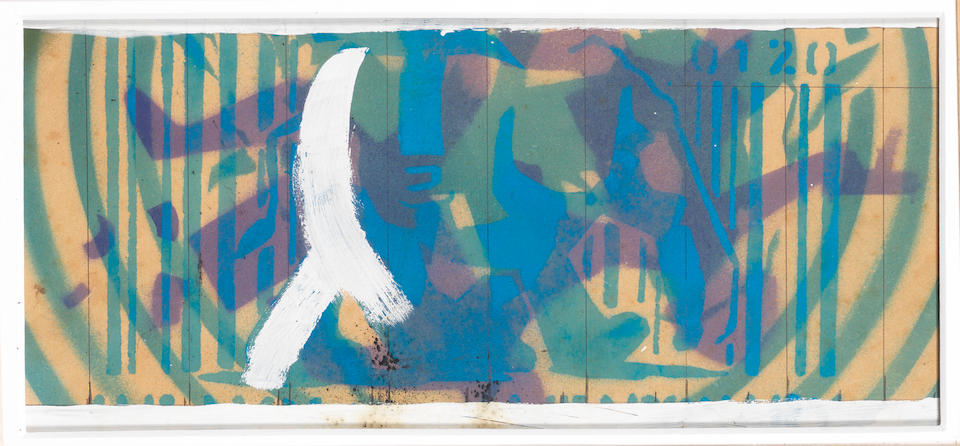
The present example is particularly significant as the reverse reveals numerous spray-painted test stencils, offering a rare glimpse into Banksy’s working process. These experimental motifs transform the object itself into a fascinating studio document, preserving the evolution of the composition and reinforcing its importance as one of the artist’s earliest surviving originals.
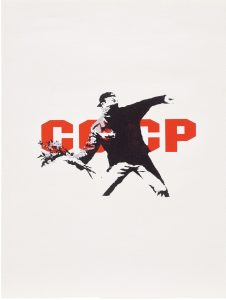
The subject would remain central throughout Banksy’s career. From Heavy Weaponry and Bomb Hugger to Flower Thrower, Civilian Drone Strike, and Bomb Love, Banksy repeatedly questioned the language through which violence is normalized and presented as clean, efficient, or even humane. In Precision Bombing, that lifelong critique is already fully formed: the crosshairs promise accuracy, but their true target is our moral complacency.