BANKSY
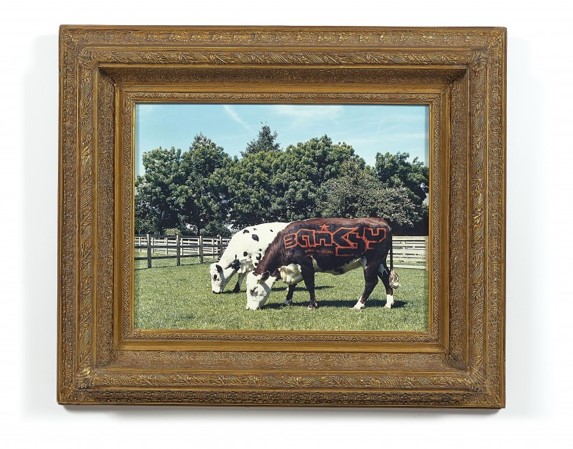
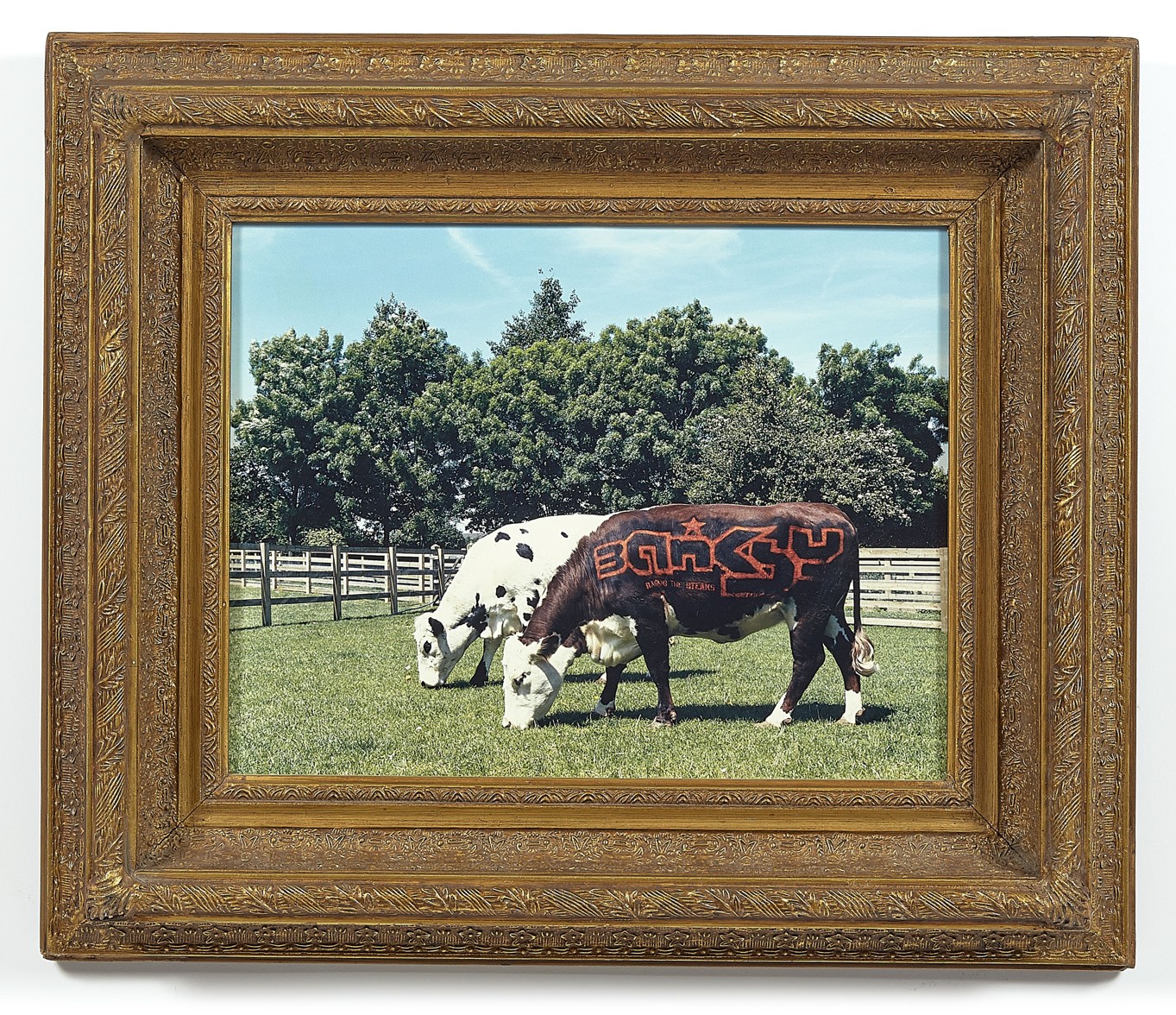
Raising the Steaks, 2001
Photograph of a work by Banksy taken by Steve Lazarides, framed by Banksy
35.5 x 45.5 cm (14×18 inches)
From a series, unsigned
Provenance
Artificial Gallery, London
Private Collection, London
Purchased from the above by current owner
Auction History
| Artcurial Paris 23 February 2020 Est.: EUR 40,000 – 60,000 |
Price Realized
EUR 84,500 / USD 91,665 |
Catalogue Note
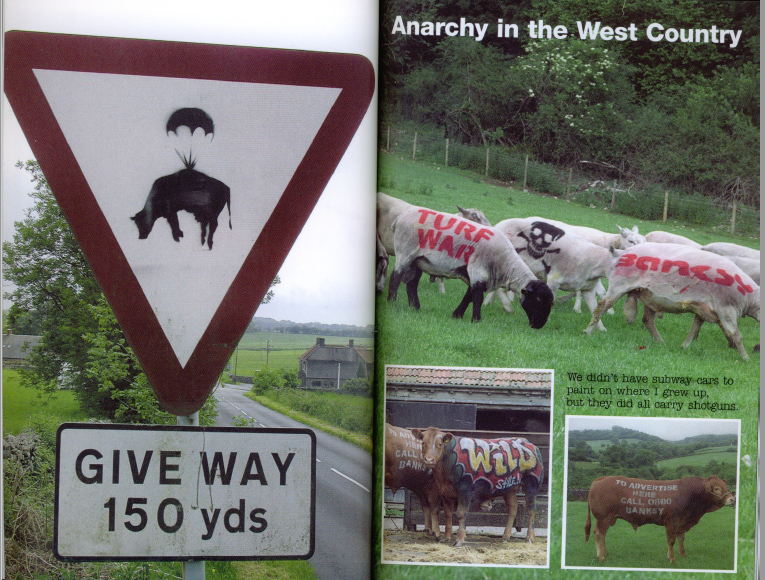
Long before Turf War transformed a London warehouse into one of the defining exhibitions of contemporary street art, Banksy was already experimenting with a far more unpredictable canvas: the English countryside itself. Raising the Steaks documents one of the artist’s earliest interventions into the rural landscape, in which grazing livestock became unwitting participants in a work that existed only temporarily before surviving through photography.
The title encapsulates Banksy’s characteristic wit. A playful corruption of the expression “raising the stakes,” it simultaneously refers to cattle farming while suggesting that the artist is raising the political stakes of graffiti itself. Rather than painting walls, trains or abandoned buildings, Banksy appropriates living animals as moving billboards, carrying graffiti into the pastoral heart of Britain. The result is both humorous and profoundly unsettling.
The work also marks one of Banksy’s earliest explorations of performance and ephemerality. The painted cows wandered freely through the fields, meaning that no single viewer ever experienced exactly the same artwork. Like much of his street practice, the intervention was destined to disappear. The framed photograph therefore becomes more than simple documentation; it is the surviving relic of an artwork that no longer exists, preserving a fleeting act of artistic rebellion.
At first glance, the image appears almost idyllic. Cows graze peacefully beneath a bright blue sky, framed by neat fences and the comforting order of the English countryside. Only gradually does the viewer notice the unmistakable BANKSY tag sprayed across the animal’s flank. The collision between rural innocence and urban graffiti creates precisely the kind of visual contradiction that defines Banksy’s early practice. Nature and vandalism, tradition and counterculture, agriculture and contemporary art suddenly occupy the same field.
The intervention also questions the ownership of public space. Graffiti is usually condemned because it alters property without permission. Here, Banksy extends that debate into the landscape itself. If a city wall can become an artist’s canvas, why not a field? Why not a cow? The absurdity of the gesture exposes the arbitrary boundaries separating legitimate art from criminal damage, while quietly mocking the conventions that determine where art is expected to exist.
The photograph gains additional significance through Steve Lazarides, whose camera documented many of Banksy’s earliest and most ephemeral actions. Framed by Banksy himself, the object becomes a collaboration between artist and photographer, transforming documentary evidence into a work of art in its own right. It captures not only the image, but the spirit of a practice that was fundamentally temporary.
Raising the Steaks also anticipates the live installations of Turf War in 2003, where painted cows, sheep and pigs occupied the exhibition space as living sculptures. Those controversial works questioned animal welfare, spectacle and artistic freedom, while simultaneously blurring the boundaries between exhibition, performance and social experiment. Seen in retrospect, this modest photograph represents the genesis of that ambitious project and one of the earliest moments in which Banksy expanded graffiti beyond the wall and into lived reality.
Ultimately, Raising the Steaks is less about painted cattle than about artistic territory. It demonstrates Banksy’s determination to challenge every convention governing where art belongs, what may serve as its support, and how long it must exist. Long before museums and auction houses embraced his work, Banksy was already proving that the most memorable canvases are sometimes alive, impossible to preserve, and destined to survive only through the stories—and photographs—they leave behind.