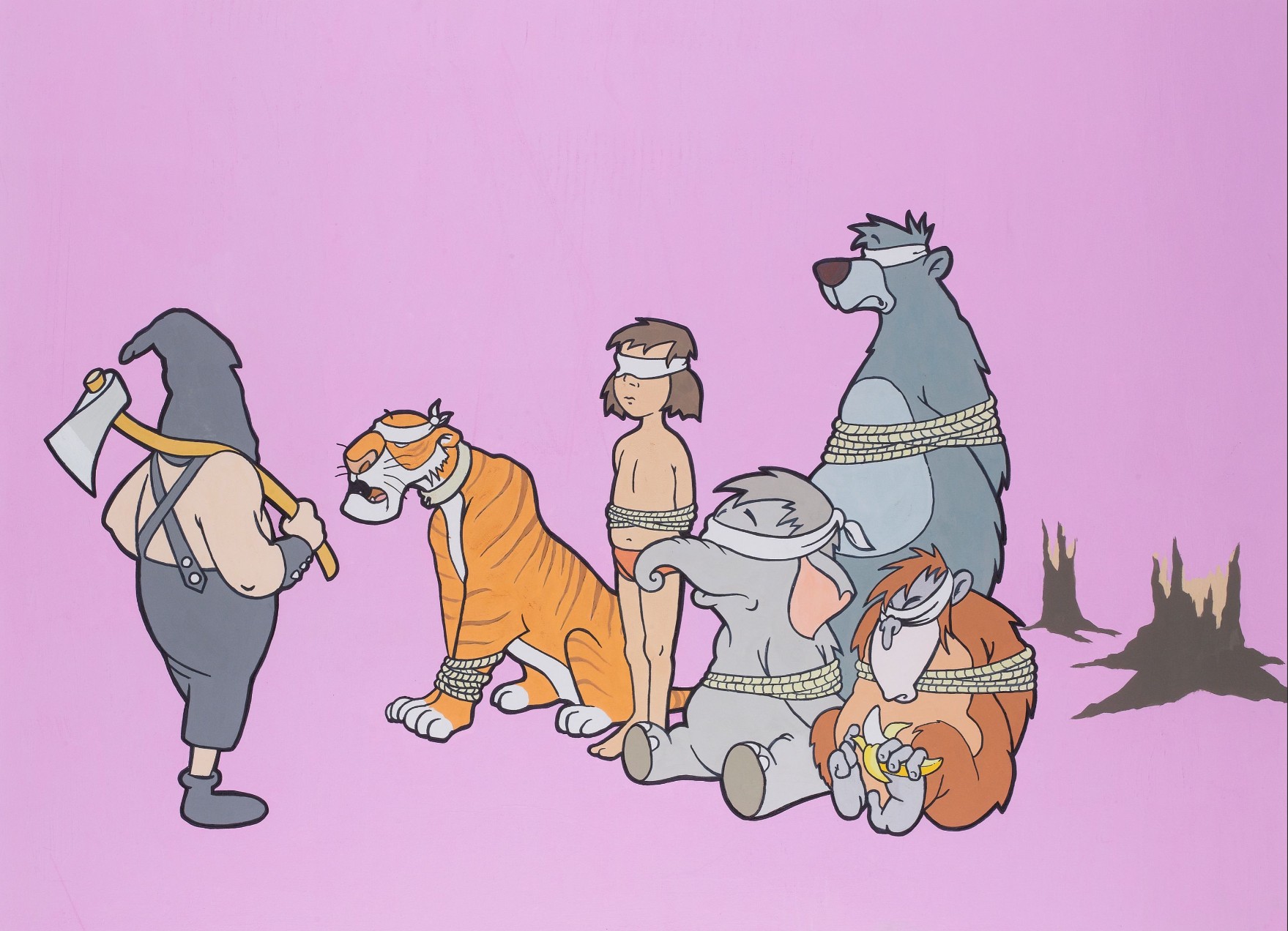
Within a double sided hermetically sealed frame
Mounted together with a digital print of the design for the planned Greenpeace campaign
Provenance
A gift to the current vendor from the artist
Auction History
| Bonhams London 11 January 2011 Est.: GBP 60,000 – 80,000 |
Price Realized
GBP 78,000 / USD 107,620 |
Catalogue Note

Banksy appropriates the beloved characters from Disney’s The Jungle Book, placing Mowgli, Baloo, King Louie and Shere Khan blindfolded and bound before an executioner standing among the stumps of a devastated forest. Stripped of their playful innocence, these familiar childhood icons become silent victims of environmental destruction, transforming one of the world’s most celebrated animated films into a powerful allegory of extinction.
The brilliance of the composition lies in its unsettling reversal of expectations. The Jungle Book has long celebrated the richness and harmony of the natural world, yet Banksy imagines its protagonists after the forest has disappeared. There is no lush vegetation, no adventure and no sanctuary—only barren tree stumps and a waiting executioner.
The blindfolds are particularly poignant. Neither the animals nor Mowgli can see what awaits them, reflecting humanity’s own tendency to ignore the long-term consequences of environmental degradation until it becomes irreversible. Banksy suggests that deforestation does not merely destroy trees; it erases entire ecosystems, cultures and stories that have shaped our collective imagination.
The original painting was intended to be combined with a photographic background of a devastated rainforest for Greenpeace’s Save or Delete campaign. Posters, postcards and billboards were produced, but the campaign never reached the public after Disney objected to the unauthorized use of its copyrighted characters.
This unexpected censorship has become an integral part of the work’s history. Ironically, a campaign intended to defend endangered forests became itself a casualty of competing legal and commercial interests. The episode illustrates one of Banksy’s recurring concerns: the uneasy relationship between political activism, corporate power and freedom of expression.
Although created at a very early stage in Banksy’s career, Save or Delete Jungle Book anticipates many themes that would later become central to his work. His appropriation of Disney imagery foreshadows celebrated pieces such as Napalm and the dystopian vision of Dismaland, while its environmental message resonates with later projects including Season’s Greetings, Show Me the Monet and numerous murals addressing climate change and ecological collapse. The work also stands as one of Banksy’s earliest examples of using universally recognizable cultural icons to communicate complex political ideas, a strategy that would become one of his defining artistic signatures.
Save or Delete Jungle Book perfectly encapsulates Banksy’s ability to transform nostalgia into political awareness. By placing some of the world’s most beloved fictional characters in a landscape stripped of life, he reminds us that environmental destruction is not an abstract ecological problem but a human tragedy that threatens the stories, symbols and natural world we all share. More than twenty years after its creation, the work remains one of Banksy’s most compelling environmental statements—a rare early masterpiece where satire gives way to quiet urgency, and where childhood innocence becomes the most powerful advocate for a disappearing planet.