BANKSY
Scene Struggle, 2006
Acrylic and spray paint on canvas
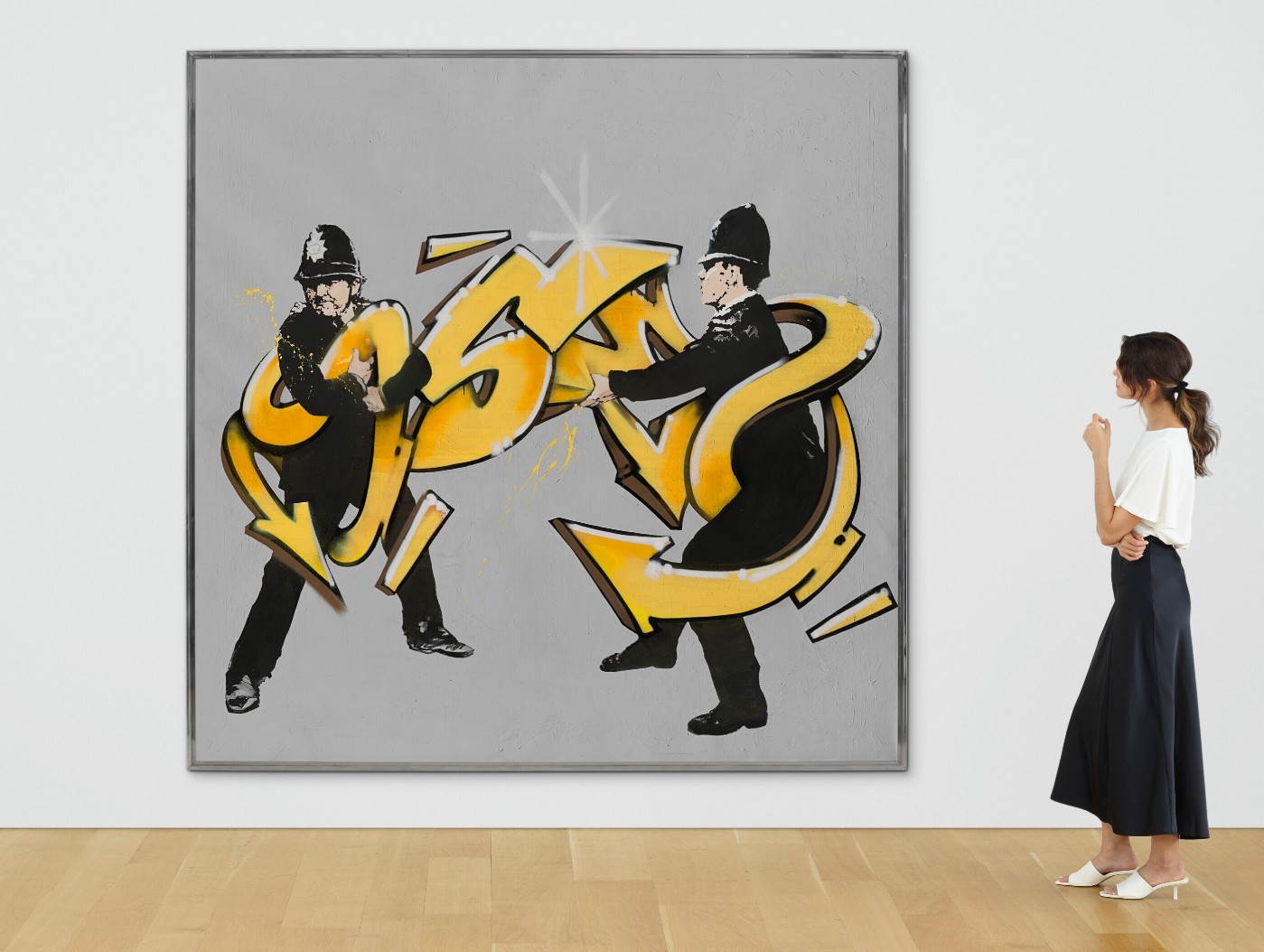
240×240 cm (94-1/2 x 94-1/2 inches)
Signed
Exhibited
Barely Legal, Los Angeles, 2006
Catalogue Note
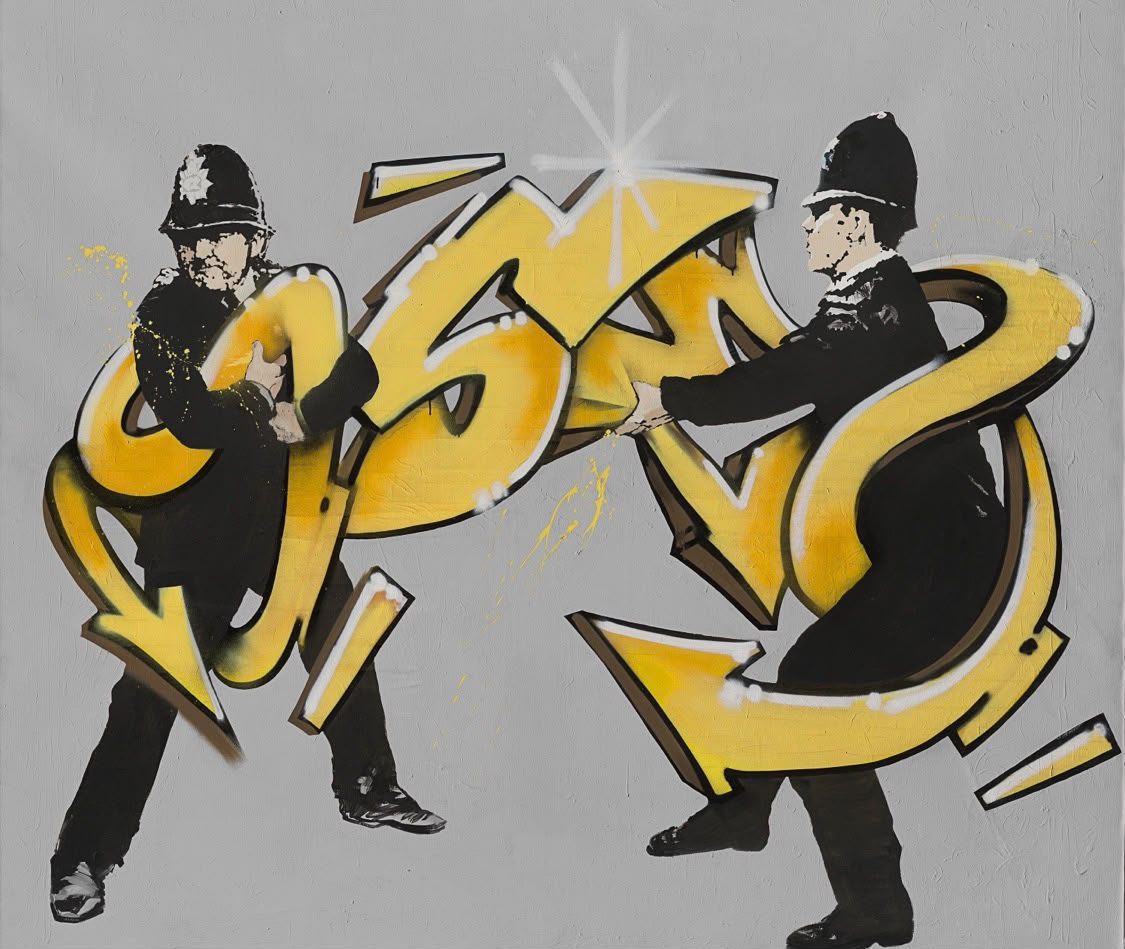
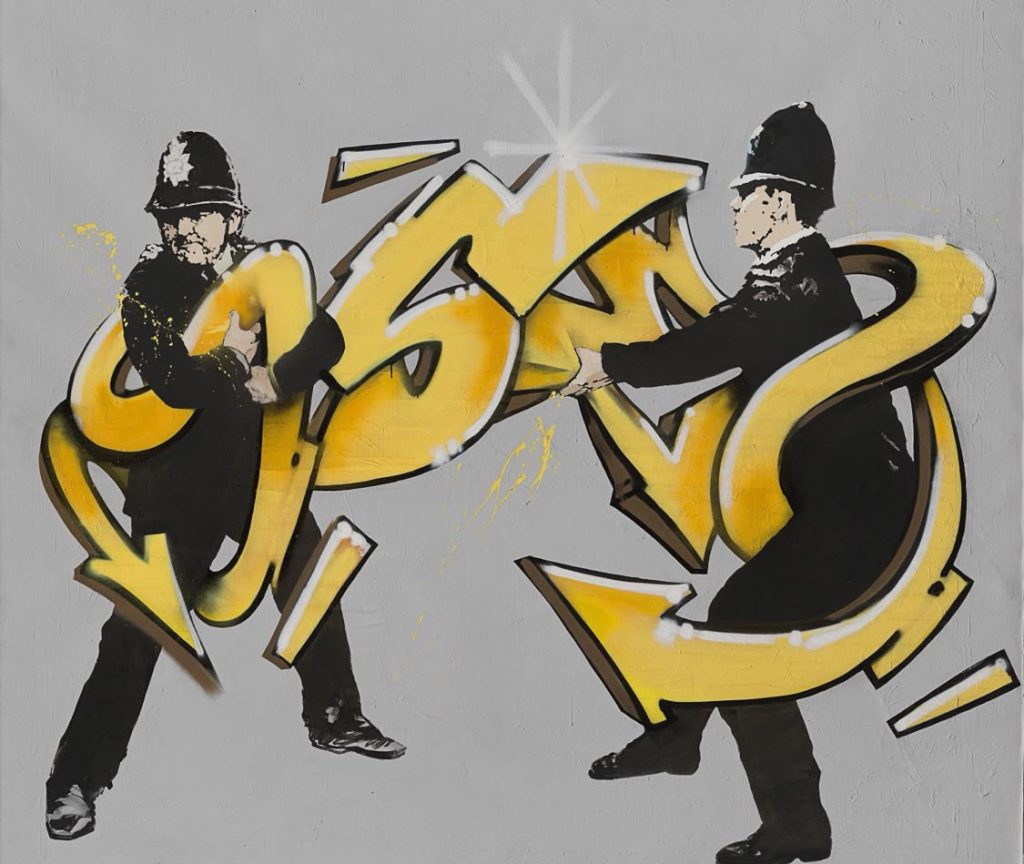
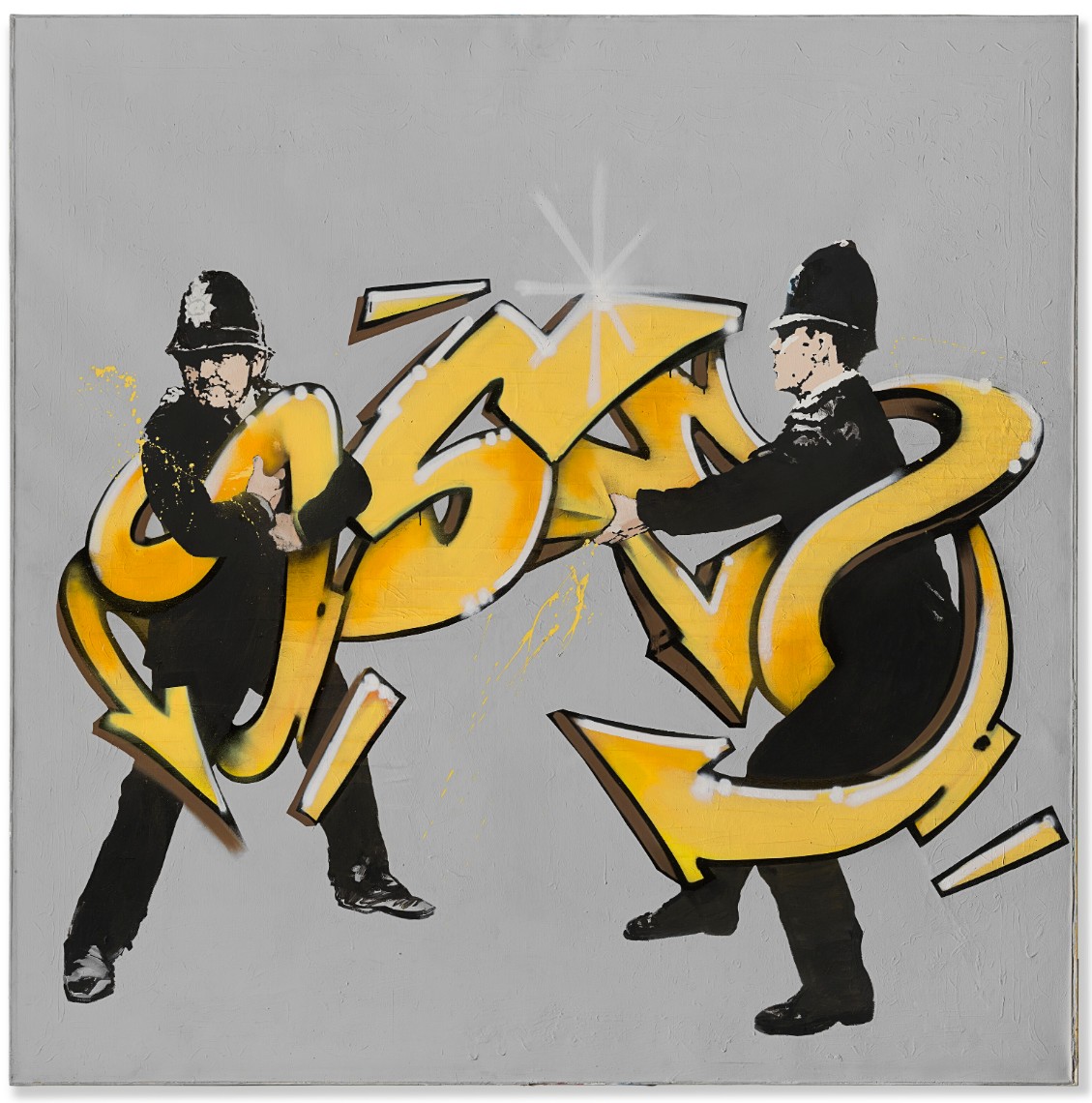
Painted in 2006 and exhibited at Barely Legal in Los Angeles, Scene Struggle depicts two British policemen carrying a large section of vibrant yellow graffiti lettering across the picture plane. Executed in acrylic and spray paint on canvas, the work combines Banksy’s instantly recognizable stenciled figures with a dynamic, three-dimensional graffiti composition that appears to float between the two officers. The restrained grey background allows the explosive yellow lettering to dominate the painting, creating a striking dialogue between order and visual disorder. At first glance, the policemen appear simply to be removing a piece of graffiti. Yet the image quickly reveals itself to be more ambiguous. Rather than erasing vandalism, they seem to be transporting it with almost ceremonial care, transforming an act of policing into an act of preservation.
Scene Struggle was created for Barely Legal, Banksy’s landmark 2006 exhibition in Los Angeles, widely regarded as the moment that firmly established his international reputation. The exhibition introduced American audiences to the breadth of Banksy’s practice, bringing together monumental paintings, installations and live interventions while exploring themes of authority, consumerism, surveillance and popular culture.
The painting belongs to an important body of works from this period in which Banksy increasingly incorporated elements of traditional graffiti writing into his compositions. Although he had emerged from Bristol’s graffiti scene, Banksy rarely foregrounded letter-based graffiti in his mature work, preferring figurative stencils. Scene Struggle therefore offers a rare acknowledgment of his artistic origins, allowing graffiti itself to become one of the central protagonists of the composition.
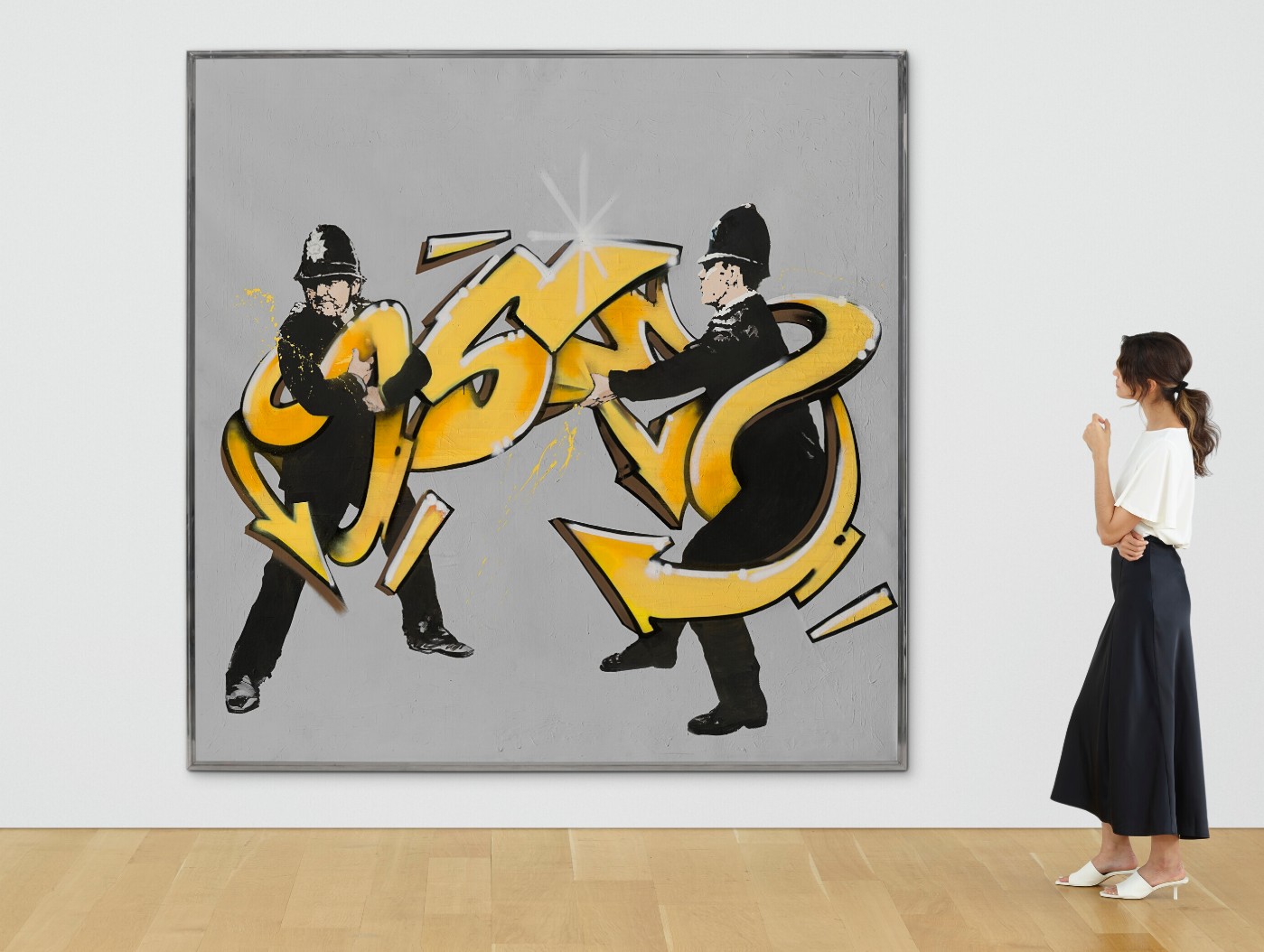
The painting thrives on contradiction. Graffiti has historically been regarded as something to remove, censor or paint over. Here, however, the police do not destroy it; they carry it. The gesture is quietly absurd. Authority appears to have accepted responsibility for protecting the very culture it has long sought to suppress. This reversal speaks to one of Banksy’s recurring themes: the uneasy relationship between institutions and artistic expression. Graffiti exists because it resists permission, ownership and permanence. Once removed from the street and transported into galleries and private collections, however, it becomes something to preserve rather than eliminate.
There is another subtle irony. The title, Scene Struggle, suggests conflict not only between graffiti artists and the police but also within the urban landscape itself. The “scene” refers as much to the graffiti community as it does to the broader cultural environment in which subversion is gradually absorbed into the mainstream. By 2006, Banksy himself occupied precisely that paradoxical position: an anonymous street artist whose work was already entering museums, auction houses and prestigious collections. The yellow graffiti form functions almost like a living object. It is neither text nor abstraction, but an energetic sculptural presence caught between two opposing forces. Rather than depicting graffiti as an act, Banksy presents it as an idea that cannot easily be contained.
Scene Struggle occupies a distinctive place within Banksy’s body of original paintings because it directly acknowledges the artist’s graffiti roots. While much of Banksy’s practice became defined by the clarity and immediacy of stencil imagery, this work reintroduces the visual language of letter-based graffiti from which his career first emerged.
The painting also belongs to a broader series exploring the relationship between authority and dissent. Policemen, security guards and agents of state control appear throughout Banksy’s oeuvre, often stripped of their traditional authority through humour or irony. Here, however, the critique is more nuanced. The police are not depicted as aggressors but as unwilling custodians of the very culture they were once expected to suppress. As one of the major canvases exhibited at Barely Legal, the work also reflects a pivotal moment in Banksy’s career, when street art was beginning its transition from the margins of urban culture to the center of the contemporary art world.
Scene Struggle is more than a witty image of policemen carrying graffiti. It is a meditation on the changing status of street art itself. By transforming graffiti into an object worthy of careful handling, Banksy captures the extraordinary reversal that defined his own career. What was once dismissed as vandalism had become cultural heritage; what once belonged exclusively to the street was now entering museums and major collections. The painting quietly asks whether graffiti loses its rebellious spirit once it is preserved, or whether its power lies precisely in its ability to survive every attempt to contain it. More than any explicit political statement, Scene Struggle reflects Banksy’s enduring fascination with inversion. The authorities become conservators, graffiti becomes sculpture, and conflict becomes collaboration. It is in these reversals that Banksy finds his sharpest observations, reminding us that the boundaries between rebellion and acceptance are often far more fragile than they first appear.