GUARD WITH BALLOON DOG
AUTHORITY ON A LEASH
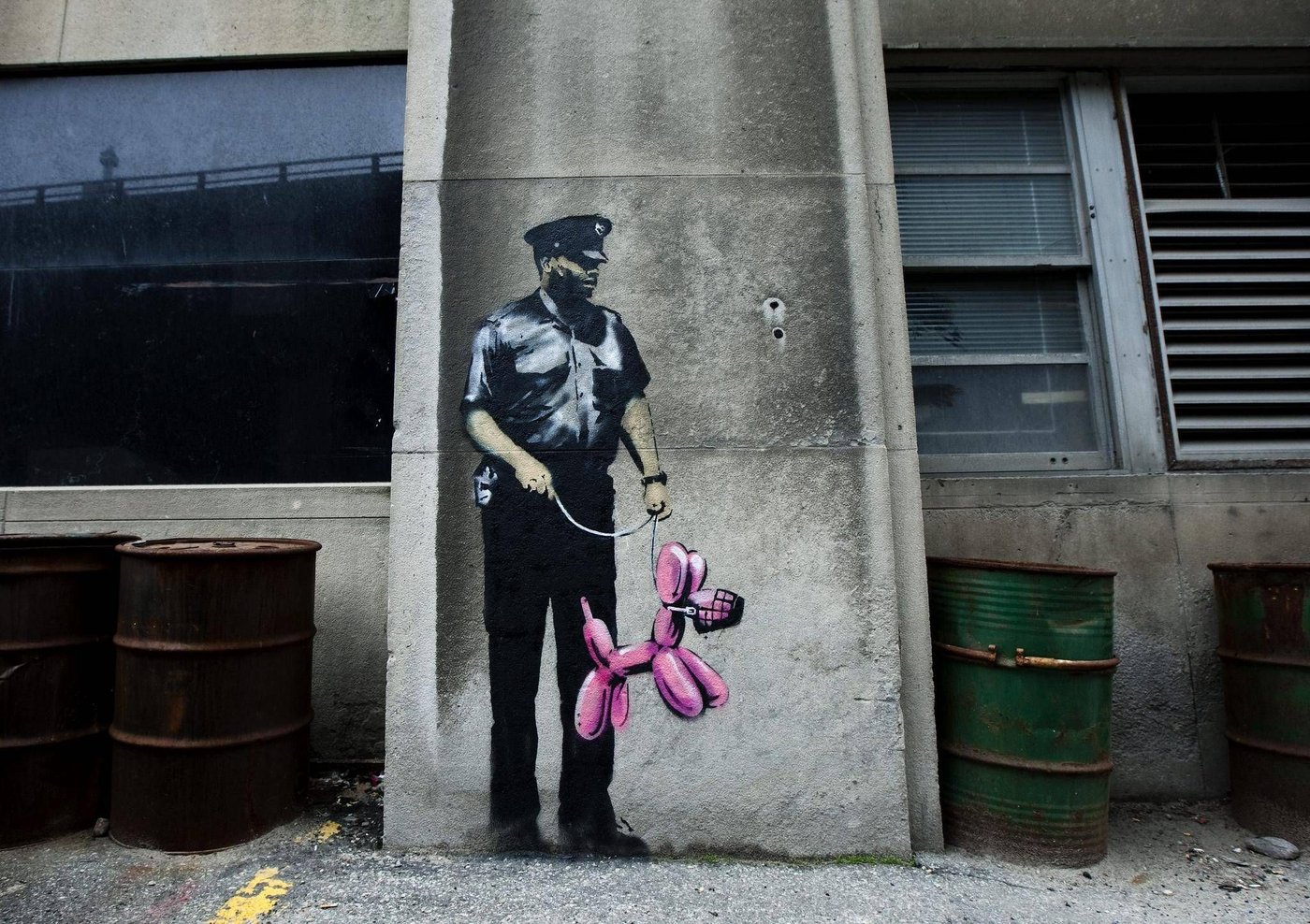
In May 2010, shortly after the North American release of Exit Through the Gift Shop, Banksy left a small group of interventions across Toronto. Among the most memorable was Guard with Balloon Dog, painted on the rear façade of a vacant building at 90 Harbour Street. The composition depicts a uniformed security guard looking down at his hand while holding a leash attached not to a conventional guard dog, but to a bright pink balloon animal. The mural was one of approximately seven Banksy works reported across Toronto during the same weekend.
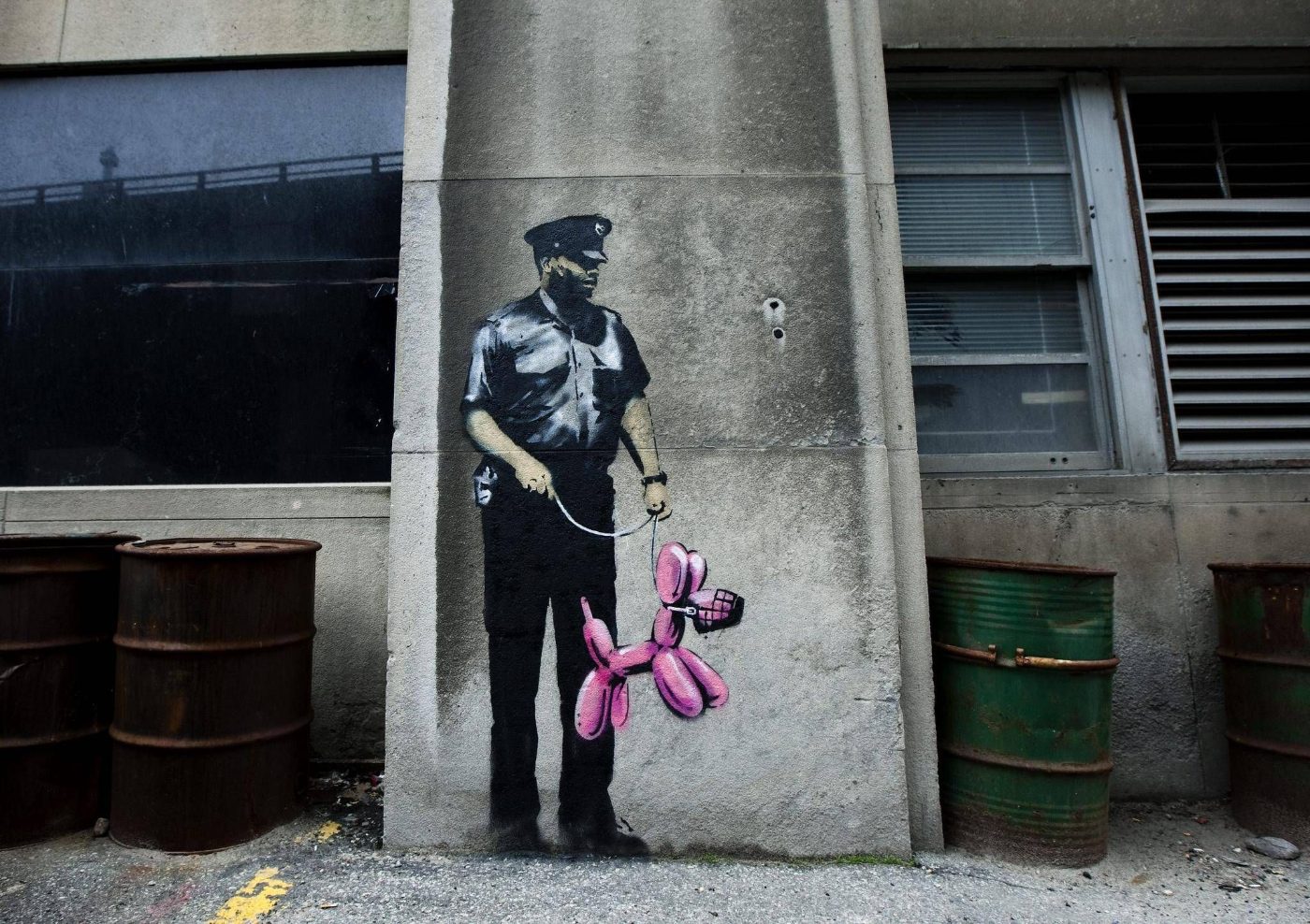
The substitution is characteristically economical. A security guard and his dog ordinarily constitute a familiar image of surveillance and controlled authority: the human issues commands while the animal provides an additional instrument of intimidation. Banksy retains the guard but replaces the potentially threatening animal with something fragile, playful and associated with children's entertainment. The visual structure of authority remains intact while its principal instrument of force has been rendered harmless.
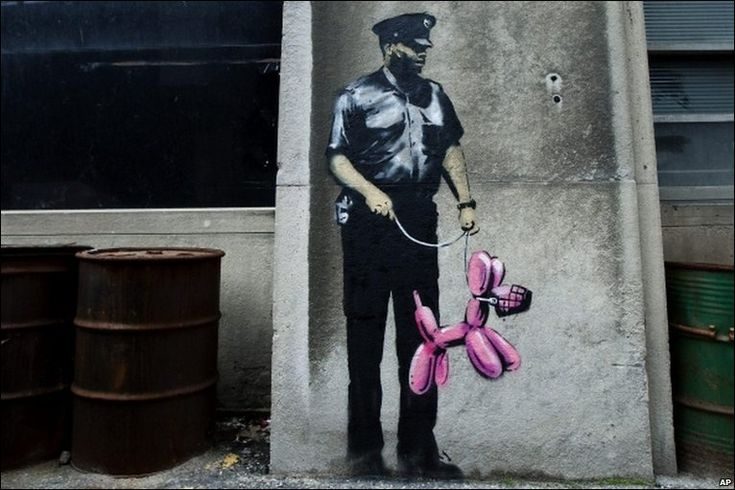
The guard himself is presented without obvious aggression. His downward gaze and relatively passive stance contrast with the institutional authority represented by his uniform. The pink dog introduces the only significant area of color into the otherwise monochromatic stencil, immediately drawing attention toward the absurdity of the relationship. As in many of Banksy's police and security images, authority is not attacked through heroic confrontation but destabilized through a small alteration that makes its rituals appear faintly ridiculous.
FROM GUARD DOG TO BALLOON DOG
The balloon animal also introduces an unmistakable art-historical association. Its form recalls the celebrated Balloon Dog sculptures created by American artist Jeff Koons as part of his Celebration series beginning in the 1990s. Koons transformed an ephemeral children's-party object into a monumental sculpture fabricated in mirror-polished stainless steel, elevating something deliberately banal into an extraordinarily sophisticated—and eventually extraordinarily valuable—art object.
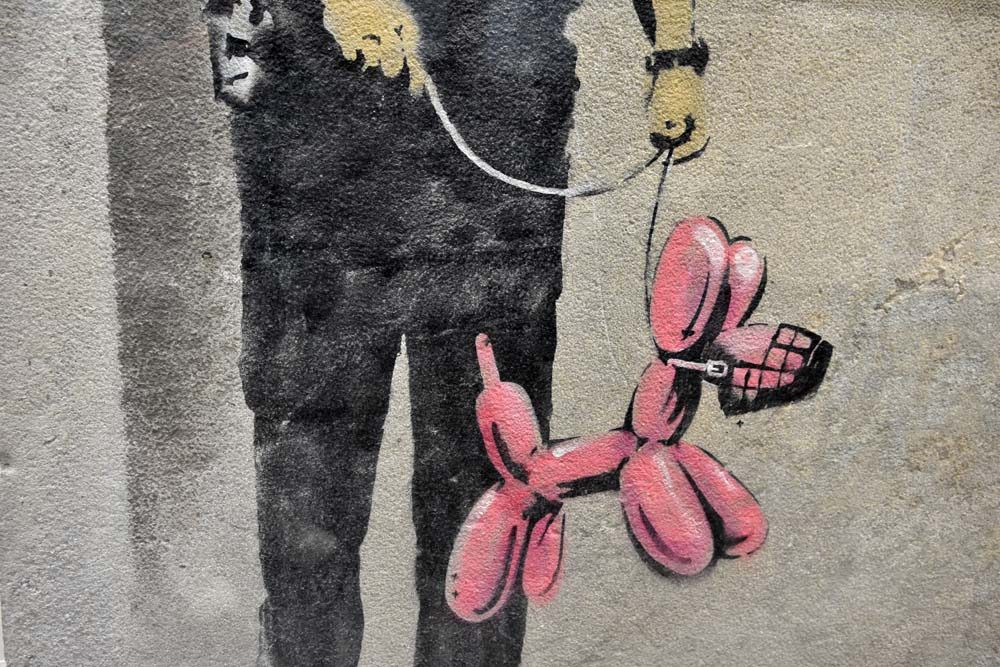
Banksy's dog performs almost the reverse operation. Rather than monumentalizing the balloon animal in stainless steel, he returns it to the street as a small, almost weightless image at the end of a security guard's leash. The reference does not require the mural to be understood as a direct parody of one particular Koons sculpture; the resemblance nevertheless establishes a productive dialogue between two radically different approaches to popular imagery. Koons takes the disposable and gives it the material permanence of luxury sculpture, while Banksy takes the visual language of contemporary art and places it anonymously on a vacant Toronto building.
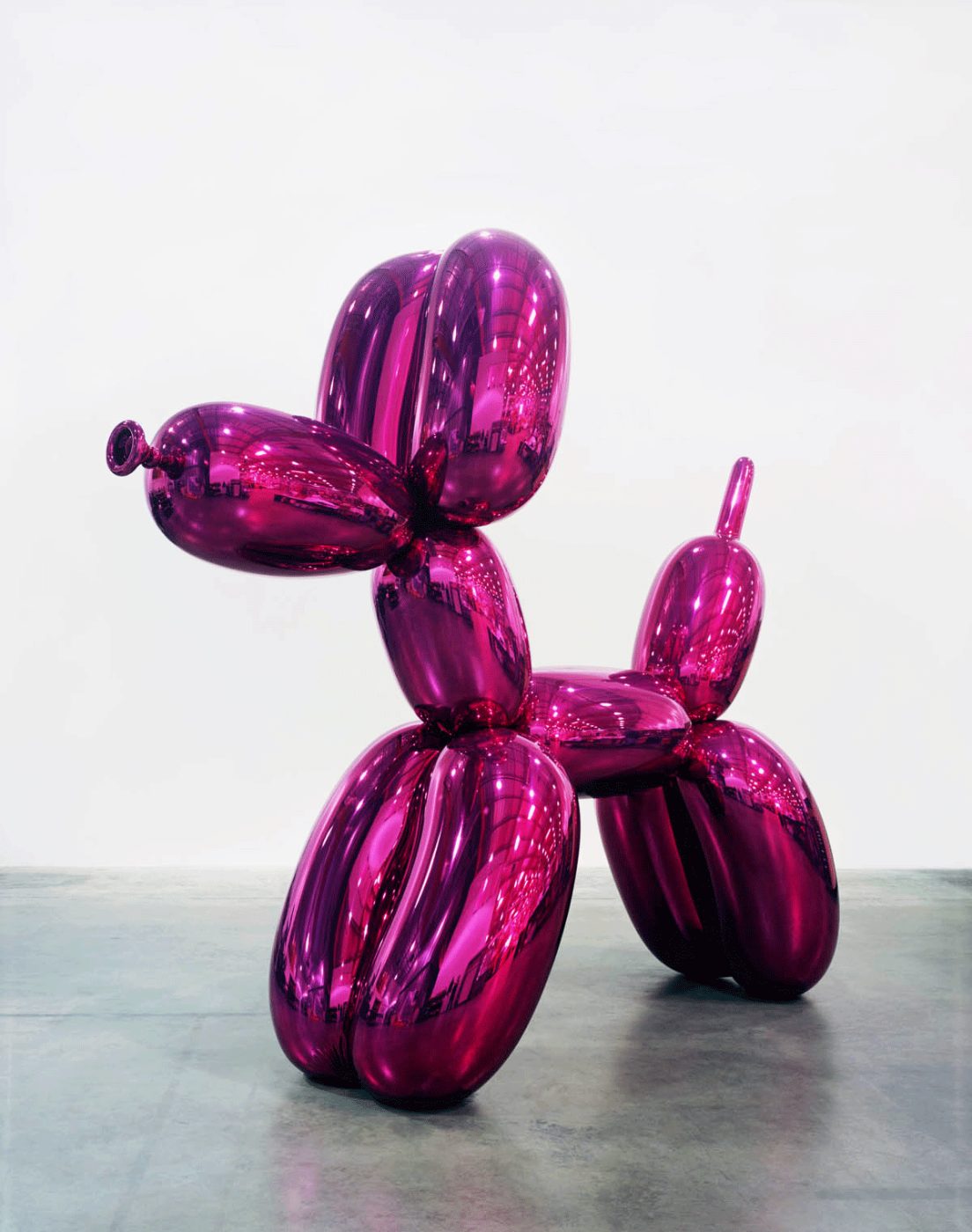
That dialogue is particularly appropriate to Banksy in 2010. By this stage, his own work occupied an increasingly ambiguous position between illegal street intervention and the international art market. Paintings and prints were commanding substantial prices while murals executed without permission could acquire considerable financial value simply because Banksy had placed them on a wall. A balloon dog associated with one of contemporary art's most commercially successful artists consequently becomes more than a visual joke: it introduces questions of value, transformation and artistic context into an otherwise straightforward image of institutional authority.
BANKSY IN TORONTO
Banksy's Toronto interventions formed part of the extraordinary period of activity surrounding Exit Through the Gift Shop. Following the film's Sundance premiere in January 2010, Banksy produced works in several North American cities, including Los Angeles, San Francisco, Boston and Toronto, effectively allowing street interventions to accompany the film as it reached new audiences.
Toronto saw approximately seven works attributed to Banksy appear during May 2010. Contemporary street-art coverage documented the sudden group of interventions while also reflecting the uncertainty that frequently accompanied new Banksy works before their authorship could be established. Guard with Balloon Dog subsequently appeared on Banksy's own website, strengthening its attribution.
The relationship with Exit Through the Gift Shop is particularly relevant. The film examines the uneasy passage of street art from unauthorized urban practice into galleries, publicity and the commercial art world. The Toronto works simultaneously returned Banksy to the simplest conditions of that practice: an anonymous artist, an ordinary building and an image left in public space without any conventional mechanism for determining what would happen to it next.
FROM STREET MURAL TO PRESERVED ARTWORK
The subsequent history of Guard with Balloon Dog provides an unusually revealing example of precisely that transformation. In 2011, Menkes Developments acquired the 90 Harbour Street property for redevelopment. Rather than allowing the Banksy to disappear when the vacant building was demolished, the developer instructed the demolition team to protect the limestone panels carrying the mural. They were removed from the building, preserved and professionally conserved.
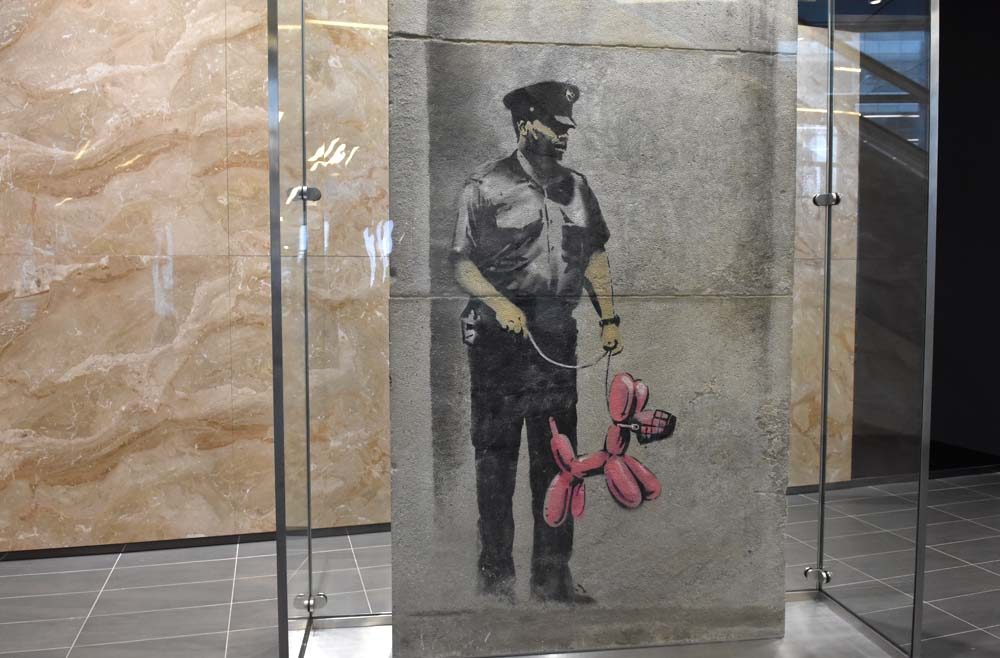
In 2017, the mural was unveiled in a new permanent setting at One York Street in downtown Toronto, enclosed behind protective glass and incorporated into the city's PATH pedestrian network. A work created anonymously on the rear of an abandoned building had therefore undergone a remarkable change of status: the architectural support itself was extracted, conserved and reinstalled as a recognized work of public art.
That history makes Guard with Balloon Dog particularly relevant within Banksy's catalogue. The mural began as an unauthorized intervention whose humor depended partly upon its ordinary urban surroundings, yet its perceived cultural and financial importance eventually justified preserving the very stones upon which it had been painted. The trajectory closely parallels one of the central questions explored in Exit Through the Gift Shop: how an image created within street culture acquires a radically different status once institutions, owners and the art market decide that it must be protected.
KOONS, BANKSY AND THE VALUE OF AN OBJECT
The survival of the mural adds an unintended final dimension to Banksy's apparent reference to Koons. Koons became famous in part by taking commonplace objects and reproducing them through technically elaborate processes that transformed their material and economic status. Banksy's balloon dog began at the opposite end of that spectrum—as a few areas of colored paint applied to an existing wall—but the subsequent preservation of the mural effectively converted that fragment of architecture into a valuable cultural object.

Guard with Balloon Dog therefore brings together several recurring concerns in Banksy's work without requiring an elaborate composition: authority and its symbols, childhood and innocence, appropriation from art history, and the unstable boundary between street intervention and collectible art. Its humor remains immediate—a security guard walking a pink balloon animal—but its subsequent history has made the work an especially revealing example of the institutional transformation Banksy's street art was undergoing by 2010.
STAY INFORMED
Receive the latest news, exhibitions, artworks and market updates on Banksy.