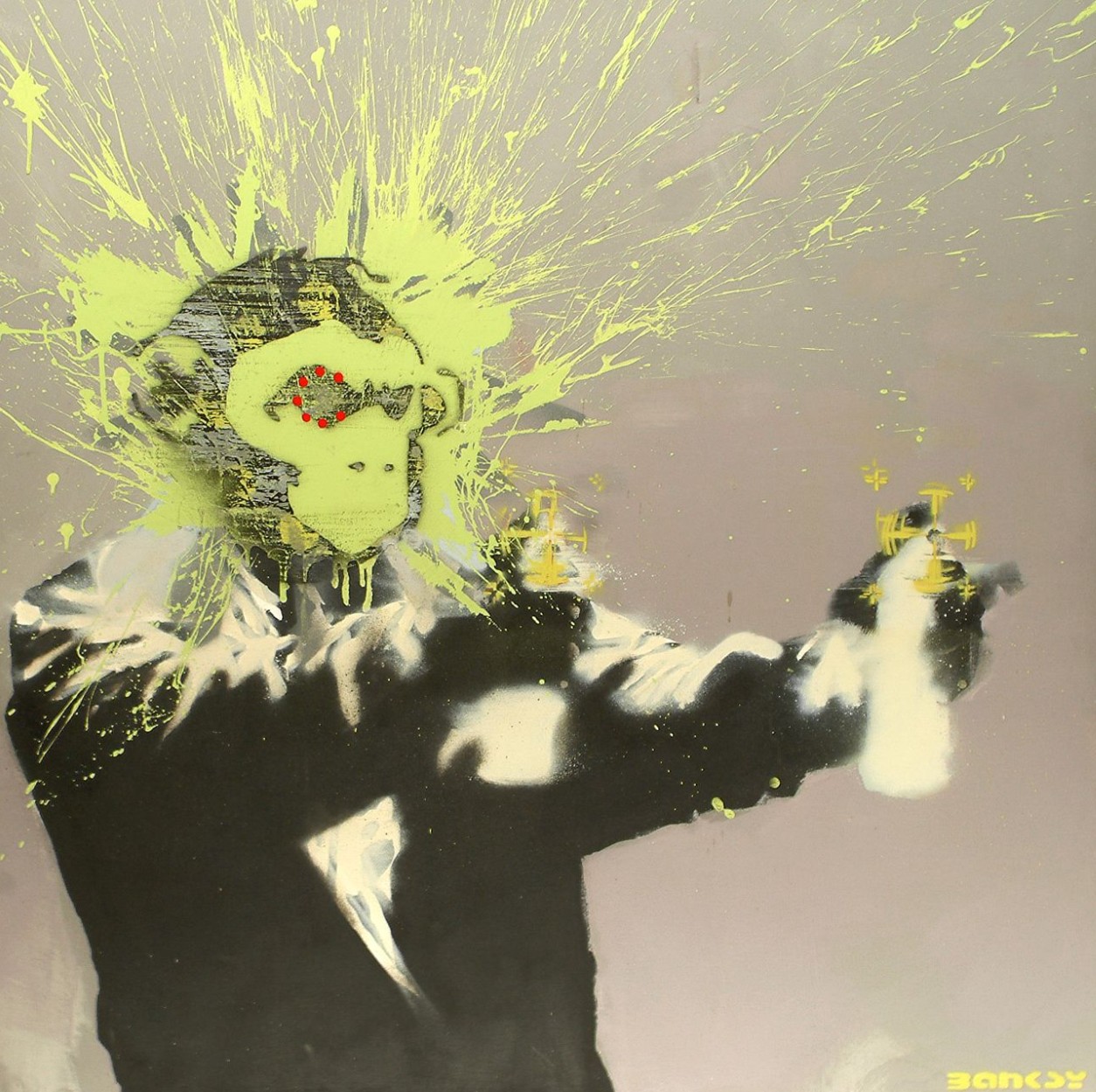
BANKSY
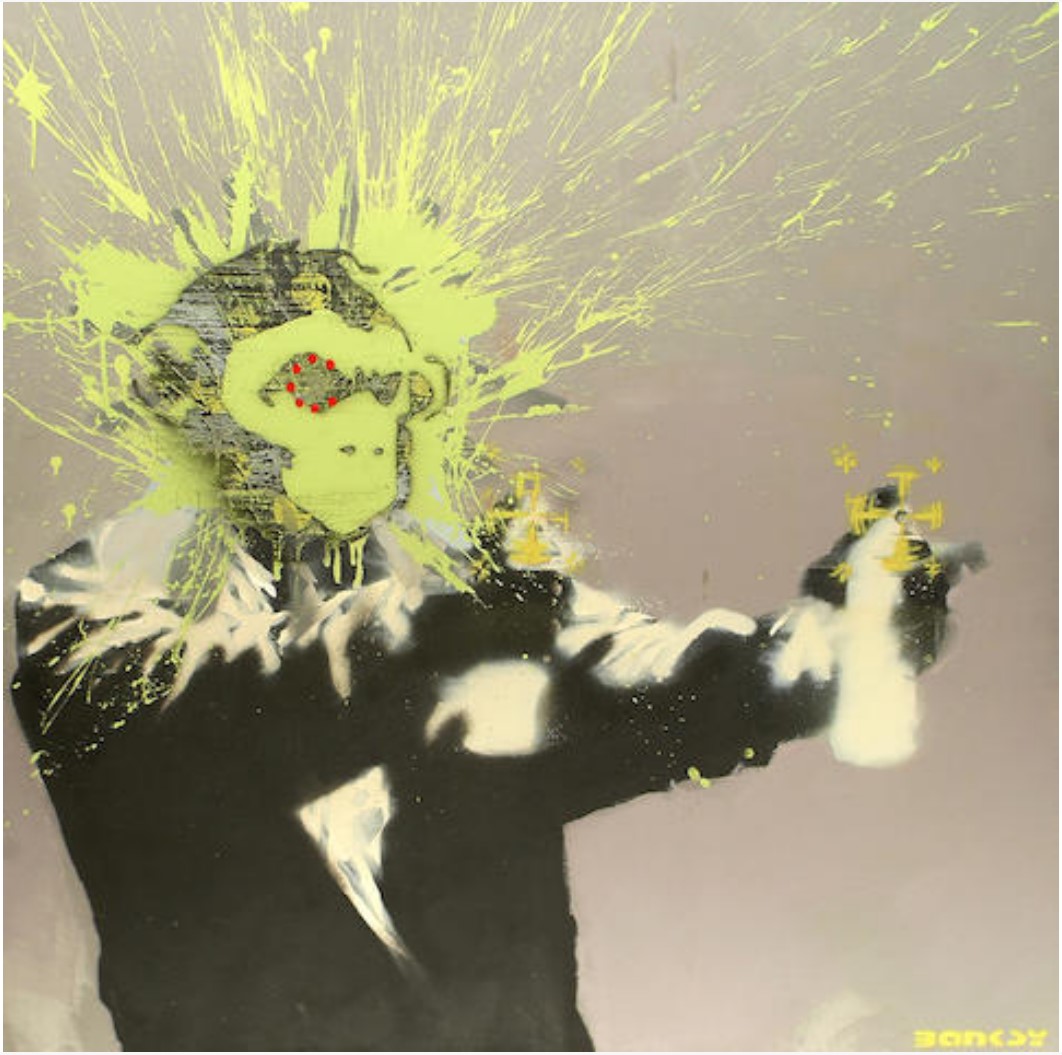
Self-Portrait, 2000
Oil and pray-paint on canvas laid on board
122×122 cm (48×48 inches)
Stencil-signed “BANKSY”, lower right
Exhibited
Severnshed, Bristol, 2000
Auction History
| Bonhams London 25 April 2007 Estimates Not Disclosed |
Price Realized GBP 198,000 / USD 259,900 Bonhams Self-Portrait |
Catalogue Note
Created in 2000, Self-Portrait stands among the earliest and most revealing paintings in Banksy’s oeuvre. Executed in stencil, spray paint, and oil on canvas laid on board, the composition depicts a life-sized figure whose face has been replaced by that of a monkey. Dressed in dark clothing and holding two spray cans fitted with stencil caps, the anonymous figure appears caught in the very act of painting. Brilliant fluorescent yellow splashes explode around the monkey’s head, transforming the composition into an energetic fusion of meticulous stencil work and spontaneous gestural abstraction.
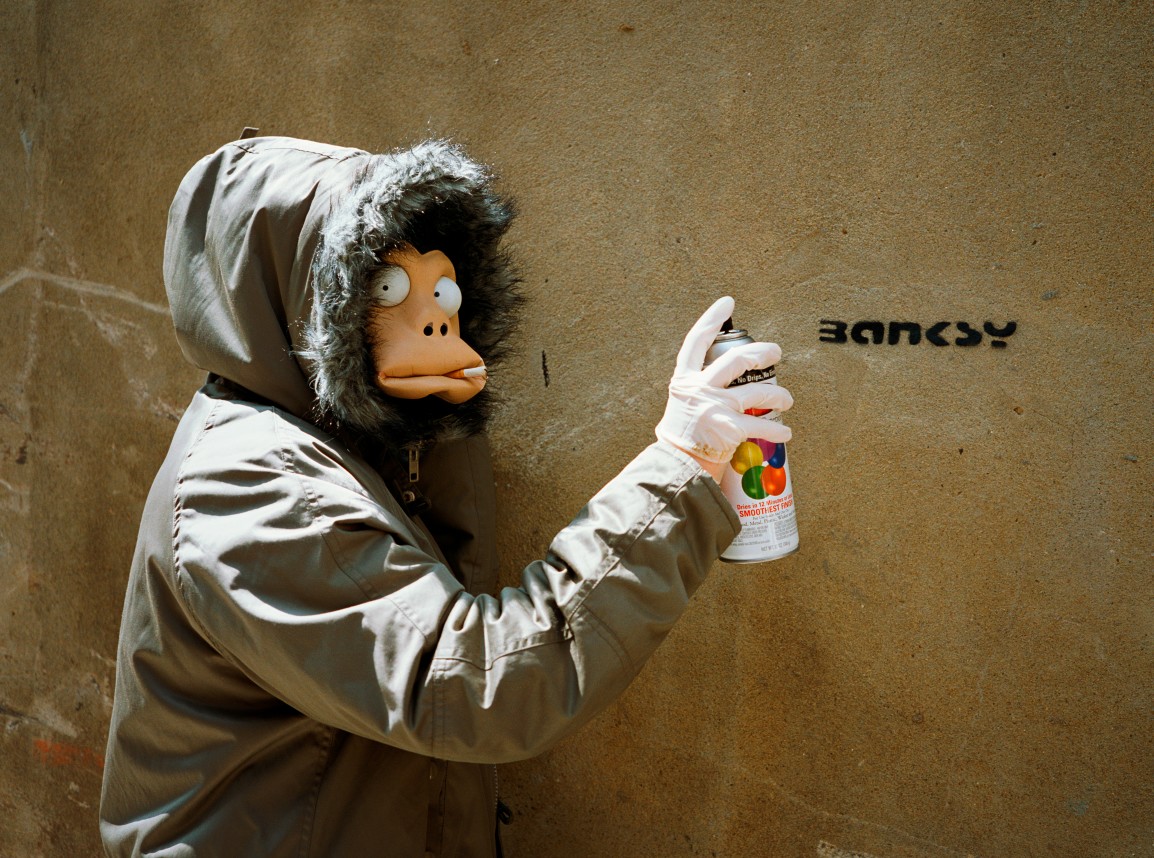
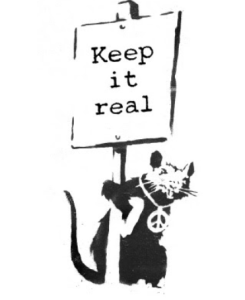
The work occupies a pivotal place within Banksy’s artistic development. Painted before international recognition and long before anonymity became part of his public mythology, it already establishes many of the ideas that would come to define his career. Rather than revealing himself, Banksy chooses concealment. Yet this concealment is far from passive. By replacing his own face with that of a monkey, he creates an alter ego that would accompany him throughout the following decades, reappearing in works such as Laugh Now, Monkey Queen, Keep It Real, and ultimately Devolved Parliament. The monkey is not merely a disguise; it is a visual philosophy.

Throughout art history, self-portraits have traditionally served to immortalize the artist. From Dürer and Rembrandt to Van Gogh, Picasso, and Warhol, painters have carefully constructed the image through which posterity would remember them. Banksy deliberately overturns this tradition. His Self-Portrait is, paradoxically, an anti-self-portrait. Instead of celebrating individuality, it erases it. The artist refuses to become the subject of admiration, insisting instead that the ideas should always eclipse the identity of their creator. Few contemporary artists have remained so globally recognizable while simultaneously remaining invisible.
The monkey itself carries centuries of artistic and literary symbolism. Long associated with imitation, satire, and the human condition, it allows Banksy to question the fragile boundary separating civilization from instinct. The choice is profoundly self-deprecating, rejecting the romantic notion of the artist as a visionary genius in favor of a creature that mirrors humanity’s virtues and absurdities alike. In doing so, Banksy quietly reminds us that the artist is no different from the society he critiques.
Visually, the painting is equally remarkable. The controlled precision of the stencil contrasts dramatically with the explosive fluorescent splashes radiating across the composition. These gestural marks immediately evoke the legacy of Jackson Pollock and Abstract Expressionism, where movement, spontaneity, and physical action become integral parts of the work itself. Banksy, however, appropriates this celebrated painterly language with characteristic irony. Rather than abandoning figuration for abstraction, he allows the two traditions to collide. The carefully cut stencil—the very symbol of planning and repetition—is violently interrupted by uncontrolled bursts of paint that suggest both creative energy and urban vandalism. The result perfectly reflects Banksy’s dual identity as both street artist and painter.
The composition also captures the physical reality of graffiti itself. Unlike many studio artists, Banksy presents himself in the act of creation, spray cans raised, fresh paint still exploding across the surface. The work therefore becomes not simply a portrait of the artist, but a portrait of artistic practice. It celebrates the immediacy, risk, and spontaneity of painting illegally in public space while simultaneously transforming those fleeting gestures into a permanent work of art.
Although painted at the very beginning of Banksy’s career, Self-Portrait already displays an extraordinary confidence, synthesizing autobiography, satire, art history, and technical experimentation into a single compelling image. In retrospect, it reads almost as a manifesto. Banksy introduces himself to the world by refusing to reveal himself, replacing his own likeness with the monkey that would become one of the defining symbols of his artistic universe. More than twenty-five years later, it remains one of the most important and deeply personal works of his formative period, offering a rare glimpse into the philosophy of an artist whose greatest masterpiece may ultimately have been the creation of his own anonymity.