Stop Me Before I Paint Again, 2004
Exhibited
Banksy: The unauthorized retrospective, S/2 London, Curated by Steve Lazarides, 2014
Catalogue Note
Created in 2004, Stop Me Before I Paint Again belongs to one of the most fertile periods of Banksy’s career. By then, the anonymous artist had moved beyond the Bristol underground to become one of Britain’s most recognizable street artists, yet he remained firmly rooted in the visual language that had first established his reputation. Executed on canvas rather than directly onto a wall, the work nevertheless preserves the immediacy, wit and visual economy of an authentic street intervention.
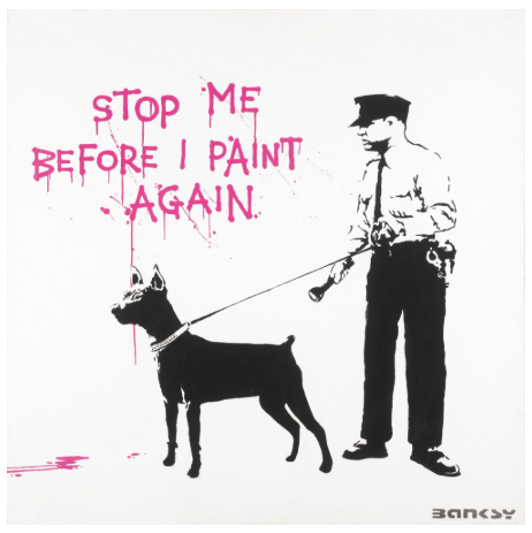
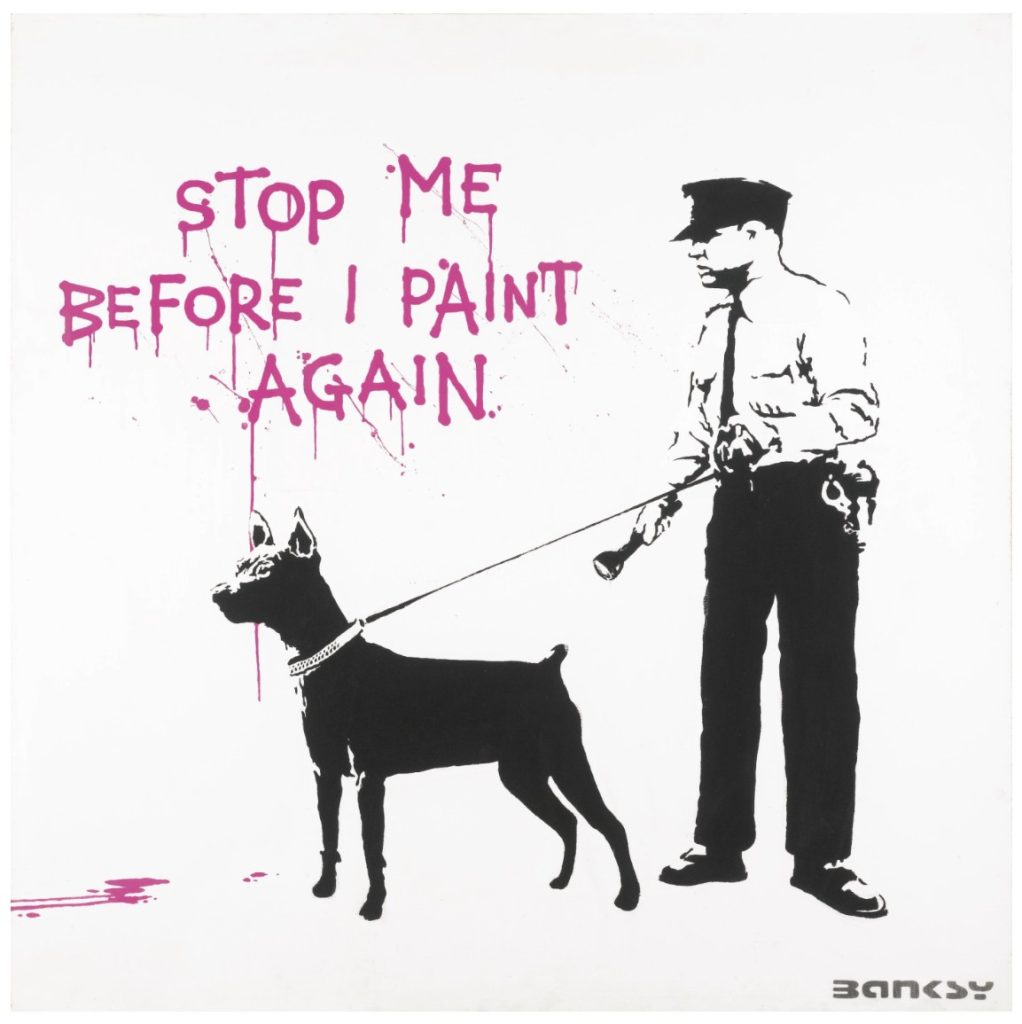
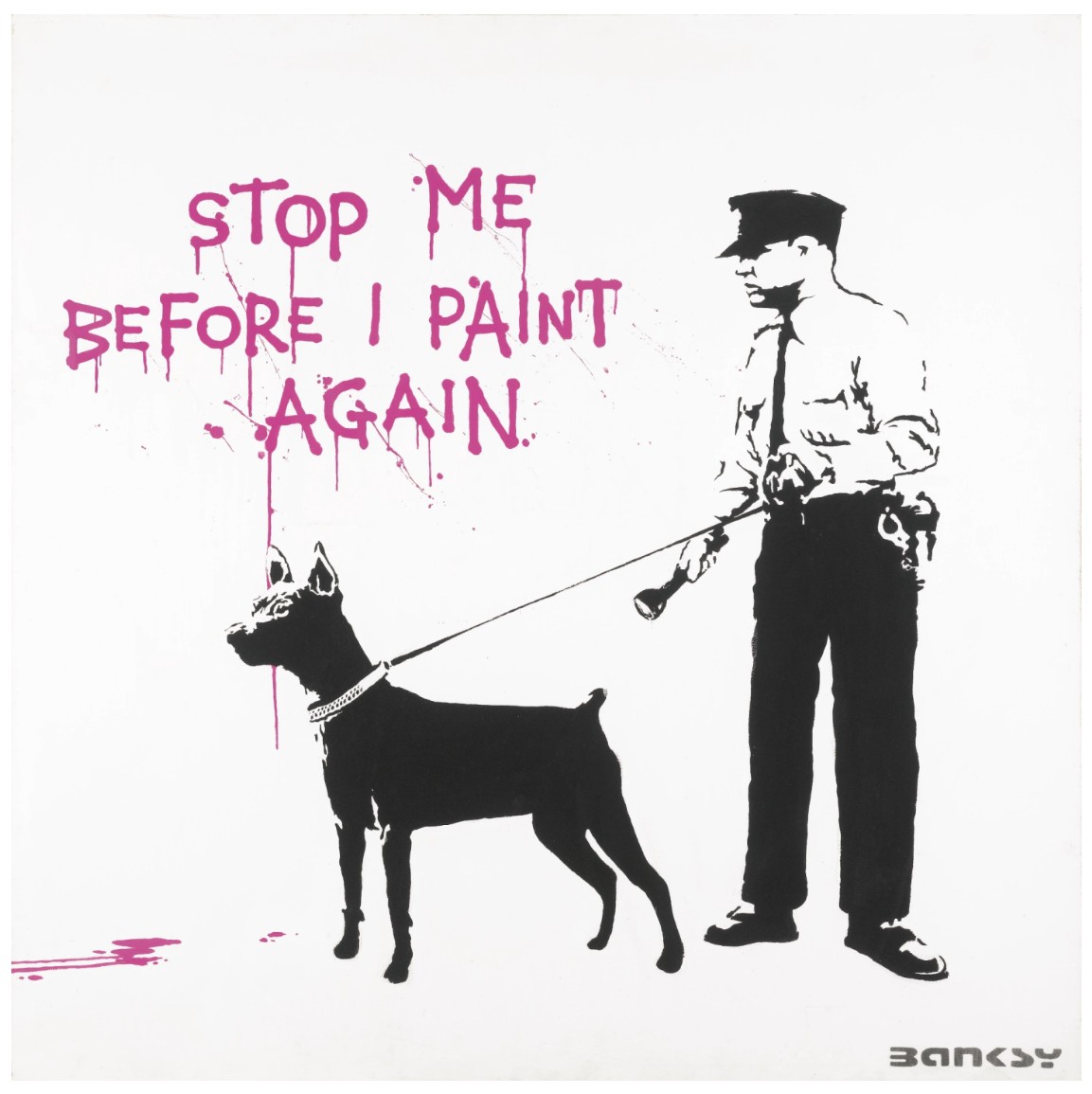
The composition brings together several of Banksy’s most enduring motifs. A uniformed British policeman stands beside a muscular police dog, both rendered in the artist’s now unmistakable black-and-white stencil technique. Opposite them, dripping across the pristine white background in vivid magenta spray paint, appears the provocative message: “STOP ME BEFORE I PAINT AGAIN.” The apparent simplicity of the scene conceals a sophisticated dialogue between authority and artistic freedom, transforming what could have been a straightforward act of vandalism into a meditation on the very nature of creativity.
Few relationships have shaped Banksy’s career more profoundly than that between the street artist and the police. For decades, graffiti has existed in an uneasy coexistence with law enforcement. Every mural painted without permission carries the possibility of arrest; every stencil represents a negotiation between artistic expression and public order. Banksy transforms this familiar conflict into comedy.
Rather than depicting a dramatic chase or violent confrontation, he presents an almost theatrical moment of anticipation. The policeman appears calm, the dog alert, while the freshly sprayed message seems to challenge authority with mischievous confidence. It is less an act of rebellion than an invitation to participate in an absurd performance whose outcome everyone already understands. The artist will paint. The police will pursue. The cycle will begin again. In typical Banksy fashion, confrontation gives way to irony. The humor lies not in defeating authority but in exposing the predictability of the relationship itself.
Like the Rat, the monkey or the anonymous protester, Stop Me Before I Paint Again can be read as a discreet self-portrait. The handwritten phrase functions almost as an internal monologue. “Stop me before I paint again” echoes the language of irresistible temptation, suggesting that creating art is less a conscious decision than an uncontrollable impulse. The joke is wonderfully paradoxical. The artist appears to acknowledge that graffiti is illegal while simultaneously admitting that he has no intention of stopping.
This playful confession captures one of Banksy’s defining characteristics. Unlike many political artists, he rarely presents himself as a heroic revolutionary. Instead, he embraces the role of the incorrigible prankster—an individual driven not by ideology alone but by an almost compulsive need to leave visual traces upon the city. The phrase could easily be interpreted as Banksy’s own artistic manifesto: an admission that creativity, once awakened, refuses to obey the rules designed to contain it.
One of Banksy’s greatest achievements has been his ability to replace anger with wit. While much political art relies upon outrage, Banksy understands that humor can be equally destabilizing. Laughter has a remarkable capacity to undermine authority without ever resorting to violence. That philosophy is perfectly embodied here.
The policeman and his dog are not demonized. They are simply participants in a joke whose punchline unfolds before our eyes. The officer becomes less an individual than a symbol of institutional authority, while the graffiti itself quietly mocks the endless ritual of pursuit and enforcement. Rather than confronting power directly, Banksy gently exposes its theatrical nature.
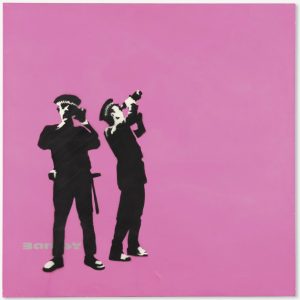
This approach would become one of the defining features of his later works. Images such as Flying Copper, Rude Copper, Kissing Coppers and Stop and Search all employ the same strategy, transforming the symbols of authority into vehicles for irony rather than fear. Stop Me Before I Paint Again stands among the earliest and clearest expressions of this artistic philosophy.
Although executed on canvas, the work deliberately preserves the vocabulary of the street. The crisp stencil recalls the speed and precision required for illegal interventions, while the dripping magenta lettering retains the spontaneity of freshly applied spray paint. The immaculate white ground functions almost like an untouched urban wall waiting to receive its message.
This tension between permanence and ephemerality is central to Banksy’s practice. Graffiti is, by nature, temporary. It may be cleaned, painted over or demolished. By transferring the imagery onto canvas, Banksy preserves not only the image but also the fleeting spirit of street art itself. The work occupies a fascinating space between two worlds: the immediacy of illegal public intervention and the permanence of fine art.
Stop Me Before I Paint Again belongs to the remarkable body of early canvases produced around 2003–2004, a period during which Banksy was refining the visual language that would later make him one of the most influential artists of the twenty-first century. These works remain particularly compelling because they preserve the raw energy of his street practice while introducing the compositional confidence and conceptual sophistication of his mature career.
The painting also forms an important bridge between Banksy’s graffiti origins and his later institutional success. The artist who jokingly invited the police to stop him would, within only a few years, become the subject of major museum exhibitions and record-breaking auction sales. Yet despite this extraordinary transformation, the mischievous spirit that animates Stop Me Before I Paint Again never disappeared. Even at the height of his international fame, Banksy continued to paint walls illegally, reminding the art world that his work remained inseparable from the streets that had first inspired it.
At first glance, Stop Me Before I Paint Again appears to be a simple joke at the expense of the police. Look more closely, however, and it reveals itself as something far richer: a witty meditation on artistic compulsion, institutional authority and the irresistible urge to create. The painting captures the essence of Banksy’s early career, when every new stencil represented both an act of defiance and an act of imagination.
More than twenty years later, the challenge still resonates. The police may attempt to stop the artist, collectors may preserve his work, and museums may celebrate it, but the impulse that gave birth to Banksy’s art remains unchanged. Creativity, like graffiti itself, has an extraordinary habit of slipping through every barrier placed in its path.