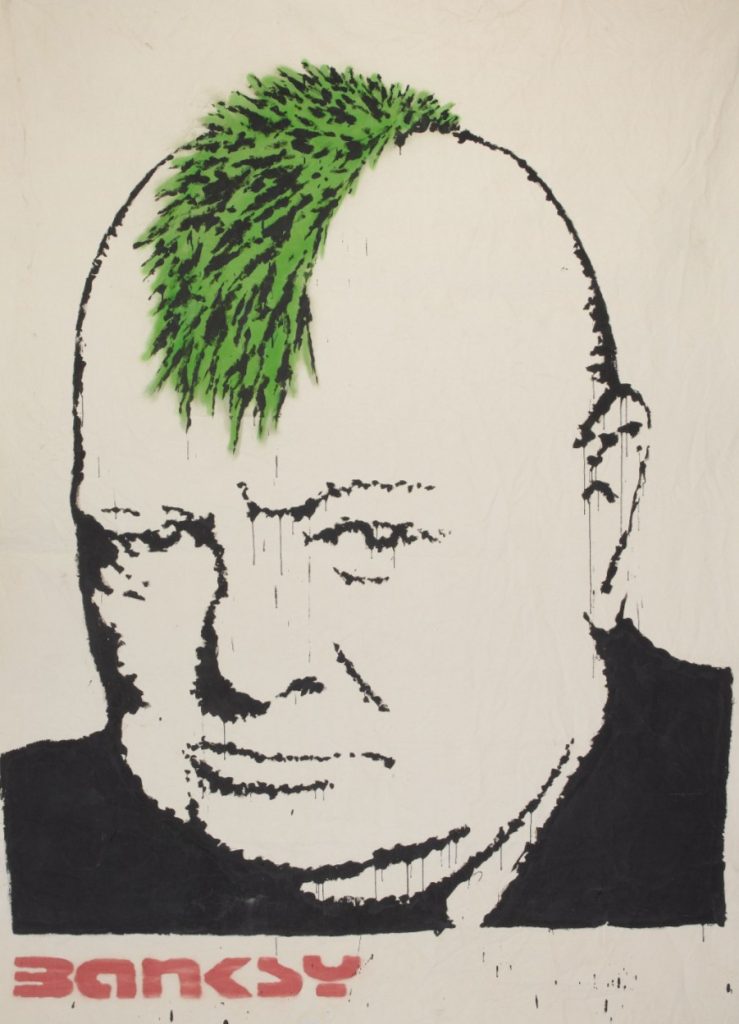
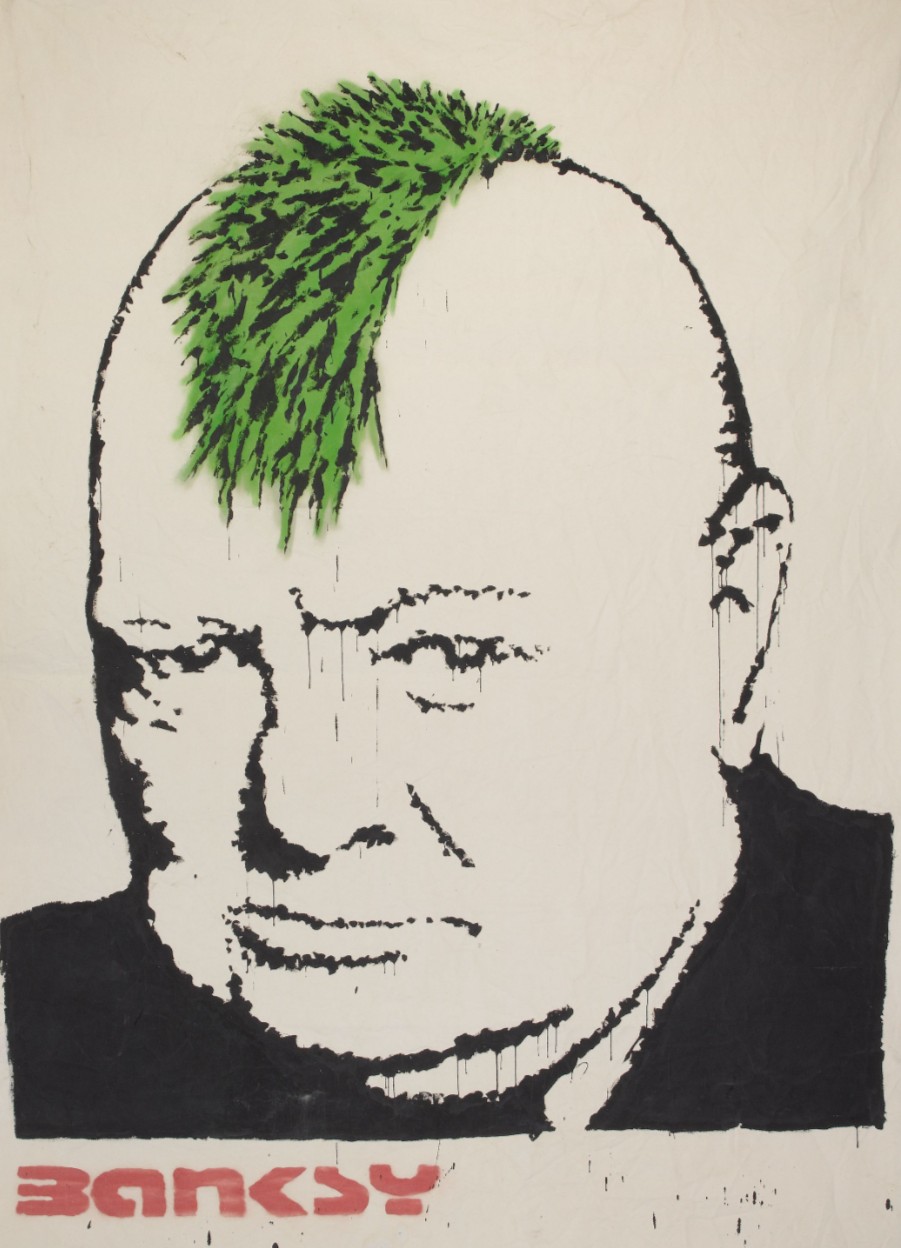
Stencil spray paint signature, acrylic and spraypaint on canvas
272×180 cm (107×71 inches)
Provenance
Bad Press Exhibition, Kunsthalle Exnergasse, Vienna, 2003
Auction History
| Bonhams London 23 October 2008 Estimates Not Disclosed |
Price Realized |
Catalogue Note
Executed in 2003, Turf War occupies a pivotal place within Banksy’s early career. Created for his landmark exhibition of the same name, the monumental canvas encapsulates many of the themes that would come to define his artistic practice: the questioning of authority, the subversion of national symbols and the appropriation of familiar historical imagery to challenge contemporary systems of power. More than a portrait, Turf War is an exploration of how cultural icons acquire—and ultimately lose—their authority.
The composition is based upon Yousuf Karsh’s celebrated 1941 photographic portrait of Sir Winston Churchill, one of the defining images of British resilience during the Second World War. Few twentieth-century portraits possess such immediate recognizability or symbolic weight. Churchill’s stern expression has long embodied courage, leadership and national identity, making the image an almost sacred monument within British collective memory. Banksy deliberately exploits this familiarity before quietly dismantling it.

Artwork: © Estate of Yousuf Karsh
The transformation itself is deceptively simple. Churchill is crowned with a vivid green mohawk fashioned from freshly cut turf, replacing one of Britain’s most revered political figures with an unexpected emblem of rebellion. At first glance the gesture appears humorous, recalling the visual language of punk culture and youthful dissent. Yet the intervention carries a far deeper resonance. The grass does not merely imitate a hairstyle; it introduces nature itself into one of the most enduring symbols of political authority. The establishment is not simply mocked—it is slowly reclaimed, suggesting that no institution, however powerful, remains immune to change.
This imagery draws directly upon the celebrated May Day demonstrations of 2000, when protesters placed a turf mohawk on the statue of Churchill in Parliament Square, transforming an act of political protest into one of London’s most memorable acts of guerrilla intervention. By translating this ephemeral gesture into a monumental painting, Banksy preserves not only the event itself but also its symbolic inversion of power. A fleeting intervention becomes a permanent image, while an untouchable national monument becomes the subject of irreverent reinterpretation.

The work also marks an important moment in Banksy’s artistic evolution. Although executed on canvas and exhibited within a gallery, Turf War retains the unmistakable visual language of graffiti. The stencil edges remain visible, the paint drips are left unapologetically exposed and the composition preserves the speed and directness associated with illegal street interventions. Rather than adapting graffiti to suit the conventions of fine art, Banksy forces the gallery to accept graffiti on its own terms.
The monumental scale reinforces this ambition. Measuring over 2.7 metres in height, the portrait possesses the commanding presence traditionally reserved for state commissions and official representations of political leaders. Banksy deliberately appropriates this visual authority only to undermine it from within. The result is neither parody nor straightforward political satire, but a sophisticated meditation on the fragile nature of power itself. Icons survive only so long as society continues to believe in them.

Image: © John Stillwell / Alamy Stock Photo (via Sotheby’s)
As the central image of the legendary Turf War exhibition, this work represents a defining moment in Banksy’s emergence from the streets into the contemporary art world. The exhibition itself generated widespread controversy—not only for its provocative imagery but also for its inclusion of live animals painted with police markings and military motifs—announcing Banksy’s arrival as an artist determined to challenge both artistic convention and institutional authority.
Today, Turf War stands among the defining works of Banksy’s formative years. Combining one of Britain’s most recognizable historical portraits with the irreverent language of graffiti, it perfectly encapsulates the paradox at the heart of Banksy’s practice: a profound respect for the power of images coupled with an equally profound determination to question the authority they represent. The work reminds us that history is never fixed. Even its greatest heroes remain open to reinterpretation, and the symbols that once united a nation can become powerful tools for questioning the very institutions they were created to celebrate.

Sir Winston Churchill, making a speech on his 80th Birthday at Westminster Hall, London
Image: © Popperfoto via Getty Images, Via Sotheby’s
A compelling, nonconformist voice in contemporary British art and one of the great social commentators of our time, Banksy subverts the language of art history by breaking down the boundaries between graphic and fine art, the street and the gallery, the whimsical and the controlled, the humorous and the earnest. Channeling a powerful current of rebel activity in the art world since the turn of the millennium, when political agitation was viewed by the artist as hopelessly naive, Banksy’s incessant creative remixing of symbols and illumination of paradox have critiqued institutional order brilliantly and with fresh force. As deployed tremendously in Turf War, Banksy is a master of conjuring ambiguity and bemusement as the ultimate tactic for challenging the power structures of contemporary life in the art world and beyond.