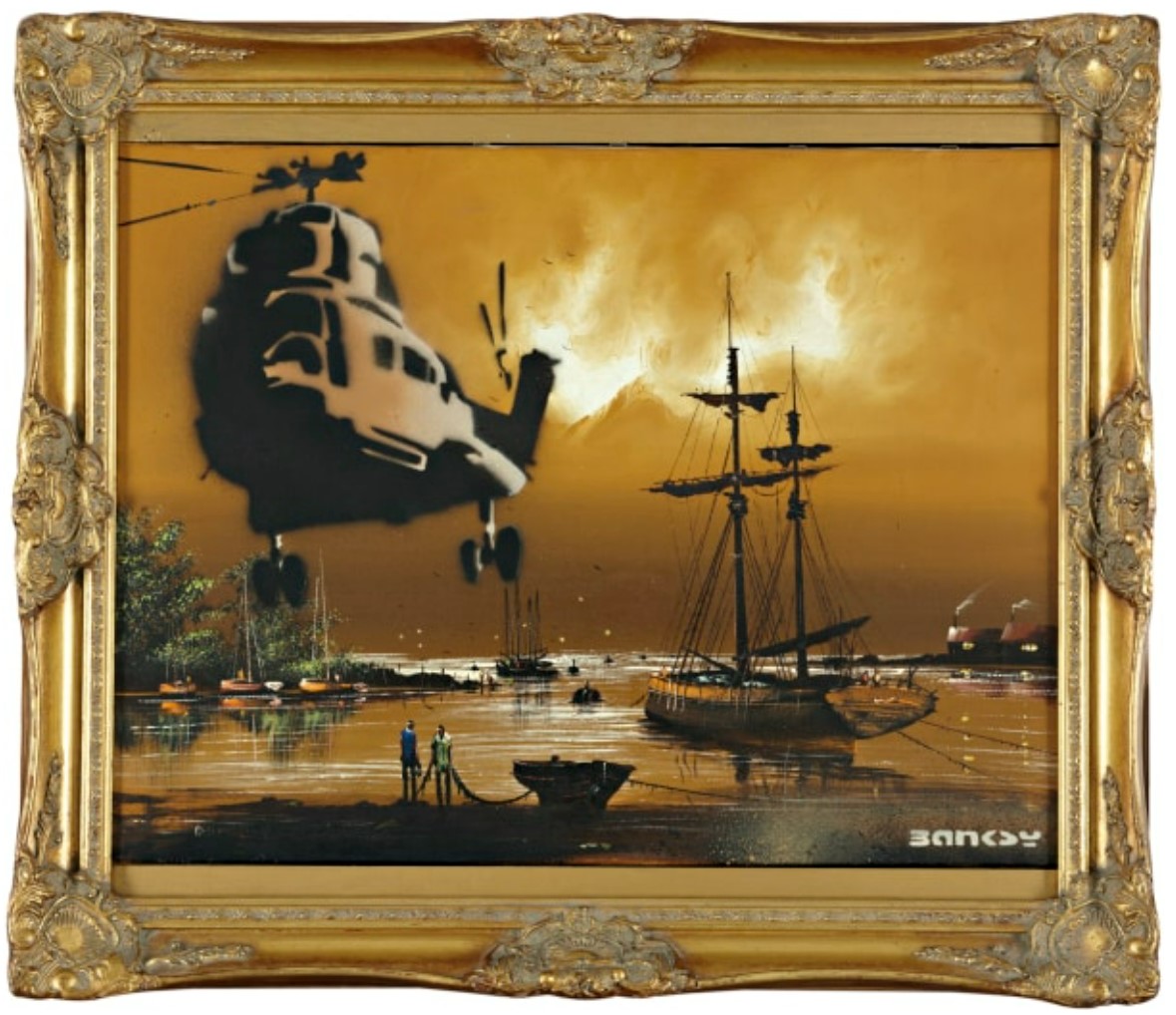
Vandalized Oil #001, 2001
Auction History
| Phillips London 12 February 2010 Est.: GBP 60,000 – 80,000 | Price Realized GBP 121,250 / USD 189,945 |
Catalogue Note
“If you want to survive as a graffiti writer when you go indoors I figured your only option is to carry on painting over things that don’t belong to you there either.”
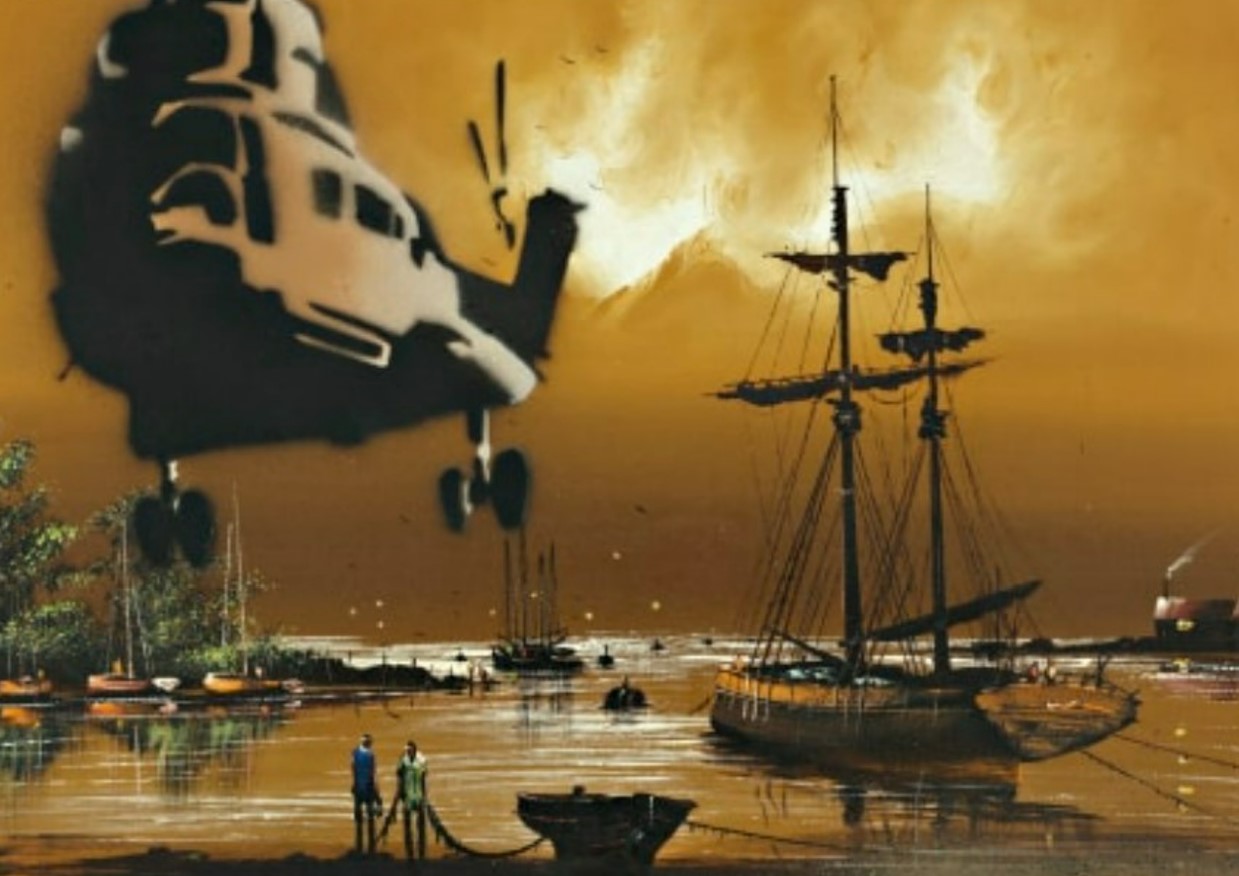
Created in 2001, Vandalized Oil #001 marks the beginning of one of Banksy’s most influential artistic series. Rather than painting onto an empty canvas, the artist appropriates a traditional landscape painting and intervenes with his unmistakable stencil technique, transforming an anonymous decorative artwork into a sharp commentary on contemporary society. It is one of the earliest examples of Banksy’s fascination with reinterpreting art history through the language of street art.
The tranquil harbor scene is suddenly interrupted by the dramatic arrival of a military helicopter, hovering above the peaceful landscape as smoke rises in the distance. The intervention is startlingly economical. With only a few stenciled additions, Banksy shatters the illusion of pastoral serenity and replaces it with the unsettling reality of modern conflict.
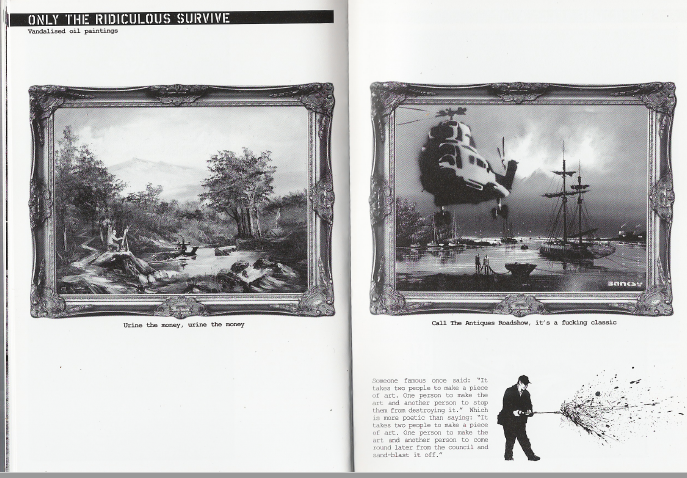
Banksy, Banging Your Head Against A Brick Wall, November 2001
The success of Vandalized Oil #001 lies in the collision of two incompatible worlds.
The original painting belongs to the long European tradition of idyllic landscape painting, celebrating nature as a place of harmony, contemplation and escape. Banksy abruptly introduces the imagery of modern warfare, forcing two centuries of artistic idealism to confront the realities of the twenty-first century.
The helicopter appears almost like an intruder from another dimension. It does not simply alter the composition—it changes the entire narrative. What was once a peaceful harbor now becomes the backdrop to an unfolding military operation, reminding us how fragile the notion of paradise has become in an age defined by geopolitical conflict.
By painting directly onto an existing artwork, Banksy also questions the authority of artistic tradition itself. Rather than treating historical paintings as untouchable masterpieces, he regards them as living objects capable of generating new meanings. His intervention recalls the strategies of Marcel Duchamp and the Situationists, who challenged conventional ideas of originality by reappropriating existing images rather than creating entirely new ones.
This dialogue between classical painting and contemporary graffiti would become one of the defining characteristics of Banksy’s career. Far from mocking the past, he revitalizes it, demonstrating that even the most conventional landscapes can become powerful vehicles for contemporary political commentary.
Vandalized Oil #001 occupies a pivotal position in Banksy’s artistic development. It represents the genesis of the celebrated Vandalized Oils series, which would culminate in the landmark exhibition Crude Oils: A Gallery of Re-mixed Masterpieces, Vandalism and Vermin in 2005. From this point onward, Banksy would repeatedly revisit found paintings, introducing shopping carts, CCTV cameras, police tape, warning signs and environmental disasters into otherwise idyllic landscapes.
These works also anticipate some of his most celebrated later reinterpretations of art history, including Show Me the Monet (after Claude Monet), Sunflowers from Petrol Station (after Vincent van Gogh) and Home Sweet Home. Together, they reveal Banksy’s conviction that great art should not merely preserve the past but continually engage with the present.
Vandalized Oil #001 perfectly encapsulates Banksy’s ability to transform familiar images through the lightest of interventions. By inserting a military helicopter into an otherwise peaceful landscape, he reminds us that modern history has made it increasingly difficult to view paradise without also seeing the conflicts that threaten it.
More importantly, the work marks the birth of one of Banksy’s most significant artistic innovations. It demonstrates that vandalism, in his hands, is not an act of destruction but one of reinvention—a way of breathing new life into forgotten paintings and proving that even the quietest landscapes still have contemporary stories to tell.