BANKSY
Weston Super Mare, 1999
Acrylic on canvas
76.5 x 76.5 cm (30×30 inches)
Tagged “BANKSY”, lower right
Provenance
Private Collection, UK
Sale: Sotheby’s, Olympia, Contemporary Art, 19 June 2006, Lot 560
Acquired directly from the above by the present owner
Exhibited
Severnshed, Bristol, 2000
Auction History
| Bonhams London 22 October 2020 Est.: GBP 400,000 – 600,000 | Price Realized GBP 747,062 / USD 979,150 Bonhams : Weston Super Mare 1999 |
Catalogue Note
Few works reveal Banksy’s sensibility as quietly and as poignantly as Weston Super Mare. Executed in 1999, the painting depicts a solitary figure sitting on a park bench beneath an immense expanse of pale blue sky. Almost the entire composition is empty. The man occupies only a tiny corner of the canvas, dwarfed by negative space that seems to stretch infinitely beyond him. It is a remarkably restrained image, already demonstrating Banksy’s understanding that absence can often speak louder than spectacle.

Although titled after the Somerset seaside resort a short distance from his native Bristol, the work is less a portrait of a place than of a state of mind. Weston-super-Mare has long embodied a peculiarly British melancholy: a once fashionable holiday destination whose faded attractions evoke nostalgia, economic decline and forgotten prosperity. Rather than depicting its famous pier or beachfront, Banksy reduces the town to a single anonymous individual, quietly waiting with nowhere obvious to go. It is a portrait of the ordinary person overlooked by history, politics and, often, by contemporary art itself.
The immense empty sky becomes the true subject of the painting. Its vastness suggests loneliness, contemplation and possibility simultaneously. The composition recalls the existential isolation found in the paintings of Edward Hopper, where silence becomes almost tangible, yet Banksy strips the scene back even further. There is no narrative, no dramatic gesture and no overt satire. The figure simply exists, almost disappearing into the landscape.
The painting also introduces one of Banksy’s recurring themes: the dignity of ordinary people. Throughout his career he would repeatedly reject celebrities and heroes in favour of anonymous children, workers, migrants, pensioners and the homeless. Here, the seated man possesses no distinguishing characteristics. He could be anyone. In that anonymity lies his universality.
The work acquired an unexpected second life in 2003 when Banksy adapted the composition into the print Weston Super Mare. There, the peaceful stillness is violently interrupted by an enormous industrial bandsaw approaching from outside the picture. The transformation is revealing. The original canvas presents quiet resignation; the later print introduces imminent danger. Banksy turns contemplation into anxiety, suggesting that even moments of solitude are increasingly threatened by the machinery of modern life. It is a rare example of the artist revisiting an early composition not merely to reproduce it, but to deepen its meaning.
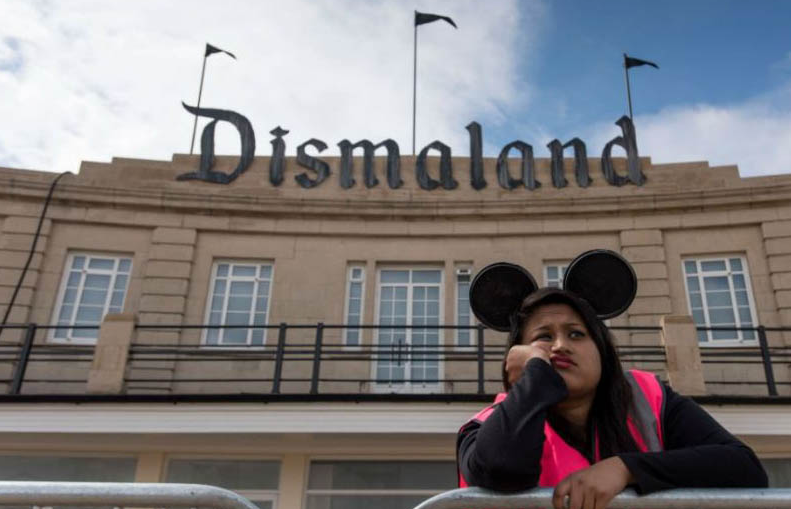
Viewed today, Weston Super Mare feels remarkably prophetic. More than fifteen years before opening Dismaland in the town itself, Banksy had already recognised Weston-super-Mare as a fitting symbol of Britain’s forgotten margins. Both works share the same underlying fascination with places that exist beyond glamour, where faded dreams reveal uncomfortable truths about society. In its extraordinary simplicity, Weston Super Mare stands among Banksy’s most introspective early paintings, proving that some of his most powerful political statements are made not through provocation, but through silence.