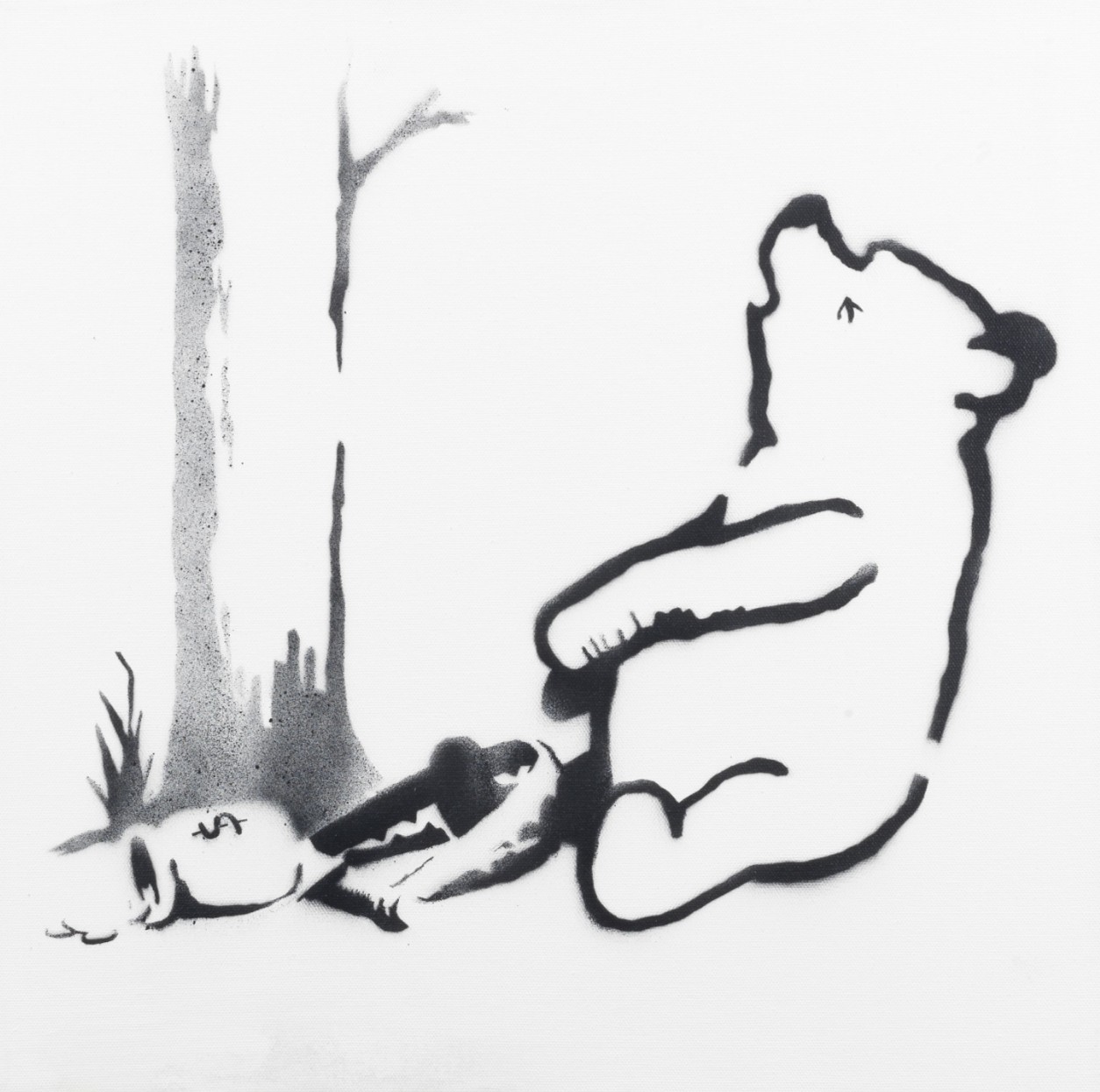
Winnie The Pooh, 2013
Banksy’s stall in Central Park, New York
Acquired directly from the above by the present owner in 2013
Exhibited
Christchurch, Canterbury Museum, Rise, 2013-2014
Auction History
| Bonhams London 2 July 2014 Est.: GBP 30,000 – 50,000 | Price Realized GBP 56,250 / USD 78,010 Bonhams Winnie The Pooh 2013 |
Catalogue Note
Originally conceived as a mural in Bristol in 1999, Winnie the Pooh belongs to Banksy’s earliest and most poignant explorations of innocence corrupted by materialism. This later canvas, acquired directly from the artist during his legendary anonymous Central Park sale in New York in 2013, revisits one of the defining images of his formative years while placing it within the remarkable context of one of the most celebrated performances of his career.
Rendered in Banksy’s unmistakable monochrome stencil style, the beloved bear sits slumped beneath a tree, his foot trapped in a bear trap. Beside him lies not his familiar pot of honey but a sack marked with a dollar sign. The substitution is deceptively simple yet devastatingly effective. Honey, the symbol of childhood innocence and simple pleasure, has been replaced by money, transforming A. A. Milne’s gentle character into another victim of greed and temptation.
Banksy’s choice of Winnie the Pooh is particularly significant. Unlike many of his recurring images—such as the monkeys, rats or policemen—the artist returned to this character only on rare occasions throughout his career. Its scarcity lends the image a particular emotional resonance. Pooh is not employed as a recurring logo but as a singular moral fable, making this one of the most distinctive appropriations within Banksy’s visual vocabulary.
The work speaks to a universal paradox. Money itself is neither villain nor virtue; it is simply another form of honey, something desirable that promises comfort and security. The tragedy lies not in its existence but in our relationship to it. In reaching for material success, individuals often become ensnared by the very ambitions they believe will set them free. Pooh’s trap therefore becomes our own, quietly suggesting that the pursuit of wealth can imprison even the most innocent among us.
The simplicity of the composition reinforces its emotional force. There is no dramatic gesture, no overt satire and no elaborate symbolism. The bear does not rage against his predicament; he simply sits in silent resignation. This understated melancholy distinguishes the work from many of Banksy’s more overtly political images, revealing instead a deeply human reflection on desire, vulnerability and the compromises of modern life.
The provenance of this particular canvas further enriches its significance. It was acquired directly from Banksy’s anonymous Better Out Than In Central Park stall, where original works were famously offered to unsuspecting passersby for just $60. In retrospect, the performance itself mirrored the very irony explored by Winnie the Pooh: society often fails to recognize genuine value while relentlessly pursuing monetary worth. The work thus occupies a unique place not only within Banksy’s early iconography but also within one of the most celebrated conceptual interventions of his mature career.