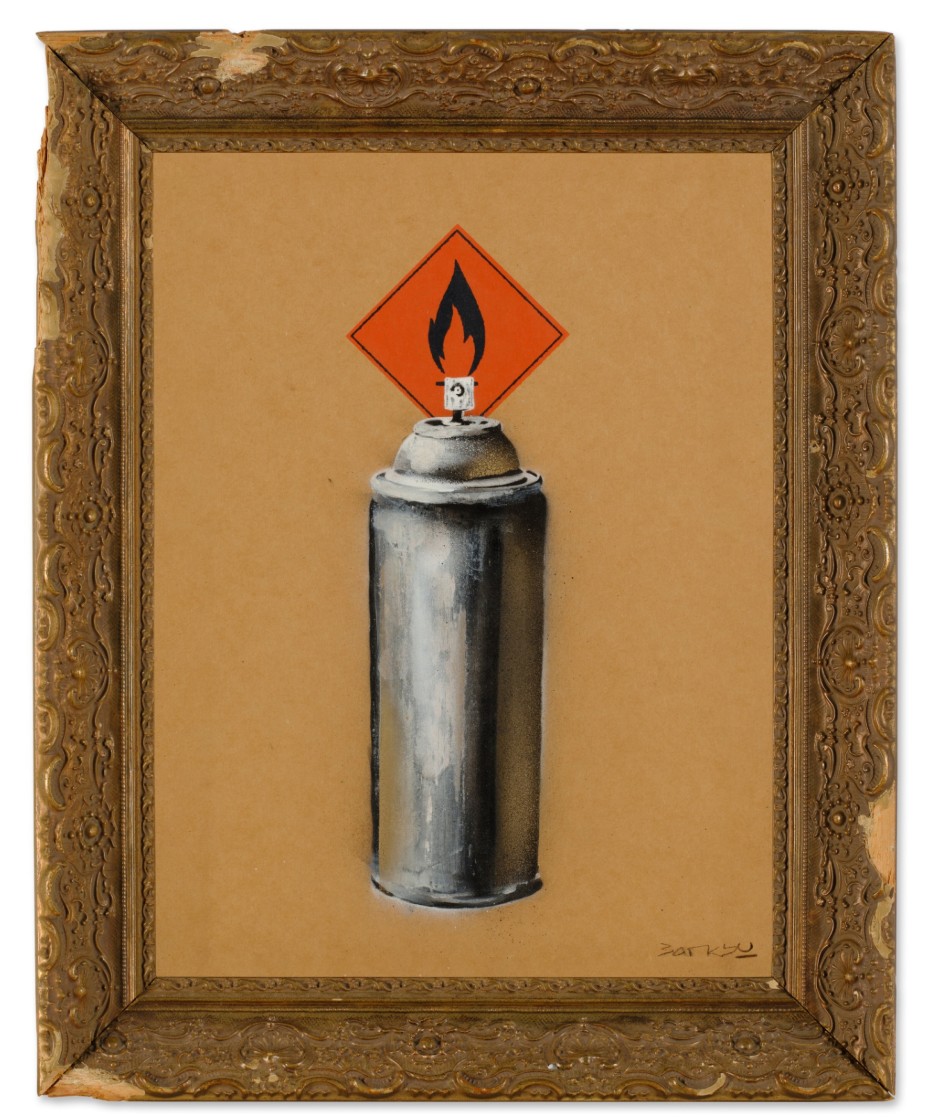
BANKSY (b. 1974)
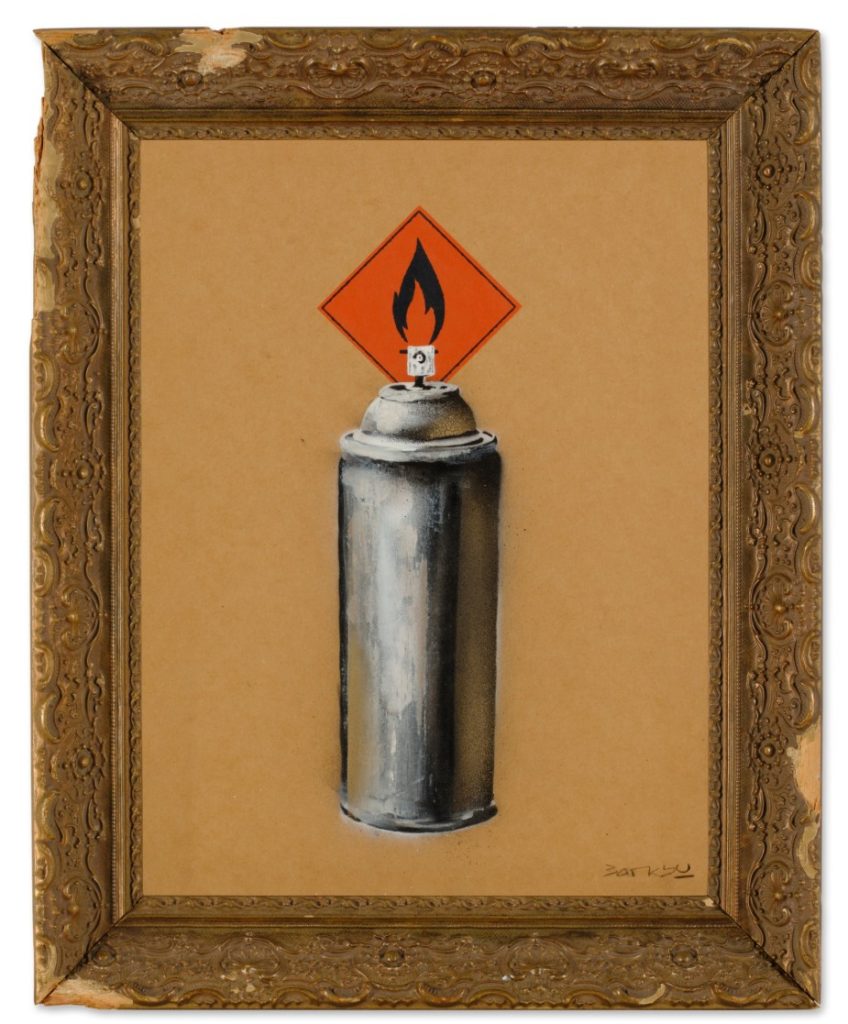
Spray Can Flame, circa 2012
Spray paint and acrylic on cardboard in artist’s frame
19-3/4 x 15-3/4 inches (50.2 x 40 cm)
Signed (lower right)
Executed circa 2012, this work is unique
Provenance
Dismaland Bemusement Park, London
Acquired from the above in 2020 by the present owner
Auction History
Sotheby’s New-York: 15 May 2026
Estimated: USD 400,000 – 600,000
USD 512,000
Banksy | Spray Can Flame | Contemporary Day Auction | 2026 | Sotheby’s
Executed around 2012, Spray Can Flame belongs to a category of Banksy originals that often receives less public attention than his large canvases or famous street interventions, yet it reveals something remarkably intimate about his visual language. Unlike works populated by policemen, rats, children, monkeys or protestors, here Banksy strips away narrative almost entirely. There is no character, no setting, no obvious joke. Instead, the artist reduces his message to an object: the humble spray can.
Suspended against plain cardboard and enclosed within a distressed antique frame, the image possesses a curious tension. It feels simultaneously like an object of everyday use and an object of devotion. The spray can is isolated in the center of the composition with an almost religious stillness, transformed from a simple artistic tool into a contemporary icon. Like many of Banksy’s strongest images, its apparent simplicity conceals multiple layers of meaning.
The Sacred Object of the Street Artist
The spray can occupies a special place within graffiti culture. It is not merely a tool; it is almost an extension of identity itself. For generations of graffiti artists, aerosol paint represented freedom, rebellion and anonymous intervention. Beginning in the New York graffiti movement of the 1970s and later evolving through European street culture of the 1980s and 1990s, the spray can became a symbol of creative resistance.
One could argue that for graffiti culture the spray can holds a status similar to what the paintbrush represented for academic painters of earlier centuries. Banksy elevates this ordinary object to the level of a portrait. There is humor in that transformation. Traditional portraiture immortalized kings, saints and aristocrats. Banksy instead immortalizes a spray can.
In doing so he quietly asks: Who are the heroes of our time? Not monarchs perhaps, but maybe those operating anonymously in urban landscapes…
Creation and Destruction
Above the can sits the universally recognizable hazard symbol for flammable material. The symbol functions on several levels simultaneously. On its most direct level, it references reality. Spray paint itself is highly flammable. Every aerosol can bears such warnings.
But Banksy rarely uses symbols only literally. The flame transforms the spray can into something more volatile, almost resembling a grenade or explosive device. Suddenly artistic creation and destruction begin to merge. For Banksy, this idea has existed throughout his career. Graffiti itself has always occupied a contradictory space: it is viewed by some as creativity and by others as vandalism. To authorities, a spray can often appears less like a brush and more like a weapon. Banksy seems fascinated by precisely this contradiction. Art becomes dangerous. Ideas become combustible. And images become capable of disrupting systems.
Banksy’s work repeatedly explores the thin line between acts of construction and acts of demolition. One thinks of works such as Love Is In The Air, where flowers replace violence, or Bomb Hugger, where instruments of destruction become objects of affection. Here the inversion operates in the opposite direction. A tool of creation becomes associated with warning signs and danger.
The work quietly suggests that artistic expression itself possesses disruptive power. Ideas can spread. Images can alter perception. Political messages can destabilize authority. Art, in other words, can become explosive.
From Duchamp to Warhol
Art history offers fascinating parallels. The elevation of everyday objects into artistic subjects recalls the radical gesture of Marcel Duchamp. When Duchamp presented a urinal as art in 1917, he fundamentally challenged assumptions regarding artistic value and authorship. Banksy performs a similar maneuver here, though with a contemporary and distinctly urban vocabulary. The spray can become a kind of modern readymade.
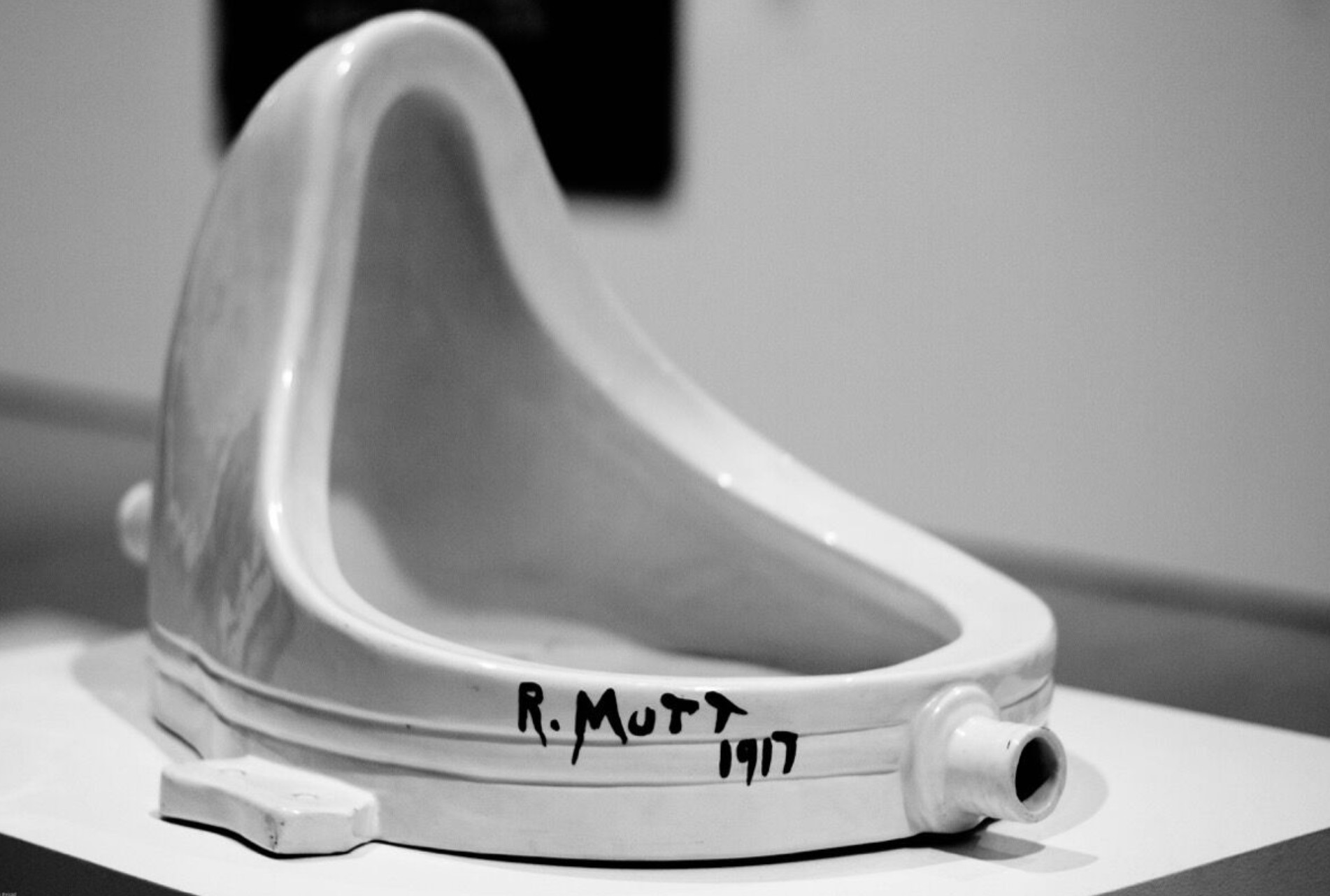
Installation view of Marcel Duchamp’s Fountain, 1917 © James Broad
There is also an echo of Andy Warhol. Warhol transformed soup cans and commercial packaging into icons of contemporary culture. Banksy similarly elevates an object from everyday life, although where Warhol examined consumer society with detached fascination, Banksy approaches it through irony and social tension. Warhol celebrated mass production. Banksy celebrates intervention. Warhol’s can sat on supermarket shelves. Banksy’s can appears ready to explode.
Cardboard and the Language of the Street
The support itself is significant. Banksy frequently uses cardboard in originals because the material carries powerful associations with urban life. Cardboard belongs to packaging, temporary signs, shipping boxes and, perhaps more importantly, homelessness.
Unlike traditional linen canvas associated with institutional painting, cardboard feels disposable. Its fragility becomes part of the meaning. The contrast between the rough support and the elaborate gilded frame creates one of Banksy’s favorite visual jokes. The frame belongs to the world of old masters and auction houses.
The cardboard belongs to the street. One world historically excluded the other. Banksy forces them together. The collision is almost comic.
Around 2012: Banksy at a Moment of Transformation
The work’s execution around 2012 places it at an interesting moment in Banksy’s trajectory. By this stage he had moved far beyond underground notoriety. Exit Through the Gift Shop had already transformed him into a global phenomenon, and his interventions increasingly blurred boundaries between street practice, performance and institutional critique.
Yet despite entering museums and auction houses, Banksy repeatedly returned to the visual language of graffiti itself. Perhaps this work reflects a moment of self-reference. The artist turns toward the very instrument that built his career. The spray can becomes almost autobiographical.
The Irony of the Frame
Perhaps the final irony lies in the fact that this image now circulates through the very mechanisms Banksy has spent decades criticizing. The object once associated with illegal interventions on city walls now hangs within a heavily ornamented frame and enters major auction sales. Banksy has always enjoyed these contradictions.
One can almost imagine him smiling at the spectacle. After all, a spray can—an object once carried through dark streets in a backpack—has now become a highly valuable collectible artifact. That transformation may itself be the hidden subject of the work. Not the can. Not the flame. But the strange journey of rebellion becoming history.