BANKSY
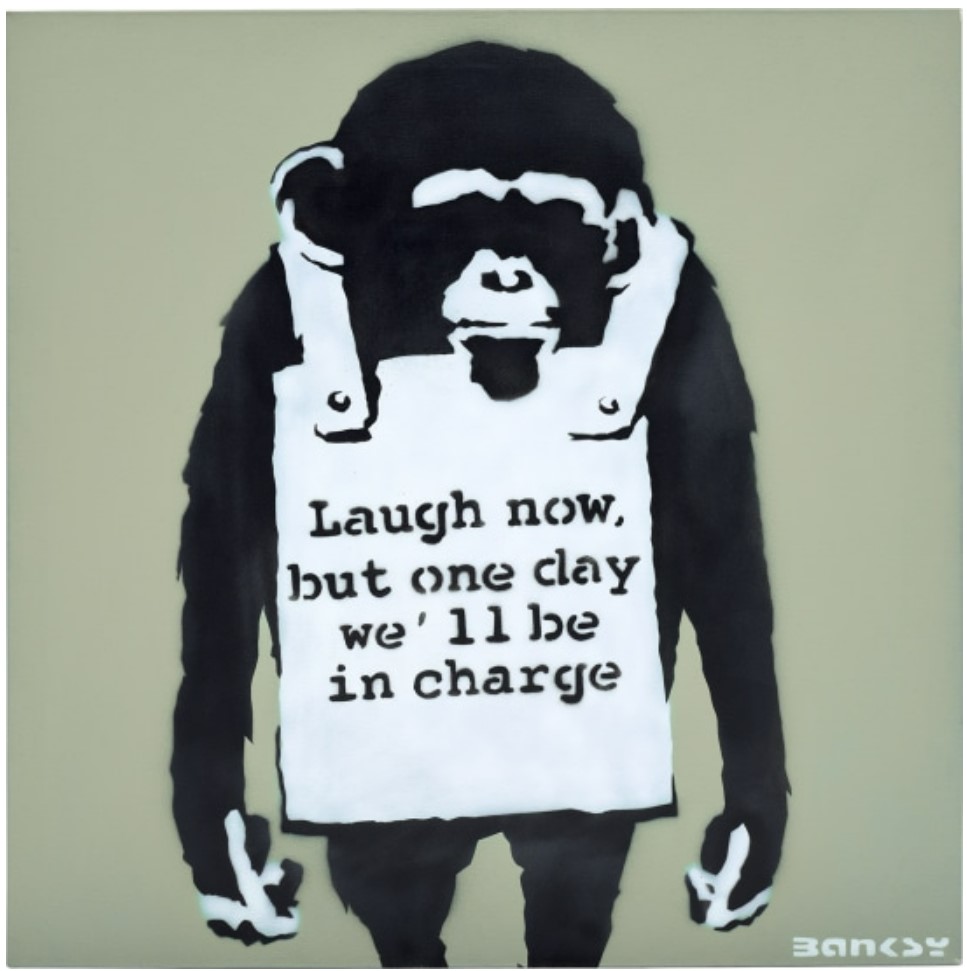
Laugh Now But One Day We’ll Be In Charge, 2002
Spray paint and emulsion on canvas
91×91 cm (35 7/8 x 35 7/8 inches)
This work is number 3 from an edition of 5 unique examples
Stenciled with the artist’s tag ‘BANKSY’ lower right
Signed, numbered and dated ‘BANKSY 03/05 2002’ on the stretcher
Provenance
Private Collection
Acquired from the above by the present owner
Auction History
| Phillips London 14 October 2022 Est.: GBP 1,000,000 – 1,500,000 | Price Realized |
Catalogue Note
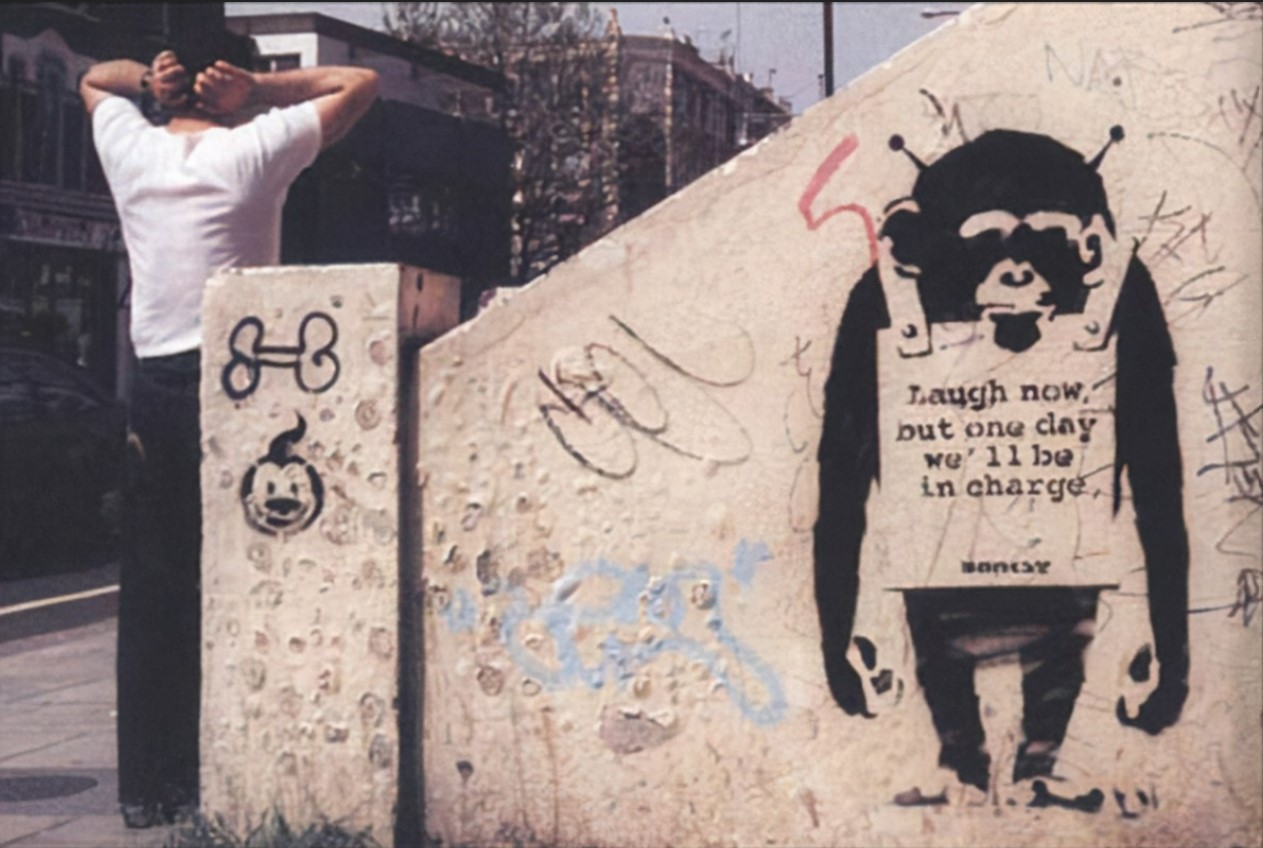
Executed in 2002, Laugh Now But One Day We’ll Be in Charge belongs to the earliest group of unique canvases exploring Banksy’s defining monkey motif. Produced in an edition of just five unique examples, the work occupies an important place in the early development of the series, illustrating how Banksy began translating one of his most successful street images into original paintings while preserving the immediacy and visual economy of the original mural.
This particular example is distinguished by its unusual slate-grey background, a colorway that is seldom encountered within the Laugh Now series. Softer and more atmospheric than the stark white grounds of many later versions, the muted grey lends the composition a quiet sense of introspection while reinforcing the graphic strength of the black-and-white stencil. The restrained palette strips the image to its essentials, allowing the viewer’s attention to focus entirely on the solitary monkey and the now-famous placard. The result is a composition of remarkable balance, where color functions not as decoration but as a subtle means of enhancing the emotional resonance of the work.

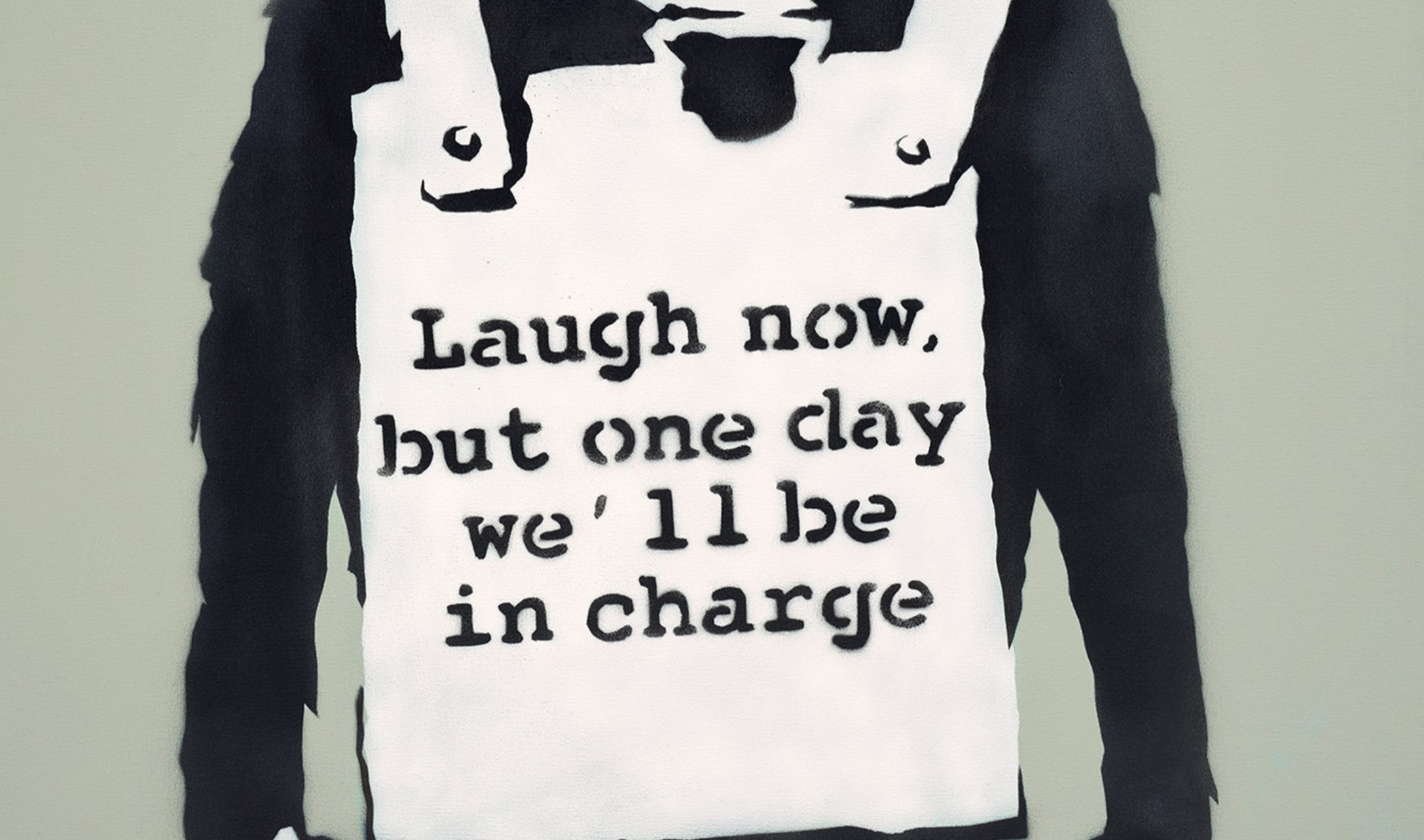
The monkey itself reveals a psychological complexity that belies the apparent simplicity of the image. Although its shoulders slope beneath the weight of the sandwich board, the figure is far from defeated. Its firmly planted stance, squared posture and gently clenched fists suggest quiet resilience rather than submission. Banksy deliberately avoids dramatic gestures or overt expressions of anger. The monkey neither protests nor rebels; it simply waits. This restraint lends the famous slogan—“Laugh now, but one day we’ll be in charge”—its extraordinary power. Rather than threatening revolution, the figure calmly predicts the inevitable reversal of power, transforming what first appears to be a joke into a quietly unsettling prophecy.
This early canvas is equally significant for what it omits. There are no expressive paint drips, distressed surfaces or reclaimed industrial supports to compete for the viewer’s attention. Instead, Banksy demonstrates complete confidence in the image itself, reducing the composition to its essential elements. The monkey, the placard and a single sentence are sufficient to communicate an idea of remarkable philosophical and political depth. This visual restraint anticipates one of the defining characteristics of Banksy’s mature practice: the ability to convey complex ideas through images of extraordinary clarity.

Viewed in retrospect, the painting also acquires an almost autobiographical dimension. Created at a time when Banksy remained an anonymous street artist operating outside the traditional art establishment, the monkey’s quiet prediction seems to echo the artist’s own trajectory. Without fanfare or self-promotion, it suggests that those dismissed or underestimated today may ultimately reshape tomorrow’s cultural landscape. More than two decades later, with Banksy recognized as one of the most influential artists of his generation, the monkey’s prophecy appears remarkably prescient.
PLEASE CLICK BELOW TO READ ABOUT LAUGH NOW
As one of only five unique canvases executed in this format, and distinguished by its rare slate-grey colorway, this work stands as an elegant and historically important early interpretation of the Laugh Now motif. It captures the moment when one of Banksy’s most enduring street images first began its evolution into a body of original works that would become central to his artistic legacy.