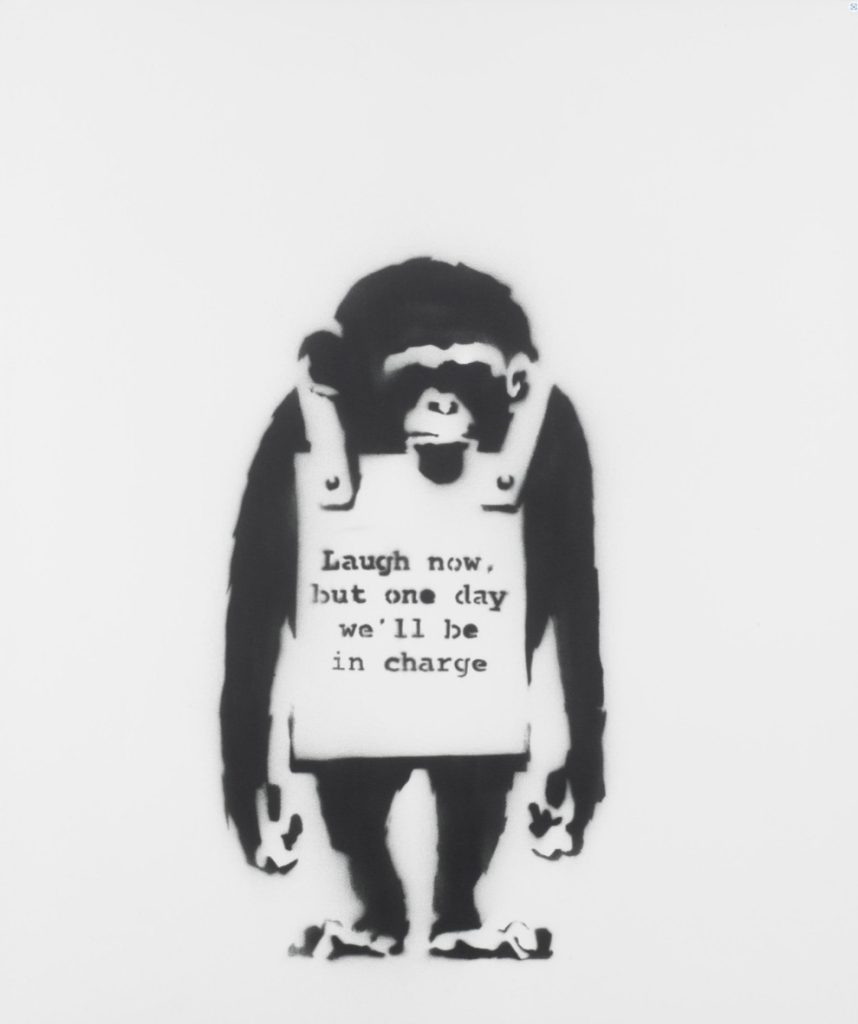

stencil spray paint on canvas
60×50 cm (23 5/8 x 19 11/16 inches)
Stencil signature to overlap
‘Urban Discipline’ Graffiti Art Exhibition, Hamburg, Germany
Auction History
| Bonhams London 23 September 2009 Est.: GBP 25,000 – 35,000 | Price Realized GBP 46,800 / USD 61,365 |
Catalogue Note
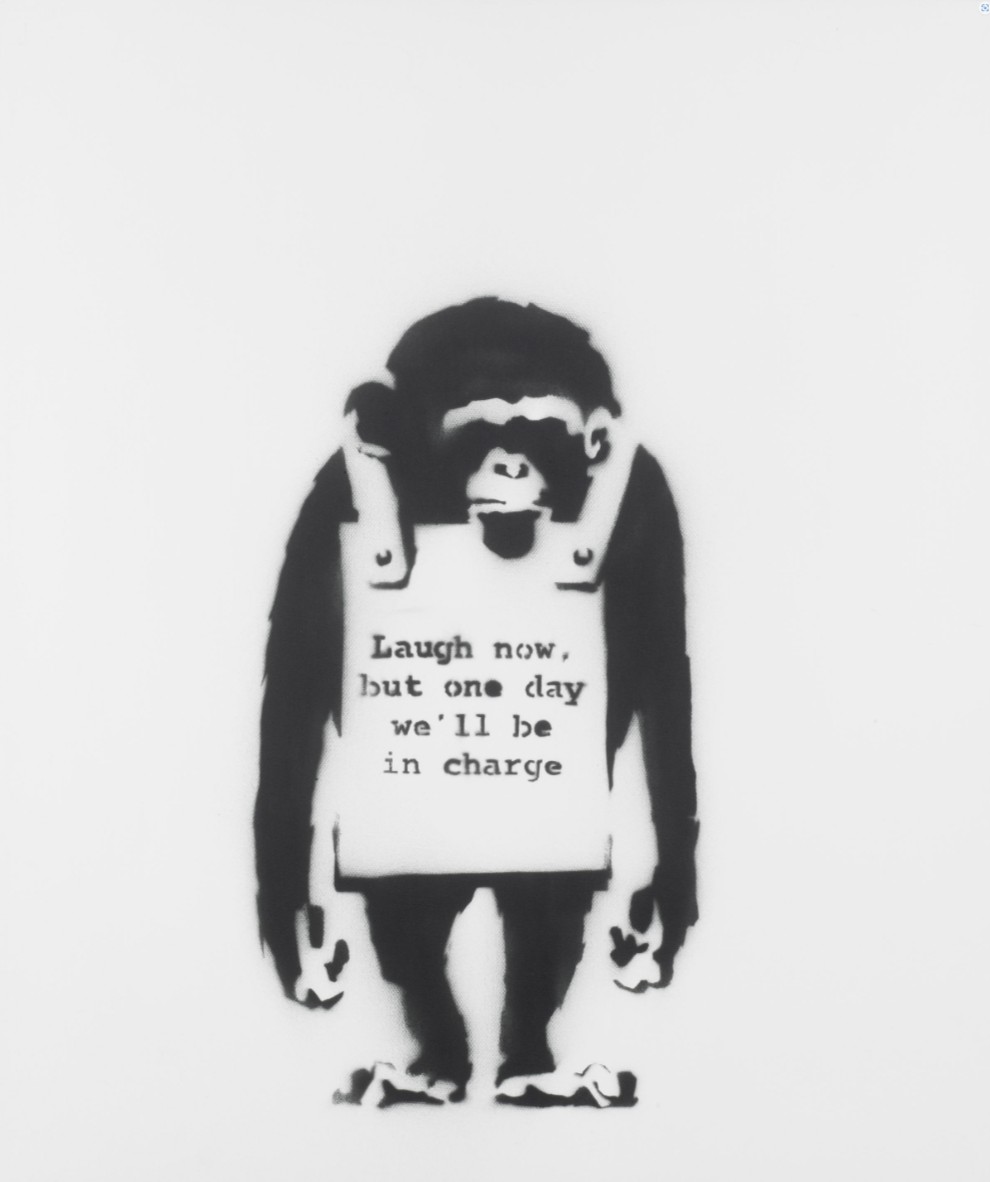
Executed in 2002, this Laugh Now belongs to the earliest series of unique canvases exploring Banksy’s defining monkey motif. First exhibited at Urban Discipline in Hamburg, one of the earliest international exhibitions dedicated to graffiti and street art, the work reflects the moment when Banksy’s imagery began reaching audiences well beyond Britain, establishing itself as part of a broader international conversation surrounding contemporary urban art.
Unlike several other early interpretations, this composition is distinguished by its remarkable restraint. Set against a pristine white ground, the monkey appears almost suspended in space, isolated from any architectural or environmental context. The absence of visual distractions directs the viewer’s attention entirely towards the relationship between the solitary figure and its now-famous placard, allowing the conceptual strength of the image to speak for itself.
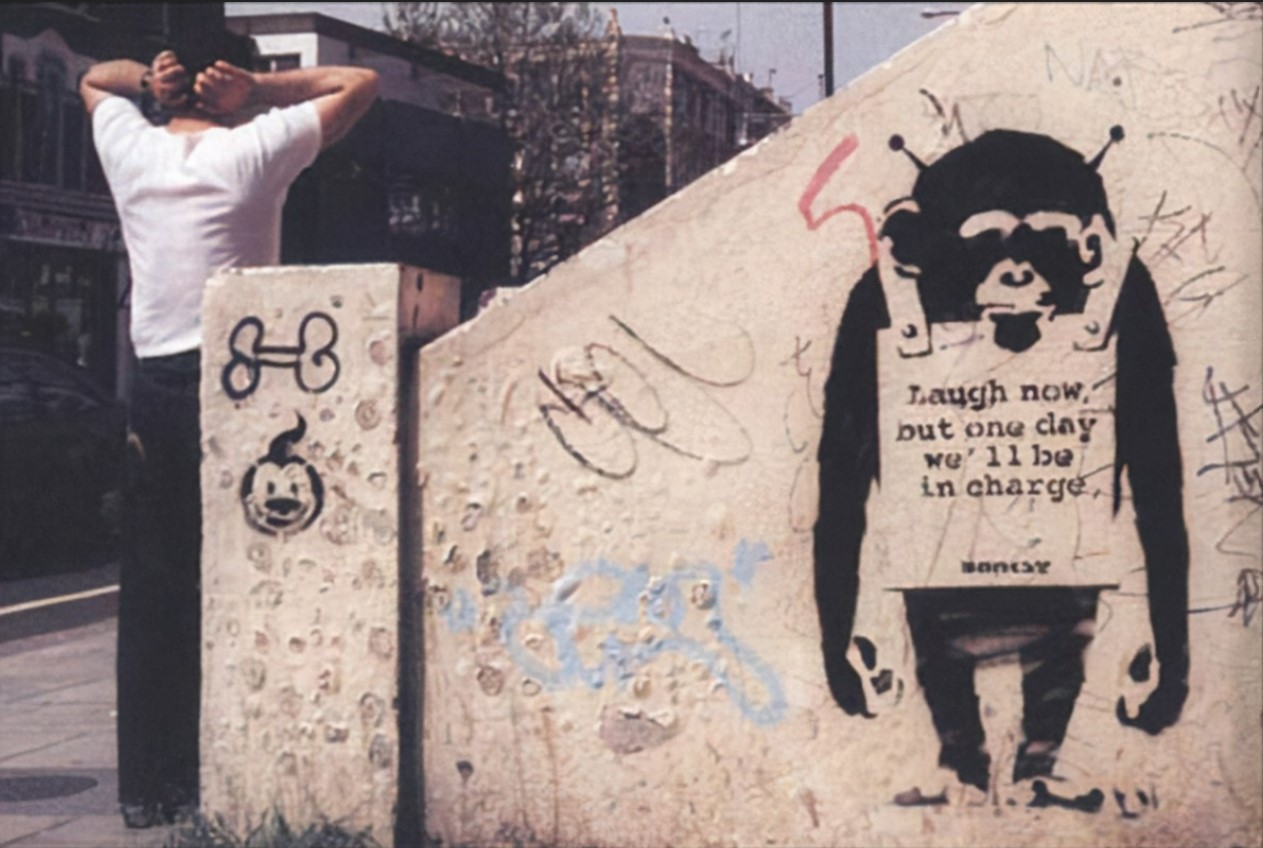
This reduction to essentials demonstrates Banksy’s extraordinary confidence in the motif. There are no expressive drips, reclaimed supports or elaborate painterly interventions. Every unnecessary element has been removed until only the central idea remains. The result is an image of striking clarity, where the power of the work derives not from complexity but from the remarkable precision with which image and text interact.
The monkey itself remains one of Banksy’s most psychologically compelling creations. Its lowered shoulders suggest the burden of marginalization, yet its firmly planted feet, quiet expression and gently clenched hands reveal neither resignation nor defeat. Instead, the figure conveys patience and quiet determination. The celebrated slogan—“Laugh now, but one day we’ll be in charge”—therefore functions less as a threat than as a calm statement of confidence, allowing the work to oscillate between humour, social commentary and prophecy.
The generous expanse of white surrounding the figure further transforms the composition. Detached from the visual noise of the street, the monkey acquires an almost emblematic quality, becoming less an individual character than a universal symbol of those overlooked, underestimated or excluded from positions of power. This openness has undoubtedly contributed to the enduring relevance of the image, allowing successive generations to project their own political and social readings onto the work.
PLEASE CLICK BELOW TO READ ABOUT LAUGH NOW
Its provenance also carries particular significance. Shown at Urban Discipline in Hamburg, the painting belongs to a landmark moment in the growing institutional recognition of street art in Europe. At a time when Banksy remained primarily known through his illegal interventions, exhibitions such as these helped introduce his work into an international artistic context while preserving the authenticity of its visual language.
Elegant in its simplicity, this early canvas demonstrates that the enduring strength of Laugh Now lies not in spectacle but in restraint. Reduced to little more than a monkey, a placard and an empty field of white, Banksy proves that some of the most powerful images in contemporary art require remarkably little to communicate ideas of lasting political and human significance.