Banksy™ Welcome Mat
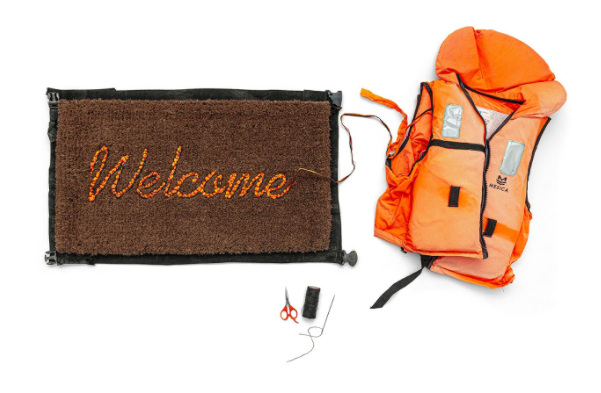
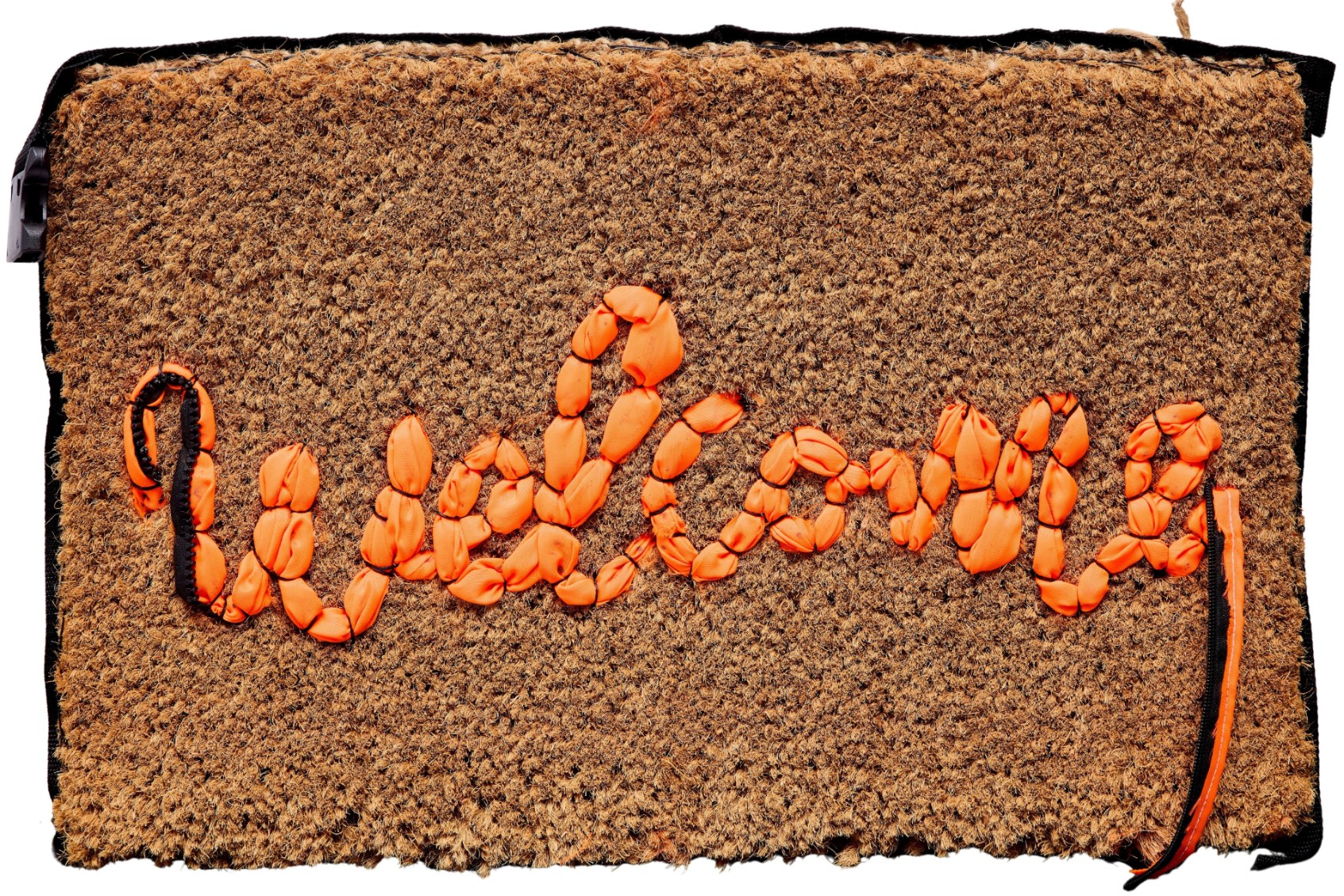
Medium: Hand-stitched welcome mat using the fabric from life vests abandoned on the beaches of the Mediterranean
Year: 2019
Dimensions: 43×60 cm
Edition: Limited edition of unknown size (most probably 500)
Release Price: GBP 500
Comes with a GDP Label
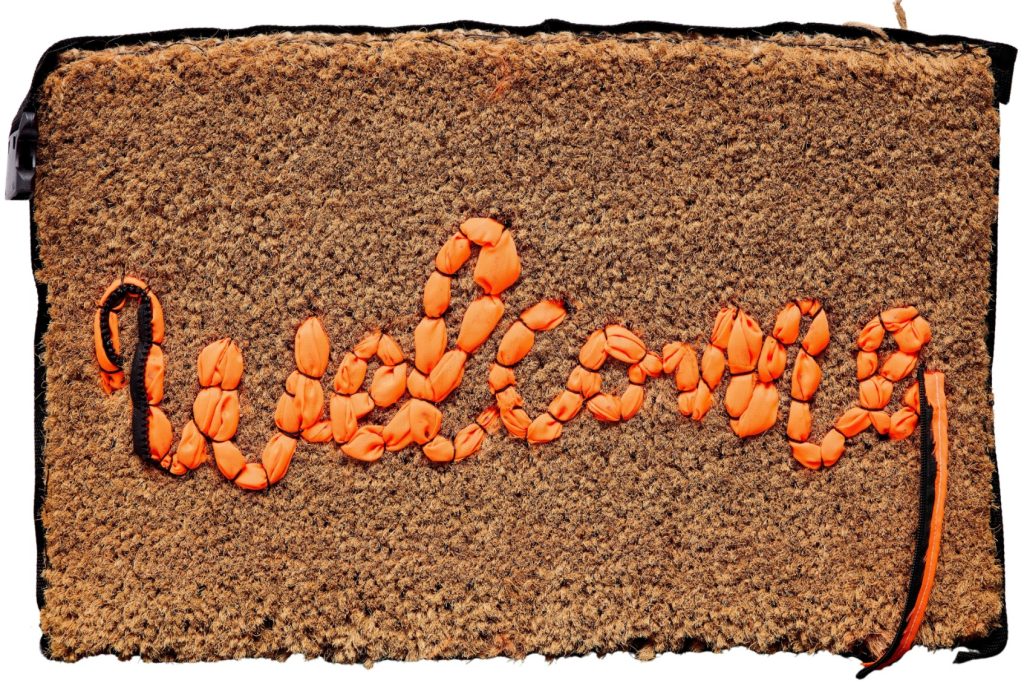
Banksy’s Welcome Mat stands among the most quietly devastating works produced within his 2019 Gross Domestic Product project. At first glance, the object appears disarmingly simple: a rectangular coir doormat, rather modest in scale. Across its coarse brown surface, the word “Welcome” is stitched in vivid orange.
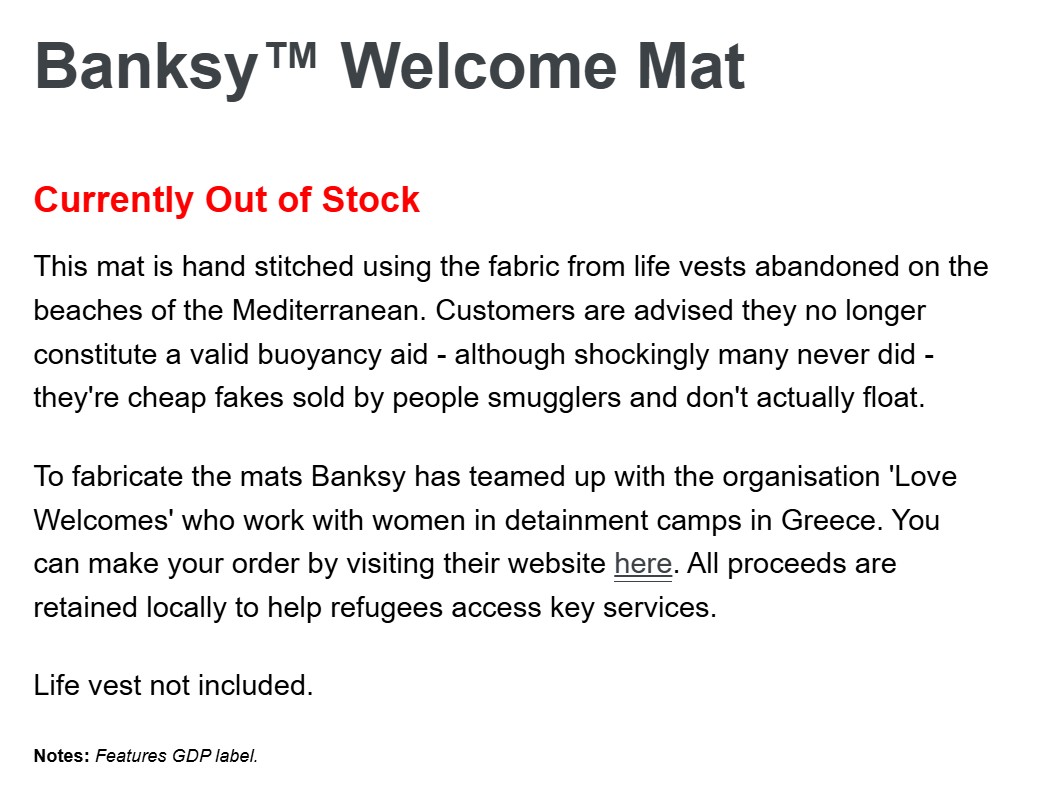
“This mat is hand stitched using the fabric from life vests abandoned on the beaches of the Mediterranean.”
The familiarity of the object immediately disarms the viewer. A doormat is the ultimate symbol of hospitality, a polite gesture placed at the threshold of the home. Yet here, that gesture is constructed from a material that carries a far heavier weight. The bright orange lettering is hand-stitched using fabric taken from life vests abandoned on Mediterranean shores: objects associated not with comfort, but with survival, displacement, and, often, tragedy. What initially reads as a playful or ironic design intervention quickly reveals itself as something far more severe. The welcome being offered is not neutral. It is loaded, unstable, and deeply compromised.
In Welcome Mat, Banksy moves away from the immediacy of stencil imagery and instead embeds meaning directly into material. The work does not depict the refugee crisis: it contains it. The life vest fabric carries an intrinsic charge. These are not symbolic substitutes; they are remnants of real journeys, often desperate and uncertain. Many such vests, as has been widely reported, were cheaply produced and ineffective, sold under false promises of safety. In that context, the material becomes a metaphor for illusion itself: protection that does not protect, welcome that does not welcome.
“Customers are advised they no longer constitute a valid buoyancy aid – although shockingly many never did – they are cheap fakes sold by people smugglers and do not actually float.”
Banksy’s decision to use these fragments transforms the work into something closer to an artifact than an artwork. The object retains a physical connection to events beyond the gallery or the home. It resists aesthetic distance. One does not simply look at it—one is confronted by what it has absorbed.
The choice of a doormat is far from incidental. It is a threshold object, marking the passage from outside to inside, from public to private, from stranger to guest. Banksy turns this domestic boundary into a moral one. Who is allowed to cross? Who is refused? What does it mean to display “Welcome” while simultaneously erecting barriers: physical, political, or psychological? Placed at the entrance of a home, the work becomes almost performative. It implicates its owner. The act of stepping over it is no longer neutral. The object quietly demands reflection on the contradictions between declared values and lived realities.
There is also a distinct undercurrent of dark humor, characteristic of Banksy at his sharpest. The doormat, traditionally something one wipes one’s shoes on, becomes a place where one might metaphorically wipe one’s conscience. The joke lands with precision—and discomfort.
The construction of Welcome Mat reinforces its conceptual weight. The letters are hand-stitched, deliberately avoiding any sense of polish or industrial perfection. The work retains a tactile immediacy, closer to labor than to luxury. Crucially, the mats were produced in collaboration with women in refugee camps in Greece. This dimension shifts the work from representation to participation. It is not merely about displaced individuals; it involves them directly in its making.
“To fabricate the mats Banksy has teamed up with the organization ‘Love Welcomes’ who work with women in detainment camps in Greece.”
This element introduces a rare alignment between message and method. The work does not simply critique systems of exclusion—it redistributes value, however modestly, within those same systems. In doing so, Banksy avoids the purely symbolic gesture and enters a more complex ethical terrain.
Welcome Mat was released as part of Banksy’s Gross Domestic Product project, a conceptual storefront and online platform launched in 2019. While the initiative had roots in a trademark dispute, it quickly evolved into a broader exploration of authorship, commerce, and control. The project presented a range of domestic objects—homewares, furniture, decorative items—each infused with Banksy’s characteristic tension between humor and critique. These were objects designed to exist within everyday life while quietly undermining it.

Within this context, Welcome Mat emerges as one of the most conceptually rigorous pieces. It encapsulates the project’s central paradox: the transformation of political critique into consumer goods, and the uneasy coexistence of ethics and market value. It is an object that can be bought, owned, and displayed, yet it resists full domestication. It remains, in essence, a disruptive presence.
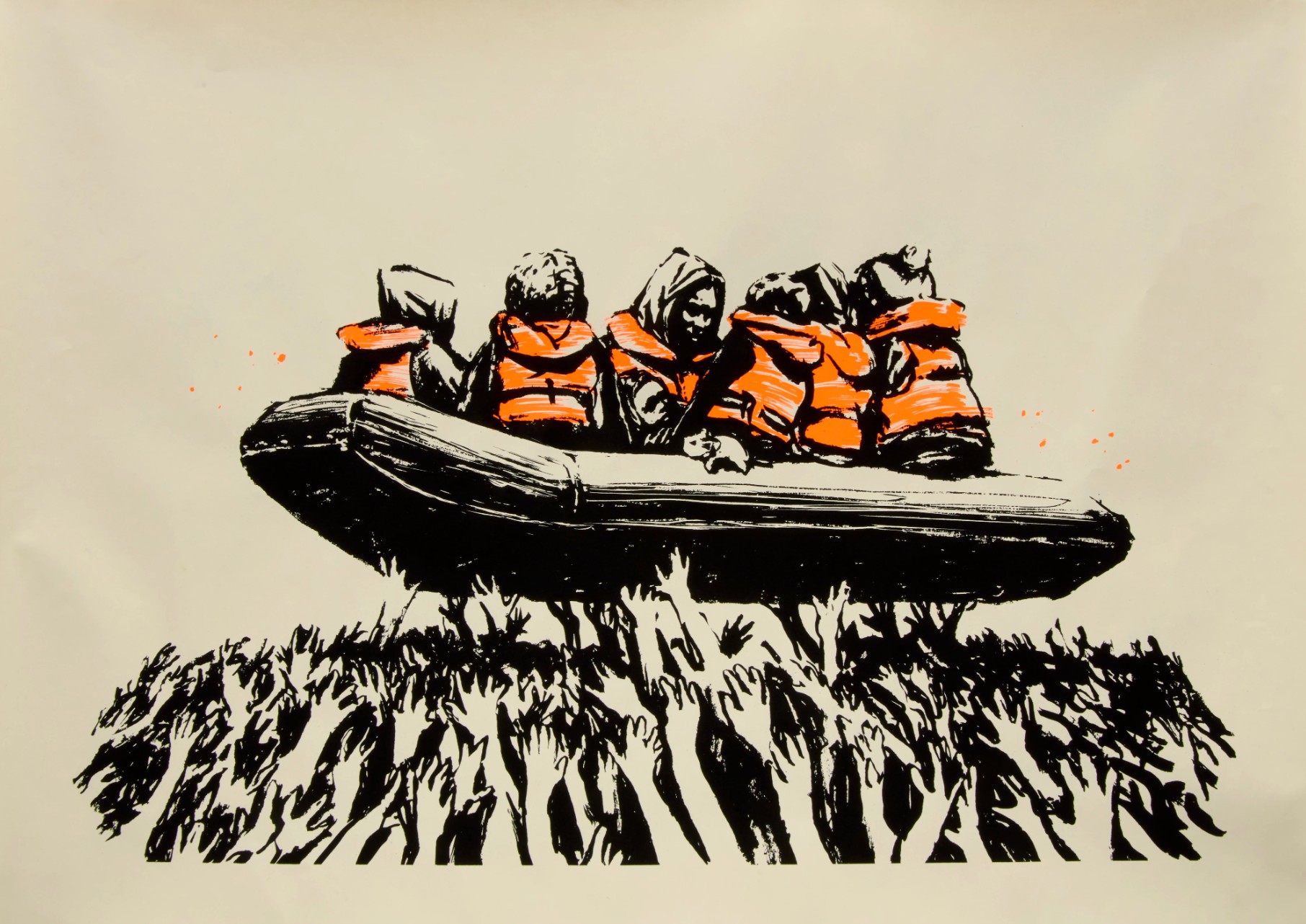
BANKSY, Migrants in a Boat, 2025
Within Banksy’s broader body of work, Welcome Mat stands as a particularly distilled expression of his engagement with migration, borders, and humanitarian crises. It shares thematic ground with several of his interventions related to displacement and political hypocrisy, yet it operates with unusual restraint. There is no central figure, no dramatic scene, no instantly legible narrative. Instead, the work relies on absence, implication, and material truth. It demands a slower reading, and in doing so, it lingers longer. Its legacy is tied not only to its message, but to its method. By embedding meaning within the object itself—and by integrating elements of real-world production and participation—Banksy expands the scope of what his work can be. He moves beyond image into object, beyond commentary into structure.
Auction Results
PLEASE CLICK BELOW FOR AUCTION RESULTS