Unofficial War Artist
“It takes a lot of guts to stand up anonymously in a western democracy and call for things no-one else believes in like peace and justice and freedom”
Few contemporary artists have explored the tragedy of war as persistently and as powerfully as Banksy. From his earliest murals on the streets of Bristol to his interventions on the separation wall in Bethlehem and, more recently, the bomb-scarred buildings of Ukraine, conflict has remained one of the defining threads running through his artistic career. Yet Banksy is not a war artist in the traditional sense. He does not glorify military victories, celebrate heroic sacrifice, or document battles from the front line. Instead, he examines something far more unsettling: the political narratives, cultural myths, and everyday indifference that allow war to become acceptable.
Throughout history, artists have sought to represent conflict. Francisco de Goya exposed the brutality of the Napoleonic Wars in The Disasters of War. Pablo Picasso transformed the bombing of Guernica into one of the twentieth century’s greatest anti-war masterpieces. Otto Dix documented the psychological devastation of the First World War with uncompromising realism. Banksy belongs to this lineage, yet his language is unmistakably contemporary. Rather than depicting bloodshed directly, he relies on irony, humor, and visual paradox to expose the absurdity of modern warfare. His weapons are not paintbrushes alone, but satire, symbolism, and contradiction.

What distinguishes Banksy from many political artists is that he is rarely interested in combat itself. Instead, he investigates the machinery that surrounds it: the politicians who justify it, the media that packages it, the corporations that profit from it, and the societies that gradually become desensitized to its consequences. His works ask why bombs can be described as “precision strikes,” why civilian deaths become “collateral damage,” and why the language of war so often disguises its human cost behind technical vocabulary and political rhetoric.
Children holding bombs, monkeys carrying missiles, smiling helicopters adorned with ribbons, pensioners playing bowls with unexploded ordnance, or the Mona Lisa armed with a rocket launcher all share the same purpose. By placing instruments of destruction into unexpected hands, Banksy dismantles the familiar imagery of military power and forces us to see it anew. The absurdity makes us laugh for a moment, only to realize that the joke conceals a far more disturbing reality.
This strategy has become one of Banksy’s greatest artistic strengths. Rather than confronting viewers with scenes of horror that may provoke immediate rejection, he draws them in through humor and visual wit before revealing the darker implications hidden beneath the surface. His images are immediately accessible, yet their meanings continue to unfold long after the first smile has disappeared.
Weapons of Mass Distraction

Perhaps this is why Banksy’s anti-war imagery has remained so remarkably relevant. Although many of these works were created in response to the conflicts of the early twenty-first century, they speak just as forcefully to the wars that continue to shape our own time. Governments change, technologies evolve, and battlefields shift, but the mechanisms that normalize violence remain strikingly familiar. More than two decades after he first turned his attention to war, Banksy’s message has lost none of its urgency.
For Banksy, war is not simply a political event or a historical episode. It is a profound failure of humanity—one sustained not only by armies and governments, but also by complacency, propaganda, and collective silence. Through some of the most iconic images of contemporary art, the anonymous street artist has become one of the twenty-first century’s most eloquent and uncompromising voices for peace.
Why Banksy Paints War
War has occupied a central place in art for centuries. From the triumphal monuments of Antiquity to the monumental battle scenes of the Renaissance and the heroic canvases of the nineteenth century, artists have long been commissioned to celebrate military victories, immortalize national heroes, and reinforce political power. Yet there has always existed another tradition—one that questions rather than glorifies conflict. Francisco de Goya’s The Disasters of War, Otto Dix’s haunting memories of the First World War, and Pablo Picasso’s Guernica all reject the romanticism of battle, exposing instead its brutality, futility, and devastating human cost. It is within this lineage that Banksy firmly belongs.
Unlike these artists, however, Banksy rarely depicts war itself. His battlefields are not littered with soldiers or corpses, nor are his skies filled with explosions. Instead, he focuses on the world surrounding conflict: the political speeches that justify it, the media narratives that sanitize it, the industries that profit from it, and the societies that gradually become accustomed to its permanence. His works reveal not simply the violence of war, but the mechanisms that make violence appear ordinary.
This approach emerged during a particularly turbulent period in recent history. The early years of the twenty-first century were dominated by the aftermath of the September 11 attacks, the invasion of Afghanistan, and, most significantly for Banksy, the Iraq War in 2003. The decision by Prime Minister Tony Blair to join President George W. Bush in invading Iraq deeply divided public opinion in Britain, giving rise to one of the largest anti-war movements in the country’s history. Millions marched through the streets of London carrying banners demanding peace while questioning both the legality and the justification of the conflict.
Banksy became one of the movement’s most recognizable artistic voices. Rather than producing traditional political posters or overt propaganda, he chose to intervene directly in public space, using walls as his canvas and satire as his weapon. His murals appeared without permission, confronting passers-by with images that challenged official narratives and encouraged independent thought. By taking art out of museums and into the streets, Banksy ensured that his anti-war message reached the very people whose lives were most directly affected by political decisions made elsewhere.
What makes Banksy’s anti-war imagery particularly powerful is its refusal to take the obvious route. Instead of showing destroyed cities or wounded civilians, he transforms familiar symbols of conflict into unexpected visual paradoxes. Military helicopters wear pink ribbons. Children embrace bombs as though they were toys. Monkeys carry missiles. Pensioners play bowls with unexploded ordnance. Even the Mona Lisa, one of the most celebrated icons in Western art, casually brandishes a rocket launcher. These images are amusing at first glance, yet their humour quickly gives way to discomfort as the absurdity reveals a profound truth about the normalization of violence.
Banksy’s genius lies precisely in this reversal. Rather than confronting viewers with horror—which can often provoke distance or emotional fatigue—he invites them to laugh before quietly exposing the contradictions hidden beneath the surface. His works dismantle the reassuring language through which modern warfare is often presented. Terms such as “precision strike,” “collateral damage,” and “surgical intervention” are stripped of their bureaucratic neutrality and revealed for what they frequently conceal: the destruction of lives, communities, and futures.
Throughout his career, Banksy has consistently reminded us that war is never confined to distant battlefields. It reaches into homes, schools, hospitals, museums, and ultimately into our collective imagination. It shapes language, politics, economics, and culture long before the first shot is fired and long after the last has fallen silent. His anti-war works therefore ask a question that remains as urgent today as when they were first created: how does society become so comfortable with conflict that it begins to accept the unacceptable?
The works explored in the following chapters answer that question from different perspectives. Individually, they challenge specific aspects of modern warfare. Together, they form one of the most coherent and uncompromising bodies of anti-war imagery produced by any contemporary artist, confirming Banksy’s place as the unofficial war artist of his generation.
When Weapons Become Toys
Few works illustrate Banksy’s ability to transform instruments of war into powerful symbols of satire more effectively than Happy Choppers. First painted as a mural in London in 2002 before being released as one of the artist’s earliest and most sought-after print editions in 2003, the image depicts a military helicopter adorned with an oversized pink ribbon tied around its rotor assembly. The juxtaposition is immediate, unexpected, and profoundly unsettling. One of the most intimidating machines ever devised by mankind is suddenly decorated like a birthday present.
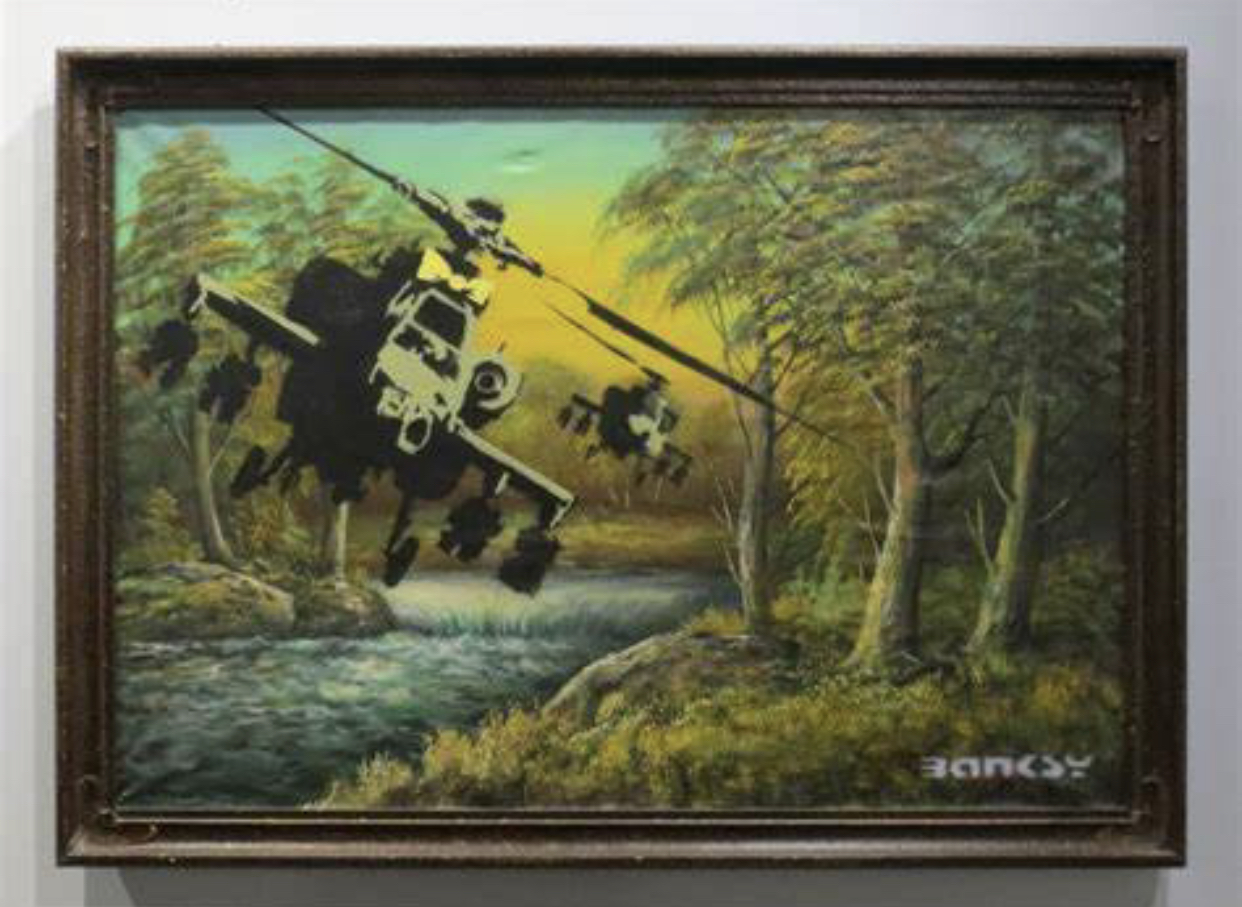
The helicopter occupies a unique place in the visual culture of modern warfare. Since the Vietnam War, it has become one of the defining symbols of military intervention, surveillance, and overwhelming force. Films such as Apocalypse Now transformed the attack helicopter into an icon of twentieth-century conflict, embodying both technological superiority and psychological domination. Banksy deliberately appropriates this familiar imagery only to dismantle it through one simple, almost absurd gesture.

The pink ribbon completely alters the emotional register of the composition. Traditionally associated with childhood, celebration, femininity, or gift wrapping, it belongs to a world of innocence entirely removed from military aggression. By attaching it to an attack helicopter, Banksy creates a visual contradiction that forces the viewer to reconcile two fundamentally incompatible ideas: tenderness and violence. The resulting tension lies at the very heart of the work.
At first glance, the image is humorous. The helicopter almost appears harmless, transformed into an object of playful ridicule. Yet this laughter quickly becomes uncomfortable. The aircraft remains exactly what it has always been—a machine designed to intimidate, destroy, and kill. The ribbon changes nothing about its function. Instead, it exposes how easily appearances can soften or disguise reality, a theme that runs throughout Banksy’s anti-war imagery.

Study for Happy Chopper, 2003
79×109.7cm (31 1/8 x 43 1/4 inches)
This paradox extends far beyond the helicopter itself. Modern warfare is frequently presented through carefully managed imagery and reassuring language. Governments speak of “peacekeeping operations,” “precision strikes,” or “surgical interventions,” while television audiences often experience conflict through distant aerial footage that resembles a video game more than human tragedy. Violence is repackaged, sanitized, and made visually acceptable. Banksy’s ribbon performs precisely the same operation. It decorates the weapon without altering its purpose, revealing how easily aesthetics can obscure brutality.
There is also a broader commentary on society’s fascination with military technology. Helicopters, fighter jets, tanks, and missiles are routinely displayed during national celebrations, air shows, and public ceremonies as objects of admiration, symbols of national pride rather than instruments of destruction. Banksy questions this cultural normalization. By treating the helicopter as something to be gift-wrapped and admired, he exposes the strange ease with which societies can become emotionally detached from the devastating consequences of the machines they celebrate.
The composition is remarkably economical. Unlike many political artists who rely upon explicit slogans or graphic imagery, Banksy conveys his message through the simplest of interventions. Nothing has been added except a ribbon. Yet that tiny alteration fundamentally changes the way we perceive the aircraft, demonstrating the extraordinary power of visual contradiction. It is a perfect example of Banksy’s artistic philosophy: say more by showing less.
Viewed within the broader context of Banksy’s work, Happy Choppers marks the beginning of a recurring strategy that would define many of his anti-war images. Rather than depicting violence directly, he repeatedly introduces symbols of innocence, humour, or beauty into military contexts, allowing the resulting paradox to expose the absurdity of conflict. Whether it is a little girl embracing a bomb, an elephant carrying a missile, or pensioners playing bowls with unexploded ordnance, the mechanism remains the same. The familiar becomes unfamiliar, compelling us to question assumptions we had long ceased to notice.

More than twenty years after its creation, Happy Choppers remains one of Banksy’s most iconic anti-war images. Beneath its deceptively playful appearance lies a profound reflection on the seductive aesthetics of military power and the alarming ease with which societies learn to accept its presence. The helicopter may wear a ribbon, but it remains a weapon. That simple truth is precisely what Banksy asks us never to forget.
The Absurdity of War Power
If Happy Choppers questions the seductive aesthetics of military technology, Heavy Weaponry pushes the absurdity even further. Created in 2002 as a mural in London, the work depicts an elephant carrying a guided missile across its back, accompanied by a small rat standing beneath its enormous feet. The composition is immediately surreal. One of nature’s most peaceful and majestic creatures has been transformed into a beast of war, burdened with a weapon that symbolizes destruction on an industrial scale.

At first glance, the image appears almost whimsical. The disproportion between the gentle elephant and the sleek military missile creates an unexpected visual joke, inviting the viewer to smile at the sheer improbability of the scene. Yet, as with so many of Banksy’s greatest images, humor quickly gives way to reflection. The elephant has not become aggressive; it simply carries humanity’s violence. The absurdity lies not in the animal itself, but in our willingness to imagine that even nature can be drafted into the machinery of war.
The elephant has long been associated with wisdom, strength, memory, and stability. Across numerous cultures, it symbolizes intelligence, patience, and peaceful coexistence. By placing a missile upon its back, Banksy deliberately violates these deeply rooted associations. The animal becomes an unwilling participant in a conflict entirely of human invention, suggesting that war ultimately corrupts everything it touches, even those symbols we instinctively associate with peace and dignity.
“As soon as I cut my first stencil I could feel the power there. I like the political edge. All graffiti is low-level dissent, but stencils have an extra history. They’ve been used to start revolutions and to stop wars.”
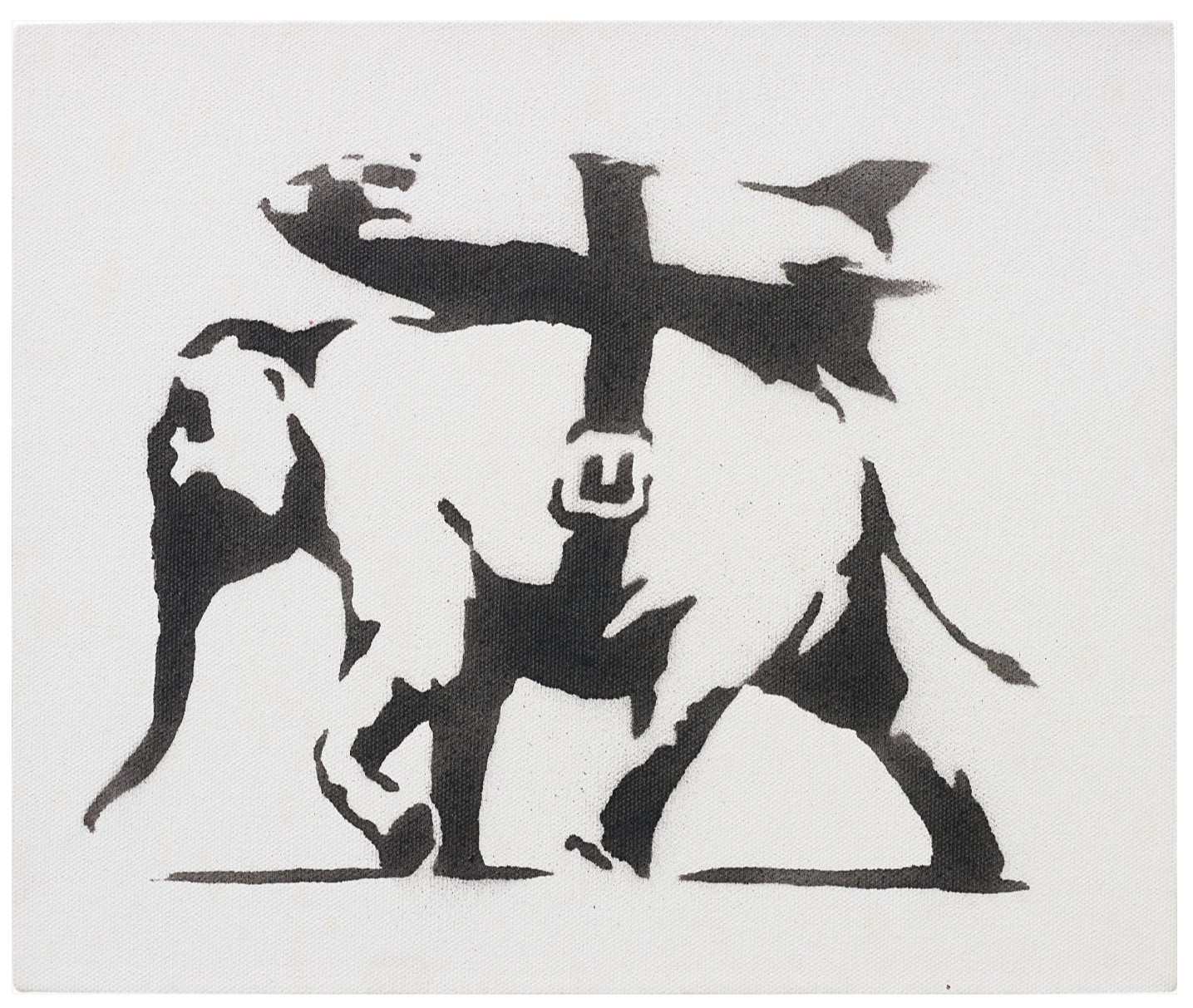
The missile itself introduces another layer of irony. Designed to represent technological progress and military superiority, it appears strangely out of place when balanced upon the back of such an ancient creature. The juxtaposition creates a powerful contrast between nature and technology, instinct and engineering, life and destruction. Banksy subtly reminds us that while military technology constantly evolves, the human impulse toward conflict remains remarkably unchanged.
Beneath the elephant stands one of Banksy’s other great protagonists: the rat. Tiny, vulnerable, and almost insignificant beside the colossal animal, it nevertheless occupies an essential role within the composition. Throughout Banksy’s oeuvre, the rat represents resilience, survival, and resistance from the margins of society. Here, the contrast in scale reinforces the imbalance of modern warfare itself. Great powers accumulate increasingly sophisticated weapons while ordinary individuals remain those most exposed to their consequences. The rat, almost crushed beneath the elephant’s weight, becomes a quiet reminder of those who bear the greatest burden of conflicts they neither create nor control.


There is also a subtle linguistic dimension to the work. The title Heavy Weaponry ordinarily refers to tanks, artillery, missiles, and other large military equipment. Banksy takes the expression literally by placing “heavy weaponry” upon the heaviest land animal on Earth. The visual pun is characteristic of his humor, yet beneath the wordplay lies a serious observation about the extraordinary effort, expense, and resources societies devote to preparing for war.
Like many of Banksy’s anti-war images, Heavy Weaponry also challenges the notion that military strength is synonymous with political strength. The elephant possesses immense physical power yet displays no desire to use it. The missile, by contrast, derives its significance entirely from its destructive capacity. Banksy contrasts these two forms of power to suggest that genuine strength may reside not in the ability to destroy, but in the wisdom to refrain from doing so.


The image acquires an even deeper significance when viewed alongside Banksy’s other animal works. Monkeys become politicians, rats become revolutionaries, birds carry grenades, and elephants transport missiles. Throughout his career, animals repeatedly assume the roles of human beings, exposing our contradictions with remarkable clarity. By stripping away uniforms, flags, and national identities, Banksy reveals war for what it ultimately is: not an inevitable feature of nature, but a uniquely human invention projected onto the world around us.
More than twenty years after it first appeared, Heavy Weaponry remains one of Banksy’s most elegant anti-war allegories. Through one impossible image, he demonstrates that conflict does not simply destroy landscapes and cities; it distorts our entire relationship with the natural world. The elephant continues its silent march, carrying a burden that was never its own. In doing so, it quietly reminds us that the greatest weight of war is often borne by those who never chose to fight it.
When Innocence Confronts Violence
Among Banksy’s many anti-war images, Bomb Love—also known as Bomb Hugger—is undoubtedly one of his most iconic and emotionally powerful. First appearing as a mural in East London in 2003 before being released as one of the artist’s earliest print editions, the work depicts a young girl embracing a large aerial bomb with the same tenderness one might reserve for a favorite teddy bear. It is a simple image, almost disarmingly so, yet it encapsulates Banksy’s anti-war philosophy more completely than perhaps any other work.
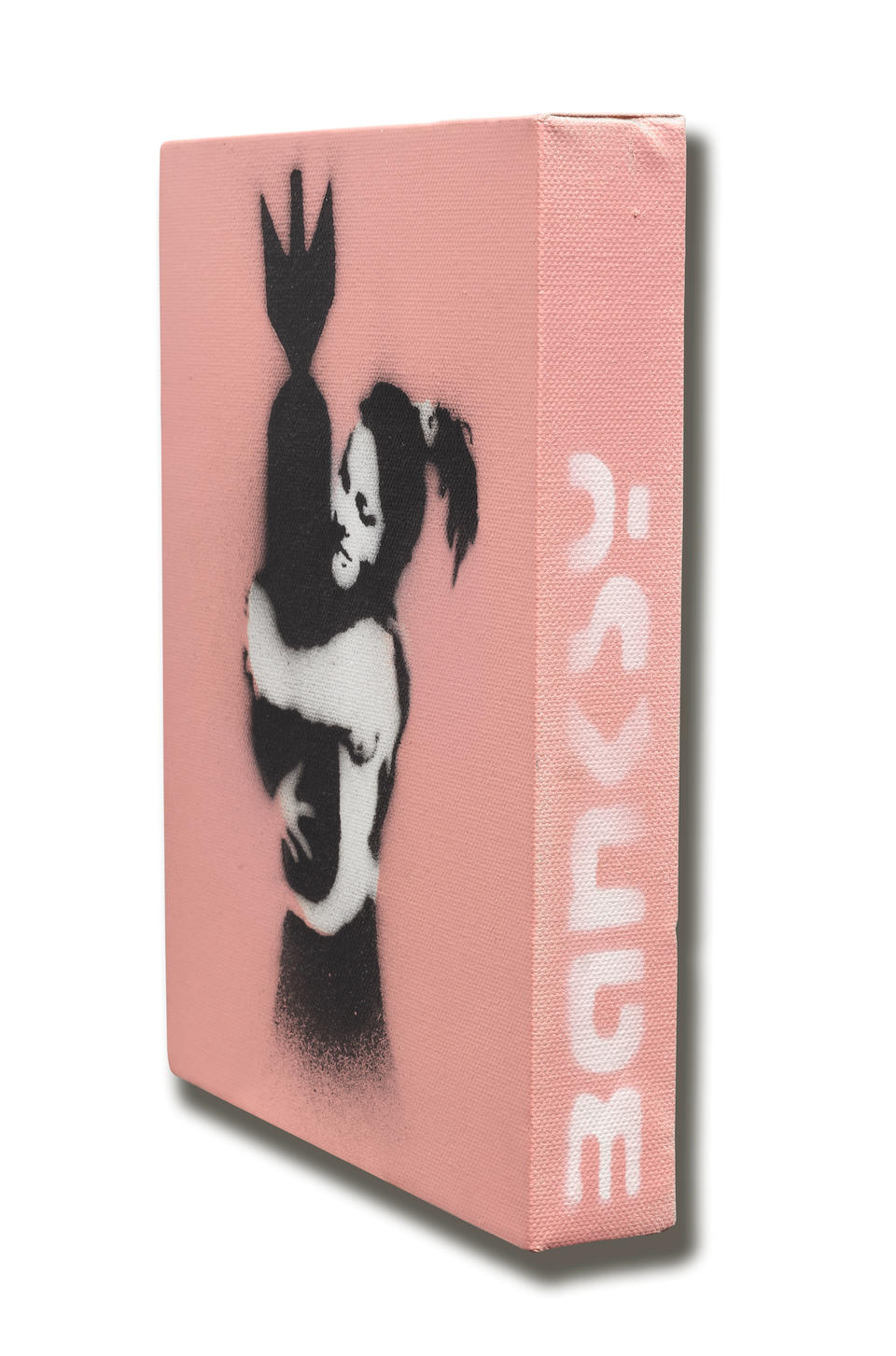
The composition relies on one of the oldest artistic devices: the collision of opposites. Childhood and warfare, innocence and destruction, affection and violence are brought together within a single embrace. The contradiction is immediate and profoundly unsettling. A bomb, designed solely to destroy life, is transformed into an object of comfort and affection. The little girl appears entirely unaware of the danger she is holding, smiling gently as if protecting something precious.
Banksy has often used children as symbols of innocence, hope, and humanity. Unlike politicians or soldiers, children possess neither ideological agendas nor political responsibility. They do not wage wars, negotiate treaties, or manufacture weapons. Yet throughout history, they have remained among the greatest victims of armed conflict. By placing the bomb in the arms of a child rather than a soldier, Banksy shifts the viewer’s attention away from military strategy and towards the human consequences of violence. War is no longer an abstract geopolitical event; it becomes a deeply personal tragedy.

The embrace itself carries multiple layers of meaning. It may suggest innocence incapable of recognizing danger, but it can equally be interpreted as a powerful metaphor for society’s increasingly comfortable relationship with violence. Modern warfare is often presented through sanitized media coverage, political rhetoric, and technological spectacle. Bombs become symbols of military precision, national security, or strategic necessity rather than instruments of death. Banksy’s little girl appears to accept the bomb without fear, reflecting a society that has gradually learned to coexist with the very objects capable of its destruction.
The image also recalls one of the central paradoxes of the nuclear age. Since the middle of the twentieth century, humanity has lived alongside weapons capable of unprecedented devastation. Although rarely visible in everyday life, they have become permanent features of the political landscape, accepted almost as unavoidable components of modern civilization. Bomb Love quietly questions this normalization. How did humanity become so accustomed to devices designed exclusively to kill that they could almost be mistaken for ordinary objects?
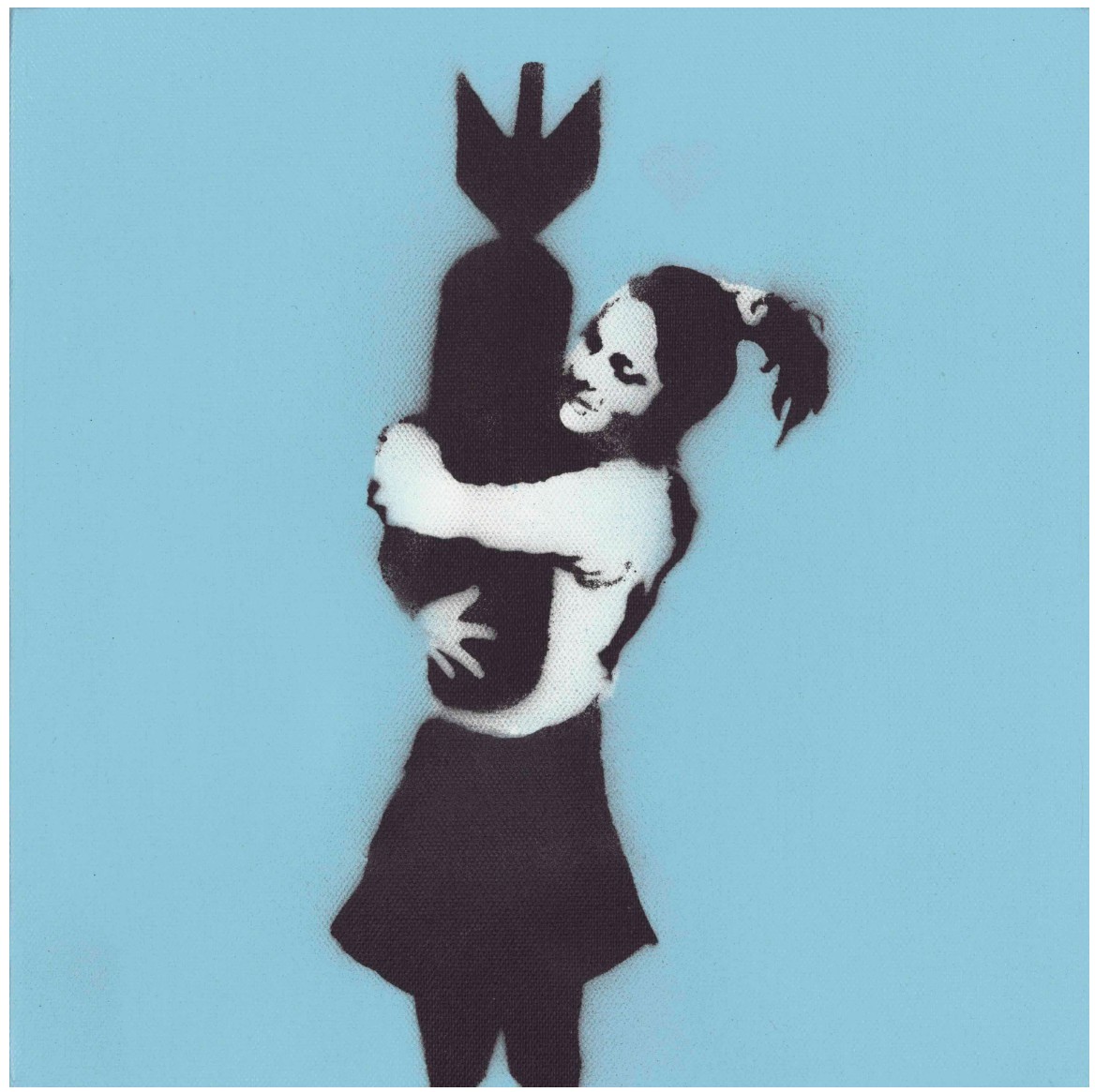
Visually, the composition achieves remarkable emotional balance. The bomb dominates the image through its imposing scale and dark silhouette, while the child introduces softness, vulnerability, and movement. The contrast is heightened by Banksy’s restrained monochrome palette, allowing the emotional tension to emerge entirely from the relationship between the two figures. As so often in his work, nothing is exaggerated. The simplicity of the composition is precisely what gives it such extraordinary force.
There is also a broader philosophical reading. The image invites reflection on humanity’s contradictory nature. We are capable of creating extraordinary works of science, engineering, and innovation, yet we frequently devote those same achievements to the development of increasingly sophisticated means of destruction. The bomb itself is a triumph of technological ingenuity, but one designed to extinguish rather than preserve life. By placing it in the loving arms of a child, Banksy exposes the moral contradiction at the heart of modern civilization.
Over the years, Bomb Love has become one of Banksy’s most celebrated images, reproduced countless times and widely regarded as one of the defining icons of contemporary anti-war art. Its enduring appeal lies in its remarkable universality. It is not tied to a specific conflict, nation, or political ideology. Instead, it speaks to every society that has learned to accept violence as an inevitable part of human existence.
More than twenty years after its creation, Bomb Love remains as poignant as ever. It reminds us that the true victims of war are often those who had no part in creating it, while questioning our own ability to normalize the unthinkable. Through one child and one bomb, Banksy distils one of the oldest and most tragic contradictions of humanity: our extraordinary capacity to embrace the very things that ultimately threaten our own future.


The Intimacy of Conflicts
Few works capture Banksy’s gift for visual contradiction as elegantly as Every Time I Make Love To You. Created in 2003, the image depicts a couple locked in an intimate embrace, their bodies pressed together in what appears to be a tender romantic moment. Yet one striking detail immediately disrupts the scene: the man wears a military gas mask. Love and war, intimacy and fear, tenderness and survival collide within a single composition, transforming an ordinary embrace into a profound meditation on the intrusion of conflict into everyday life.
Unlike many traditional anti-war images, Banksy does not depict soldiers, weapons, or battlefields. War is present only through the gas mask, one of the twentieth century’s most enduring symbols of chemical warfare, terrorism, and environmental catastrophe. Its appearance is subtle but impossible to ignore. The mask functions like an unwelcome intruder, reminding the viewer that conflict rarely remains confined to distant front lines. It infiltrates homes, relationships, and the most private moments of human existence.
The title adds another layer of poignancy. Every Time I Make Love To You suggests repetition, routine, and familiarity. It implies that even intimacy has become conditioned by the realities of conflict. The gas mask is no longer an emergency measure worn during moments of crisis, but an ordinary part of everyday life. In this sense, Banksy explores one of the most insidious consequences of prolonged warfare: not simply its physical destruction, but its gradual normalization. The extraordinary becomes ordinary. Fear becomes habit.

91.5x76cm (36×29 7/8 inches)
The image also reflects a broader transformation in the nature of modern conflict. Throughout much of history, wars were fought on distant battlefields by professional armies, allowing civilian life to continue at a relative remove. Contemporary warfare increasingly blurs those boundaries. Terrorism, chemical weapons, missile attacks, and the threat of unconventional warfare have brought conflict directly into cities, homes, and civilian spaces. The gas mask therefore symbolizes far more than military equipment. It represents the disappearance of any clear separation between war and peace.
There is a distinctly Orwellian quality to the composition. In George Orwell’s dystopian vision, war becomes a permanent condition used to shape society and justify systems of control. Banksy similarly suggests that conflict can become so deeply embedded within everyday existence that it begins to redefine even our most personal relationships. The embrace remains genuine, yet it unfolds beneath the constant shadow of fear.
Visually, the work is striking in its restraint. The lovers are depicted with remarkable tenderness, their bodies forming an elegant, almost timeless silhouette. The gas mask is the only disruptive element, yet it transforms the emotional meaning of the entire composition. Banksy once again demonstrates his extraordinary ability to alter an image completely through the introduction of a single unexpected detail.
The work also raises uncomfortable questions about resilience and adaptation. Human beings possess an extraordinary capacity to adjust to changing circumstances, even the most traumatic. While this resilience is essential for survival, it also carries a hidden danger. We gradually accept situations that would once have seemed intolerable. The lovers continue to embrace, but the gas mask suggests they have learned to live with conditions that should never be considered normal.

Playmate of the Month, 2000
Viewed within Banksy’s broader anti-war oeuvre, Every Time I Make Love To You represents a subtle but important shift in perspective. Rather than examining the machinery of war itself, it explores its psychological consequences. Conflict is shown not as an event but as an atmosphere—an invisible presence capable of reshaping emotions, relationships, and ordinary human experience. The battlefield has moved from the outside world into the intimacy of daily life.
More than twenty years after its creation, the image remains profoundly relevant. Whether confronting terrorism, pandemics, environmental disasters, or armed conflict, modern societies continue to grapple with the challenge of preserving their humanity in the face of persistent fear. Through one quiet embrace interrupted by a gas mask, Banksy reminds us that the greatest victory over war is not merely surviving it, but refusing to allow it to define the way we live, love, and relate to one another.
War from the Comfort of Home
Among Banksy’s most biting political satires, Bomb Middle England occupies a unique place. Created in 2003, at the height of the Iraq War, the work depicts four elderly women, impeccably dressed in traditional British attire, calmly playing a game of lawn bowls. Instead of polished wooden bowls, however, they roll large aerial bombs across the immaculate green. The image is instantly absurd, yet beneath its humor lies one of Banksy’s sharpest critiques of public indifference towards war.
The title itself is highly significant. “Middle England” is a distinctly British expression referring not to a geographical location, but to a social and cultural ideal. It evokes suburban prosperity, political moderation, traditional values, and a comfortable middle-class lifestyle, often associated with quiet villages, neat gardens, and orderly routines. By placing instruments of mass destruction into this reassuring environment, Banksy deliberately shatters one of Britain’s most familiar symbols of stability and normality.

The choice of lawn bowls is equally inspired. Often regarded as one of Britain’s most quintessentially genteel pastimes, the sport is associated with retirement, leisure, patience, and community. It represents an almost idyllic vision of peaceful everyday life. Banksy replaces the harmless bowls with military bombs without altering the behaviour of the players. The women continue their game with complete composure, apparently oblivious to the extraordinary nature of the objects they are handling. The satire does not lie in the bombs themselves, but in the players’ indifference.
This indifference forms the central message of the work. Banksy suggests that war has become so distant, so mediated, and so politically abstract that it can coexist comfortably alongside the routines of ordinary life. While conflicts unfold thousands of miles away, many citizens continue their daily activities largely untouched, experiencing war through television screens, newspaper headlines, or political speeches. Violence becomes another item in the daily news cycle—acknowledged briefly before life simply carries on.
The work also comments on the extraordinary ability of democratic societies to compartmentalize conflict. Governments wage wars abroad while domestic life remains remarkably unchanged. Shops remain open, gardens are maintained, sporting events continue, and political debate gradually fades into routine. Banksy asks whether this comfortable separation has made modern warfare easier to accept. When the consequences of military intervention are geographically remote, moral responsibility can become equally distant.
Created during the months following Britain’s participation in the invasion of Iraq, Bomb Middle England reflects a nation deeply divided over the legitimacy of the conflict. Despite the unprecedented anti-war demonstrations that brought more than a million people onto the streets of London, the invasion proceeded regardless. Banksy’s image quietly captures this contradiction: public concern existed, yet everyday life continued largely uninterrupted. The bombs rolled on while the bowls club remained open.
Like many of Banksy’s greatest works, the image derives its strength from understatement rather than outrage. There are no explosions, no victims, and no scenes of destruction. The bombs remain perfectly intact, transformed into sporting equipment through one brilliantly simple act of visual substitution. It is this quiet absurdity that makes the work so memorable. Banksy does not accuse his audience directly; he merely invites them to recognise themselves within the scene.

The composition also reflects a recurring theme throughout Banksy’s anti-war imagery: the normalization of violence. In Happy Choppers, military helicopters become decorative objects. In Bomb Love, a bomb becomes a comforting toy. Here, aerial bombs become sporting equipment. Each work explores a different way in which societies learn to domesticate the imagery of conflict until it no longer shocks us. War gradually loses its horror and becomes just another familiar object within everyday culture.
More than two decades after its creation, Bomb Middle England remains one of Banksy’s most incisive political observations. It reminds us that the greatest danger is not only the existence of war itself, but the ease with which prosperous societies can learn to live alongside it without questioning its consequences. Through one impeccably kept bowling green and four quietly determined players, Banksy exposes a profound truth about modern conflict: sometimes the greatest distance separating us from war is not measured in miles, but in indifference.
Can Peace be Imposed by Force?
Among Banksy’s most thought-provoking anti-war images, CND Soldiers occupies a special place. Created in 2003 during the height of the Iraq War, the mural depicts two British soldiers dressed in full combat gear, carefully painting the familiar Campaign for Nuclear Disarmament (CND) peace symbol onto a wall. The scene appears almost ordinary, yet its central paradox is immediately apparent. The very individuals trained to wage war have become the ones promoting peace.
Few images illustrate Banksy’s mastery of irony more effectively. Soldiers are traditionally associated with discipline, obedience, and the legitimate use of force on behalf of the state. The CND symbol, by contrast, has become one of the world’s most recognizable emblems of pacifism, anti-nuclear protest, and non-violent resistance. By bringing these two opposing symbols together, Banksy creates a visual contradiction that invites the viewer to question the relationship between military power and the pursuit of peace.

Banksy, Wall and Piece, 2006
The work was created against the backdrop of growing public opposition to the invasion of Iraq. Political leaders repeatedly justified military intervention as a necessary step towards securing peace, democracy, and stability in the Middle East. Banksy condenses this controversial argument into one deceptively simple image. Can violence truly create peace? Can war be fought in the name of ending war? Rather than offering an explicit answer, he leaves the contradiction unresolved, allowing the viewer to confront its inherent ambiguity.
The mural also reflects one of Banksy’s recurring themes: the tension between individual morality and institutional responsibility. The soldiers are not shown fighting, threatening civilians, or carrying out military operations. Instead, they quietly perform an act that appears almost artistic, carefully painting a symbol that seemingly contradicts the very purpose of their profession. Their expressions remain neutral, suggesting neither conviction nor resistance. They simply execute the task before them, much as soldiers throughout history have been expected to carry out orders regardless of their personal beliefs.
This ambiguity gives the work remarkable psychological depth. Are the soldiers sincere advocates for peace, or are they unwitting participants in a political paradox? Banksy deliberately refuses to clarify. His attention is directed less towards the individuals themselves than towards the broader systems within which they operate. The mural quietly reminds us that those sent to fight are often not those who choose the conflicts in which they become involved.

There is another subtle layer to the composition. The soldiers are themselves creating street art. Armed not with rifles but with brushes and paint, they temporarily assume the role traditionally occupied by Banksy himself. The reversal is particularly striking. Throughout his career, Banksy has used graffiti to challenge authority, question official narratives, and advocate for peace. Here, representatives of state authority become the graffiti artists. The image blurs the boundary between protest and power, suggesting that symbols can be appropriated by anyone, regardless of the ideals they originally represented.
The simplicity of the mural is one of its greatest strengths. There are no explosions, no victims, and no overt scenes of violence. Instead, Banksy relies entirely upon contradiction. The image forces viewers to pause, smile, and then reflect upon the uncomfortable questions concealed beneath its apparent humour. Like the finest political cartoons, it achieves extraordinary intellectual complexity through remarkable visual economy.

When Art History Goes to War
Few artists have appropriated masterpieces of Western art as frequently—or as irreverently—as Banksy. Throughout his career, he has repeatedly borrowed universally recognizable images before subtly altering them to expose the contradictions of contemporary society. Among the most striking examples of this approach is Mona Lisa, first executed in 2003, in which Leonardo da Vinci’s serene masterpiece is transformed into an unlikely soldier, calmly carrying a shoulder-mounted rocket launcher.
The genius of the image lies in its extraordinary simplicity. Banksy leaves Leonardo’s composition almost entirely untouched. The enigmatic smile, folded hands, and tranquil landscape remain exactly as they have for more than five centuries. Only one element has changed: the addition of a modern anti-tank weapon resting casually across her shoulder. That single intervention is enough to transform perhaps the most celebrated symbol of beauty, harmony, and artistic achievement into an unsettling meditation on war.

The Mona Lisa has long transcended its status as a painting to become a universal cultural icon. She represents the pinnacle of Renaissance humanism, an era that celebrated reason, knowledge, and the limitless potential of mankind. By placing a weapon in her hands, Banksy deliberately collides two worlds separated by five centuries: the intellectual optimism of the Renaissance and the technological violence of the modern age. The contrast is both humorous and profoundly disturbing.
The work also reflects Banksy’s fascination with the militarization of everyday life. Throughout his anti-war imagery, objects traditionally associated with innocence, beauty, or normality become intertwined with instruments of destruction. Children embrace bombs, helicopters wear ribbons, pensioners play bowls with explosives, and now the world’s most famous portrait quietly carries a rocket launcher. The strategy remains consistent. Rather than presenting war as something distant or exceptional, Banksy reveals how deeply its imagery has permeated contemporary culture.
There is another layer of irony in the choice of the Mona Lisa. Few images have been reproduced more extensively in history. It has appeared on postcards, coffee mugs, advertisements, T-shirts, and countless commercial products. In many respects, Leonardo’s masterpiece has become one of the earliest examples of mass visual culture. Banksy exploits this familiarity brilliantly. Because every viewer immediately recognizes the image, the smallest intervention produces maximum impact. The rocket launcher is shocking precisely because everything else remains so reassuringly familiar.
The work can also be interpreted as a commentary on the vulnerability of culture itself during times of conflict. Throughout history, wars have not only claimed human lives but have destroyed libraries, monuments, museums, and irreplaceable works of art. From the destruction of the Buddhas of Bamiyan to the looting of the Iraq Museum and the more recent damage inflicted upon cultural heritage in Ukraine, warfare repeatedly threatens humanity’s collective memory. By arming one of civilization’s greatest artistic treasures, Banksy subtly reminds us that even culture cannot escape the shadow of violence.
At the same time, Mona Lisa is unmistakably playful. Banksy understands that satire often achieves more through wit than through outrage. The juxtaposition is so absurd that the viewer cannot help but smile before reflecting upon its deeper implications. This ability to combine humor with profound political commentary has become one of the defining characteristics of his artistic practice.
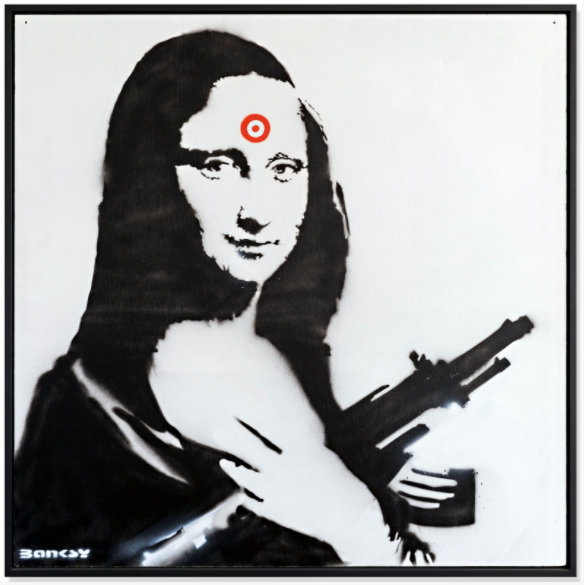
122×122 cm (48×48 inches)
The image also illustrates Banksy’s ongoing dialogue with art history. Rather than rejecting the Old Masters, he actively engages with them, appropriating familiar masterpieces to demonstrate that great art remains capable of addressing contemporary concerns. Leonardo’s painting is not diminished by this intervention; on the contrary, it is given a new voice. Banksy shows that even the most revered icons of Western culture can be reinterpreted to comment on the political realities of the twenty-first century.
Viewed within the broader context of Banksy’s anti-war oeuvre, Mona Lisa represents the collision of civilization’s greatest achievements with one of its oldest failures. Art and violence, beauty and destruction, creation and annihilation coexist within the same image, forcing us to confront the uncomfortable truth that humanity has always possessed an extraordinary capacity to produce both. The smile remains unchanged, but the weapon transforms everything. It is a powerful reminder that even our most treasured symbols of culture cannot remain untouched by the conflicts we continue to create.
The Illusions of Safety
As military technology has evolved, warfare has become increasingly distant, automated, and abstract. Few themes have fascinated Banksy more than this transformation. Throughout his career, he has repeatedly questioned the notion that modern conflict has somehow become cleaner, more humane, or more precise simply because it is conducted with increasingly sophisticated technology. Works such as Precision Bombing, Family Target, Duck & Cover, and even the unsettling installation at the Walled Off Hotel all examine the same disturbing paradox: the further we move away from the battlefield, the easier violence becomes to justify.
Precision Bombing (2000)
Created around 2000, Precision Bombing depicts a group of businessmen calmly approaching what appears to be a luxury sports car. Superimposed over the composition is the unmistakable green targeting reticle of a military guidance system, placing both the vehicle and its occupants squarely within the crosshairs. The image is striking precisely because nothing appears to be happening. There are no explosions, no soldiers, and no visible threat. Yet the viewer immediately understands that destruction is imminent.
The title refers to one of the defining concepts of modern military doctrine. Precision bombing seeks to destroy carefully selected targets while minimizing so-called “collateral damage.” Since the First World War, advances in guided missiles, laser designation, satellite navigation, and surveillance technology have transformed precision into one of the principal justifications for contemporary aerial warfare. Political leaders frequently invoke this language to suggest that modern weapons are capable of delivering violence with almost surgical accuracy.

Banksy quietly dismantles that reassuring narrative. By allowing viewers to see the world through the eyes of the targeting system itself, he transforms us into reluctant participants. We are no longer observing the scene from the ground but from the detached perspective of someone—or something—preparing to eliminate a target. Human beings cease to be individuals and become coordinates on a screen. The psychological distance created by technology becomes one of the work’s central themes.
This distance is perhaps the most profound consequence of modern warfare. Precision does not eliminate violence; it merely changes our relationship with it. The battlefield increasingly resembles a computer interface where lives are reduced to digital information, thermal images, and blinking crosshairs. Banksy suggests that technology has not only increased military accuracy but has also made destruction emotionally easier to accept. War risks becoming an exercise in logistics rather than a confrontation with human suffering.
Family Target (2003)
Banksy returned to this idea in Family Target, a deceptively simple painting depicting a conventional family portrait overlaid with the unmistakable laser targeting symbol of a guided weapon. The image is devastating in its economy. Instead of military infrastructure or enemy combatants, the crosshairs settle upon an ordinary family.

The work directly challenges the language surrounding “collateral damage.” Military planners often distinguish between legitimate targets and unintended civilian casualties through technical terminology that can appear almost clinical. Banksy strips away this bureaucratic vocabulary by forcing viewers to confront those who too often disappear behind statistics. Behind every precision strike lies the possibility of profoundly imprecise human consequences.
The painting also exposes the fragility of certainty in modern warfare. Intelligence can be flawed. Coordinates can be incorrect. Identification can fail. The reassuring promise of technological perfection remains precisely that—a promise. By placing an innocent family within the targeting system, Banksy reminds us that precision is never absolute, while the consequences of error are always irreversible.
Duck & Cover (2019)
Nearly two decades later, Banksy revisited these concerns through one of the most inventive objects produced for Gross Domestic Product. Duck & Cover consists of three decorative wall-mounted drones arranged in the familiar formation of the ceramic flying ducks that adorned countless British living rooms during the 1960s and 1970s. One of the most comforting clichés of suburban interior decoration is quietly replaced by one of the defining weapons of twenty-first-century warfare.

The transformation is both humorous and deeply unsettling. Drones have become emblematic of remote warfare, capable of conducting surveillance and delivering lethal strikes from thousands of miles away while their operators remain safely removed from the battlefield. Conflict has never been more technologically sophisticated—or more emotionally detached.
Banksy’s substitution brilliantly captures this contradiction. Like the decorative ducks they replace, the drones become ordinary household ornaments, suggesting how easily societies absorb the imagery of war into everyday life. Violence itself becomes domesticated, quietly entering our homes as another familiar object of modern design.

The work also reflects a profound ethical shift in the nature of warfare. Increasingly, those responsible for military operations no longer witness their consequences directly. Decisions capable of ending lives are made through computer screens, satellite feeds, and joystick controls from secure locations far removed from danger. Banksy asks whether this unprecedented physical distance inevitably creates moral distance as well.
The Target at the Walled Off Hotel
Banksy brings this reflection to its most provocative conclusion at the Walled Off Hotel in Bethlehem. Among the hotel’s many installations is one of its most shocking images: Jesus Christ himself is shown with the red laser sight of a sniper fixed squarely upon his forehead.
The symbolism is immediate and deeply unsettling. Few figures embody peace, forgiveness, and compassion more universally than Christ. By placing him within a sniper’s crosshairs, Banksy confronts viewers with the terrifying banality of modern targeting systems. To the weapon, identity is irrelevant. The crosshair does not distinguish between soldier and civilian, criminal and innocent, believer and sceptic. Everything that enters its field of vision becomes merely another potential target.

Positioned only a short distance from the separation wall that inspired the hotel itself, the installation acquires an even greater emotional resonance. Here, Banksy reminds us that behind every technological innovation designed to make warfare more efficient remains an unchanging moral question: who decides where the crosshairs are placed?
Taken together, Precision Bombing, Family Target, Duck & Cover, and the Walled Off Hotel installation reveal one of the central concerns running throughout Banksy’s anti-war imagery. Technology may increase the precision of weapons, but it cannot eliminate the ethical burden of using them. If anything, the greater the physical distance separating us from violence, the greater the risk that we begin to perceive war as something abstract, clinical, and almost unreal. Banksy reminds us that no matter how sophisticated the technology becomes, every target ultimately remains a human life.
Nature Drafted into Battle
When Even Animals Go to War
One of the most distinctive features of Banksy’s anti-war imagery is his recurring use of animals. Throughout his career, monkeys, elephants, rats, birds, and insects become unwilling participants in human conflicts, carrying missiles, grenades, gas masks, and other instruments of destruction. The strategy is both visually striking and philosophically profound. Nature knows neither borders nor ideology, yet it is repeatedly forced to bear the consequences of wars created exclusively by mankind. By placing animals at the centre of his anti-war imagery, Banksy reminds us that conflict never affects only those who choose to wage it.
Bird and Grenade (2002)
Among the most elegant examples of this approach is Bird and Grenade. Executed in 2002, the work depicts a small songbird flying joyfully through an idyllic countryside while carrying a live grenade delicately suspended from its beak. The image is immediately unsettling. The bird appears entirely unaware of the extraordinary danger it carries, while the weight of the grenade seems sufficient to pull the safety pin free at any moment.
The contrast could hardly be greater. Birds have traditionally symbolized peace, freedom, hope, and the beauty of the natural world. The grenade represents precisely the opposite: destruction, fear, and sudden death. By combining these two incompatible symbols, Banksy creates another of his characteristic visual paradoxes. The countryside remains peaceful, the bird continues its effortless flight, yet catastrophe appears permanently imminent.

The work echoes the emotional power of Bomb Love. In both images, innocence unknowingly embraces the very object capable of destroying it. Banksy suggests that violence often infiltrates the most ordinary and beautiful aspects of life, not through dramatic confrontation but through quiet normalization. The bird continues to sing, unaware that its own burden may become its undoing.
More broadly, Bird and Grenade reminds us that war extends far beyond the battlefield. Explosions destroy ecosystems, displace wildlife, contaminate landscapes, and leave scars that often remain visible for generations. Nature itself becomes another silent casualty of human conflict.
Dumbo (2014)
More than a decade later, Banksy revisited this theme through one of his most unexpected anti-war works. Created during his Better Out Than In residency in New York, Dumbo depicts Disney’s beloved flying elephant lying wounded and disoriented after being shot from the sky. Around him, armed extremists celebrate their apparent victory while a small child quietly kicks one of the militants in an act of simple but deeply symbolic resistance.
The image originates from Banksy’s short film Rebel Rocket Attack, released online in 2014. The animation depicts Islamist fighters using rocket launchers to bring down Dumbo before triumphantly posing around the fallen character. Banksy later transformed this moving image into an exceptionally rare hand-painted screenprint.

The choice of Dumbo is particularly inspired. Created by Walt Disney in 1941, Dumbo has become one of the most universally recognized symbols of innocence, childhood, and American popular culture. Banksy transforms this harmless fictional elephant into a metaphor for Western intervention in the Middle East. Rather than representing military hardware directly, he substitutes one of America’s most beloved cultural exports, exposing how cultural identity and geopolitical conflict have become increasingly intertwined.
Yet, as always, Banksy’s true sympathy lies with innocence rather than ideology. Dumbo is neither soldier nor politician. He simply becomes another victim caught in a conflict that he neither understands nor controls. Even the final gesture of the young child carries enormous significance. Unlike the armed adults celebrating violence, the child instinctively rejects it. Hope, Banksy seems to suggest, often survives where innocence remains intact.
Mosquito (2002)
Created in 2002, Mosquito offers one of Banksy’s most surreal and intellectually playful reflections on militarism. The composition depicts an oversized mosquito wearing a military-style gas mask, flying against a background composed of repeated portraits of Queen Elizabeth II—herself also wearing a gas mask. The royal image is instantly recognizable, having later served as the basis for Monkey Queen, creating another subtle connection within Banksy’s wider visual vocabulary.
The mosquito itself appears transformed into an airborne combatant. Its enlarged wings, aggressive posture, and military equipment suggest an insect prepared for battle. Yet Banksy’s humour quickly overturns this expectation. A mosquito survives by feeding on blood. By covering its mouth with a gas mask, the artist equips it with precisely the one object that prevents it from carrying out its natural function. The soldier has become incapable of fighting.

This elegant visual contradiction illustrates one of Banksy’s recurring observations about militarization itself. Weapons, uniforms, and protective equipment often symbolize strength, yet they can also reveal the absurdity of systems built upon perpetual preparation for conflict. The mosquito appears intimidating, but its own equipment renders it strangely powerless.

The repeated image of Queen Elizabeth introduces another dimension to the work. Throughout Banksy’s oeuvre, the monarchy frequently serves as a symbol of institutional authority and state power. By placing the gas mask upon both monarch and insect alike, Banksy subtly blurs the distinction between political authority and military machinery, suggesting that violence often becomes embedded within the very institutions responsible for protecting society.
Like many of Banksy’s animal works, Mosquito also invites viewers to reconsider humanity’s relationship with the natural world. Animals possess no political ambitions, no national identities, and no ideological conflicts. Yet in Banksy’s universe they repeatedly inherit the symbols of warfare created by human civilization. The mosquito, like the elephant carrying a missile or the bird transporting a grenade, becomes another unwilling participant in mankind’s endless conflicts.
Taken together, Bird and Grenade, Dumbo, and Mosquito reveal a recurring theme that runs throughout Banksy’s anti-war imagery. War does not simply transform cities, governments, or political borders. It distorts our entire relationship with the living world, projecting human violence onto creatures that know nothing of our ambitions or divisions. Through these remarkable animal allegories, Banksy quietly reminds us that conflict is never confined to those who wage it. Its consequences spread far beyond the battlefield, reaching landscapes, ecosystems, cultures, and every form of life unfortunate enough to exist in its path.
Art on The Front Line
For much of his career, Banksy’s anti-war imagery existed primarily within the realm of symbolism. Bombs became toys, helicopters wore ribbons, birds carried grenades, and monkeys inherited the follies of mankind. His works commented on conflict from a philosophical distance, using satire and visual paradox to expose the absurdity of violence. In Ukraine, however, that distance disappeared. For the first time, Banksy found himself creating anti-war art directly upon the ruins of an active war zone.
In November 2022, several months after Russia’s full-scale invasion of Ukraine, Banksy secretly travelled across the country, leaving a series of murals in Kyiv, Irpin, Borodyanka, Hostomel, and other towns devastated by the fighting. Rather than producing a single monumental statement, he created a constellation of images scattered throughout damaged buildings, shattered apartment blocks, and bombed streets. The walls themselves became witnesses. Unlike the pristine gallery spaces that traditionally preserve works of art, these murals were painted directly onto the physical scars left by war.
Among the most celebrated of these works is the gymnast balancing effortlessly atop the fractured remains of a bombed building in Borodyanka. The image immediately conveys resilience. Surrounded by destruction, the young athlete performs with extraordinary grace, transforming the ruins into an improvised stage. Beauty emerges not despite devastation but directly from it. It is one of Banksy’s most optimistic images, suggesting that the human spirit possesses an extraordinary capacity to endure even the darkest circumstances.
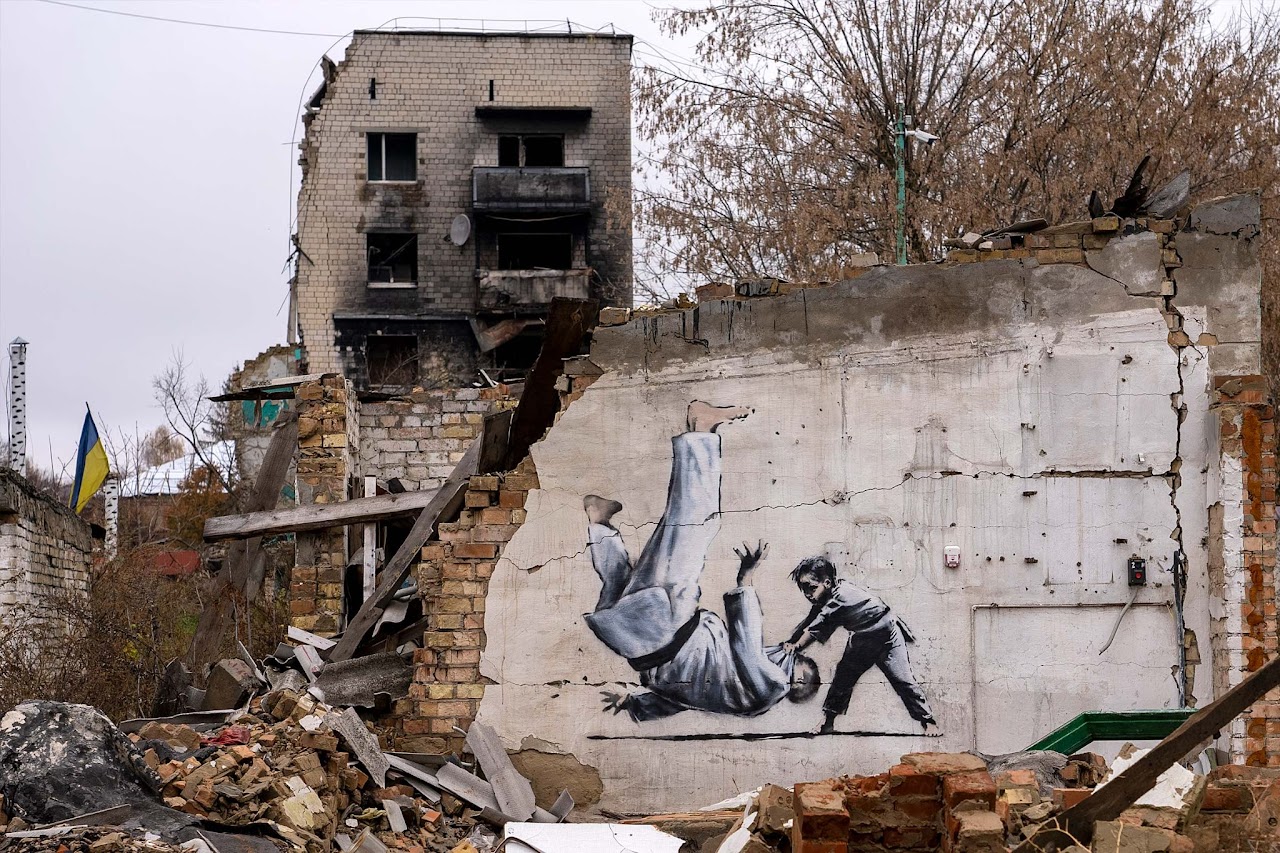
Nearby, another mural depicts a young boy effortlessly throwing an adult man to the ground during a judo match. The symbolism was widely understood. Vladimir Putin has long cultivated an international image based upon his black belt in judo and carefully staged displays of masculine strength. Banksy’s reversal transforms this carefully constructed mythology into an image of vulnerability, allowing a child—standing in for Ukraine itself—to overcome an apparently superior opponent through determination rather than brute force.
Elsewhere, children appear once again at the centre of Banksy’s visual language. On damaged walls, young gymnasts, playful figures, and ordinary civilians reclaim spaces transformed by violence. This emphasis is entirely consistent with his wider oeuvre. Throughout his career, children have represented hope, innocence, and moral clarity. In Ukraine they acquire an additional significance: they become symbols of national survival itself. The future literally continues to play among the ruins.
Unlike many war artists before him, Banksy avoids depicting battle directly. There are no soldiers engaged in combat, no explosions, no scenes of bloodshed. Instead, he focuses upon what remains after the violence has passed: broken architecture, fractured communities, and the quiet resilience of those who continue living within them. His attention shifts from military events to human endurance.
This approach places Banksy within a long tradition of artists responding to conflict, while simultaneously distinguishing his contribution. Francisco Goya revealed the horrors inflicted upon civilians during the Peninsular War. Otto Dix exposed the psychological trauma left by the First World War. Pablo Picasso immortalized the destruction of Guernica through monumental allegory. Banksy, by contrast, works directly within the landscape of destruction itself. His murals do not merely represent war; they physically inhabit it.
The choice of street art is especially significant. Murals cannot be separated from their surroundings. They belong to the damaged walls on which they are painted, absorbing the cracks, bullet holes, and shattered concrete into their own composition. In Ukraine, the buildings themselves become part of the artwork, collapsing the distinction between artistic representation and historical reality. The city is no longer simply the subject of the work—it is its canvas.
The response from local communities further distinguishes these murals from traditional public art. Rather than removing them, Ukrainian authorities took extraordinary measures to preserve many of the works, carefully protecting fragments of damaged buildings so they could survive reconstruction. In doing so, Banksy’s interventions became part of the country’s collective memory, functioning simultaneously as works of art, historical documents, and symbols of resistance.
The Ukraine murals also reveal an important evolution in Banksy’s practice. Earlier anti-war works often relied upon irony, humour, and visual contradiction. In Ukraine, those elements remain present, but they are accompanied by an unmistakable sense of empathy. Satire gives way to solidarity. Rather than observing conflict from afar, Banksy places himself among those living through it, allowing art to become an act of witness as much as an act of protest.
Taken together, the murals represent the culmination of more than two decades of reflection on war. The themes explored in Bomb Love, Happy Choppers, CND Soldiers, and Precision Bombing all converge upon the streets of Ukraine, where the abstract questions raised by those earlier works become immediate human realities. Here, Banksy reminds us that the true purpose of anti-war art is not merely to criticize violence, but to affirm humanity in the midst of it. Even when cities crumble and walls collapse, art continues to speak. Sometimes, it speaks most powerfully from the ruins themselves.
