Authority, Absurdity, and the Collapse of Power
‘Celebrate the fact the highest position in British society is not a reward for talent or hard work, but simply handed out with the accident of birth. God Save The Queen.’
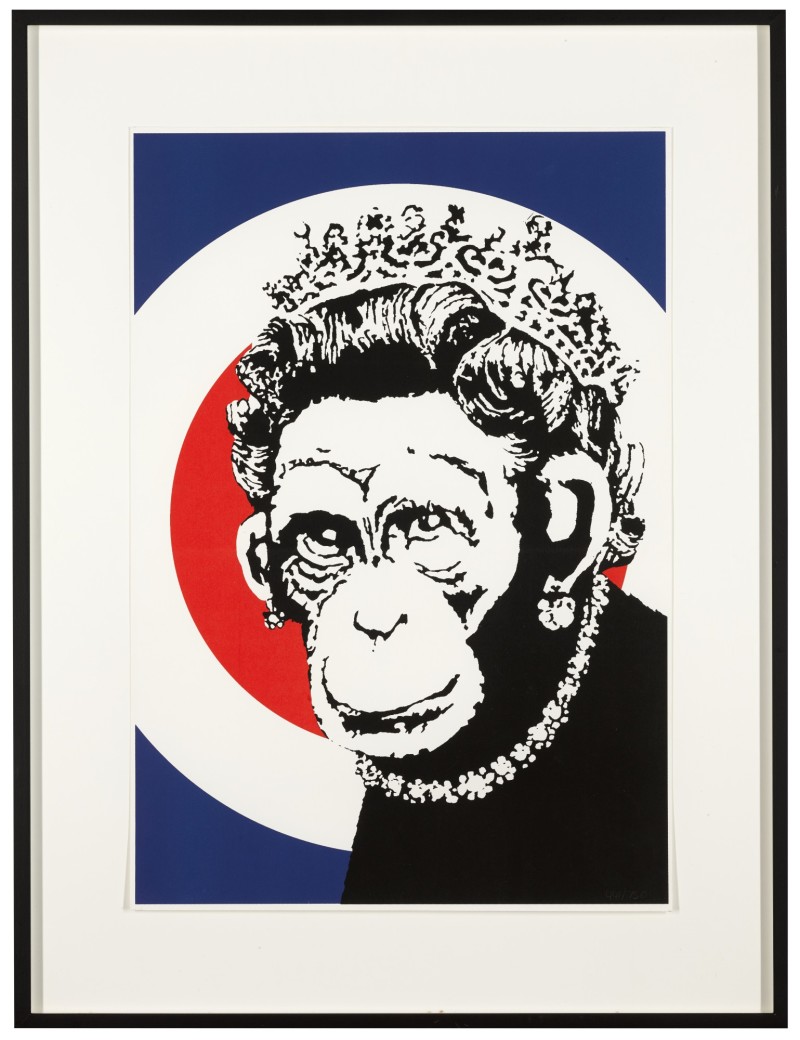
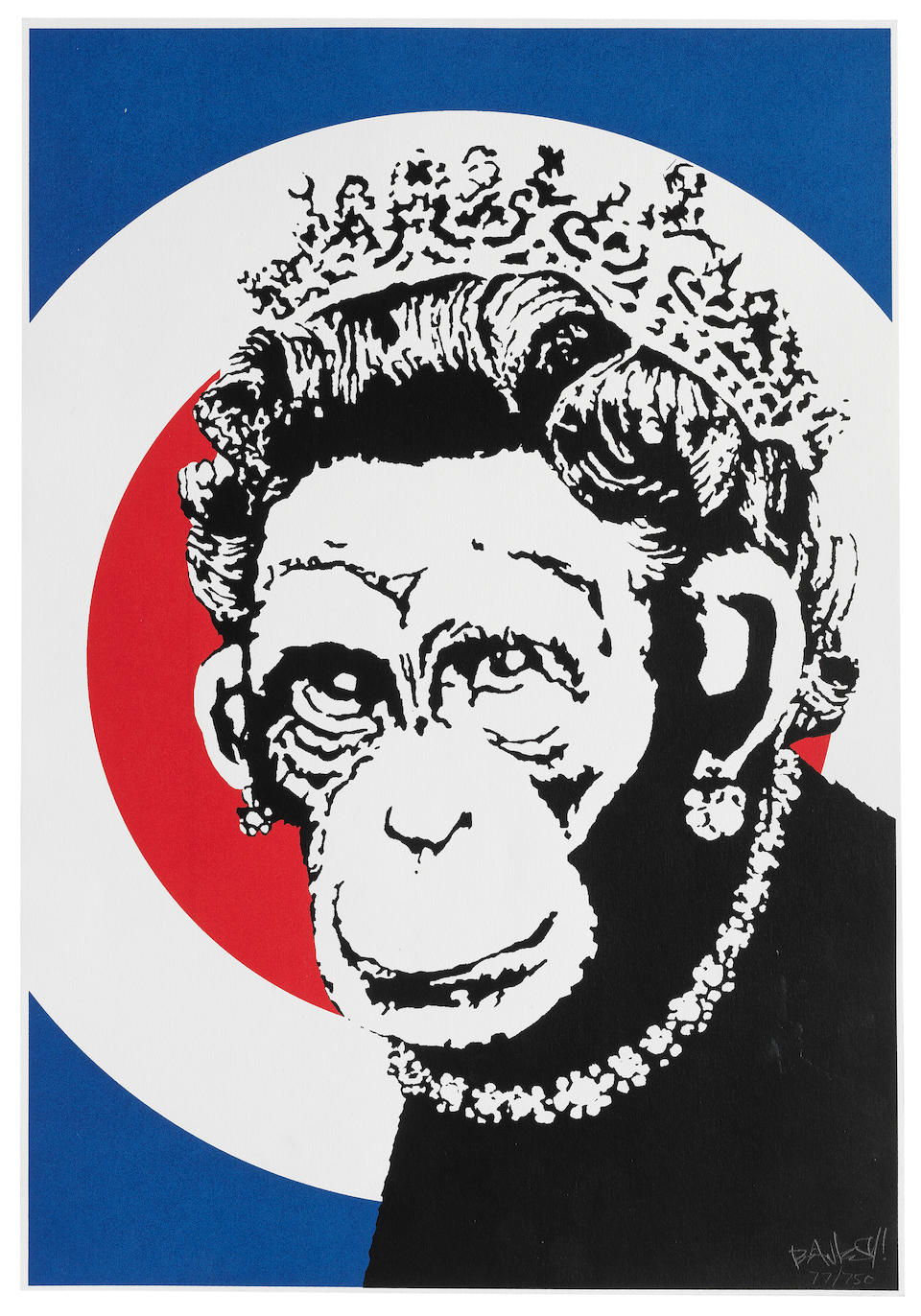
Few images in Banksy’s oeuvre capture the artist’s dry, unmistakably British sense of humor as effectively as Monkey Queen. By replacing one of the most enduring symbols of authority with a figure of absurdity, Banksy delivers a critique that is at once playful, unsettling, and quietly subversive. Monkey Queen is one of Banksy’s most iconic early prints, exemplifying his ability to undermine established systems of power through deceptively simple imagery. By appropriating the format of a traditional royal portrait and substituting the figure of Queen Elizabeth II with a chimpanzee, Banksy constructs a sharp commentary on authority, hierarchy, and national identity. The work stands as a defining example of his use of satire to challenge deeply embedded cultural symbols.
A Familiar Portrait, Unsettlingly Altered
The composition closely mirrors the visual conventions of official royal portraiture. The figure is presented in profile, adorned with ceremonial attire, including crown and regalia: elements that immediately signal power, continuity, and institutional authority.

Yet the substitution is immediate and jarring: the Queen’s face is replaced by that of a chimpanzee. Rendered in Banksy’s stark stencil style, the image retains the dignity of the original format while simultaneously undermining it. The result is a visual tension between reverence and ridicule, where the structure of power remains intact, but its legitimacy is called into question.

Executed using Banksy’s signature stencil technique, Monkey Queen achieves a clean, graphic clarity that reinforces its immediate impact. The restrained palette and sharp contrasts allow the image to function almost like a printed emblem: direct, reproducible, and instantly recognizable. The translation into screenprint further amplifies this effect. By moving from street to edition, the work adopts the very mechanisms of replication it often critiques, allowing the image to circulate widely while maintaining its visual integrity.
Satire, Monarchy, and the Fragility of Authority
At its core, Monkey Queen operates through substitution. By replacing a revered figure with an animal, Banksy does not attack the institution directly; instead, he exposes its constructed nature. Authority, the work suggests, relies as much on perception and symbolism as it does on legitimacy. The use of the monkey, a recurring motif in Banksy’s work—introduces an additional layer of meaning. Monkeys often serve as stand-ins for human behavior, reflecting hierarchy, imitation, and absurdity. In this context, the image becomes less about the individual figure of the Queen and more about the systems that sustain power itself.

The critique is subtle but effective. Rather than confronting authority head-on, Banksy destabilizes it through humor, allowing the viewer to question what is being represented—and why it is accepted.
Monkey Queen has become one of Banksy’s most enduring and recognizable images, emblematic of his early exploration of authority and identity. Its clarity, humor, and immediacy have ensured its continued relevance, both within the art world and in broader popular culture. More broadly, Monkey Queen encapsulates a central aspect of Banksy’s practice: the ability to challenge powerful institutions not through confrontation, but through the precise and disarming use of satire.


Description
Monkey Queen
Year: 2003
Edition
Total Edition: 750 (of which 150 signed)
Signature and Numbering
Numbered /750 in pencil, either lower right, or lower left
Signed in black ink or pencil, either left or right
Some with, others without publisher’s blindstamp

Auction Results
PLEASE CLICK BELOW FOR AUCTION RESULTS