Affection in the Margins
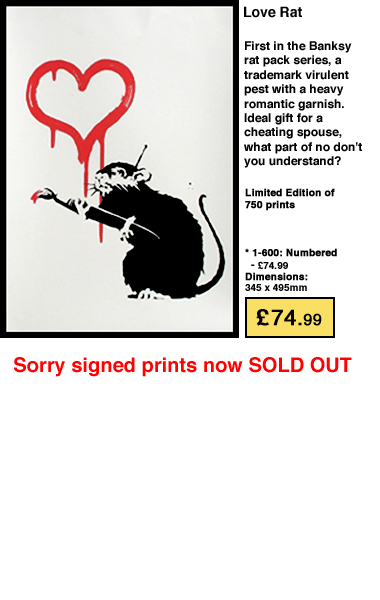
“First in the Banksy rat pack series, a trademark virulent pest with a heavy romantic garnish. Ideal gift for a cheating spouse.
What part of no don’t you understand?”
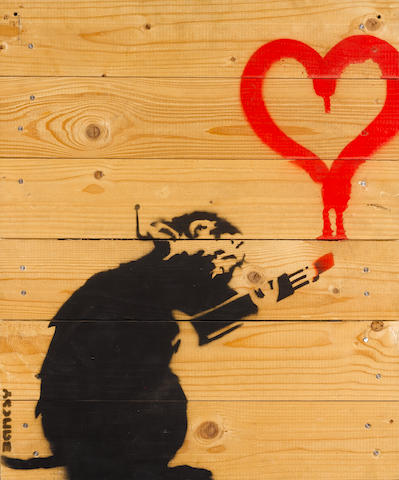
Created in 2004, Love Rat is one of the earliest and most enduring expressions of Banksy’s rat motif, where the artist’s alter ego intersects directly with one of the most universal symbols: the heart. In this work, affection is not idealized or elevated. It is grounded, immediate, and placed firmly within the language of the street.
Introduction
The Image: A Rat and a Painted Heart
The composition is striking in its simplicity. A small black rat, rendered in Banksy’s stencil style, stands in profile against a blank background. Its body is compact, its posture alert, its tail extending behind it in a loose curve. In front of the rat, a large red heart is painted directly onto the surface. The paint is visibly dripping, with elongated runs falling downward, emphasizing the immediacy of the gesture. The edges of the heart are uneven, more sprayed than drawn, reinforcing its graffiti origin. The rat faces the heart closely, almost touching it. The relationship between the two elements defines the entire image. Nothing else is needed.

The heart is one of the most recognizable symbols in visual culture, typically associated with sentiment, intimacy, and idealized affection. Banksy strips it of refinement. Here, the heart is not clean or polished. It is sprayed, imperfect, and transient. The drips suggest urgency rather than care, as if the act of painting mattered more than the result. This tension between the universality of the symbol and the roughness of its execution is central to the work. Love is present, but it is not protected. It exists in the open, exposed.
The Rat as Witness
The rat functions as a surrogate figure. Small, overlooked, and persistent, it occupies the margins of the urban environment. In Love Rat, the figure is positioned not as an aggressor but as an observer. It stands in front of the heart, engaging with it quietly. There is no irony in its stance, no overt disruption. Instead, there is a form of recognition. The rat does not alter the symbol. It acknowledges it.

The work brings together two opposing visual languages. On one side, the softness of the heart, loaded with cultural meaning. On the other, the raw immediacy of graffiti, associated with illegality and ephemerality. Banksy does not resolve this opposition. He allows both to coexist. The result is a form of affection that is not detached from reality, but embedded within it. As with much of his early work, the emotional register remains accessible, but never simplistic.
Within Banksy’s oeuvre, Love Rat remains one of the most recognizable and widely appreciated images. Its strength lies in its simplicity, but also in its ability to carry multiple readings without forcing any single interpretation. It is at once direct and open. At first glance, one thinks this act is intended to spread love. However, the blood-red paint drip painting implies that the heart is in fact bleeding, reminding us of love’s potential to induce pain and suffering as well as joy and pleasure. Indeed, Banksy promoted the release of this first of his 2004 rat prints as an ideal gift for a “cheating spouse”.
Description
Love Rat
Editions
Signed Edition: 150
Unsigned Edition: 600