“They say youth is wasted on the young but sitting on your ass all day
eating mints and watching telly seems wasted on the elderly.
Here’s a picture of two old dears knitting themselves a sweater.”
Created in 2006, Grannies is one of Banksy’s most deceptively gentle images: an artwork that replaces confrontation with quiet sabotage. Released in the context of his landmark Los Angeles exhibition Barely Legal, the work captures a familiar domestic scene only to undermine it with surgical precision. There is no aggression here, no visible anger. Only patience—and a message stitched carefully into place.
Introduction
The Scene: Tradition at Work
Two elderly women sit side by side, absorbed in their knitting and drinking tea. They seem very pleased of themselves, smiling, most probably talking, exchanging good memories, and knitting for their grandchildren. However, on closer inspection, the text emblazoned in block-capitals across the jumpers are unlikely slogans: “PUNK’S NOT DEAD” and “THUG FOR LIFE”. They stand in stark contrast to the gentleness of the figures producing them. The figures are rendered with soft tonal transitions, while the typography is bold, immediate, and impossible to ignore. They both appear to be quietly pleased with themselves, as they fly in the face of cultural norms, and share such an act of rebellion.

Banksy constructs the image through contradiction. On one side, the visual language of tradition: elderly figures, knitting, domestic calm. On the other, the vocabulary of rebellion, drawn from subcultures associated with youth, defiance, and resistance. This collision is not explosive. It is controlled. The strategy recalls, in a distant way, the recontextualization of language seen in the work of Barbara Kruger, yet Banksy removes the graphic aggression. Here, the message is not shouted: it is patiently assembled.
Who Owns Rebellion?
The tension in Grannies lies in its inversion of expectation. The slogans, historically tied to urgency, anger, and youth culture, are here produced slowly, methodically, almost lovingly. What was once immediate becomes deliberate. What was once loud becomes quiet. Banksy suggests that rebellion itself may be absorbed, repackaged, and domesticated. The radical becomes decorative. The slogan becomes pattern.

And yet, the work resists cynicism. There is humor here, but also a subtle respect for the persistence of message: even when its form changes. The figures are rendered with a softer tonal quality, closer to photographic reproduction than raw street stencil. This refinement is deliberate. It reinforces the calmness of the scene, allowing the text to carry the disruption. The balance between image and typography is precise, neither overwhelms the other, yet the tension between them drives the entire composition. Rendered in Banksy’s signature black and white stencil style, the pair is set against a block pink background, which juxtaposition serves to heighten the humorous contradiction between scene and message, a technique mastered by the artist.

Within Banksy’s oeuvre, Grannies stands apart for its restraint. It does not rely on shock, violence, or overt political imagery. Instead, it operates through inversion: placing radical language within the most conservative of settings. The result is a work that feels both humorous and quietly unsettling, its critique unfolding gradually rather than immediately. They sit calmly, focused on their work, each stitch deliberate and precise. The message emerges slowly, line by line: proof that even rebellion, when handled with care, can be woven into something enduring.


Obviously, it can also be seen as a metaphor for how artists also impact the world, not through any kind of violence, but simply by creating artworks that are shared with a wide public. On the flip side, it has also been suggested that the picture represents the gentrification of counter-culture into a tame, mainstream movement suitable even for grannies.
Barely Legal
Grannies was released in the immediate orbit of Barely Legal, Banksy’s defining 2006 exhibition in Los Angeles. The show marked a decisive moment: a street artist entering the global art stage while maintaining full control over his message.

Description
Grannies
Year: 2006
Editions
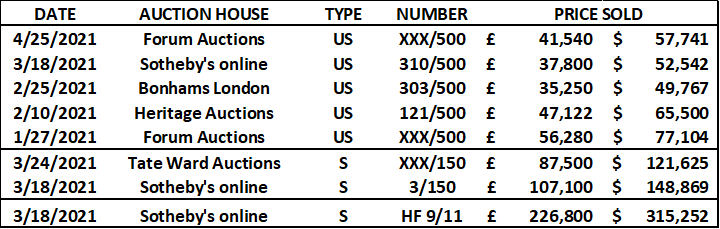
Signed Edition: 150
Unsigned Edition: 500
Hand-Finished Edition: 11 signed
Auction Results
PLEASE CLICK BELOW FOR AUCTION RESULTS