Cueing the Spectacle of War
“Ladies and gentlemen, please put your hands together for a print named APPLAUSE. This is taken from a Banksy sketch that frankly is a good deal more interesting than the painting ended up being. Kind of sexy, kind of smart, kind of sarcastic in a way you can afford to be if you’ve never spent six months floating in a giant tin can getting herpes defending the good name of queen and country.”
Created in 2006, Applause is one of the most incisive works to emerge from Banksy’s Barely Legal period. The image borrows from the language of military power but redirects it toward something far more unsettling: the transformation of conflict into spectacle. What should provoke tension is instead met with instruction: when to respond, and how.
Introduction
The Scene: A Fighter Jet on an Aircraft Carrier
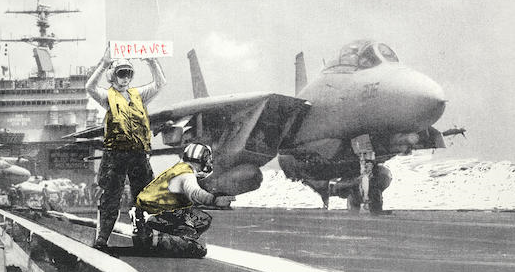
The composition centers on a fighter jet positioned on the deck of an aircraft carrier, viewed frontally. Its angular structure dominates the scene, projecting force, speed, and control. Flanking the aircraft stand two ground crew members, dressed in high-visibility yellow vests, performing the standardized gestures used to guide and prepare a jet for launch. Their stance is symmetrical, almost ceremonial, reinforcing the impression that the aircraft is being presented rather than deployed.

The image is rendered primarily in monochrome, with two striking interruptions: the bright yellow vests and a bold red sign reading “APPLAUSE.” That sign does not belong to the military setting. It belongs to performance. The red APPLAUSE sign transforms the entire scene. Borrowed from the vocabulary of television studios and live entertainment, it signals to an audience when to respond. In this context, it suggests that even an image of military force can be framed, timed, and consumed like a show. The implication is direct: reaction is no longer spontaneous. It is orchestrated.
War, Edited for the Audience
By combining a fighter jet with the mechanics of staged applause, Banksy points to the way modern conflict is presented to the public: filtered, packaged, and repeated until it becomes familiar. The work echoes the visual culture of the early 2000s, where images of military power circulated widely across media channels, often detached from their human consequences. As your page suggests, the reference to highly staged political imagery: such as presidential arrivals on military aircraft—reinforces this idea of war as performance.

What is being launched here is not just a jet, but an image. The restrained palette is deliberate. By limiting color to key elements, the vests and the sign, Banksy directs attention with precision, ensuring that the conceptual shift is immediate and unmistakable. Within Banksy’s oeuvre, Applause stands out for its clarity. There is no need for excess narrative or symbolism. The image operates through a simple displacement: inserting the language of entertainment into a scene of military preparation. The result is not exaggerated. It is precise and therefore more unsettling.

This work illustrates the media’s attempt to often simplify and transform serious and violent themes in the news into entertainment to increase its audience. We live in a world in which images of aggression are communicated 24 hours a day through television and/or social media, dramatic events have become a form of amusement and entertainment – and this had led to the public becoming desensitized to violence.
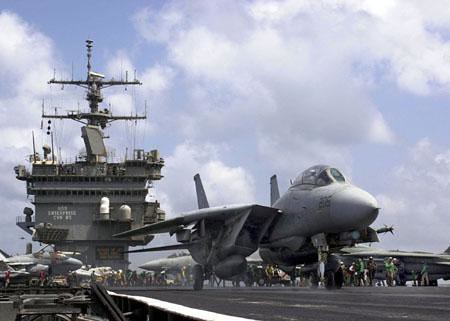
It is also perhaps alluding to a show filmed in front of a live studio audience in which there are people that hold up signs telling people when and how they should react. Banksy suggests we are being controlled by media and told exactly when and how and how we should react to something as heavy as warfare. Banksy used a well-known image of former US President George W. Bush deplaning a military Bomber for this print.
Barely Legal
Held in 2006 in a converted warehouse in Los Angeles, the exhibition marked a decisive turning point in Banksy’s career. It was not simply a show—it was a carefully orchestrated environment in which spectacle, media attention, celebrity presence, and critique coexisted. The most infamous installation featured a live elephant painted to match the wallpaper of a Victorian living room, a direct and controversial metaphor for ignored global issues. The exhibition drew collectors, actors, journalists, and institutions, transforming a street artist into a global phenomenon almost overnight.
But Barely Legal was never neutral. It was a critique disguised as an event. Within this context, Applause functions almost like a distillation of the entire exhibition. It does not depict the artwork. It depicts the mechanism around it: the audience, the reaction, the validation.
Description
Applause
Year: 2006
Editions
Auction Results
PLEASE CLICK BELOW FOR AUCTION RESULTS