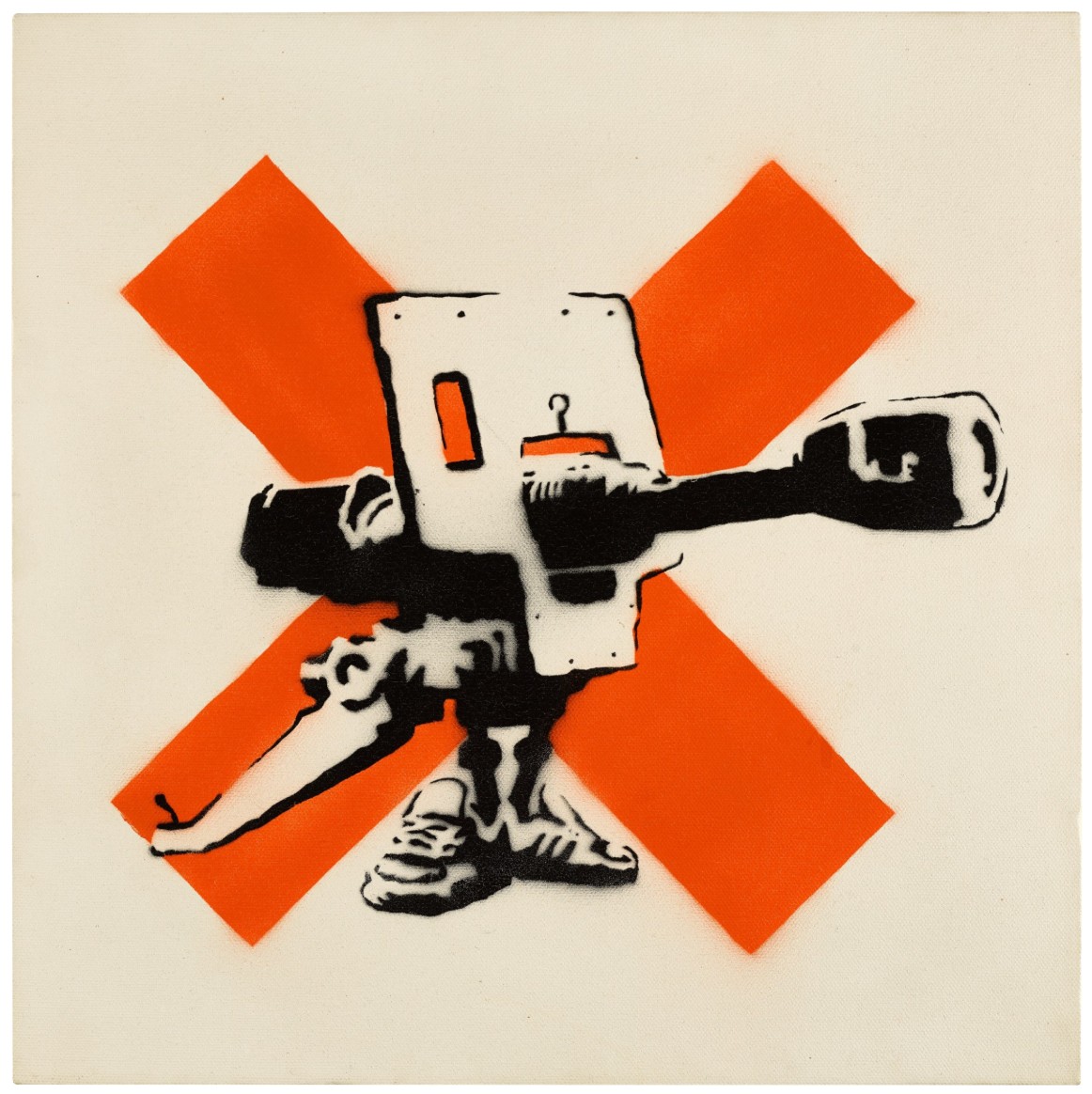
BANKSY (b. 1974)
Bad Meaning Good, 2002
Acrylic and spray paint on canvas
40.9 x 40.6 cm (16 1/8 x 15 7/8 inches)
Stenciled with the artist’s name on the overturn edge
Opera Gallery, New York
Acquired from the above by the present owner
Auction History
| Sotheby’s London 26 March 2021 Est.: GBP 150,000 – 200,000 |
Price Realized
GBP 277,200 / USD 382,000 |
Catalogue Note
Created in 2002 for the first volume of the Bad Meaning Good compilation, Bad Meaning Good belongs to a pivotal moment in Banksy’s development, when the artist was beginning to transform commercial commissions into fully fledged works of political art. Rather than merely illustrating an album cover, Banksy appropriated its title as a visual paradox: can something inherently violent ever become “good” simply because culture tells us so?
The answer arrives in the form of an anthropomorphic machine gun. Standing upright on oversized trainers, the weapon appears strangely alive, almost childlike, its threatening silhouette undermined by an absurd pair of sneakers. Banksy performs a subtle inversion: instead of giving a human a weapon, he gives the weapon human attributes. Violence itself acquires a personality.
This strategy recurs throughout Banksy’s early oeuvre. Tanks wear bunny ears, riot police smile behind yellow emoticons, military vehicles embrace beneath dripping hearts, and surveillance cameras sprout legs. Rather than depicting violence as an abstract political force, Banksy repeatedly domesticates it, exposing how easily society accepts instruments of oppression once they are wrapped in the language of entertainment, advertising, or popular culture.
“I’ve done a few things to pay the bills, and I did the Blur album. It was a good record and [the commission was] quite a lot of money. I think that’s a really important distinction to make. If it’s something you actually believe in, doing something commercial doesn’t turn it to shit just because it’s commercial. Otherwise you’ve got to be a socialist rejecting capitalism altogether, because the idea that you can marry a quality product with a quality visual and be a part of that even though it’s capitalistic is sometimes a contradiction you can’t live with. But sometimes it’s pretty symbiotic, like the Blur situation.”
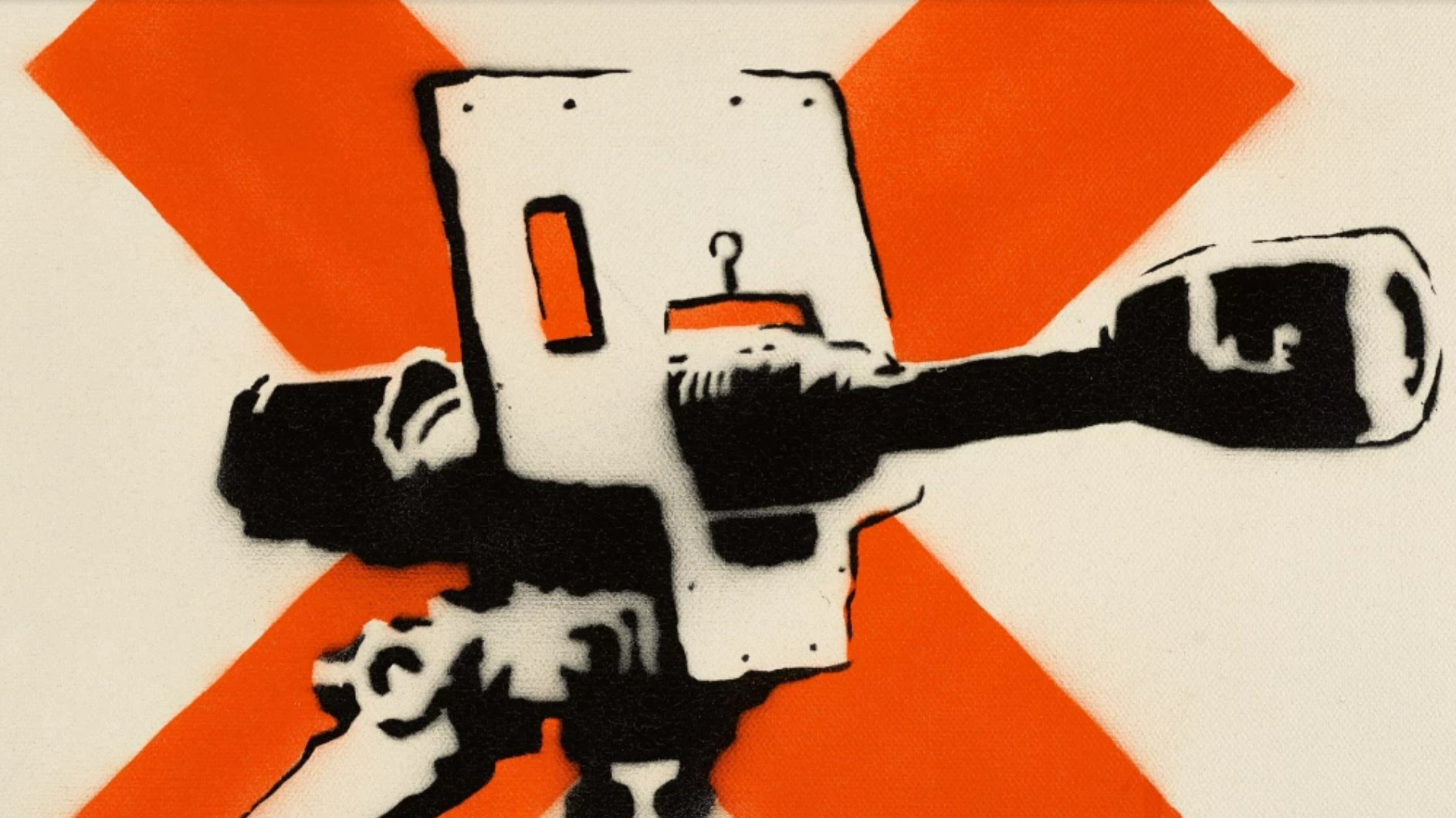
The bold orange cross behind the figure reinforces this ambiguity. It simultaneously evokes a warning sign, a target, a graphic design element and an erased mark—as though the weapon has already been condemned even as it is being celebrated. Banksy leaves the contradiction unresolved. Is the X cancelling violence, or elevating it into an icon?
Produced during a period in which Banksy was designing record sleeves for musicians such as Blak Twang and later Blur, Bad Meaning Good demonstrates how effortlessly he blurred the boundaries between street art, graphic design, and contemporary painting. Even within a commercial commission, he refused to abandon satire, quietly smuggling anti-authoritarian commentary into popular culture.

Ultimately, Bad Meaning Good is less about the machine gun than about our relationship with it. Banksy suggests that the greatest danger is not violence itself, but our extraordinary ability to normalize it. Give a weapon a pair of trainers, a catchy title, and an attractive graphic identity, and it begins to resemble something familiar—even likable. It is precisely at that moment, Banksy implies, that satire becomes most necessary.
Between 2002 and 2003, Banksy designed four album covers for the Bad Meaning Good music compilations. Created from tracks chosen by different artists and recorded on CD and vinyl, these compilations range from electronic and hip-hop, to jazz, rock, funk and reggae
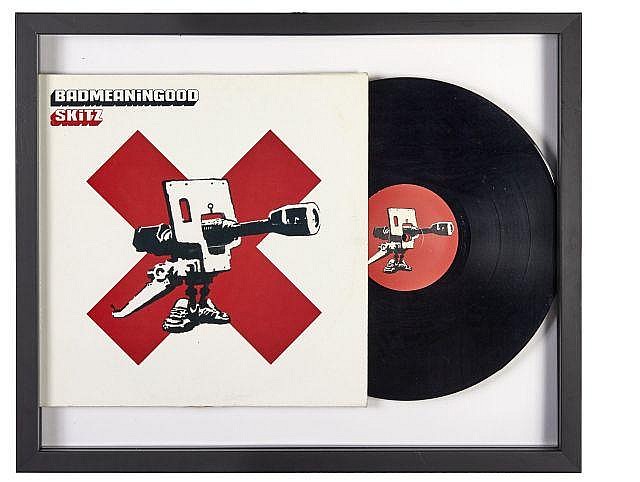
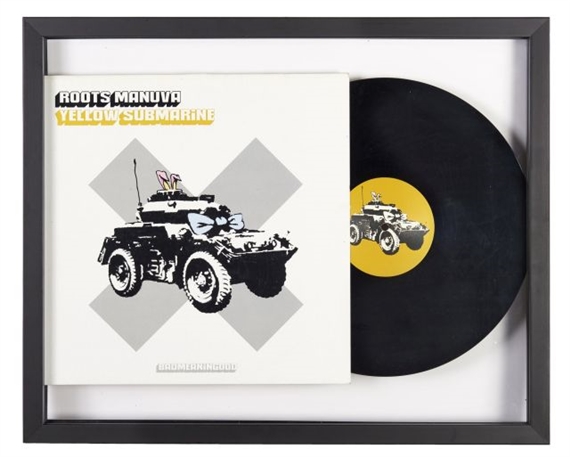

Badmeaninggood, 2002
Acrylic and spray paint on canvas
40×40 cm (15 3/4 x 15 3/4 inches)
Stenciled with the artist’s name on the overturn edge
Signed and numbered 1/4 on the reverse
This work is number 1 from an edition of 4
Provenance
Private Collection (acquired from the artist)
Sotheby’s, London, Contemporary Art, 20 October 2008, Lot 324
Acquired from the above by the present owner
Auction History
| Sotheby’s London 9 March 2017 Est.: GBP 30,000 – 40,000 |
Price Realized
GBP 93,750 / USD 114,035 |
| Sotheby’s London 20 October 2008 Est.: GBP 15,000 – 20,000 |
Price Realized
GBP 26,250 / USD 44,975
|