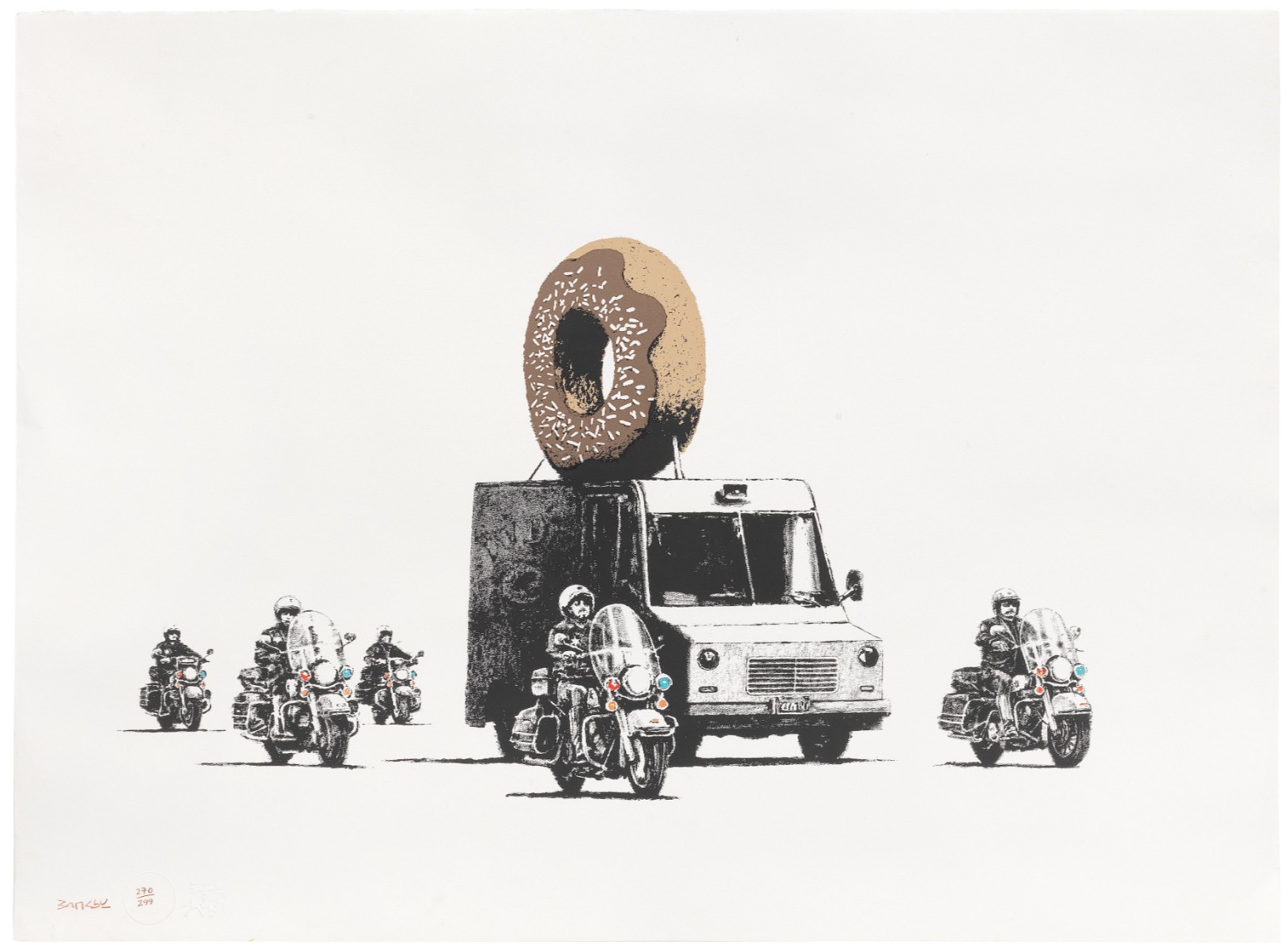
Donut
Editions
Donut (Strawberry): 299 signed
Donut (Chocolate): 299 signed
Hand-finished Edition: 25 signed hand-finished
Signature and Numbering
Donut (Strawberry)
Signed and numbered /299 in pink crayon with the publisher’s blindstamp, lower left
Donut (Chocolate)
Signed and Numbered /299 in brown crayon with the publisher’s blindstamp, lower left


With Donut, Banksy delivers a work that is at once humorous and deeply unsettling. At first glance, the image appears almost absurd: a large donut being carefully transported by police officers. Yet, as often in Banksy’s visual language, the absurd is never incidental. It is constructed with precision to expose a deeper imbalance between authority, value, and common sense.
The Policing of the Trivial
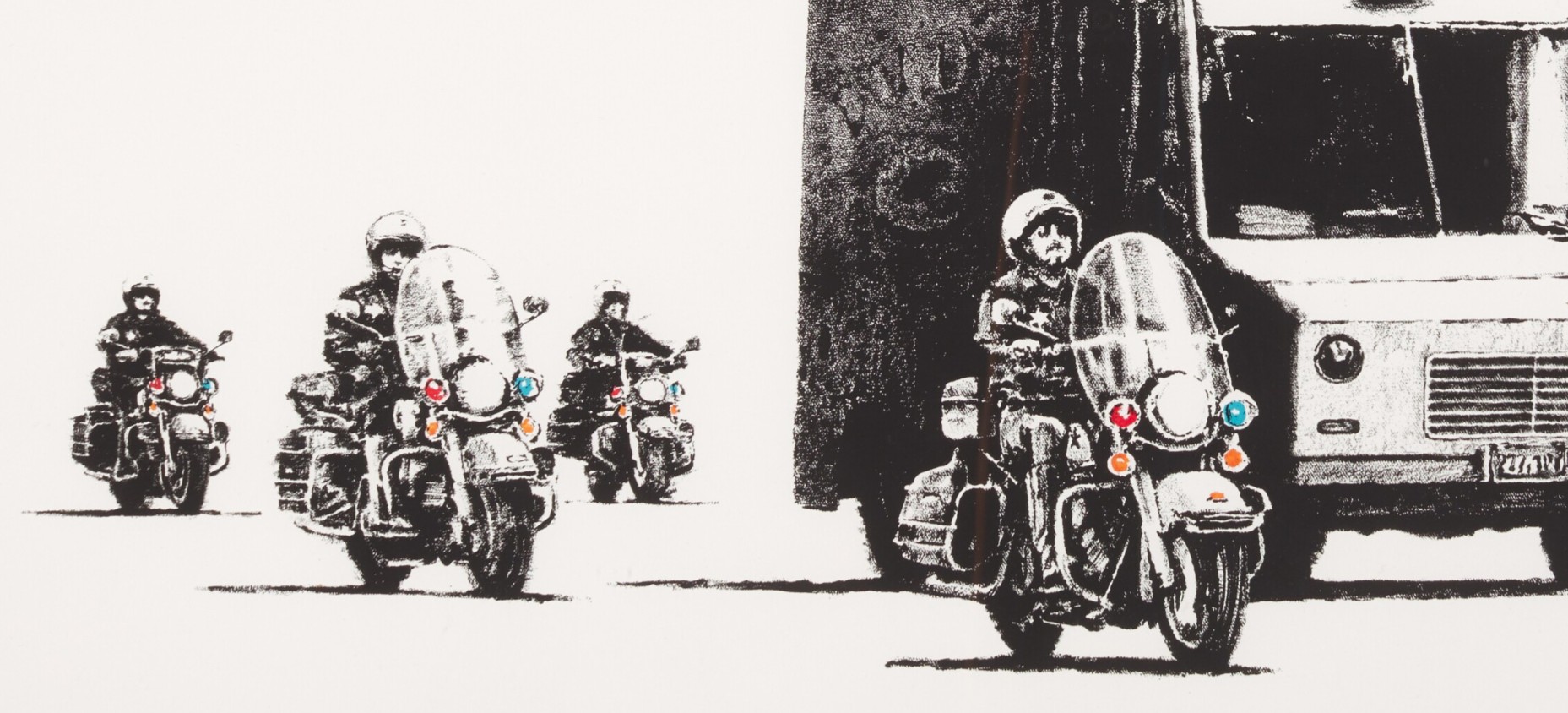
The composition presents a group of uniformed police officers engaged in the careful handling of a large donut. The scene is rendered with an exceptional level of detail, making it arguably one of Banksy’s most intricate and visually precise prints.
Each figure is meticulously constructed. The folds of the uniforms, the positioning of the hands, the coordinated movement of the group, all contribute to a sense of discipline and control. The donut itself, despite its simplicity as an object, becomes a central sculptural presence, balanced within the composition with almost ceremonial care.
There is a quiet choreography at play. The officers do not rush; they execute. Their posture suggests procedure, protocol, and collective focus. The entire scene is composed with a clarity that elevates it beyond satire into something almost formal. And yet, at the center of this precision: a donut.
The humor in Donut is subtle and controlled. The image invites an initial reaction of amusement, but it does not rely on exaggeration or caricature. Instead, it maintains a level of seriousness that enhances the absurdity of the situation. This restraint is essential. By refusing to overstate the joke, Banksy allows the viewer to arrive at the realization independently. The humor fades quickly, leaving behind a more analytical engagement with the image.
Donut occupies a distinctive position within Banksy’s body of work. It may not be his most immediately iconic image, but it stands out for its technical refinement and conceptual clarity. The work demonstrates his ability to move beyond simple visual impact and engage with more complex compositions. Its relevance remains strong. The image speaks to environments in which systems operate with efficiency and discipline yet remain disconnected from meaningful priorities. It captures a condition that extends far beyond the specific subject of the work.
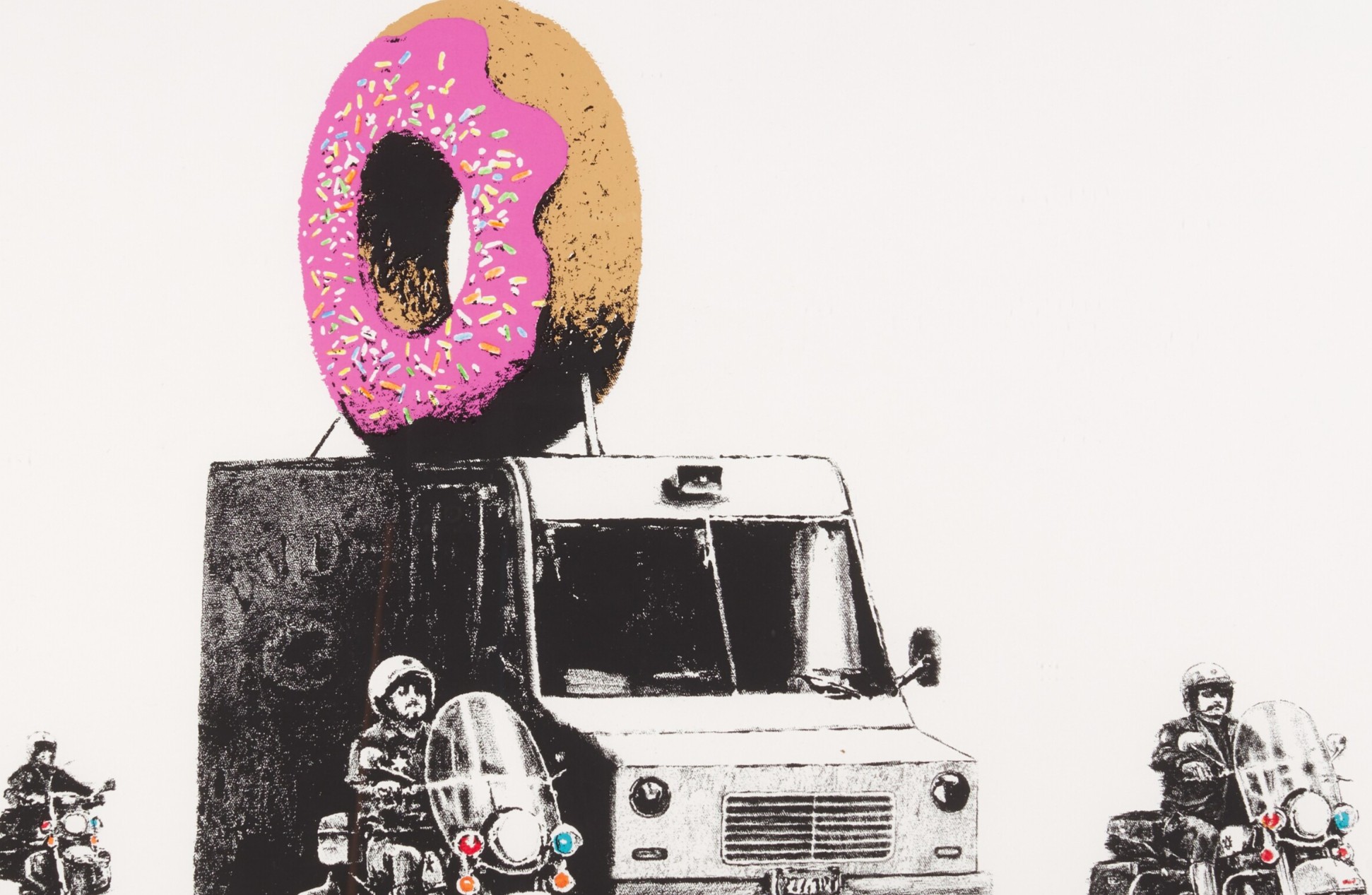
A group of officers carries out their task with precision and control. Their movements are coordinated, their focus unwavering. Everything suggests importance and necessity. At the center of this operation sits a donut. Nothing is broken. Nothing is chaotic. Everything functions exactly as intended. And yet, the purpose remains entirely unclear. Banksy does not disrupt the system. He allows it to perform. In doing so, he reveals how easily structure, discipline, and authority can be applied to something fundamentally insignificant, and how convincing that performance can become.
The Seriousness of the Absurd
At its core, Donut explores the disjunction between function and purpose. The police officers embody authority, structure, and institutional discipline. Their presence typically signals importance, danger, or necessity. In this work, however, that same authority is applied with complete rigor to an object that carries no real weight or consequence. The power of the image lies in this imbalance. The officers are not exaggerated or mocked. They are credible and composed, performing their task with professionalism. The absurdity emerges from the object itself. The donut, associated with indulgence and banality, becomes the center of a highly controlled operation.

Banksy suggests that systems of authority can operate with perfect precision while remaining disconnected from meaningful purpose. The image does not accuse; it reveals. It presents a situation in which everything functions exactly as it should, except for the reason why it is happening. The result is quietly unsettling. The viewer is invited to question not the behavior of the figures, but the logic that governs them.

Release History
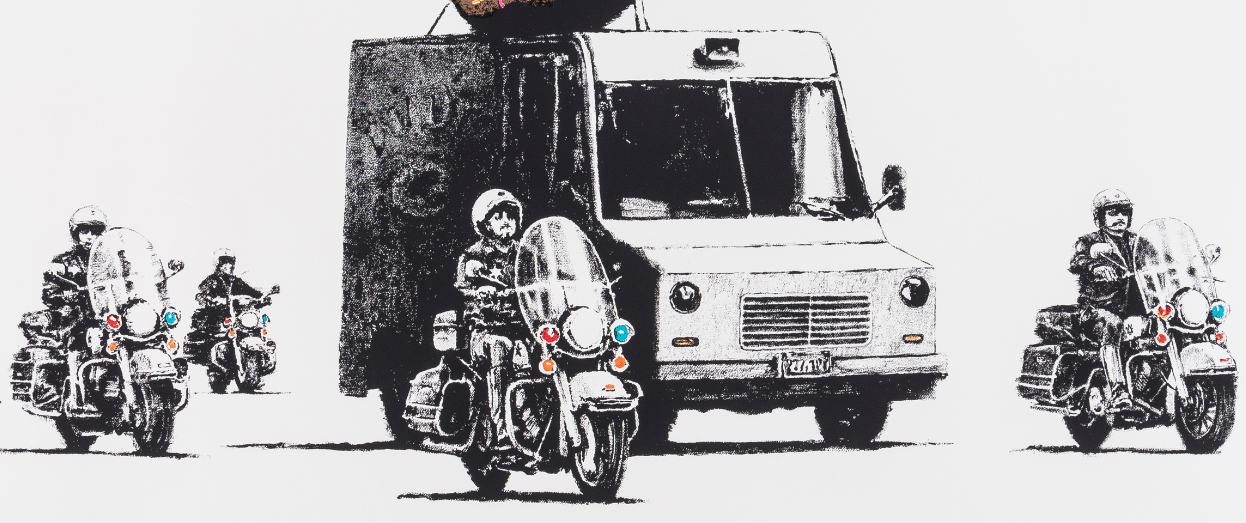
Created in 2009, Donut reflects a moment in Banksy’s practice where his printmaking reached a notable level of sophistication. While his street works often rely on immediacy, his prints reveal a more controlled and layered approach. In this work, the complexity of the composition stands out. The number of figures, their coordination, and the balance of the central object demonstrate a careful and deliberate construction. This is not simply a clever visual idea; it is a highly resolved image that rewards close attention. The precision of execution reinforces the conceptual framework. The more controlled the image becomes, the more evident its underlying contradiction appears.
Auction Results
PLEASE CLICK BELOW FOR AUCTION RESULTS