BANKSY
Game Changer, 2020
Oil on canvas
91×91 cm (35 7/8 x 35 7/8 inches)
Signed ‘BANKSY’ (lower right)
Gifted by the artist to the present owner in 2020.
Auction History
NEW AUCTION RECORD FOR BANKSY
| Christie’s London 23 March 2021 Est.: GBP 2,500,000 – 3,500,000 | Price Realized GBP 16,758,000 / USD 23,210,000 BANKSY, Game Changer | Christie’s |
The Day Banksy Stopped Laughing
In the spring of 2020, the world fell strangely silent. Streets emptied, airports closed, museums shut their doors and entire nations retreated indoors as the COVID-19 pandemic swept across the globe. Amid uncertainty and fear, one profession suddenly stood at the centre of public consciousness. Doctors, nurses and healthcare workers became the frontline of an unprecedented global crisis, risking their own lives to save those of others.
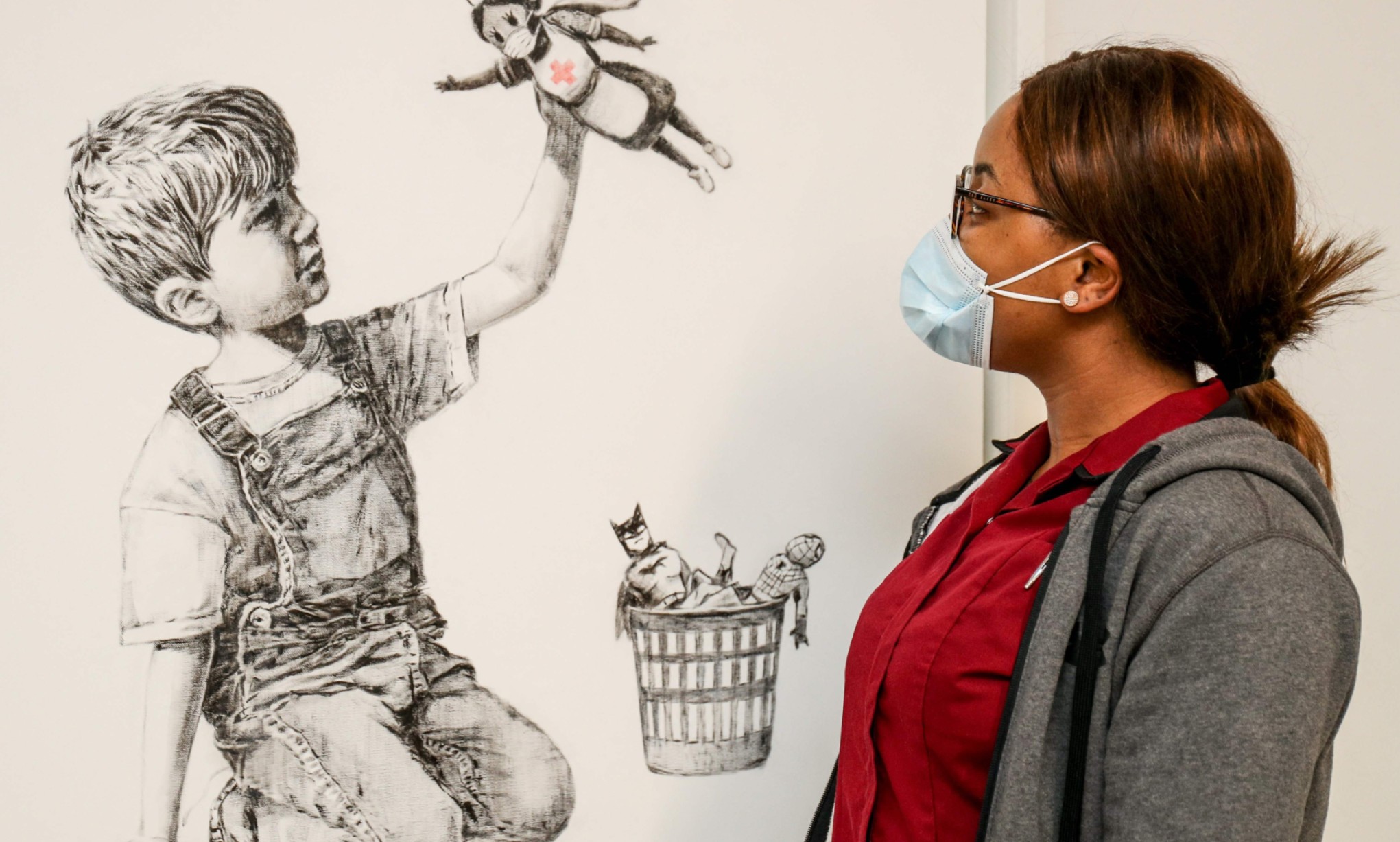
It was during this extraordinary moment that Banksy created one of the most unexpected works of his career. Donated to Southampton General Hospital in May 2020, Game Changer depicts a young boy kneeling beside a wastepaper basket. Batman and Spider-Man have been discarded, while a nurse wearing a flowing cape and a Red Cross emblem soars triumphantly through the air. Accompanied by a handwritten note thanking hospital staff for everything they were doing, the painting immediately became a symbol of hope, gratitude and resilience.

For an artist renowned for exposing hypocrisy, mocking authority and challenging political power, Game Changer is strikingly different. There are no policemen to ridicule, no politicians to criticize, no satirical punchline waiting to reveal itself. Instead, Banksy offers something remarkably rare: an unambiguous tribute to ordinary people performing extraordinary acts.
More than a response to the pandemic, Game Changer marks a pivotal moment within Banksy’s artistic journey. It reminds us that beneath decades of irony and provocation lies an artist deeply concerned with human dignity. If much of Banksy’s work asks us to question the world around us, Game Changer asks us to appreciate those who quietly make that world a better place.
The World Comes to a Standstill
When COVID-19 spread across the world in early 2020, daily life changed almost overnight. Hospitals became overwhelmed, families were separated by lockdowns, and uncertainty touched every aspect of society. Across Britain, a new ritual emerged. Every Thursday evening, millions of people stood outside their homes to applaud the National Health Service, expressing their gratitude to the doctors, nurses and support staff working tirelessly under unimaginable pressure.
Banksy, who has often responded to major political and social events through public interventions, chose a quieter path. Rather than painting another mural on a city wall, he created a single canvas and anonymously donated it to Southampton General Hospital. Installed where staff and patients could see it, the work carried a simple handwritten message:
“Thanks for all you’re doing.
I hope this brightens the place up a bit, even if it’s only black and white.”
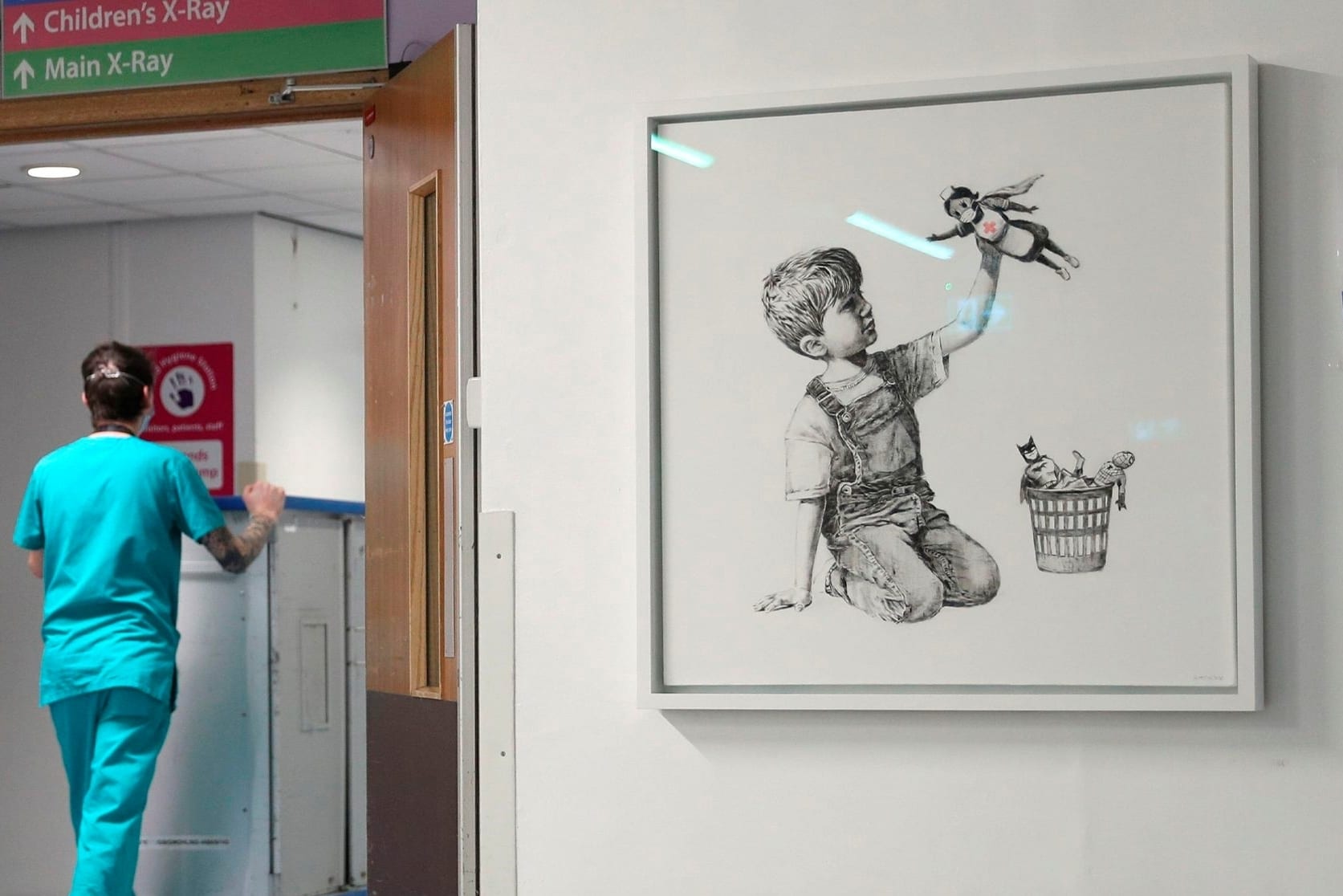
The note perfectly reflects Banksy’s characteristic modesty and wit. Yet behind the humour lies genuine admiration. Unlike many of his previous works, which expose failures of institutions and authority, Game Changer celebrates individuals whose courage had become impossible to ignore.
The painting remained at the hospital for nearly a year before being auctioned at Christie’s in London in March 2021, where it realized GBP 16.8 million (USD 23.2 million), establishing a new auction record for the artist at the time. In keeping with Banksy’s original intention, the proceeds were donated to NHS charities and healthcare organizations, allowing the work itself to continue supporting those it was created to honor.
When the Nurse Replaces Batman
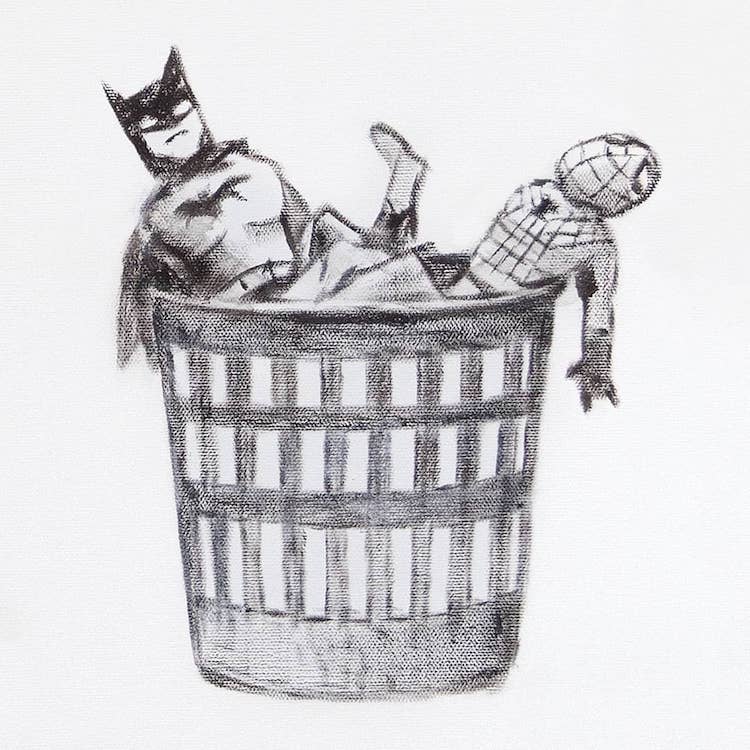
At first glance, Game Changer appears almost disarmingly simple. A young boy kneels on the floor, engrossed in play. Beside him sits a wicker basket containing two discarded action figures—Batman and Spider-Man, perhaps the two most recognizable superheroes of modern popular culture. Flying above him, held aloft in his outstretched hand, is a nurse dressed in the traditional NHS uniform, complete with apron, cape and a Red Cross emblem. Her arm is raised confidently, as though she is soaring into the sky.
The composition is remarkably restrained. Executed almost entirely in black and white, the only splash of color is the bright red cross adorning the nurse’s uniform, immediately drawing the viewer’s eye to the painting’s moral center. As throughout much of Banksy’s work, color is used sparingly, not for decoration but for emphasis.
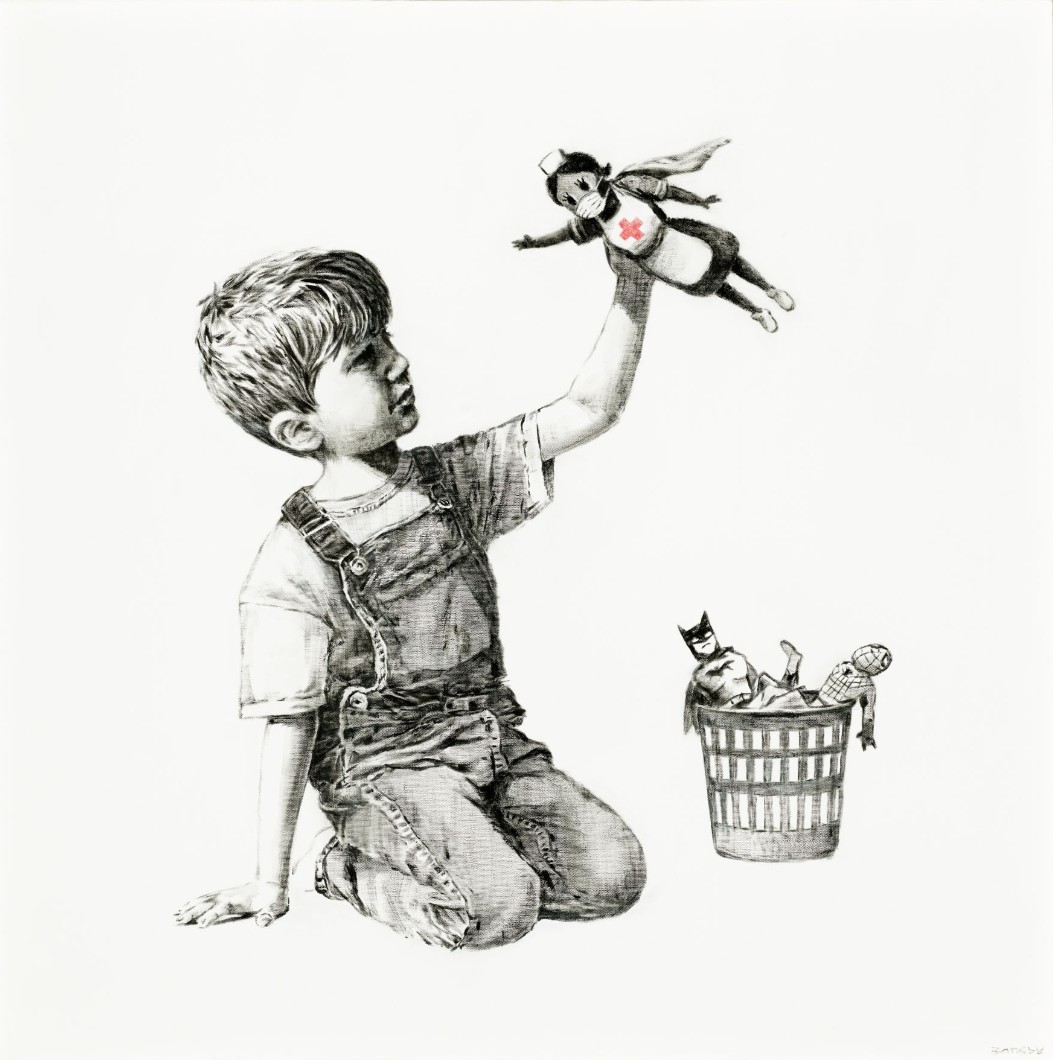
What makes the image so powerful is its complete absence of complexity. There are no hidden symbols, no elaborate background and no satirical details waiting to be discovered. Everything the viewer needs to understand is contained within a child’s instinctive choice. Faced with a collection of heroes, he simply reaches for the one who matters most.
For generations, superheroes have embodied qualities that society admires: courage, self-sacrifice, justice and the willingness to protect others. They possess extraordinary powers that ordinary people can only imagine. Banksy quietly dismantles this mythology. The nurse has no supernatural abilities. She cannot fly, stop bullets or possess superhuman strength. Her only weapons are knowledge, compassion and an unwavering commitment to care for strangers.
In doing so, Banksy redefines the very idea of heroism. True courage, he suggests, is not measured by spectacular acts or fictional adventures, but by quiet perseverance in the face of fear. During the pandemic, doctors and nurses walked into hospital wards each day knowing the risks they faced. Their heroism did not lie in invincibility, but in vulnerability accepted for the benefit of others.

The child is equally important to the painting’s meaning. Children often perceive the world with a clarity that adults gradually lose. Unburdened by politics, ideology or cynicism, they instinctively recognize genuine acts of kindness and bravery. By allowing a child—not an adult—to choose the new superhero, Banksy suggests that the moral truth of the moment required no explanation. It was self-evident.
The discarded figures of Batman and Spider-Man are not mocked or diminished. They simply belong to another world. In times of peace, fictional heroes entertain and inspire us. In moments of genuine crisis, however, reality produces heroes far greater than fiction ever could. The basket becomes more than a toy box; it symbolizes a changing hierarchy of values. Fantasy gives way to reality, spectacle to service, and myth to humanity.
It is this extraordinary simplicity that makes Game Changer so universally resonant. Banksy does not ask us to admire healthcare workers because they wear uniforms or represent an institution. He asks us to admire them because they embody the very qualities we have always celebrated in our superheroes. The only difference is that these heroes are real.
Rewriting the Superhero
The image at the heart of Game Changer resonates so deeply because it redefines one of the most enduring figures in modern culture: the superhero.
Since the twentieth century, superheroes have become contemporary mythology. Like the heroes of ancient Greece or the knights of medieval legend, they embody society’s highest ideals. Batman represents determination, Spider-Man responsibility, Superman hope and justice. Their stories reassure us that extraordinary individuals will appear whenever the world faces extraordinary danger. Banksy gently overturns this familiar narrative.
His nurse possesses none of the attributes traditionally associated with superheroes. She has no secret identity, no supernatural powers and no extraordinary technology. Her heroism derives entirely from qualities that are profoundly human: compassion, knowledge, resilience and an unwavering sense of duty. She does not save the world through spectacular acts of strength but through countless small acts of care repeated day after day.
It is a subtle but important distinction. Fictional superheroes often triumph through exceptional abilities that separate them from ordinary people. Banksy’s heroine achieves precisely the opposite. She reminds us that genuine heroism is accessible to anyone willing to place the wellbeing of others before their own.
The composition also reflects a broader cultural shift that occurred during the pandemic. For decades, popular culture celebrated athletes, actors, musicians and fictional characters as icons of success and admiration. COVID-19 temporarily overturned that hierarchy. Suddenly, the people keeping hospitals running, delivering supplies, caring for the vulnerable and maintaining essential services became the individuals upon whom society truly depended.
In that sense, the nurse represents far more than healthcare workers alone. She stands for an entire generation of essential workers whose quiet dedication allowed everyday life to continue under extraordinary circumstances. The painting therefore transcends the immediate context of the NHS to become a universal tribute to those whose contributions often remain invisible until crisis reveals their true importance.
There is also something profoundly optimistic about Banksy’s choice. Throughout his career, he has frequently portrayed children as symbols of innocence confronting the failures of the adult world. Here, however, the child is not witnessing injustice or loss. Instead, he is imagining a better future, instinctively choosing compassion as the quality most worthy of admiration.
This simple act transforms the painting into something more than a tribute to the pandemic. It becomes a reflection on the values we choose to pass to future generations. What kind of heroes should children aspire to become? Banksy’s answer is both timeless and disarmingly simple. Not those who possess extraordinary powers, but those who dedicate their lives to helping others.
In replacing comic-book mythology with everyday courage, Game Changer reminds us that the greatest heroes are rarely those who seek recognition. They are the individuals who quietly answer the call of duty, often without applause, and whose true strength lies not in their ability to conquer others, but in their determination to care for them.