BANKSY
Insane Clown, 2001
Spray-paint stencil on HESSIAN
252 x 193.5 cm (99 1/4 x 76 1/8 inches)
Provenance
Lazarides Gallery, London
Auction History
| Phillips New-York 12 November 2009 Est.: USD 200,000 – 300,000 | Price Realized USD 386,500 |
Catalogue Note
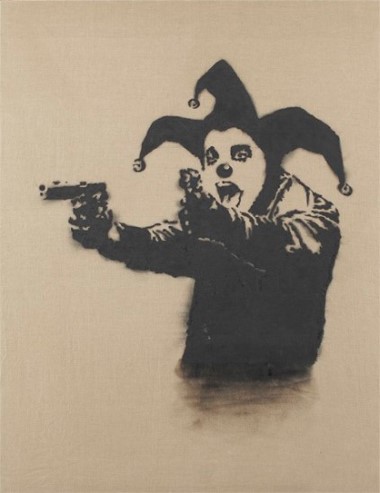
Few figures embody contradiction quite like the clown. Designed to provoke laughter yet often inspiring discomfort, the clown has long occupied the uncertain territory between comedy and menace. In Insane Clown, Banksy pushes this ambiguity to its breaking point. A jester, frozen in the act of drawing two pistols with theatrical enthusiasm, becomes a disquieting emblem of a society in which entertainment and violence have become inseparable.
Executed in 2001, the work belongs to Banksy’s formative years, when his visual language was already built upon the collision of irreconcilable opposites. Here, innocence confronts aggression, comedy meets terror, and popular culture collides with social critique. The image functions almost like a visual paradox: the more absurd the subject appears, the more unsettling it becomes.
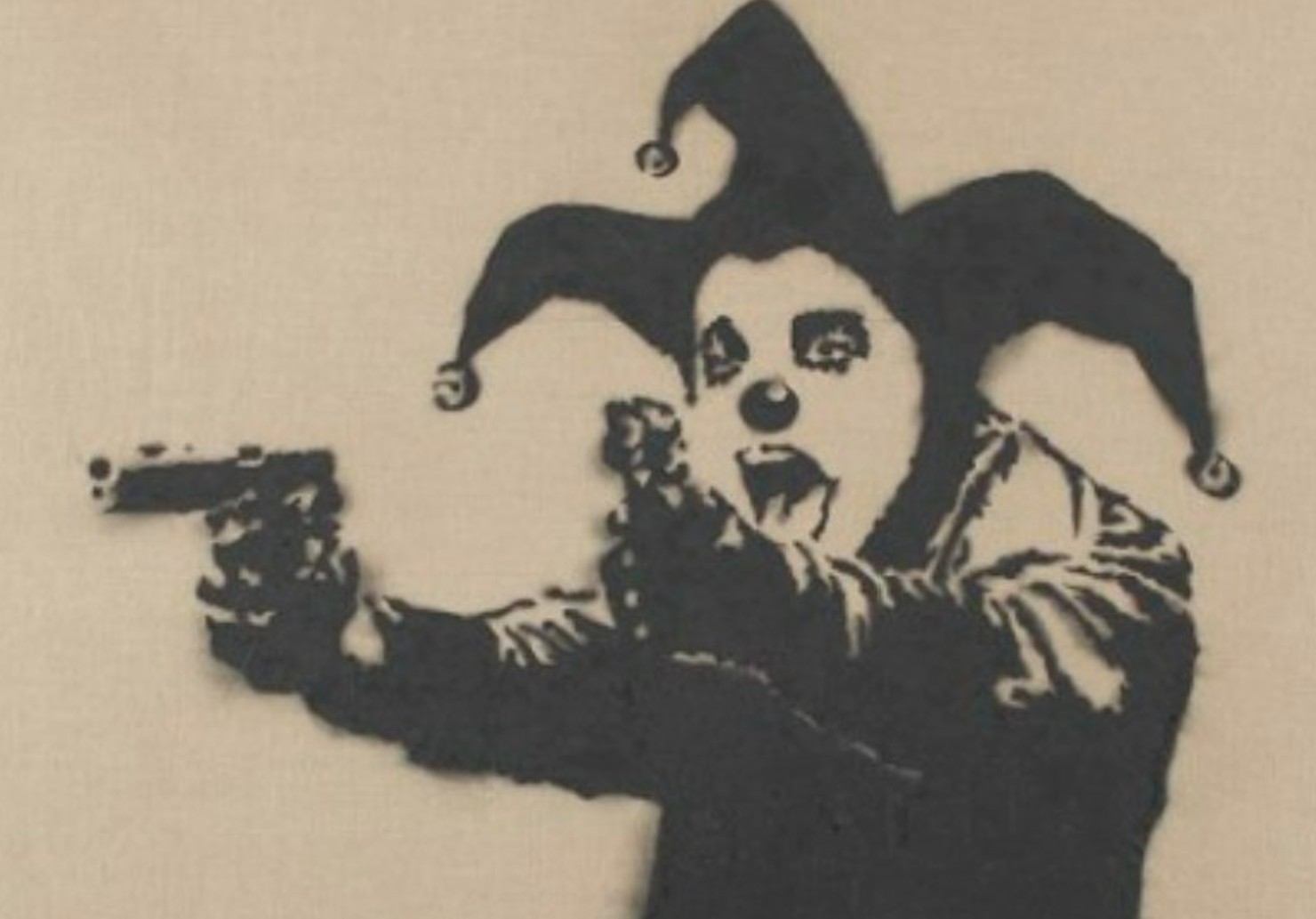
The jester has traditionally occupied a unique position within society. As the only figure permitted to ridicule kings, he spoke uncomfortable truths under the protection of humor. Banksy revives this historical archetype but adapts it for the twenty-first century. His fool no longer mocks authority from the margins; instead, he has become infected by the very violence he was meant to expose. The joker has become the joke.
The work also reflects a culture increasingly desensitized to violence through constant media exposure. The clown’s exaggerated expression resembles a performer seeking applause rather than a criminal committing an act of aggression. Violence itself has become spectacle, consumed with the same fascination as popular entertainment. Banksy repeatedly explored this idea throughout his career, revealing how modern society packages fear, conflict and tragedy as forms of mass consumption.
The coarse hessian support further amplifies the raw immediacy of the image. Unlike the pristine surface of a traditional canvas, the rough textile recalls sacks, temporary shelters and improvised materials associated with the street. Banksy deliberately avoids refinement, allowing the stark black stencil to emerge directly from an unpretentious surface that preserves the immediacy of graffiti. The material itself resists the conventions of high art, reinforcing the work’s anti-establishment character.
Inscribed alongside the work is one of the artist’s most revealing quotations: “Every time I hear the word culture, I release the safety catch on my 9 mm.” Borrowed from a phrase historically associated with Nazi playwright Hanns Johst—who wrote, “When I hear the word culture, I reach for my gun”—Banksy deliberately inverts the quotation with characteristic irony. Rather than celebrating anti-intellectualism, he exposes the dangerous impulse to silence culture whenever it becomes threatening or subversive. By placing these words in the mouth of a clown, he suggests that the greatest dangers often arrive disguised as entertainment.
“Every time I hear the word Culture, I release the safety catch on my 9 mm”

More than two decades after its creation, Insane Clown remains remarkably prescient. It is not simply a portrait of madness, but of a culture in which amusement and aggression increasingly share the same stage. As so often in Banksy’s work, laughter becomes a Trojan horse through which profoundly uncomfortable truths quietly enter. Here, the clown is not the enemy; he is merely the mirror in which society catches sight of its own unsettling reflection.
In Insane Clown, Banksy fuses dark humor and social critique into a single haunting figure: a clown in full jesters’ regalia, brandishing two handguns with manic glee. Rendered in Banksy’s signature stenciled black on a stark beige background, the image is both absurd and chilling. The clown, a symbol of innocent entertainment, is reimagined as an agent of chaos: part Joker, part street soldier, posing questions about who society allows to wield power and violence.