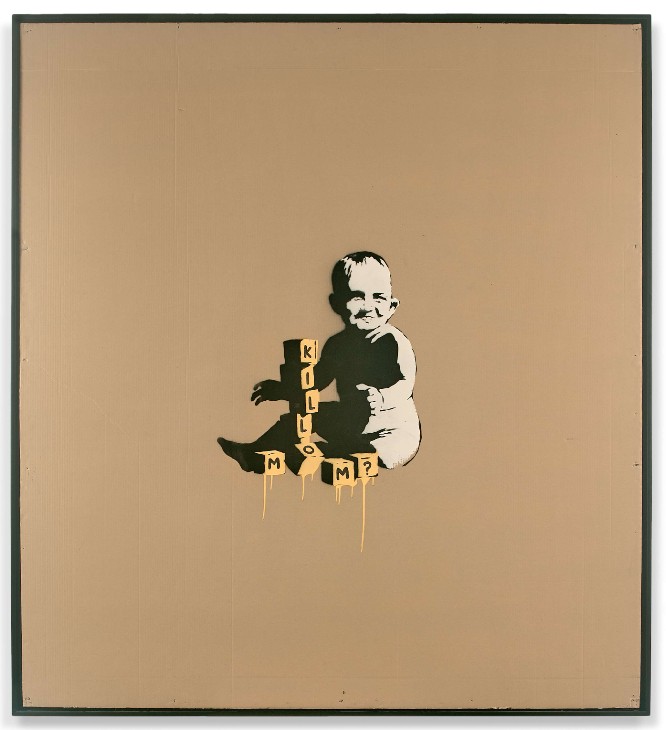
BANKSY
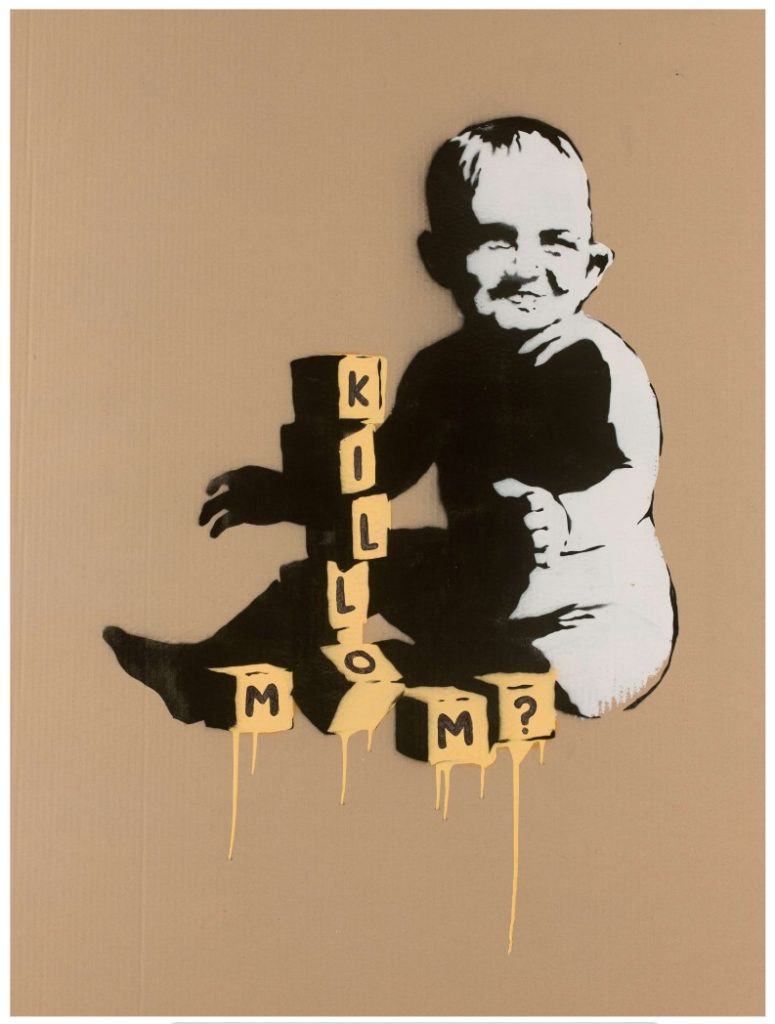
Kill Mom?, 2003
Stencil, acrylic and spray paint on cardboard
220×200 cm (86-5/8 x 78-7/8 inches)
Unique work
Provenance
WUK, Vienne
im Kinsky, Vienne, Contemporary art, 20 novembre 2007, lot 451
Acquis lors de cette dernière par l’actuel propriétaire
Auction History
Artcurial Paris: 19 November 2018
Estimated: EUR 250,000 – 350,000
EUR 591,800 / USD 676,250
Kill Mom? belongs to a fascinating and still relatively under-discussed moment in Banksy’s career, when the artist was transitioning from pure street interventions into large-scale studio works that nevertheless retained the raw visual language of graffiti. The first thing that strikes the viewer is the immense emptiness surrounding the child. The composition is almost brutally minimal. A tiny infant sits isolated in the middle of a monumental cardboard surface, surrounded by silence and void. Banksy understands something essential here: scale itself can become psychological. The child appears vulnerable, abandoned almost, swallowed by emptiness. This is not merely a witty stencil anymore; it is a work about alienation.
The support is extremely important. The use of cardboard is not accidental decoration. Cardboard evokes packaging, fragility, transience, urban poverty, temporary shelters, consumer circulation. Banksy frequently used found or humble materials during this period precisely to maintain an anti-monumental quality even when producing gallery-oriented works. Unlike the polished surfaces associated with blue-chip contemporary painting in the early 2000s, this material preserves the aesthetics of the street: provisional, rough, disposable.
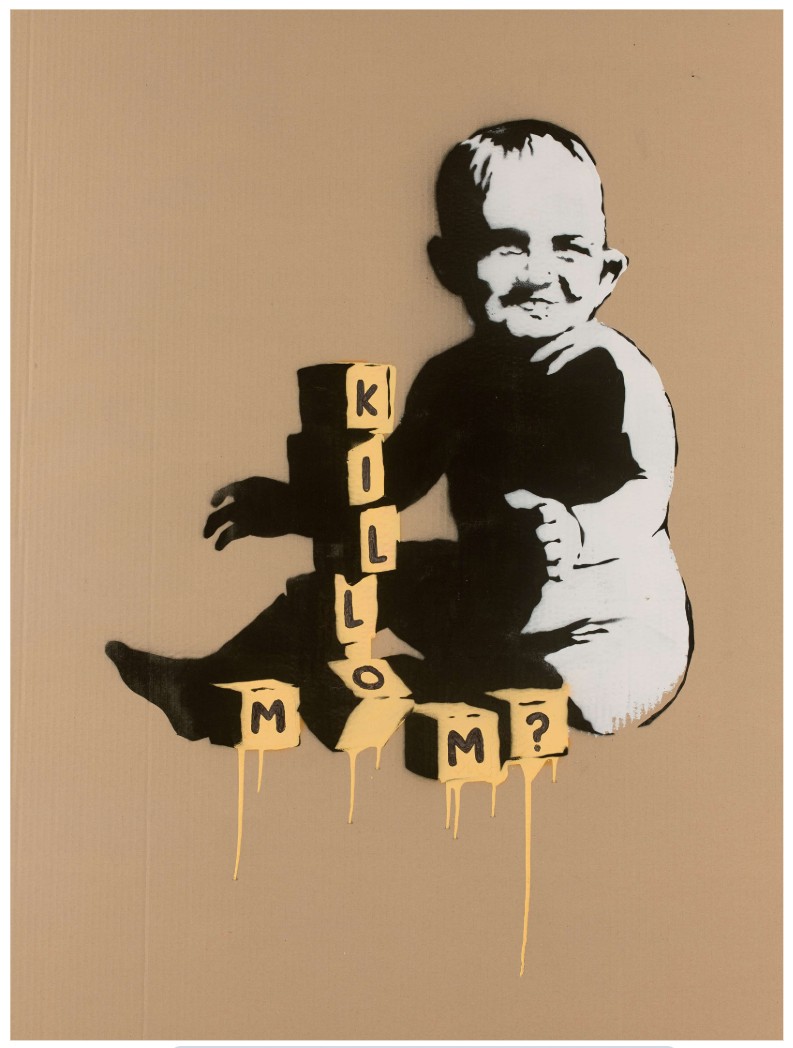
At the center, the infant stacks alphabet blocks that spell “KILL MOM?” The phrase is shocking because it emerges from one of the most innocent visual vocabularies imaginable: children’s toys. Banksy has always been highly effective at weaponizing innocence against the viewer. Much like in Bomb Hugger or Napalm, childhood becomes the vehicle through which violence and social dysfunction are exposed. But the ambiguity of the sentence is what gives the work its intelligence. Is the child innocently assembling random letters without understanding them? Is this a comment on the corruption of innocence by media culture? A dark joke about family structures? A critique of social conditioning? The question mark matters enormously because it destabilizes the aggression. The phrase oscillates between threat, misunderstanding, parody, and accidental absurdity.
There is also something psychologically disturbing in the expression of the child itself. The baby smiles gently, almost proudly, unaware of the violence embedded in the message. That contrast produces a deeply uncomfortable tension. Banksy often operates through collision: innocence against brutality, humor against despair, childhood against systems of violence. Here, the contradiction is stripped to its purest form.
Art historically, the work belongs to a long lineage of artists using children as mirrors of societal failure. One can think of the unsettling innocence found in the work of Diane Arbus, or even the grotesque childlike language of Jean-Michel Basquiat, where simplified symbols conceal psychological violence and social critique. Banksy, however, filters these traditions through the immediacy of graffiti and mass communication.
The work is also remarkably restrained compared to later Banksy pieces. There is no complex narrative scene, no crowd, no police officers, no obvious political symbol. The image functions almost like a conceptual haiku. Its power comes from reduction. And that reduction is precisely why the work remains strong today. Many street artists of the early 2000s relied heavily on stylistic aggression or visual overload. Banksy understood earlier than most that simplicity travels further psychologically. One child. A few blocks. A question mark. Vast emptiness. The image lodges itself into memory almost instantly.
From a market perspective, unique early Banksy paintings from 2002–2004 have become increasingly important historically because they capture the moment before Banksy fully transformed into a global cultural phenomenon. Works from this period still retain proximity to Bristol graffiti culture, Pictures on Walls aesthetics, and the raw anti-establishment energy of early British street art before the artist entered the realm of museums, auction theatrics, and institutional mythology. And perhaps that is what makes Kill Mom? particularly compelling today: it still feels dangerous in a very primitive way. Not spectacular. Not performative. Just quietly wrong enough to stay in your head.