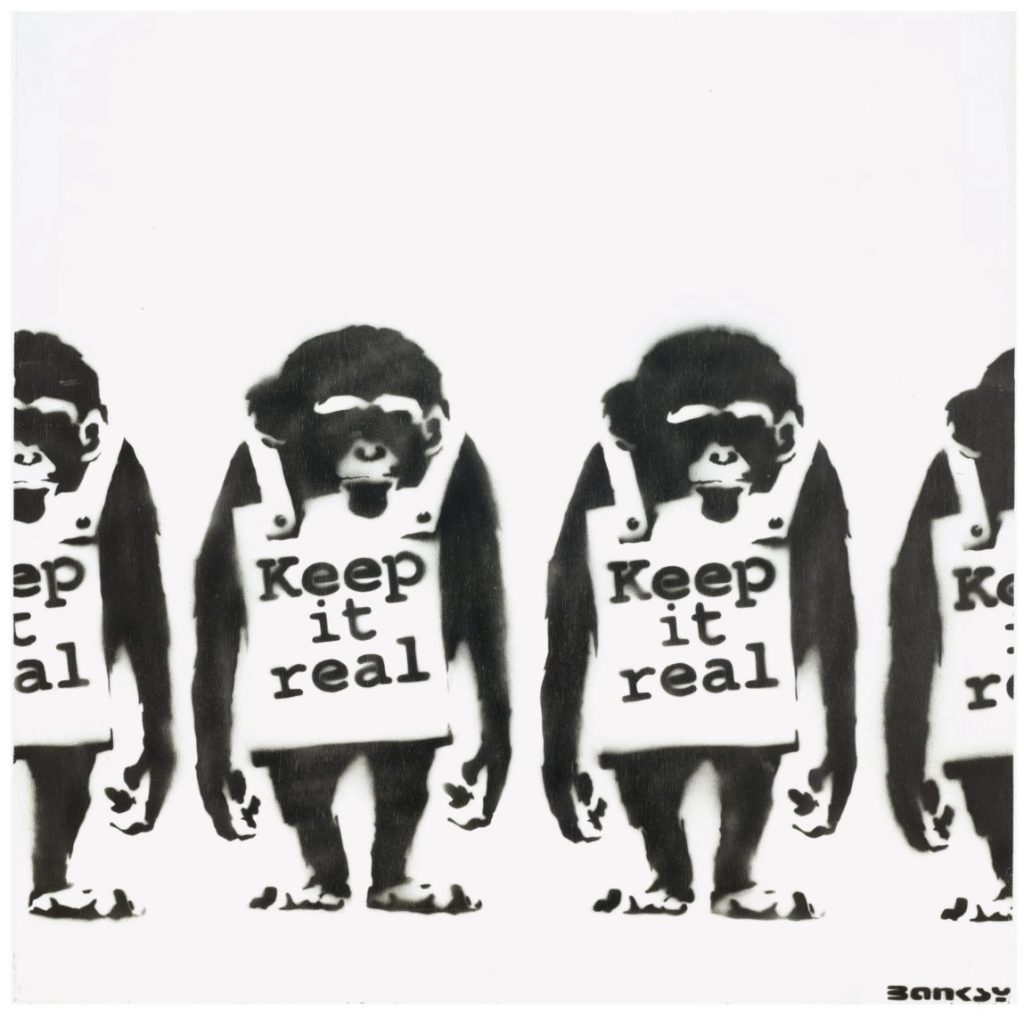
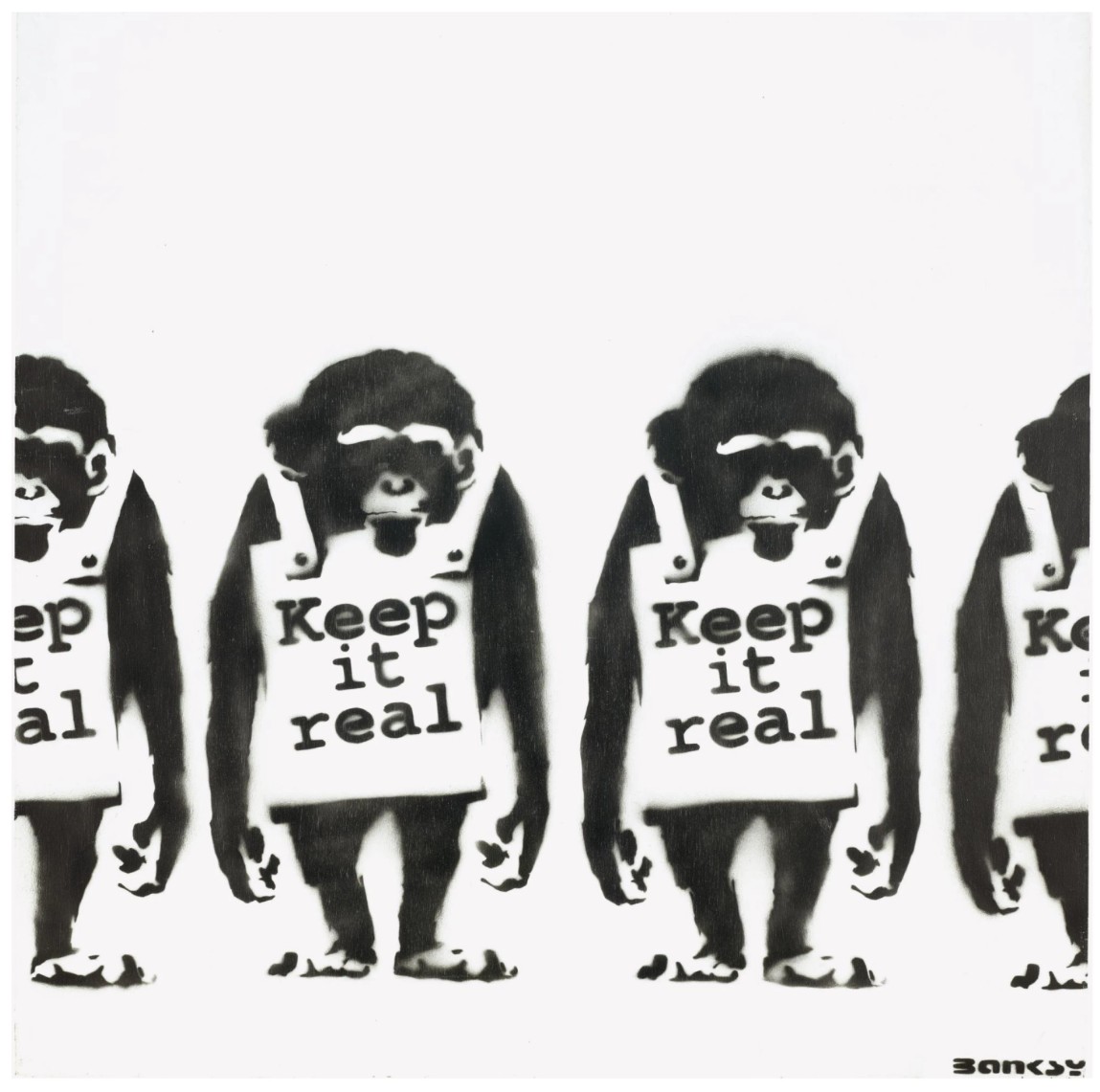
Monkeys, 2000
Acquired directly from the artist by the present owner
Auction History
| Sotheby’s London 22 June 2007 Est.: GBP 30,000 – 40,000 | Price Realized GBP 144,000 / USD 287,080 (#334) Banksy |
Catalogue Note
Monkeys belongs to Banksy’s seminal Keep It Real series, one of his earliest and most incisive meditations on authenticity, identity, and mass culture. Rather than presenting a single ape, Banksy repeats the figure across the canvas like a manufactured product, each chimpanzee wearing the now-famous placard proclaiming “Keep it real.” The multiplication of the image is no accident: by transforming the monkey into a pattern, Banksy questions whether authenticity can survive once it has itself become a slogan.
The work encapsulates one of the central paradoxes of contemporary culture. “Keeping it real” has become a mantra of individuality, yet its endless repetition often produces conformity rather than originality. Banksy’s identical monkeys expose this contradiction with characteristic wit. Each appears to advocate authenticity while looking almost indistinguishable from the next, suggesting that even rebellion can become standardized and commercially packaged.
Created in 2000, this large-format composition marks an important chapter in the evolution of Banksy’s monkey imagery. While later works such as Laugh Now, Monkey Parliament, and Monkey Queen would use apes to satirize politics and society, the Keep It Real series is more introspective. It asks a question that would resonate throughout Banksy’s entire career: how can an artist remain authentic in a world where authenticity itself has become a commodity?
PLEASE CLICK BELOW TO READ ABOUT KEEP IT REAL
Viewed today, Monkeys reads almost as a manifesto. Long before the international acclaim, museum exhibitions, and record-breaking auction prices, Banksy was already warning of the dangers of branding, celebrity, and the commercialization of dissent. The irony is delicious: an artwork that urges us to “keep it real” has itself become one of the defining icons of the contemporary art market.