The Emperor Has No Clothes
Few artists have mocked the art world with as much wit and affection as Banksy. Created in 2002, Keep It Real depicts a chimpanzee standing before an easel, holding a paintbrush beneath a hand-painted sign that simply reads: “Keep It Real.” The image is immediately humorous, yet beneath its playful exterior lies one of Banksy’s earliest and sharpest commentaries on artistic authenticity, originality and the often self-important rituals of the contemporary art world.

Like many of his greatest works, Keep It Real succeeds because it asks a deceptively simple question: what makes art “real”? Is it technical skill, institutional recognition, market value, or simply the sincerity of the artist’s intention? Banksy offers no definitive answer. Instead, he lets the chimpanzee do the talking.
The Outsider Looking In
When Keep It Real first appeared in 2002, Banksy remained an outsider to the establishment he would later transform. His reputation had been built on the streets of Bristol and London rather than in museums or commercial galleries. The art market had yet to fully embrace street art, and graffiti was still widely dismissed as vandalism rather than serious artistic practice. The chimpanzee therefore becomes a subtle self-portrait.
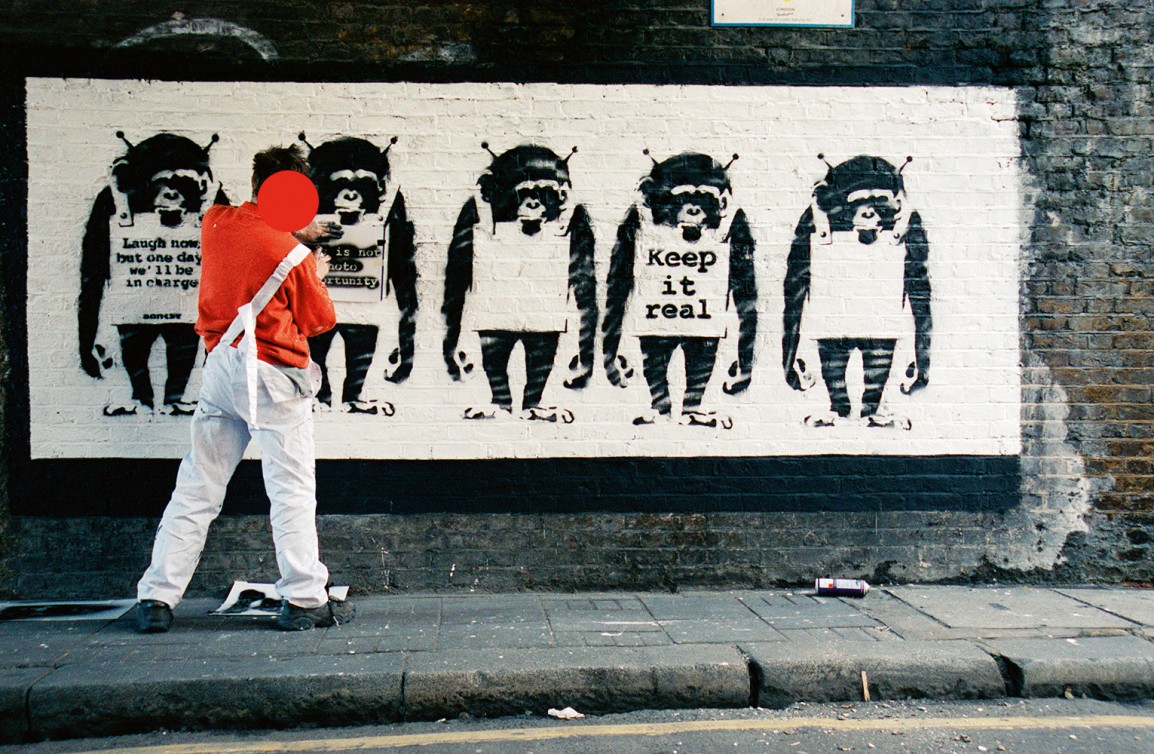
Throughout his career, Banksy has repeatedly used monkeys to represent those excluded from positions of authority. In later works they would become members of parliament, museum visitors, revolutionaries and even artists. Here, the ape occupies the painter’s studio itself, quietly questioning whether the distinction between the cultured artist and the supposedly primitive outsider is as meaningful as society pretends. The joke is directed not at the monkey but at us.
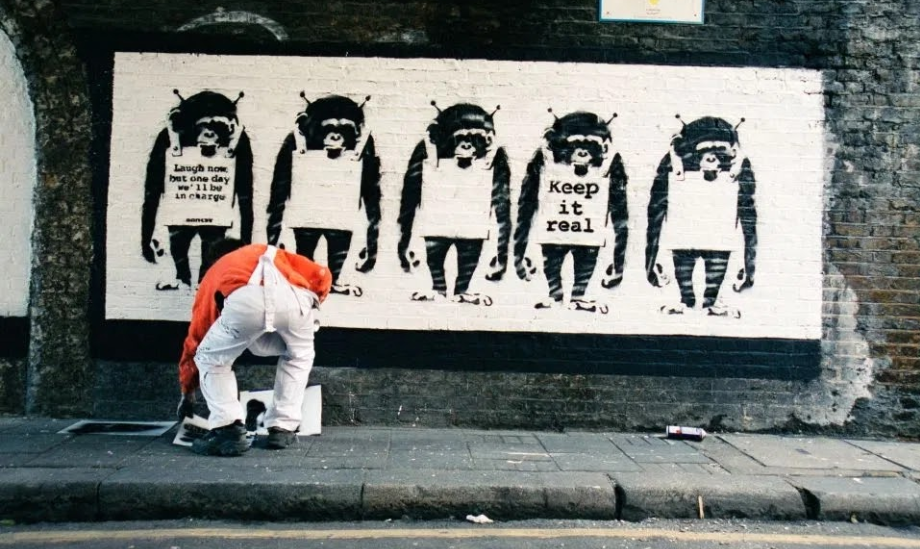


Keep It Real offers a contemporary take on singerie, the pictorial genre in which stylish monkeys engage in human activities. Scenes of monkeys cast within the human realm began to appear in the sixteenth century, and were later explored by a variety of artists including Pieter Bruegel the Elder, Jan Brueghel the Elder and the Younger, and Jean-Antoine Watteau. These painters employed monkeys to critique society and its trimmings, a mantle that Banksy has taken up with zeal.
“I use monkeys in my pictures for a lot of reasons, guerrilla tactics, cheeky monkeys, the fact that we share 98.5 per cent of our DNA with them. If I want to say something about people, I use a monkey.”
As with so many of his motifs and characters, Banksy has reincarnated the primate in various guises, famously replacing British parliamentarians with chimpanzees in his 2009 painting Devolved Parliament, which lambasted England’s political class.

Since achieving widespread recognition, the world’s most notorious provocateur has expanded his global footprint. His works address burning issues facing humanity, from climate change and immigration to the conflicts in Ukraine and Gaza. Like William Hogarth’s engravings, the Dadaists’ response to the horrors of war, and Andy Warhol’s cutting eye, Banksy’s art, too, is rooted in the public consciousness; it is in and of the world, attending to the questions that need uncovering, the zeitgeist and its debris. Unlike so many of his predecessors, however, Banky’s works are conceived not as commentary but actions meant to disrupt the status quo and effect change. By using comprehensible motifs paired with pithy messages, Banksy ensures that his biting critiques are legible to all. His belief that art should be for everyone is underscored by a no-compromise, anarchic ethos—a Banksy may appear at any moment, in any locale—but the medium is the message, too. In Keep It Real, the artist sets the stage for a practice that would speak truth to power, give voice to the powerless, and, ultimately, spread joy.
Authenticity in an Artificial World
The phrase “Keep It Real” originated in popular culture as an appeal to authenticity—to remain genuine in a world increasingly shaped by image and performance. Banksy deliberately places this slogan inside one of the least authentic environments imaginable: the highly commercialized contemporary art market.
The irony is unmistakable.

Art is frequently celebrated for its originality while simultaneously becoming an object of speculation, branding and financial investment. Reputation often matters as much as the artwork itself. Museums, collectors and auction houses all contribute to determining cultural value.
Banksy does not reject this system entirely. Instead, he exposes its contradictions with characteristic humor. If a chimpanzee can stand before an easel and remind us to “keep it real,” perhaps authenticity has become something the art world itself has misplaced.

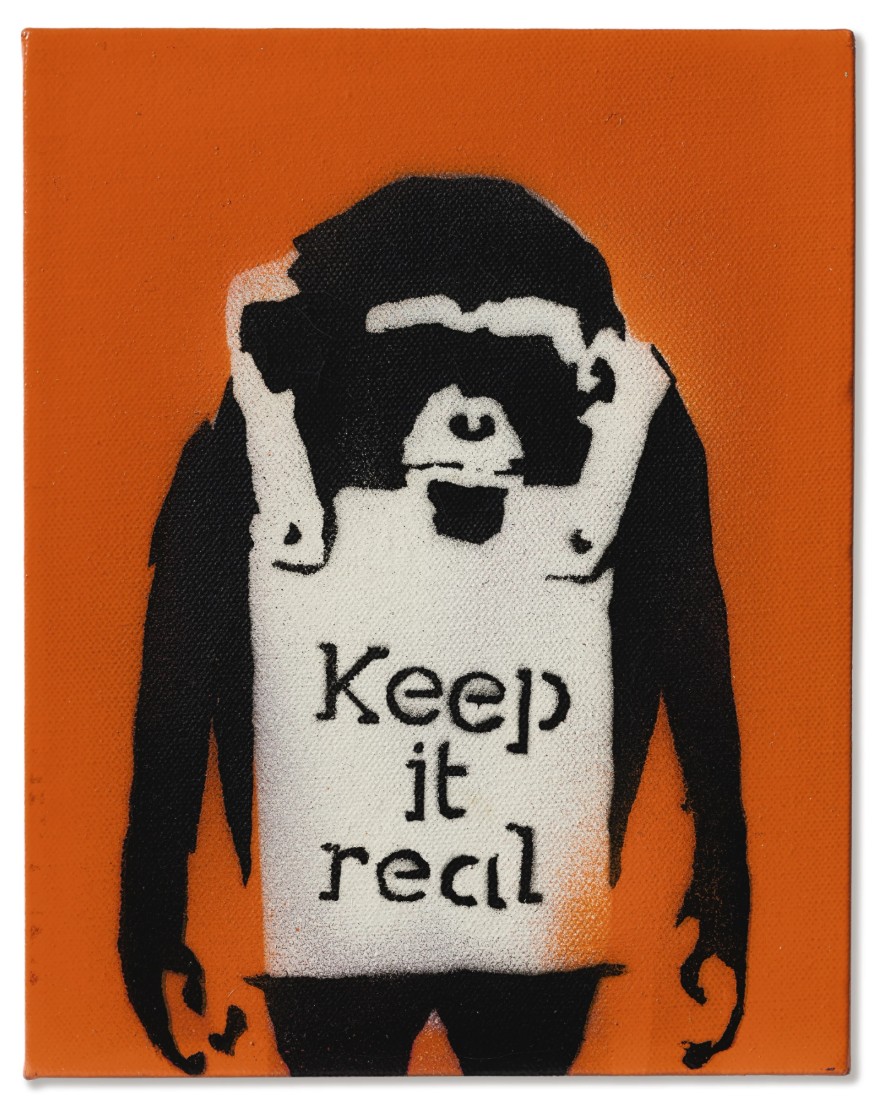
Known for his acerbic observations and subversive tactics, Banksy is the art world’s agitator par excellence. Set against a brilliant orange ground, the present work’s forlorn protagonist sports a sandwich board that reads ‘Keep it real’, a punchy rebuke at odds with his downtrodden countenance. The work was executed in 2002: the same year that the artist produced his seminal mural, commissioned by a nightclub in Brighton, depicting ten chimpanzees adorned with boards reading ‘Laugh now, but one day we’ll be in charge’. Two years earlier, depictions of anthropomorphized primates had covered the walls of his first ‘show’ on London’s Rivington Street exhibition; the ape would go on to become one of his most iconic motifs. These were pivotal years for Banksy, marking the start of his meteoric rise to acclaim and his early embrace of the stencil medium that would become his signature. Keep It Real solidifies this transition and makes clear his rebellious vision.
Legacy
Keep It Real introduces ideas that would resonate throughout Banksy’s career. His critique of artistic institutions would later find expression in Morons, where collectors enthusiastically bid on a canvas declaring, “I can’t believe you morons actually buy this shit.” In Exit Through the Gift Shop, Banksy turned the documentary itself into an exploration of celebrity, authorship and commercial success. Years later, Gross Domestic Product would parody luxury branding by transforming household objects into limited-edition artworks sold through an elaborate conceptual performance.
Taken together, these projects reveal a consistent philosophy. Banksy has never rejected art itself; he has questioned the structures that determine how art is valued, marketed and consumed. The monkey appears repeatedly throughout this journey. Whether seated in parliament, carrying placards or standing before an easel, it functions as Banksy’s preferred outsider—a figure capable of exposing human absurdity precisely because it stands just beyond the boundaries of accepted authority.
More than two decades after its creation, Keep It Real remains remarkably fresh. The contemporary art world has become even more global, more commercial and more intertwined with celebrity culture than it was in 2002. Questions surrounding authenticity, originality and artistic identity continue to shape debates about contemporary art. Banksy’s answer remains characteristically understated.
He does not ridicule painting, museums or collectors. Rather, he reminds us that art loses something essential whenever it becomes disconnected from honesty, curiosity and genuine creative expression. The monkey’s message is almost childishly simple, yet perhaps that is precisely why it endures. Sometimes the clearest truths are delivered by those whom society is least inclined to take seriously. In Keep It Real, Banksy transforms a single ape, a paintbrush and three ordinary words into a timeless reflection on what it truly means to be an artist. More than a satire of the art establishment, the work is an invitation to remain authentic in a world that too often mistakes reputation for substance.
Keep It Real (Editions)

BANKSY (b. 1974)
Keep It Real, 2003
Acrylic and spray paint on canvas
30.5 x 30.5 cm (12×12 inches)
Stenciled with the artist’s signature on the overturn edge
Numbered 10/15 on the stretcher
This work is number 10 from an edition of 15
Auction History
| Sotheby’s London 15 October 2021 Est.: GBP 400,000 – 600,000 |
Realized Price |

BANKSY
Keep it Real, 2003
Acrylic and spray paint stencil on canvas
30×25 cm (11 3/4 x 9 7/8 inches)
Signed on the turning edge
Dated 2003 and numbered 5/15 on the stretcher
This work is number 5 from an edition of 15
Auction History
| Sotheby’s New-York 15 November 2018 Est.: USD 100,000 – 150,000 |
Price Realized |

BANKSY
Keep it Real, 2002
Stencil spray paint and acrylic on canvas
Inscribed with the artist’s stencil signature on the overlap
Numbered 3/15 on the reverse
This work is number 3 from an edition of 15.
Auction History
| Sotheby’s Hong-Kong 19 January 2017 Est.: HKD 700,000 – 1,000,000 |
|
Keep It Real (White)

BANKSY
Keep it Real, 2000
Acrylic and spray paint on canvas
30×30 cm
Signed on side of canvas
Auction History
| International Art Center Aukland 30 March 2021 Est.: NZD 600,000 – 1,000,000 |
Price Realized |
BANKSY
Keep It Real, 2002
Acrylic and spray paint stencil on canvas
35.5 x 28 cm (14×11 inches)
From a series
Stenciled with the artist’s name on the overturn edge
Further signed, dated 2002, and dedicated on the stretcher
Auction History
| Sotheby’s London 4 October 2019 Est.: GBP 100,000 – 150,000 |
Price Realized
GBP 337,500 / USD 416,130 |

Keep It Real, 2002
Stenciled signature “BANKSY” on the side, lower right
Auction History
| Christie’s London 21 October 2008 Est.: GBP 30,000 – 50,000 |
|
Keep it Real (Orange)
BANKSY
Keep It Real, 2002
Spray paint and emulsion on canvas
25.5 x 20 cm (10×8 inches)
Tagged ‘BANKSY’ (on the turnover edge)
This work is from a series
Auction History
| Christie’s London 9 March 2024 Est.: GBP 150,000 – 200,000 |
Price Realized |
REPEAT SALE
| Sotheby’s Hong-Kong 1 April 2019 Est. HKD 1,000,000 – 1,500,000 |
Price Realized |

Keep It Real, 2002
Stencil spray paint on canvas
51 x 40.5 cm (20 1/16 x 16 inches)
Signed in stencil on turnover edge
Auction History
| Bonhams London 1 July 2015 Est.: GBP 40,000 – 60,000 |
Price Realized
GBP 134,500 / USD 210,555 |
Keep It Real (cardboard)

Keep It Real, 2002
From a series
Auction History
| Sotheby’s Hong-Kong 7 October 2019 Est.: HKD 300,000 – 600,000 |
Price Realized
HKD 3,125,000 / USD 398,355 |

BANKSY
Keep It Real (with Japanese slogan), 2002
Spray-paint and emulsion on cardboard
135×90 cm (53 1/8 x 35 3/8 inches)
From a series, unique in this format
Auction History
| Sotheby’s London 21 November 2017 Est.: GBP 30,000 – 40,000 |
Price Realized |
Keep It Real (Red)

Keep It Real, 2002
Acrylic and stencil spray paint on canvas
From a series
Auction History
|
Sotheby’s London
27 June 2018 Est.: GBP 50,000 – 70,000
|
Price Realized
GBP 418,000 / USD 548,405 |
REPEAT SALE
|
Sotheby’s London
30 June 2011 Est.: GBP 10,000 – 15,000
|
Price Realized GBP 46,850 / USD 75,260 |
Acrylic and stencil spray paint on canvas
20.2 x 20.2 cm (7 15/16 x 7 15/16 inches)
Signed in stencil on the turnover edge
Auction History
| Bonhams London 29 June 2017 Est.: GBP 40,000 – 60,000 |
Price Realized |

Stencil spraypaint on canvas
20.3 x 20.3 cm (8×8 inches)
Signed in stencil on the overlap
Auction History
| Bonhams London 24 February 2009 No Estimates Disclosed |
Price Realized
GBP 15,600 / USD 22,585 |
Keep It Real (Cartoon)
BANKSY (b. 1975)
Keep It Real, 2002
Stencil spray-paint, emulsion and acrylic on canvas
61×61 cm (24×24 inches)
Stencil signature “BANKSY” lower right
Unique in its format
Auction History
| Bonhams London 4 March 2014 Est.: GBP 50,000 – 70,000 |
Price Realized |
Keep It Real (Steel)
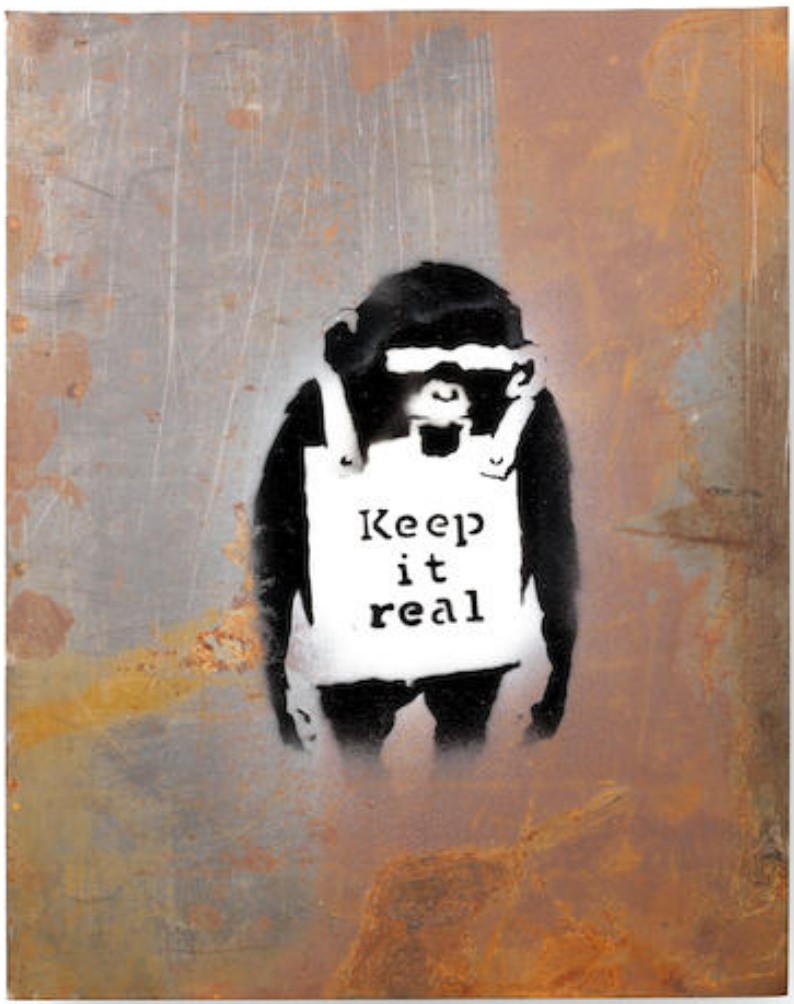
BANKSY
Keep It Real, 2006
Stencil spray-paint on found steel sheet
45.5 x 35.5 cm (18×14 inches)
Unique in this format
Signed and dated “2006” on the reverse
Auction History
| Bonhams London 11 February 2016 Est.: GBP 100,000 – 150,000 |
Price Realized GBP 194,500 / USD 234,305 Bonhams Keep it Real 2006 |
Keep It Real (Multiple)
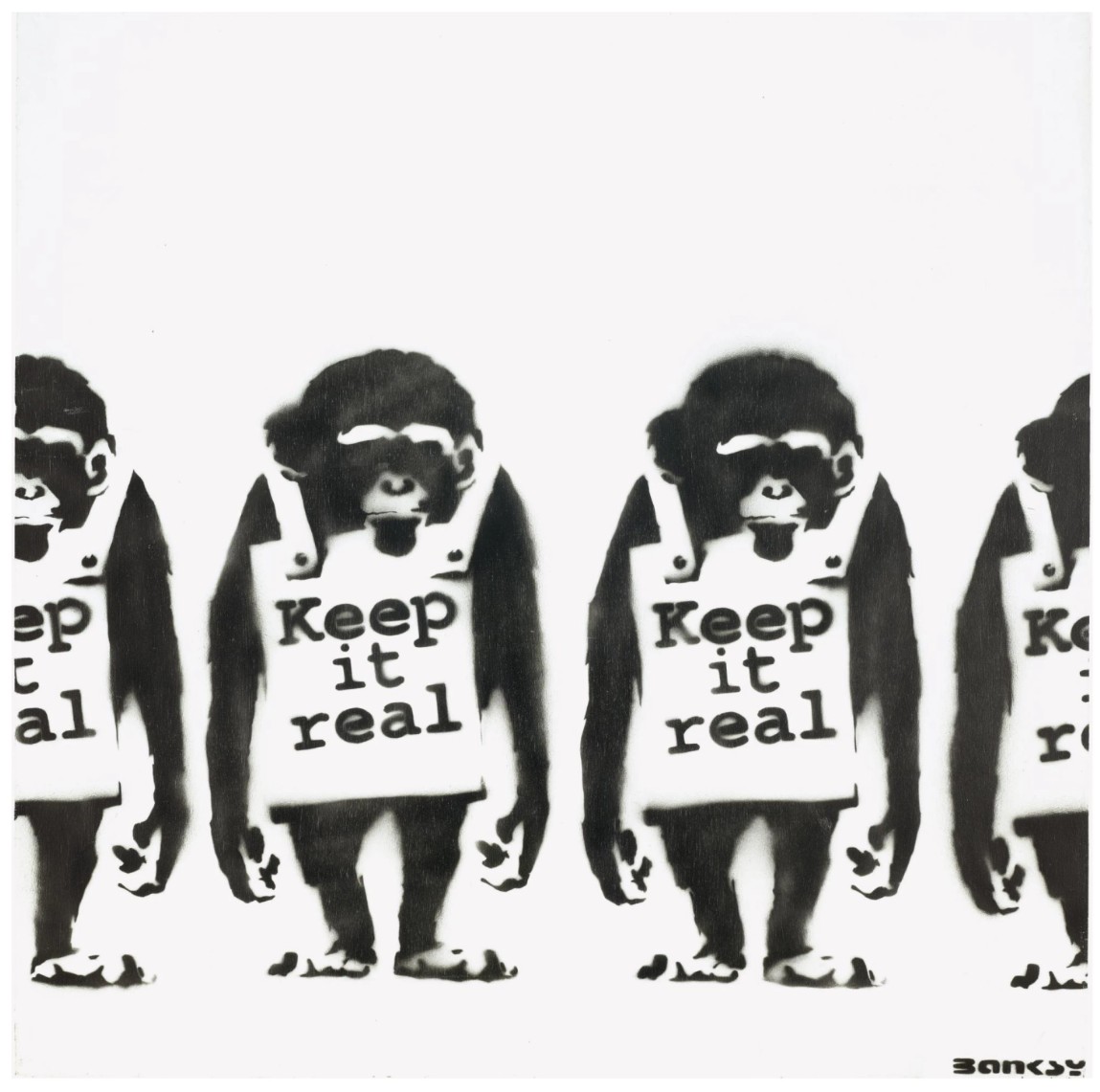
Monkeys, 2000
Auction History
| Sotheby’s London 22 June 2007 Est.: GBP 30,000 – 40,000 |
Price Realized
GBP 144,000 / USD 287,080
(#334) Banksy |