BANKSY
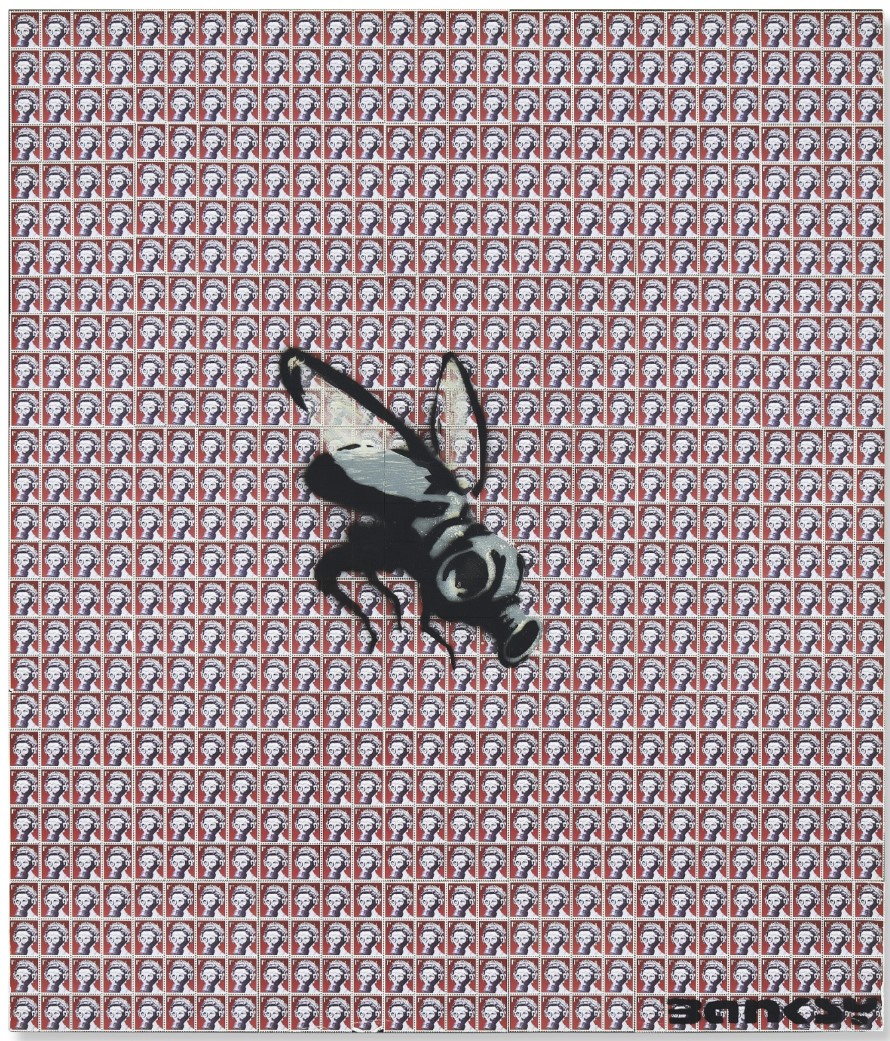
Mosquito, 2002
Spray-paint and emulsion on perforated card, mounted on board
80×90 cm (31 1/2 x 35 3/8 inches)
Stenciled-signed “BANKSY”, lower right
Provenance
Private Collection, Japan (acquired from the artist in 2002)
The present work was executed by Banksy at an event held in Japan in 2002.
Auction History
| Sotheby’s London 9 March 2017 Est.: GBP 30,000 – 40,000 |
Price Realized |
Catalogue Note
Executed in Japan in 2002, Mosquito is one of Banksy’s earliest and most conceptually layered examinations of power, surveillance, and authority. Against a painstaking mosaic composed of hundreds of postage stamps depicting Queen Elizabeth II wearing a gas mask, a single oversized mosquito hovers across the surface like an airborne intruder. The result is a composition that operates simultaneously as portrait, pattern, and political allegory.
At first glance, the mosquito appears threatening. Yet Banksy immediately undermines this expectation by fitting the insect itself with a gas mask. Deprived of its ability to bite, the mosquito becomes an absurd combatant, equipped for conflict while incapable of fulfilling its own violent purpose. The image therefore shifts from one of aggression to one of institutional absurdity, suggesting that militarization often becomes a spectacle detached from any rational objective.
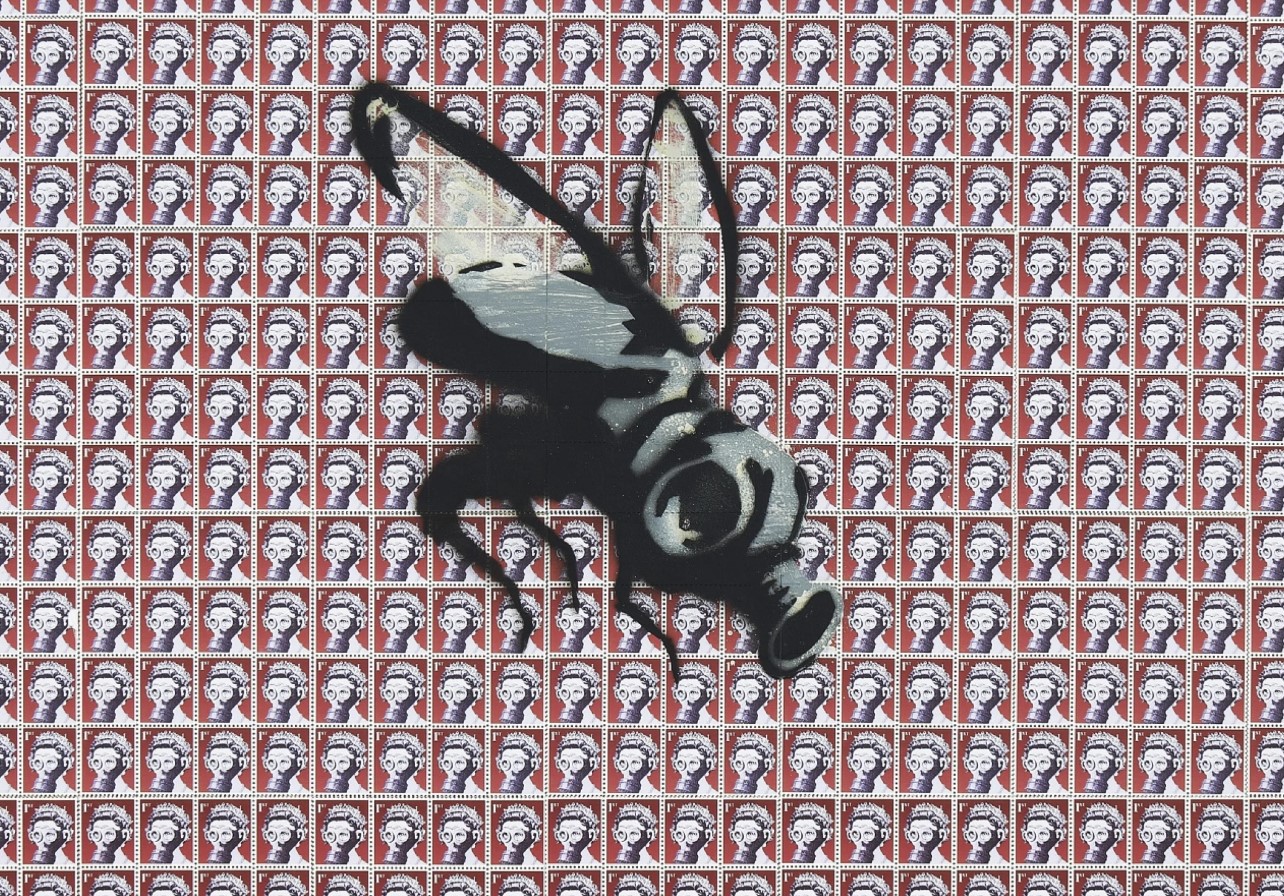
The background is equally significant. Constructed from hundreds of identical royal stamps, it evokes the machinery of the British state: monarchy, bureaucracy, national identity, and systems of circulation and control. Stamps are among the smallest yet most pervasive instruments of governmental authority, carrying the sovereign’s image into every corner of everyday life. By transforming them into a repetitive wallpaper, Banksy reduces royal iconography to the visual language of mass production, where authority derives less from uniqueness than from endless replication.
The gas mask, meanwhile, functions as one of Banksy’s defining symbols during the early 2000s. Appearing throughout works such as Monkey Queen, Toxic Mary, and numerous anti-war compositions, it evokes a society permanently conditioned by fear, conflict, and the anticipation of catastrophe. Here, both monarch and mosquito inhabit the same psychological landscape, blurring the distinction between protector and threat.

The mosquito itself is an inspired metaphor. Tiny, irritating, and seemingly insignificant, it nevertheless possesses the ability to spread fear disproportionate to its size. Like Banksy’s celebrated rats and monkeys, it represents the overlooked actor capable of unsettling far larger systems. Rather than celebrating brute force, Banksy repeatedly suggests that history is often disrupted by those considered too small to matter.

Executed at a pivotal moment in the artist’s career, Mosquito demonstrates Banksy’s growing mastery of visual economy. A handful of universally recognizable symbols—a stamp, a gas mask, an insect—are orchestrated into a meditation on power, repetition, and the fragility of authority. The work reminds us that empires, like mosquitoes, may appear indestructible from afar, yet both ultimately depend on the same fragile illusion: that fear alone is enough to sustain control.