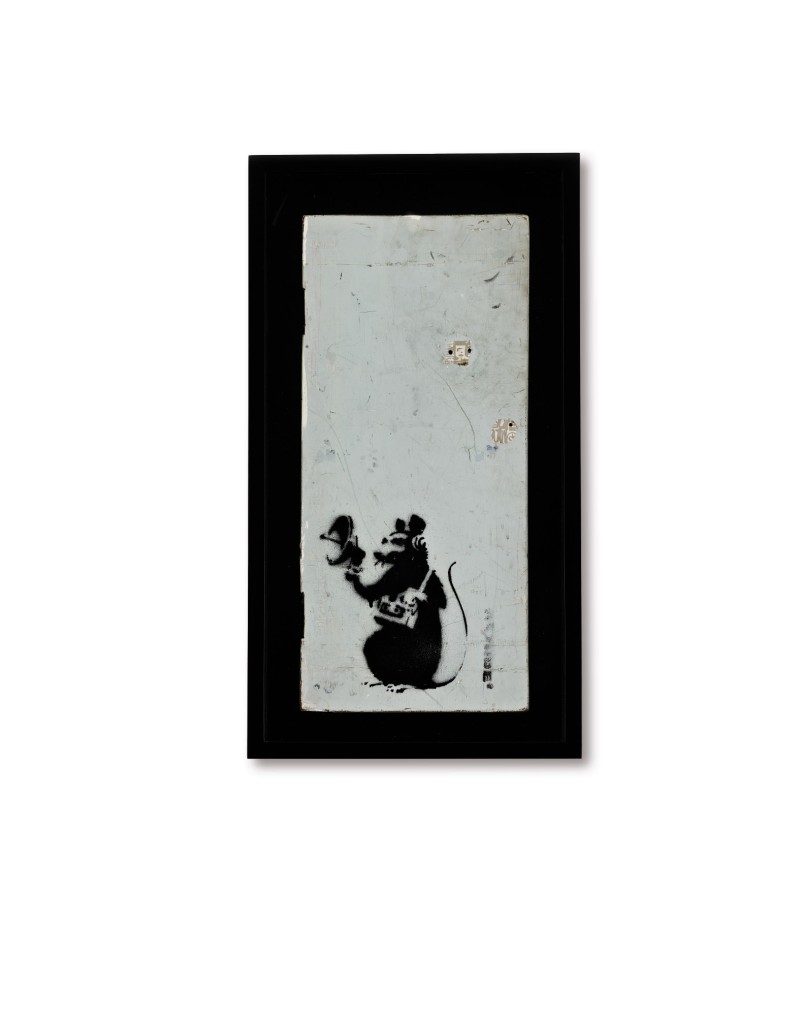
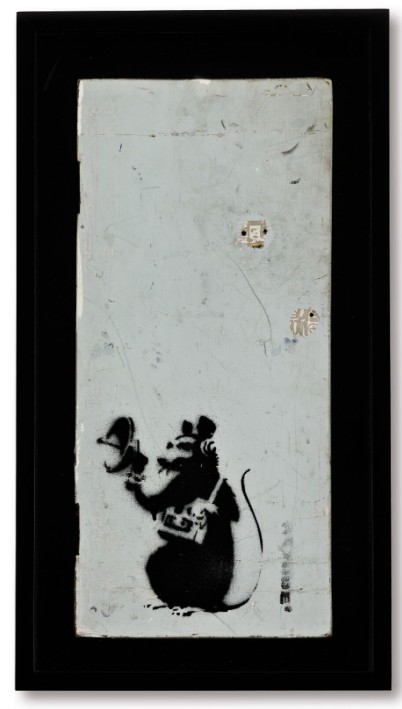
Radar Rat, 2003
Acquired directly from the artist by the present owner
Auction History
| Sotheby’s Hong-Kong 10 July 2020 Est.: HKD 800,000 – 1,500,000 |
Price Realized
HKD 5,455,000 / USD 703,815 |
Catalogue Note
Among Banksy’s enduring cast of urban protagonists, the rat occupies a singular position. Anonymous, resilient and endlessly adaptable, it became the artist’s alter ego during the early years of his career. Living unnoticed beneath the city while quietly resisting attempts at eradication, the rat perfectly embodies the street artist himself. In Radar Rat, Banksy transforms this familiar character into something even more subversive: not a vandal or revolutionary, but an intelligence operative.
Armed not with explosives or weapons but with a directional microphone and radio receiver, the rat appears absorbed in the invisible world of signals and communication. It is an image of remarkable restraint. The drama lies not in action but in observation. Banksy suggests that information itself has become the most powerful currency of the modern age.
Executed in 2003, Radar Rat emerged in the immediate aftermath of September 11, at a moment when surveillance rapidly became a defining feature of public life. Governments expanded intelligence gathering, CCTV networks proliferated across British cities, and debates surrounding privacy and state security began to reshape everyday experience. Throughout this period, Banksy repeatedly returned to themes of surveillance in works such as Masons, Spy Booth, and numerous CCTV interventions, questioning the increasingly blurred boundary between protection and control.
Yet Radar Rat introduces a subtle inversion. Rather than depicting citizens being watched, Banksy imagines the watcher being watched. The rat listens back. This simple reversal transforms the work from a critique of surveillance into a meditation on accountability. Knowledge no longer flows in only one direction. The smallest, most overlooked creature becomes capable of observing those who claim the exclusive right to observe everyone else.
The choice of support reinforces this idea beautifully. Painted directly onto a salvaged cupboard door, the work preserves the physical history of an ordinary domestic object. Scratches, marks and traces of previous use remain visible beneath the stencil, giving the surface the character of an urban wall layered with memory. Like many of Banksy’s finest originals, the support is not neutral but carries its own history, grounding the image firmly within the everyday environments from which his street practice emerged.
The rat itself remains one of Banksy’s most sophisticated inventions. Traditionally associated with disease, filth and social marginality, it becomes in his hands a symbol of survival, ingenuity and quiet resistance. Small enough to escape notice yet clever enough to outlive every attempt at extermination, the rat represents those who exist beyond the reach of established authority. It is perhaps no coincidence that Banksy once observed that rats “exist without permission”—much like graffiti itself.
Deceptively playful, Radar Rat ultimately reminds us that power increasingly resides not in physical force but in the control of information. The most dangerous figure is no longer the one carrying a gun, but the one carrying knowledge. Through one of his most beloved recurring characters, Banksy transforms an overlooked urban pest into a symbol of vigilance, resistance and intellectual freedom, proving once again that the smallest voices are often capable of hearing what the powerful would rather keep silent.