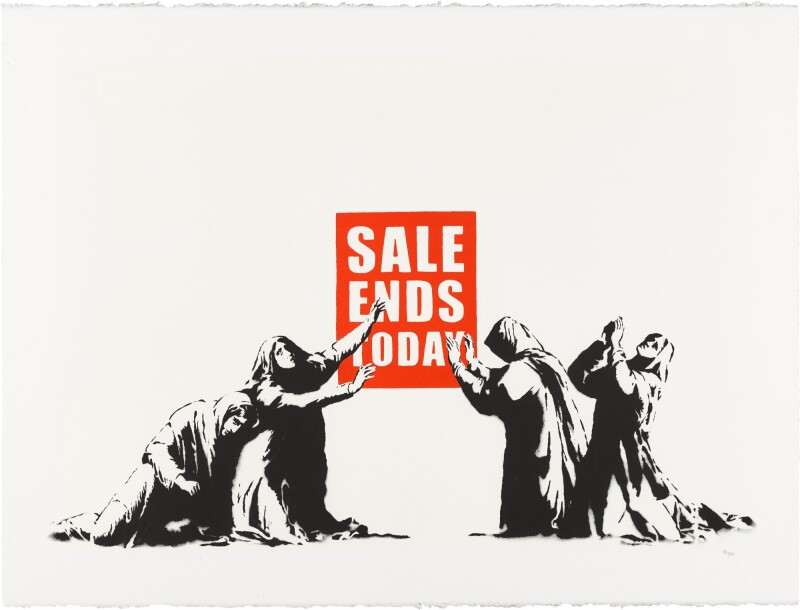
Sale Ends (LA Edition)
Year: 2006
Edition
Unsigned Edition: 500 unsigned (only 100 were printed)
Signed Edition: 150 signed
Printer’s Proofs: 6 signed PP
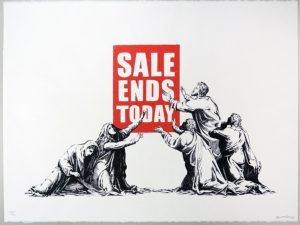
In Sale Ends, Banksy constructs one of his most incisive and visually refined critiques—where the language of devotion is no longer directed toward the divine, but toward the marketplace. The result is both immediate and unsettling: a scene of worship without transcendence. First conceived in 2006 for the landmark Barely Legal exhibition in Los Angeles, Sale Ends translates the visual grammar of religious painting into a contemporary context dominated by consumption. Drawing directly from the iconography of Renaissance lamentation scenes, Banksy replaces the object of devotion with a commercial imperative, collapsing centuries of spiritual tradition into a single, stark image.
Devotion Redirected
The composition presents a group of cloaked figures, positioned low to the ground, their bodies bent, arms extended upward in gestures of prayer, supplication, or mourning. Their forms unmistakably recall the lamenting figures traditionally depicted at the foot of the crucifixion. Yet there is no Christ. At the center of their attention stands a bold red sign: “SALE ENDS TODAY.”
The substitution is absolute. The sacred has not disappeared: it has been replaced. The figures appear suspended between grief and reverence, as if mourning not a death, but the imminent disappearance of opportunity: the end of the sale itself.

Banksy’s critique operates through equivalence. The gestures of faith, kneeling, reaching, imploring, are here redirected toward an object designed to stimulate consumption. The sign, typical of retail environments, becomes an icon. Its urgency replaces doctrine; its message replaces belief. The work suggests that consumer culture has not merely influenced society: it has adopted the structure of religion. Ritual, anticipation, collective behavior, and even a form of salvation are now embedded within the act of purchasing. The faithful have not vanished. They have changed object.
Rendered in Banksy’s signature stencil technique, the figures retain a sculptural, almost classical presence. Their drapery, posture, and grouping evoke art historical precedents, grounding the work in a visual tradition that extends far beyond street art. Against this, the red sign functions as a rupture: flat, graphic, immediate. Its visual language belongs not to painting, but to advertising. The collision is precise and deliberate.
Mourning the End of the Sale
One of the most subtle aspects of the work lies in its ambiguity. Are the figures worshipping the sale: or mourning its end? The phrase “SALE ENDS TODAY” introduces urgency, but also finality. The emotional intensity of the figures suggests loss, not anticipation. What is disappearing is not a product, but an opportunity to consume.

In this sense, Banksy captures something deeper: the anxiety embedded within consumer culture, where value is tied not to possession, but to access: and its imminent withdrawal. Sale Ends stands as one of Banksy’s most fully realized works: conceptually, visually, and historically. It bridges street art, art history, and market critique with unusual precision. More broadly, it remains one of the clearest articulations of Banksy’s central concern: not simply that we consume, but that we believe in it.
Estimated: HKD 21,000,000 – 28,000,000
Price realized: HKD 47,050,000 / USD 6,060,000

Sale Ends Today, 2006
Oil on canvas
213.4 x 426.7 cm (84×168 inches)
Through this work, Banksy points at the near-religious fervor with which contemporary society regards consumerism. The image can be interpreted as an ironic statement on the glorified, hegemonic status of capitalism and the market, commenting on the nearly religious nature of sales and of consumer goods worshipped by the masses.With its careful balance of satire and tradition, this work shows Banksy at the height of his creative talent. The people inSale Ends seem to be mourning the last day of the sale while simultaneously worshipping capitalism, making this an important piece of criticism as well as a striking work of art.
Release History
Barely Legal and the Original Edition (2006)
Sale Ends was first introduced in 2006 as part of the Barely Legal exhibition in Los Angeles, where it appeared both as a monumental original painting and as a print edition.
The original painting later achieved significant recognition, notably selling at auction for over $6 million in Hong Kong.

Version 2 and the End of Pictures on Walls (2017)

Auction Results
PLEASE CLICK BELOW FOR AUCTION RESULTS