Children Looking Toward the Sky
Bayswater, London
Center Point London
22 December 2025
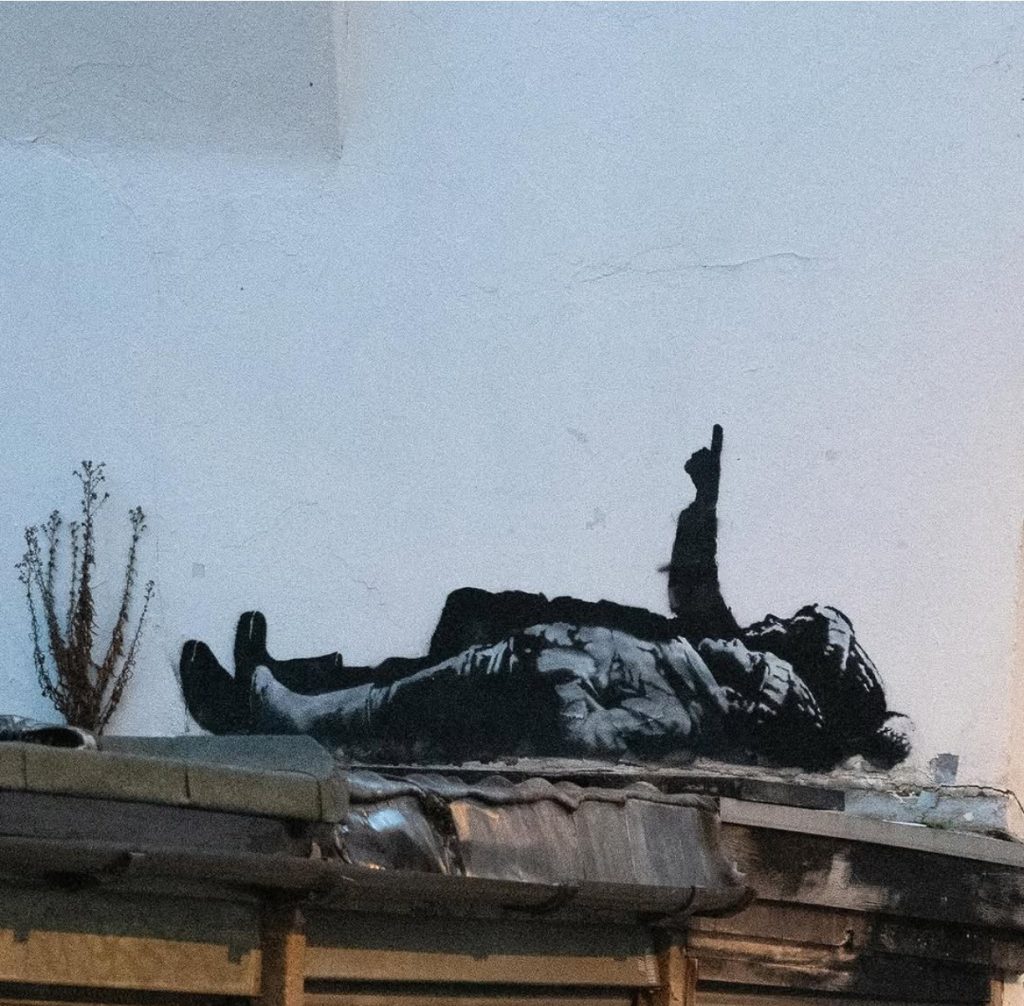
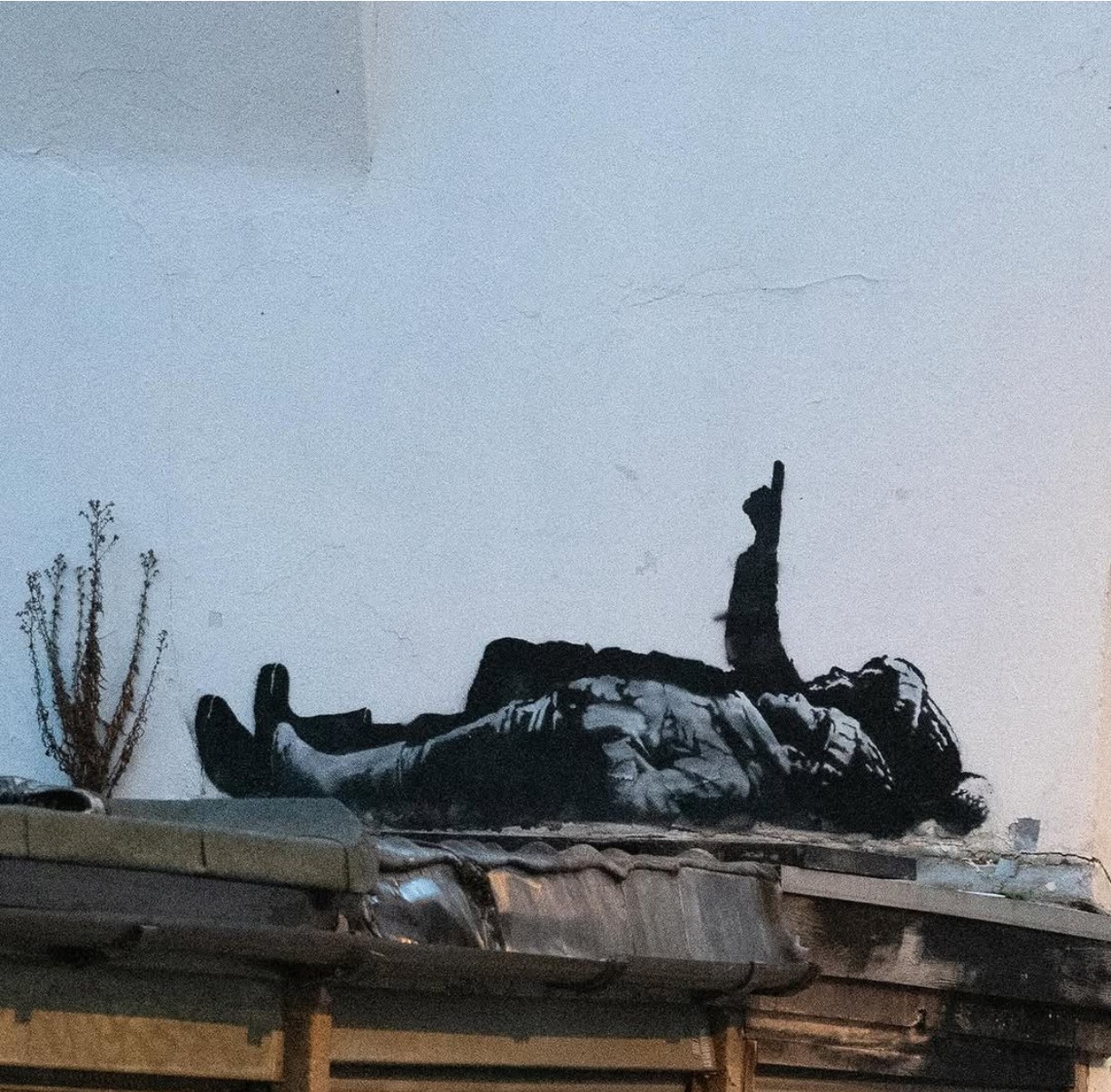
Confirmed by Banksy on 22 December 2025, these two identical murals appeared in London only days before Christmas, continuing the artist’s long tradition of year-end interventions focused on poverty, vulnerability, and social neglect. The works depict two children lying side by side on the cold ground, bundled in oversized winter coats, boots, and wool caps. One child quietly points upward toward the sky while the other lies motionless beside them. The gesture is simple, almost tender, yet profoundly ambiguous. Are they looking at the stars? Searching for hope? Following the North Star? Or merely trying to escape, mentally at least, the harsh reality beneath them?
The murals were installed in two very different parts of London: one at the foot of the iconic Centre Point Tower in Central London, the other atop a row of garages in Queen’s Mews near Hyde Park. Though visually identical, the duplication changes the way the image operates. Banksy rarely repeats the exact same mural in separate locations. Here, the repetition itself becomes meaningful, suggesting that homelessness, poverty, and displacement are not isolated tragedies but systemic conditions embedded throughout the city.
A Quiet Christmas Intervention
At first glance, the image feels unusually restrained for Banksy. There are no police officers, riot scenes, explosions, slogans, or obvious punchlines. The work relies instead on stillness and atmosphere. The children are not actively begging, crying, or protesting. They simply lie there, almost blending into the urban environment. That quietness is precisely what makes the murals unsettling.
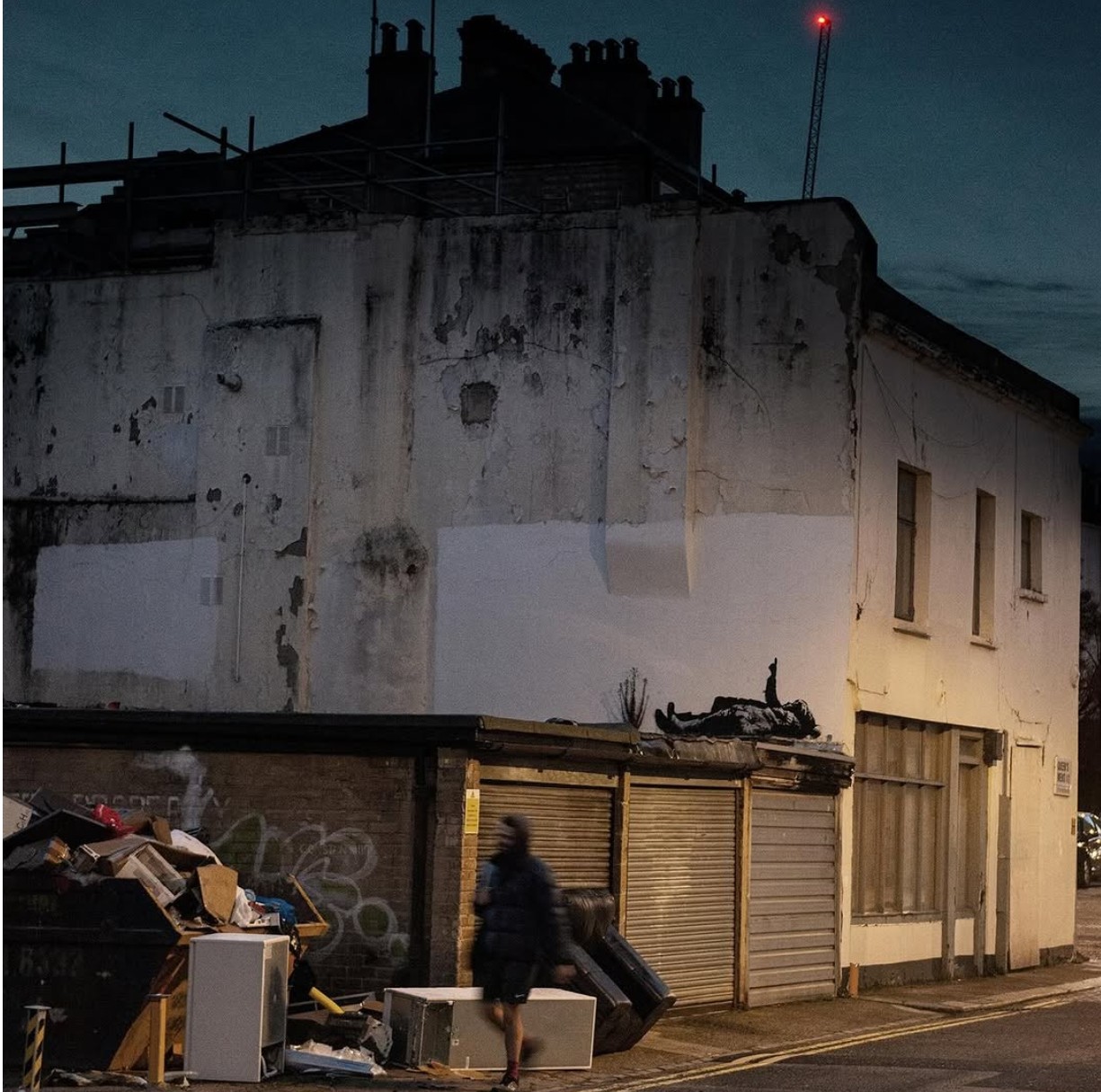
The scene recalls the visual language of nativity imagery and religious painting. Two vulnerable children lying outdoors in winter immediately evoke biblical associations of shelterlessness and hardship. The upward-pointing gesture introduces an almost spiritual dimension. Throughout Western art history, figures pointing toward the heavens often signify faith, revelation, transcendence, or hope beyond earthly suffering.
Yet Banksy deliberately avoids sentimentality. The children are not romanticized angels. They look exhausted, cold, and forgotten. The heavy coats and rough positioning suggest survival rather than innocence. This tension between tenderness and brutality has always been central to Banksy’s best work.
The Centre Point Location: Luxury Above, Poverty Below
The placement beneath Centre Point Tower is extraordinarily precise and historically loaded. Today, Centre Point is a luxury residential skyscraper in one of the most expensive areas of London. Yet the building carries a deeply controversial social history. Constructed in the 1960s as a speculative office tower, it famously stood empty for years during a severe housing crisis, becoming a national symbol of inequality and urban dysfunction.
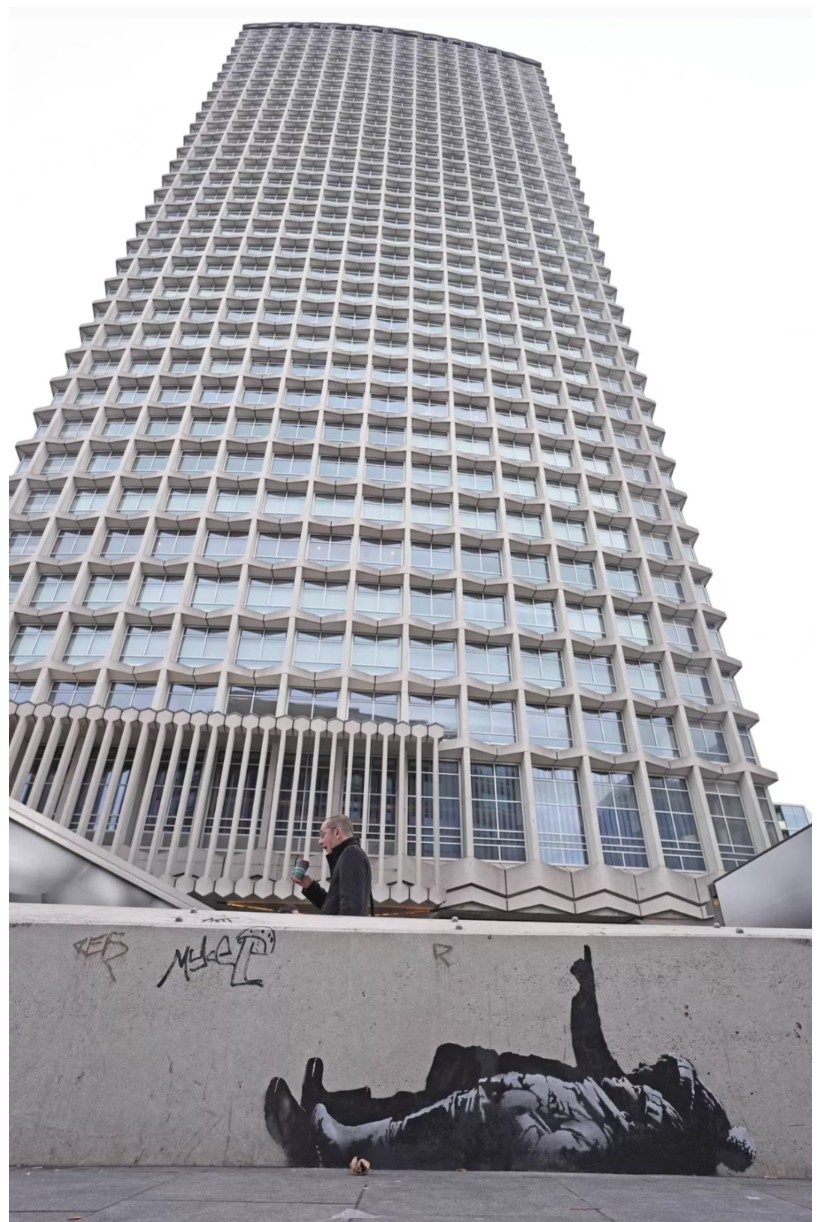
The homelessness charity Centrepoint itself was named in reaction to the tower. Reverend Ken Leech reportedly described the empty building as “an affront to the homeless.” Decades later, the irony has only intensified: the former symbol of empty speculative wealth has now been transformed into multimillion-pound luxury apartments in a city increasingly unaffordable for ordinary residents.
Banksy clearly understood this history. By placing two children seemingly sleeping on the pavement directly beneath the tower, the mural creates a brutal visual contrast between vertical wealth and horizontal vulnerability. Above them rises a monument to financial capital and luxury redevelopment. Below lie children who appear to have nowhere to go. The composition almost functions architecturally. The tower itself becomes part of the artwork, looming over the figures like an indifferent system.
The North Star and the Idea of Guidance
Much commentary surrounding the mural has focused on the upward-pointing child and the possibility that the figure references the North Star. If so, the symbolism would be highly significant. In Christian tradition, the star of Bethlehem guided travelers toward salvation and shelter. In broader cultural history, the North Star symbolizes orientation, guidance, hope, and survival. It has historically served as a navigational tool for travelers, migrants, and fugitives.
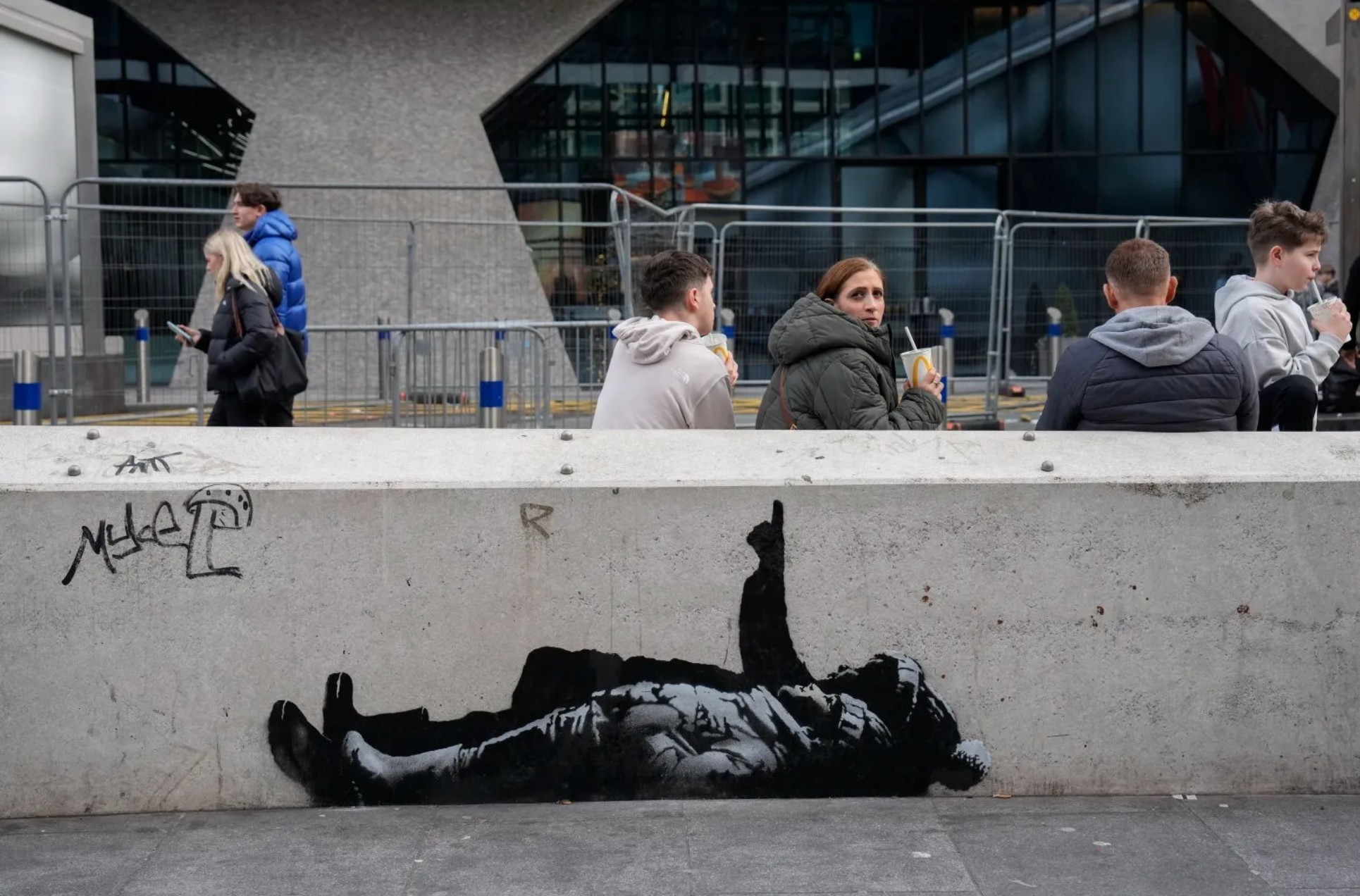
Banksy often employs simple gestures capable of carrying multiple symbolic readings simultaneously. Here, the pointing finger transforms the entire mural. Without it, the children might simply appear abandoned. With it, the image acquires aspiration, imagination, and perhaps even resistance. The gesture also introduces a painful irony. The children look upward while society walks past them looking straight ahead.
The Public Walking Past
One of the most powerful aspects of the Centre Point mural was not the artwork itself but the public reaction around it. Observers noted how commuters continued walking past the image without stopping, even after the mural became internationally known. This detail echoes one of Banksy’s recurring concerns: the normalization of suffering within urban life. Modern cities train people to stop seeing certain things. Homelessness becomes background scenery. Poverty becomes invisible through repetition.
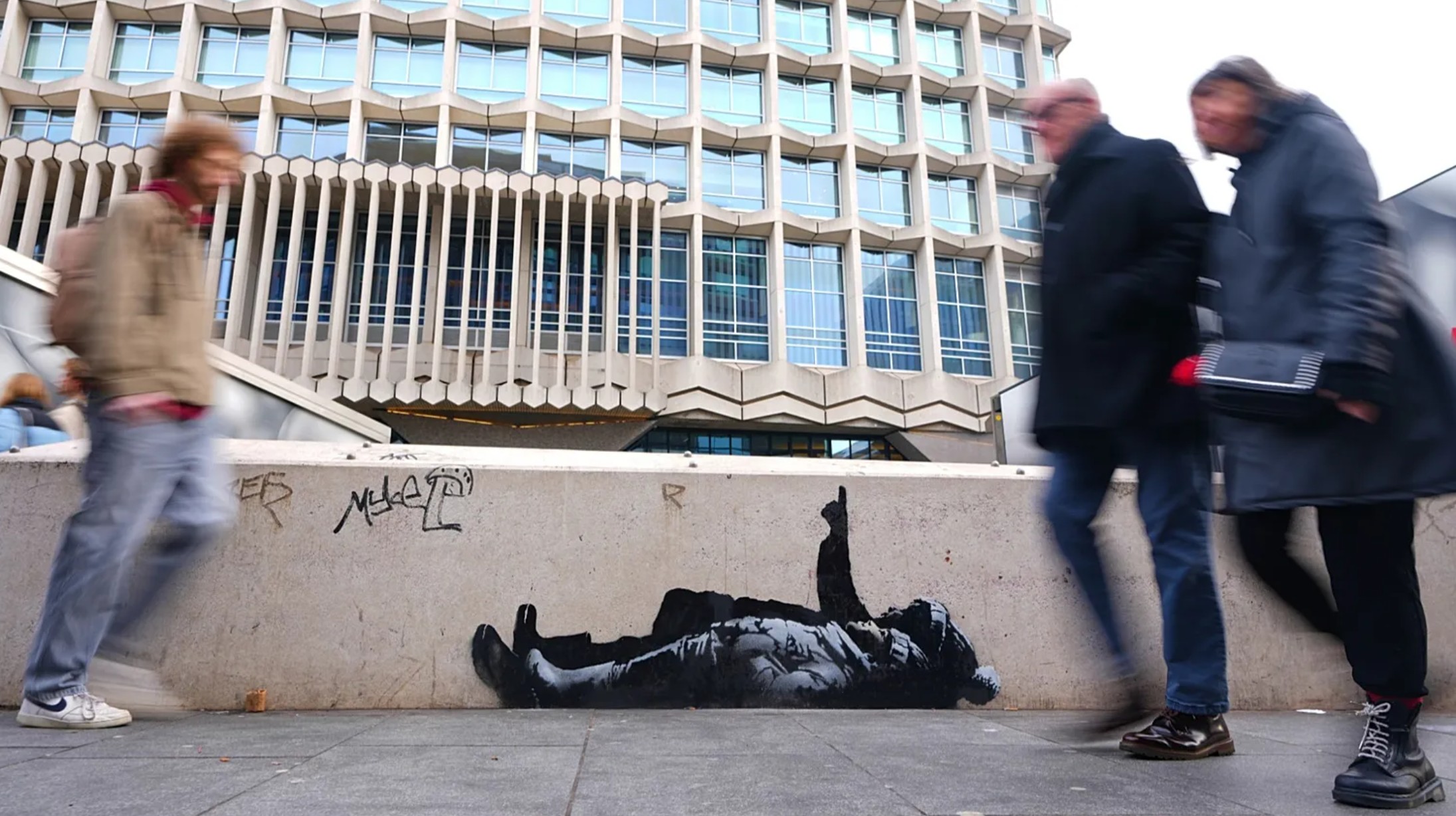
Banksy has explored this idea repeatedly throughout his career, particularly in works involving children, migrants, refugees, or rough sleepers. Like Homeless Ryan in Birmingham or Season’s Greetings in Port Talbot, these murals force viewers to confront realities they are socially conditioned to ignore.
The irony is devastating: Londoners rushing beneath one of the world’s most photographed new Banksy murals are replicating the exact indifference the artwork criticizes.
A Dialogue With Earlier Christmas Murals
The twin murals belong clearly within Banksy’s growing cycle of winter and Christmas-themed interventions.
Season’s Greetings (Port Talbot, 2018) depicted a child joyfully catching what appeared to be snow, only for viewers to realize the “snow” was actually ash from an industrial fire. Homeless Ryan (Birmingham, 2019) transformed a homeless man sleeping on a bench into part of a makeshift reindeer sleigh scene, mixing festive imagery with brutal social commentary.
Like those works, the 2025 murals weaponize the emotional language of Christmas against modern urban inequality. Christmas traditionally represents warmth, shelter, generosity, and collective care. Banksy instead shows children lying outdoors in winter beneath symbols of immense wealth and redevelopment. The contrast becomes the message.
Importantly, Banksy avoids turning the children into passive victims. There remains dignity in the image. The upward gesture suggests imagination and emotional resilience despite deprivation. That subtle humanity prevents the work from collapsing into pure miserabilism.
A Meditation on Visibility
The existence of two identical murals introduces another fascinating dimension. Banksy’s works are usually site-specific singular events. By duplicating the image, he almost creates a network across London—a visual echo between different neighborhoods and social realities. One appears beneath a global symbol of luxury redevelopment in central London; the other emerges quietly in a more residential and overlooked corner near Bayswater. The duplication suggests that homelessness and precarity are not confined to isolated districts. They permeate the entire urban fabric. There is also something cinematic about the repetition. The murals resemble two still frames from the same story appearing simultaneously across the city. It creates the sensation that these children could be anywhere.
Perhaps more than anything, these murals are about visibility: who gets seen, who gets ignored, and what modern cities choose to value. Banksy has always understood that contemporary urban environments are structured around spectacle. Towers, advertisements, luxury developments, and illuminated storefronts dominate attention. Meanwhile, vulnerable human beings become visually erased despite occupying the same spaces.
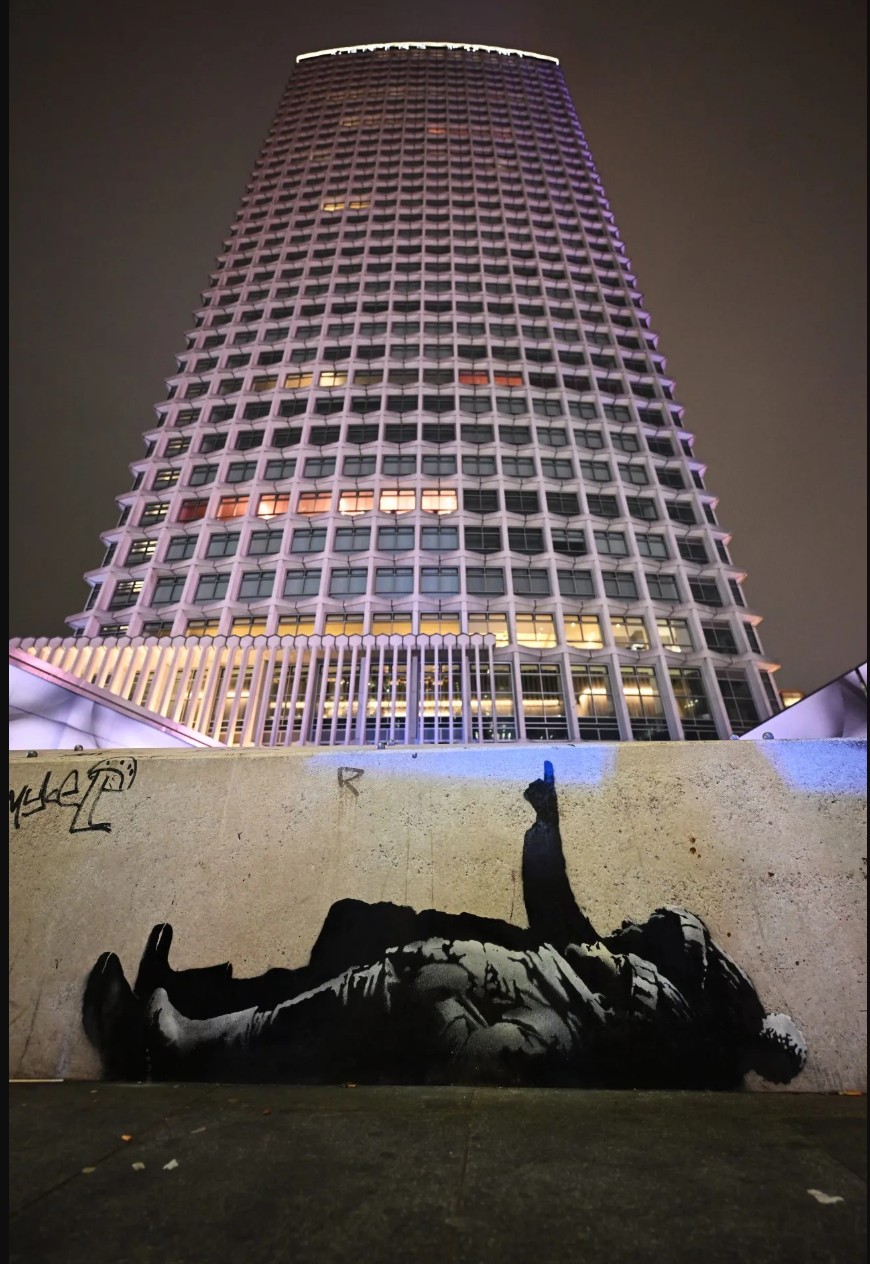
Here, the children lie almost flush against the architecture itself, nearly dissolving into the city around them. The black-and-white stencil aesthetic reinforces this effect, making them appear ghostlike or already forgotten. And yet one small finger points upward. That tiny gesture prevents the work from becoming hopeless. It introduces wonder, imagination, and perhaps even faith into an otherwise brutal urban landscape. The children may have nothing, but they still possess the capacity to dream beyond the concrete surrounding them.
In classic Banksy fashion, the image remains accessible enough for a passerby to understand in seconds while carrying layers of political, historical, and emotional complexity underneath. It is simultaneously a Christmas image, a homelessness statement, an architectural critique, and a meditation on how modern societies learn not to see suffering. Quietly, almost gently, Banksy turns two children lying on the pavement into one of the most haunting social images of the year.