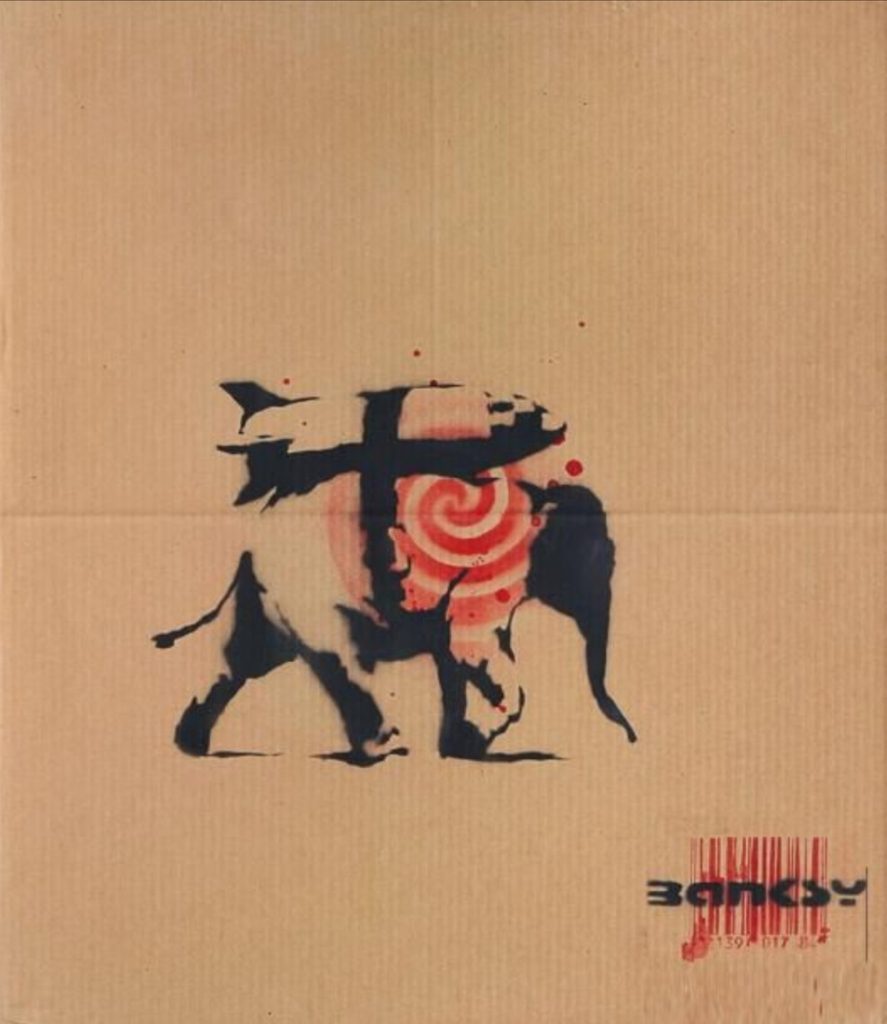
BANKSY (Britannique, né en 1975)
Heavy Weaponry (over Radar Rat), 2002
Spray paint on cardboard
75×65 cm (29-1/2 x 25-1/2 inches)
Signed with artist tag and barcode stencil lower right
Provenance
Gifted by the artist to the original owner
Auction History
Digard Auctions: 11 June 2014
Estimated: EUR 60,000 – 80,000
EUR 109,968 / USD 148,800
BANKSY (Britannique, né en 1975) – Lot 67
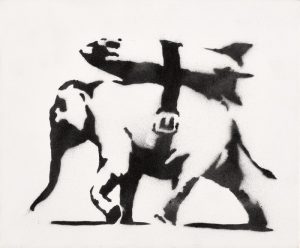
Among Banksy’s earliest studio works, Heavy Weaponry (over Radar Rat) is a remarkable hybrid composition that brings together two of the artist’s most recognizable early motifs: the elephant carrying a missile from Heavy Weaponry and the hypnotic spiral associated with Radar Rat. Executed in spray paint on corrugated cardboard, the work predates the commercial editions of both images and offers a rare glimpse into Banksy’s creative process at a moment when his visual vocabulary was still taking shape.
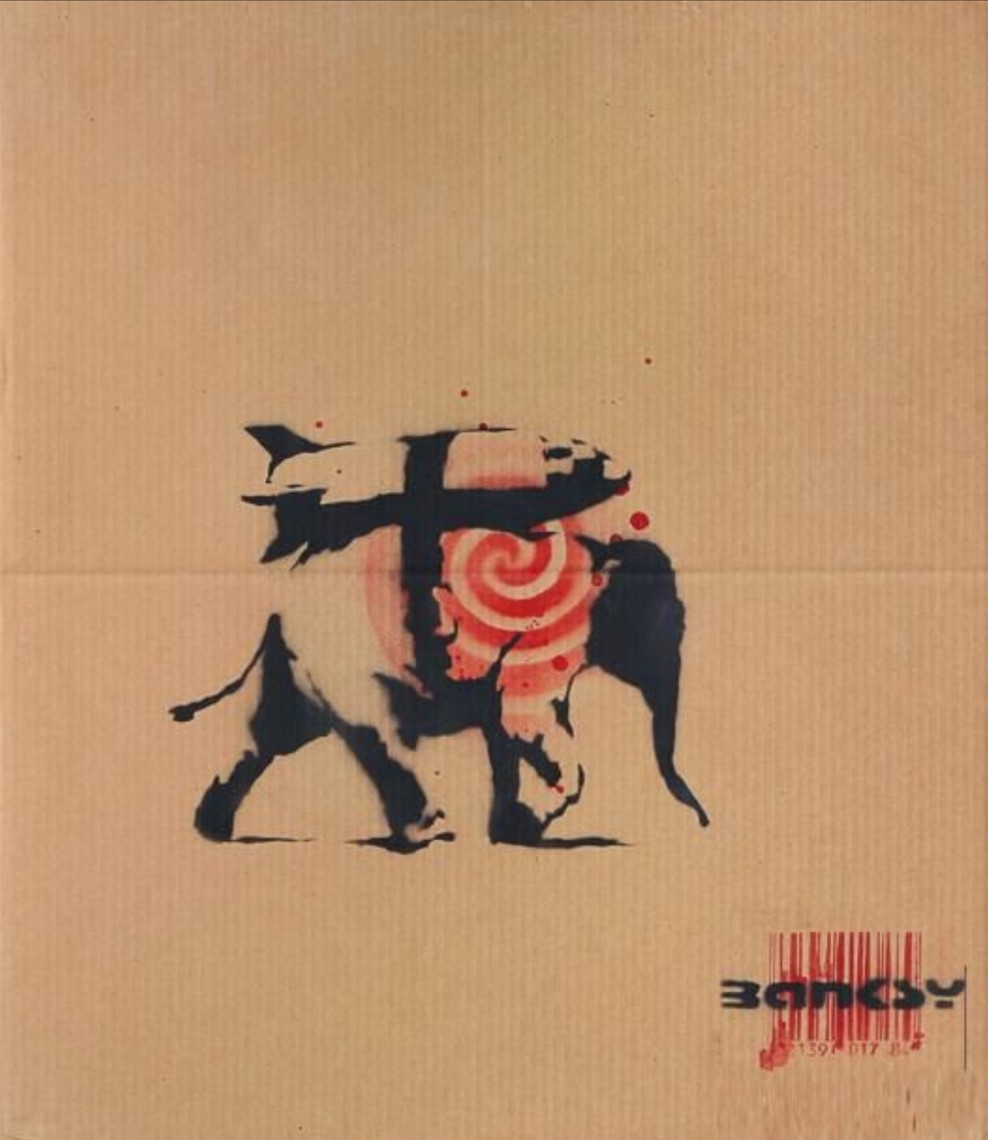
The composition is striking in its economy. Against the raw surface of recycled cardboard, Banksy depicts the silhouette of an elephant advancing across the picture plane. Balanced improbably on its back is a cruise missile, rendered as though it were an ordinary burden. Behind the animal, a vivid red spiral radiates from its body, recalling the hypnotic target motif later associated with Radar Rat. In the lower right corner appears Banksy’s early stenciled barcode logo, itself an icon of his critique of consumer society.
The elephant occupies a recurring place within Banksy’s early iconography. Universally associated with strength, memory and peaceful majesty, it is transformed into a beast of burden carrying one of humanity’s most destructive inventions. The juxtaposition is deliberately absurd. The missile appears almost weightless, as though warfare had become so commonplace that even nature has learned to carry it without resistance. As in many of Banksy’s early works, humor softens the image while simultaneously making its underlying critique all the more unsettling.
The addition of the Radar Rat spiral enriches the composition considerably. Rather than functioning simply as a decorative background, the concentric target introduces ideas of surveillance, detection and control. It evokes radar screens, military targeting systems and the invisible technologies through which modern warfare is conducted. Positioned directly behind the elephant, the spiral also suggests a hypnotic force, as though both nature and society had become trapped within the orbit of militarisation. The work therefore moves beyond a straightforward anti-war statement to become a meditation on the pervasive reach of military culture.
This combination of two independent visual ideas is particularly significant. Heavy Weaponry and Radar Rat originally existed as separate street interventions before each developed into important editions in Banksy’s print catalogue. Bringing them together on a unique cardboard support demonstrates Banksy’s willingness to recombine and reinterpret his own imagery rather than treating each motif as a fixed composition. The work functions almost like a visual laboratory, revealing how his symbols evolved through experimentation long before they became widely recognised icons.
The choice of cardboard is equally characteristic of Banksy’s early practice. During the early 2000s he frequently worked on found materials—plywood, cardboard, metal sheets and reclaimed objects—that retained their utilitarian character rather than imitating the conventions of traditional painting. Here, the corrugated surface remains fully visible, reinforcing the work’s direct connection to the street. The humble support also echoes the precariousness of the subject itself. Cardboard is temporary, fragile and disposable, standing in stark contrast to the permanence and destructive power of the missile it carries.
Created in 2002, the work belongs to a pivotal moment in Banksy’s career. It was produced shortly before his breakthrough exhibitions Turf War (2003) and Crude Oils (2005), at a time when his artistic language was becoming increasingly concise and symbolic. Rather than depicting explicit scenes of conflict, Banksy was beginning to communicate political ideas through instantly recognisable metaphors—animals, toys, children and everyday objects transformed into powerful vehicles of social commentary. This visual economy would become one of the defining characteristics of his mature work.
The elephant carrying a missile also anticipates many later themes in Banksy’s oeuvre. Throughout his career, he repeatedly employed animals to expose human folly. Rats, monkeys, elephants, dolphins and birds become unwilling participants in conflicts they neither created nor understand. By assigning human violence to the natural world, Banksy reveals its absurdity. The animal remains innocent; only the burden belongs to humanity.
The work’s provenance further enhances its significance. Gifted directly by the artist to its original owner, Heavy Weaponry (over Radar Rat) possesses an intimacy rarely encountered among Banksy’s early originals. It is not simply an early variation of familiar imagery but a unique synthesis of two foundational motifs that would later assume independent importance within his body of work.
Today, Heavy Weaponry (over Radar Rat) stands as an exceptional document of Banksy’s formative years. It captures an artist refining the symbolic language that would soon make him internationally recognized, demonstrating his remarkable ability to condense complex political ideas into images of extraordinary clarity. Combining two of his earliest visual inventions into a single composition, the work illustrates that Banksy’s greatest strength has never been the invention of isolated icons, but the creation of a coherent symbolic universe in which each image continually informs and enriches the others.