Golf Sale
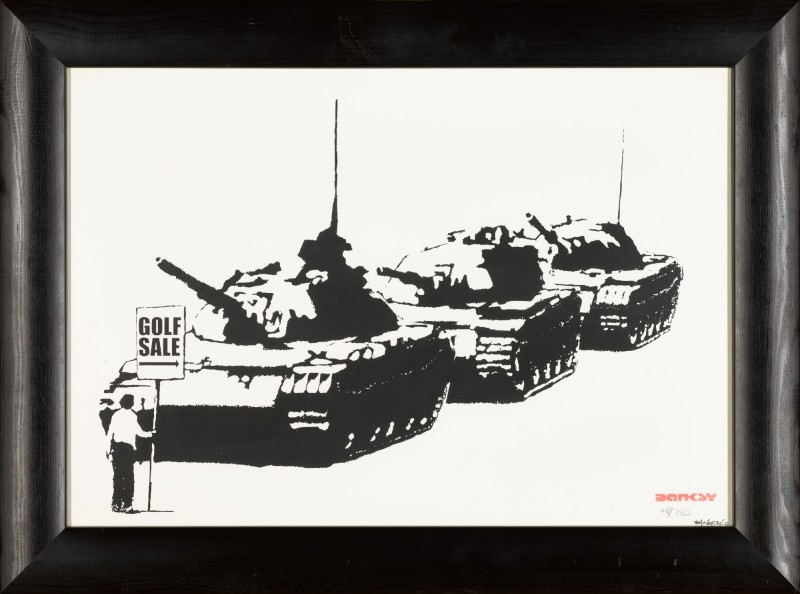
Medium: Screenprint in black on wove paper
Year: 2003
Sheet: 35×50 cm (13 5/8 x 19 1/2 inches)
Printer & Publisher: Pictures on Walls, London
Editions
Edition: 750 (of which 150 signed)
Signature and Numbering
Banksy Red Ink Stamp as issued
Numbered in pencil, lower right
Signed and in black ink, lower right
Numbered in pencil, lower left (for the signed prints)
A Study in Defiance and Absurdity
With Golf Sale, Banksy reinterprets one of the most powerful images of the twentieth century, transforming an act of profound political courage into a scene of quiet absurdity. By inserting a banal commercial message into a moment historically defined by resistance, Banksy exposes the fragility of meaning in a world increasingly shaped by distraction and consumption.
“In 1998, a young Chinese student’s sacrifice taught a valuable lesson to the world. A lesson Banksy has tried to cheapen with glib humor and crass opportunism but that still remains very potent. God Bless That Man.”
The composition is immediately recognizable. A lone figure stands in the path of a line of advancing tanks. The vehicles, rendered in stark perspective, recede into the background, forming a rigid and imposing structure of force. At the center, the man faces them: still, upright, and exposed. But Banksy introduces a decisive alteration. Instead of standing empty-handed, the figure holds a sign reading: “GOLF SALE”

The typography recalls the everyday visual language of urban commerce: simple, direct, almost forgettable. This insertion disrupts the entire scene. The gravity of the moment is not erased, but displaced, reframed through an object that carries no political weight, no urgency, no resistance. The image remains entirely monochrome. Clean, controlled, and stripped of excess, it allows the contradiction to unfold without interference.
What makes Golf Sale particularly effective is the precision of its intervention. Nothing in the composition is exaggerated. Nothing is added beyond the sign. And yet, everything changes. The figure remains in front of the tanks, but his purpose is now ambiguous. Is he resisting? Advertising? Distracted? The work refuses to resolve this tension. In doing so, Banksy raises a more uncomfortable question: What happens when systems of consumption begin to overwrite systems of meaning?
When Meaning Collapses
At its core, Golf Sale is not merely a critique of consumerism—it is a meditation on the erosion of meaning. The original image, captured by Jeff Widener in the aftermath of the 1989 Chinese Democracy Movement, is widely regarded as one of the most significant acts of non-violent resistance in modern history. The solitary figure—often referred to as “Tank Man”—embodies defiance, courage, and moral clarity.

Banksy does not recreate this image to honor it. He destabilizes it. By replacing the gesture of resistance with a commercial sign, he introduces a dissonance that is both absurd and deeply unsettling. The implications unfold gradually: heroism is replaced by banality, resistance is overshadowed by distraction, meaning is diluted by the language of commerce The work suggests a world in which even the most powerful symbols can be absorbed, neutralized, and recontextualized within systems of consumption.
“We can’t do anything to change the world until capitalism crumbles.
In the meantime, we should all go shopping to console ourselves.”

Golf Sale is directly based on the iconic photograph taken in 1989 during the aftermath of the Tiananmen Square protests. The original image quickly became a global symbol of resistance against authoritarian power. By 2003, Banksy revisits this image within his own visual language, translating it into stencil form and releasing it as a print through Pictures on Walls (POW). This moment reflects a key development in his practice: the appropriation of historical imagery and the transformation of documentary into commentary

The Tiananmen Square protests were student-led demonstration held in Tiananmen Square in Beijing during 1989. Military troops armed with assault rifles and accompanied by tanks fired at the demonstrators and those trying to block the military’s advance into Tiananmen Square in what is known as the Tiananmen Square Massacre. The protests started on April 15 and were forcibly suppressed on June 4 when the government declared martial law and sent the People’s Liberation Army to occupy parts of central Beijing. Estimates of the death toll vary from several hundred to several thousand, with thousands more wounded.
Jeff Widener, a photographer with the Associated Press, was focusing his camera on a line of tanks in Beijing’s Tiananmen Square when out of the blue came this man in a white shirt and dark trousers, carrying what appeared to be shopping bags. At first, Widener was annoyed by the man entering his shot, he thought the man was going to mess up the composition of his frame. Little did he know that he was about to make one of the most iconic photos in history.
Golf Sale stands as one of Banksy’s most intellectually controlled appropriations. Its power lies not in visual complexity, but in conceptual clarity: a universally recognized image, with just a single, minimal alteration, leads to a complete transformation of meaning… Golf Sale does not mock the original act, it only displaces it. A man still stands before tanks. But the meaning of that gesture has shifted. And in that shift, Banksy reveals something profoundly unsettling: that even the most powerful symbols of resistance are not immune to being absorbed, diluted, and quietly rewritten.
Auction Results
PLEASE CLICK BELOW FOR AUCTION RESULTS