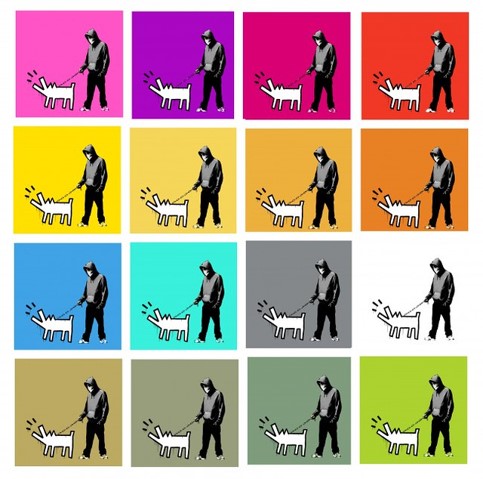
Choose Your Weapon
Editions
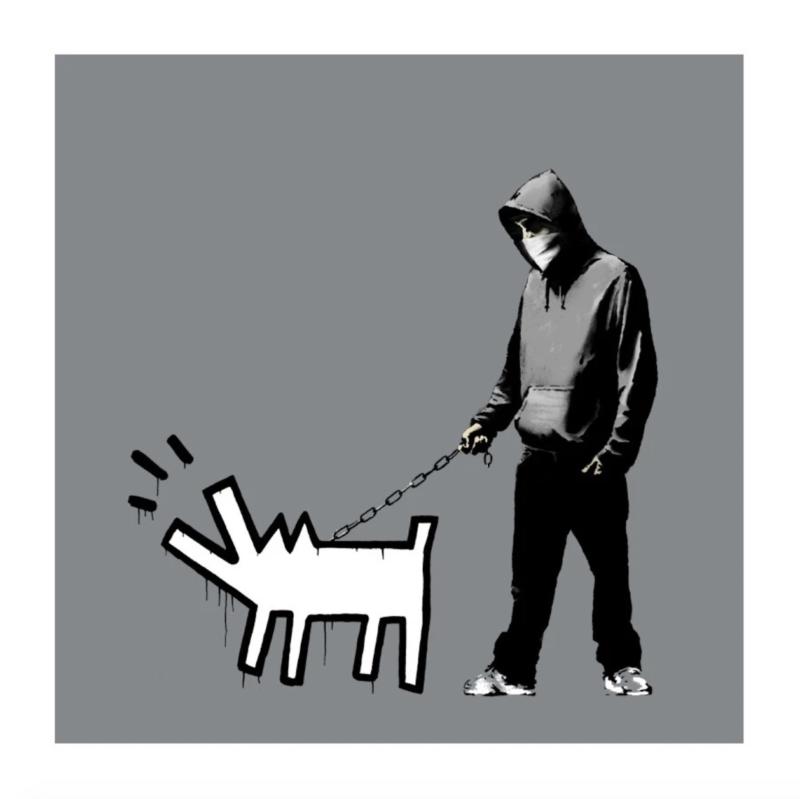
Choose Your Weapon (Grey): 100 signed
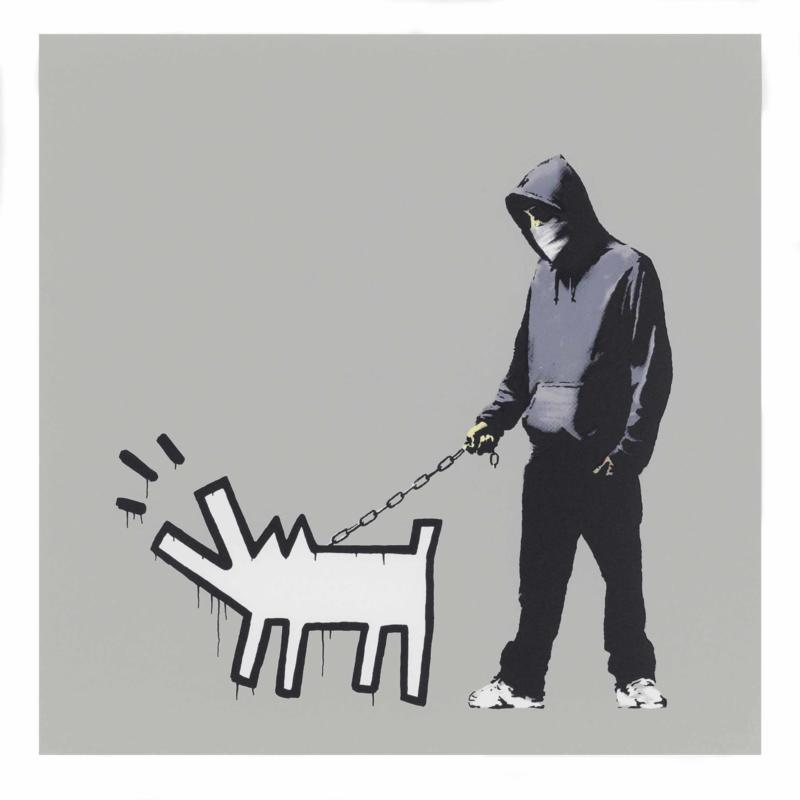
Choose Your Weapon (Warm Grey – Queue Jumper): 58 signed
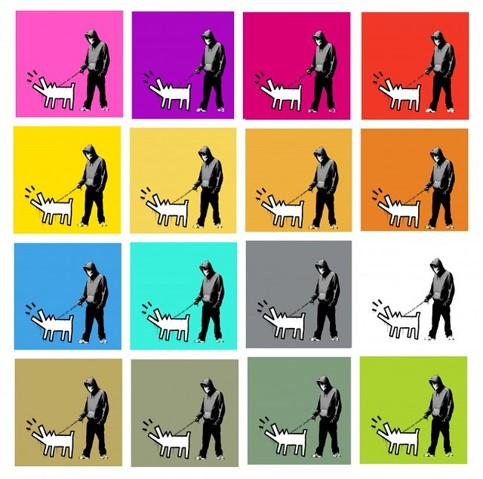
Colorway Editions
14 regular colorways: 25 signed each
Bright Pink, Bright Purple, Dark Orange, Khaki, Light Orange, Slate
Soft Yellow, Turquoise, Lemon, Olive, Magenta, Red, Sky Blue, Green
3 VIP Editions: 25 signed each
Gold, Silver, White
Some prints from the White VIP Editions are hand-finished with red dots
Artist’s Proofs Edition
Total Edition: 58 signed AP
17 different colorways
Numbering and Signature
Signed in crayon with matching color, lower right
Numbered in crayon with matching color, lower left
Introduction
With Choose Your Weapon, Banksy produced one of the most concentrated and memorable images of his later print practice: a hooded young man, masked and self-contained, walking a barking dog that is not rendered in Banksy’s own naturalistic stencil style, but in the unmistakable graphic language of Keith Haring. The work is at once a portrait of urban aggression, a reflection on disaffected youth in Britain, and an art-historical homage that turns another artist’s iconic motif into a live instrument of social commentary.
“Graffiti is one of the few tools you have if you have almost nothing. And even if you don’t come up with a picture to cure world poverty, you can make someone smile while they are having a piss.”
The composition is deceptively simple. A young man stands in profile, his face partly hidden by a bandana and his head covered by an oversized hood. One hand remains in his pocket, lending him an air of almost studied detachment, while the other holds a chain leash attached to a barking dog. The man is rendered with Banksy’s characteristic tonal precision and near-photographic realism, whereas the dog appears as a flat, hieroglyphic white silhouette, stylized and abrupt. This contrast is the engine of the image: realism and cartoon, menace and wit, contemporary street presence and inherited visual code.

That formal opposition gives the work much of its charge. The figure is heavy, grounded, and psychologically closed. The dog, by contrast, is graphic, almost absurd in its clarity, yet aggressively alive. The chain joins the two worlds. It binds a contemporary urban body to a symbol lifted from the history of graffiti and pop-inflected activism. The result is not merely stylish. It is a compressed statement about how aggression is performed, outsourced, aestheticized, and controlled.
What Is the “Weapon”?
The title is doing a great deal of work. Choose Your Weapon suggests decision, alignment, and perhaps even a code of survival. On its most immediate level, the work has often been read as a commentary on British gang culture and on the way aggressive dogs became extensions of masculine identity and street power in certain urban contexts. The chained barking dog operates as a substitute weapon, a proxy for threat, intimidation, and control. Banksy presents this with remarkable economy: he does not show violence itself, but the apparatus of possible violence.

Yet the title opens into a second reading, and this is where the work becomes far richer. The dog is a Keith Haring dog. That means the “weapon” is not only a literal animal associated with menace, but also a cultural image inherited from another artist. Banksy seems to suggest that images themselves can function as weapons: weapons of protest, recognition, defiance, and public communication. In that sense, the work asks a deeper question than its title first implies: not only what kind of threat one chooses, but what kind of language one chooses to confront the world.
This is what gives the image its unusual tension. The young man appears emotionally muted, even casual, with one hand in his pocket, but the dog is all noise, tension, and declaration. The weapon is both external and symbolic. It is brute force, yes, but it is also style, iconography, and cultural inheritance. Banksy, characteristically, does not resolve the contradiction. He lets it remain active.

Choose Your Weapon endures because it manages to be legible at first glance and richer on second thought. The image can be read immediately as a portrait of urban menace and disaffection. But it also rewards a more informed viewer, because the Haring quotation opens the work into a conversation about artistic lineage, street art history, and the transformation of symbols across generations. The dog is not merely barking. It is speaking in two dialects at once.
It also remains important because it captures something central to Banksy’s intelligence: his ability to build a serious social proposition out of a single, visually economical confrontation. A masked youth, a chain, a barking dog, a field of color. That is all. And yet the work touches on gang culture, public fear, performative masculinity, the inheritance of graffiti language, and the possibility that art itself may be a chosen weapon—one capable of confronting violence without imitating it.

Choose Your Weapon is one of Banksy’s most elegant compressions of threat and thought. A young man appears to walk an aggressive dog, but the dog comes from another artist’s world, and that changes everything. What first seems like a portrait of intimidation becomes, on closer inspection, a work about the transmission of visual power itself. The chain binds more than man to animal. It binds one era of street art to another, one language of protest to another, one weapon to another. Banksy’s title remains deliberately unresolved, and that is precisely why it lasts. The work does not tell us what to choose. It simply reminds us that we already have.
Keith Haring and the Barking Dog
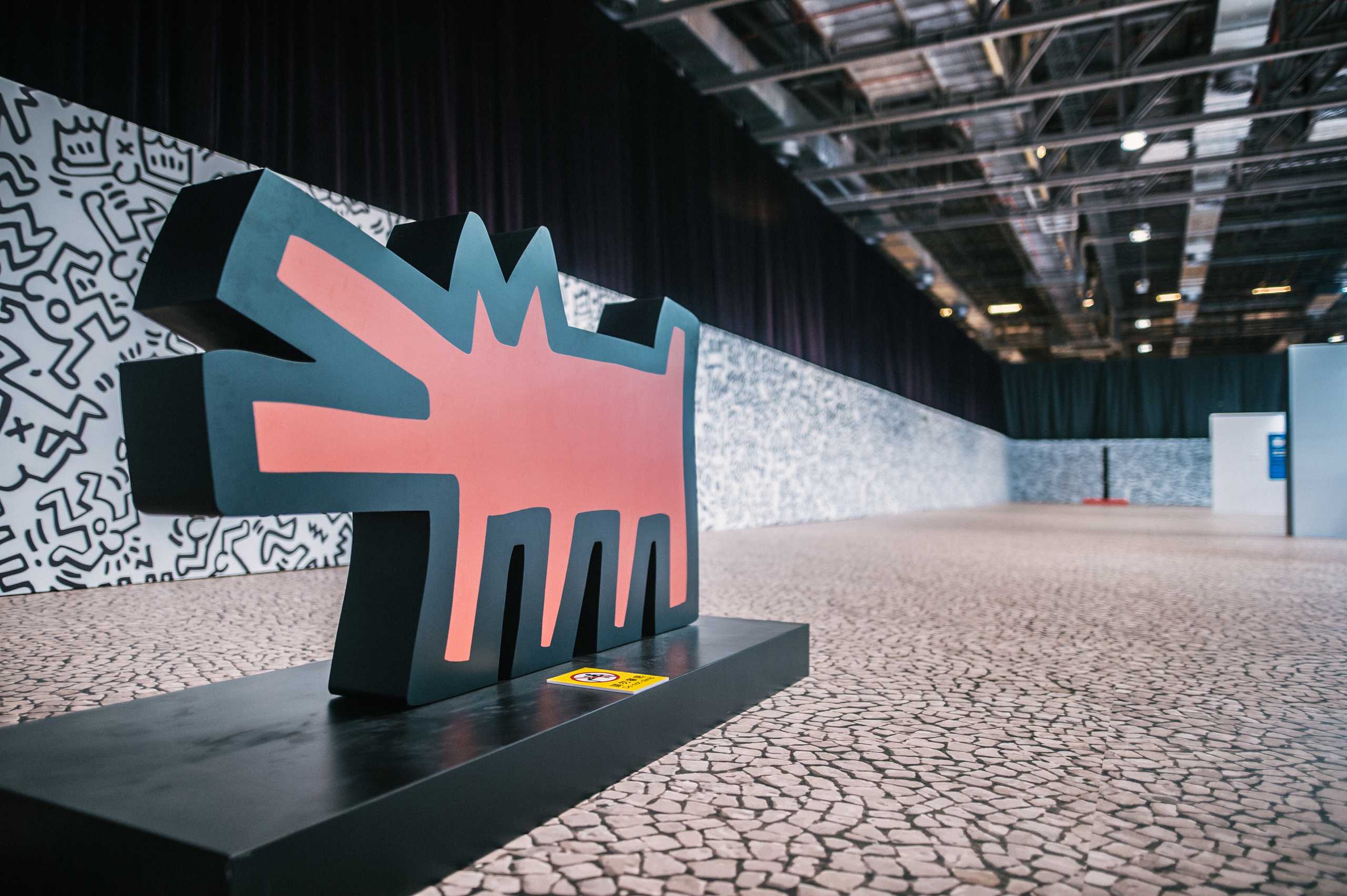
The debt to Keith Haring is explicit and central, not incidental. The white barking dog directly recalls Haring’s most recognizable motifs from the 1980s, and multiple art-market and reference sources identify the image as a deliberate nod to Haring’s visual language. That matters because Haring, like Banksy, rose to prominence through public drawing, immediacy, repetition, and a belief that urban visual language could carry serious social meaning. Banksy’s appropriation is therefore respectful, but not passive. He does not quote Haring merely to flatter him. He redeploys Haring’s dog in a different historical climate, moving it from the utopian energy of downtown New York into the harder social atmosphere of contemporary British street culture.

This transformation is crucial. Haring’s dog was already dynamic, barking, and alert, but in Banksy’s hands it becomes chained to a masked youth and acquires a sharper social menace. The image now lives in a world of surveillance, gang anxiety, urban alienation, and coded masculinity. It is still playful in form, but no longer innocent in function. That shift is one of the great strengths of the work. Banksy turns homage into pressure.

The dog’s simple, cartoonish shape references Haring’s interest in Egyptian hieroglyphics, an example of how humans communicate their experiences through universal shapes and signs. Haring’s “Barking Dogs” can be found throughout his body of work, from some of his early Subway Drawings to merchandise sold in his Pop Shops. In 1990, just a few months before his early death, Haring chose to immortalize his “Barking Dog” motif alongside four of his most celebrated symbols in a series of lithographs entitled “Icons” cementing the graphic canine as one of the most important symbols in his body of work. The Barking Dog, for example, can indicate action or suspicion. The Dog as a character, sometimes represented as a standing figure (combined with a human form), represents authoritarian government, abuse of power, police states, and oppressive regimes. In addition to these two representations, the other dogs in the art of Keith Haring are all anthropomorphic. Certain Dogs are depicted dancing, laughing, DJing, etc. in these personifications, it is almost as though they take on the role of an alter ego of the artist. Throughout Art History, Dogs have been portrayed in paintings as the personification of fidelity. Dogs also imply loyalty, guidance, protection and love. As a student of semiotics, none of these implications would have been lost on haring and it is not surprising that this would be one of his most-used icons.
Mural Context and London Location
The image began as a mural in Bermondsey, South London, and later became one of Banksy’s best-known prints. MyArtBroker identifies the wall as being in The Grange area of Bermondsey and notes that the work was boarded over shortly after appearing, then later reframed and covered in Perspex. By 2016, the Perspex itself had reportedly been obscured by posters and flyers, which adds a perfectly urban afterlife to the work: a mural about street tension becoming itself partially swallowed by the competing noise of the street.
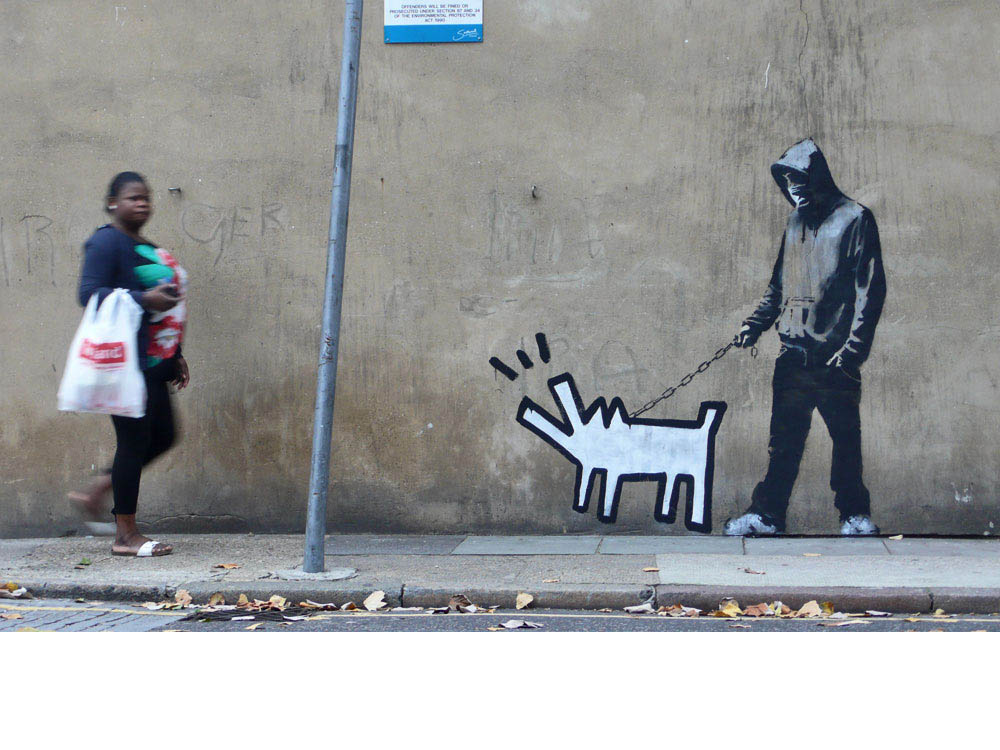 The wall origin matters because Choose Your Weapon belongs to that phase of Banksy’s practice in which the street image and the print are in especially close dialogue. The mural carries the grit, risk, and locality of a London intervention, while the print isolates and codifies the image, allowing it to circulate as a concentrated icon. The mural speaks in place; the print speaks in series.

[3 lines]
Release History
Choose Your Weapon was released by Pictures on Walls at their East London gallery, Marks & Stencils in Soho and through an online lottery. The first release included 15 different colorways (including a main edition of 100 in Grey). 14 colorways were editions of 25 signed prints. Other colorways were released afterwards, including Choose Your Weapon (Fluoro Green).
8 Colorways @ POW
3 Colorways @ Marks & Stencils
3 Colorways @ Online Lottery
Special VIP Editions
Queue Jumper’s Edition
“Each print is GBP 450 but if it’s any consolation Banksy is donating all royalties to the VOINA artist cooperative in Russia, two of whom are currently residing in a St Petersburg jail.”
“VOINA are the people who drew a giant penis on a road bridge
opposite the KGB headquarters and protested against police corruption by overturning eleven patrol cars in one night.”
Choose Your Weapon Colorways
Choose Your Weapon (Grey), 2010
Edition: 100 signed
Edition: 58 signed

Edition: 25 signed

Choose Your Weapon (Bright Purple), 2010
Edition: 25 signed
Edition: 25 signed

Edition: 25 signed

Edition: 25 signed

Edition: 25 signed

Edition: 25 signed

Edition: 25 signed

Choose Your Weapon (Lemon), 2010
Edition: 25 signed
Edition: 25 signed

Choose Your Weapon (Magenta), 2010
Edition: 25 signed

Choose Your Weapon (Sky Blue), 2010
Edition: 25 signed

Choose Your Weapon (Green), 2010
Edition: 25 signed

Edition: 25 signed

Edition: 25 signed

Edition: 25 signed

Edition: 25 signed
Unreleased Colorway

Auction Results
PLEASE CLICK BELOW FOR AUCTION RESULTS