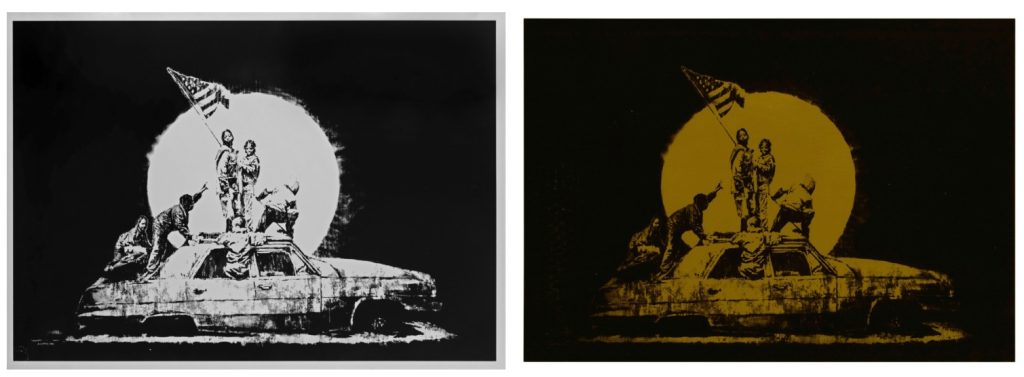
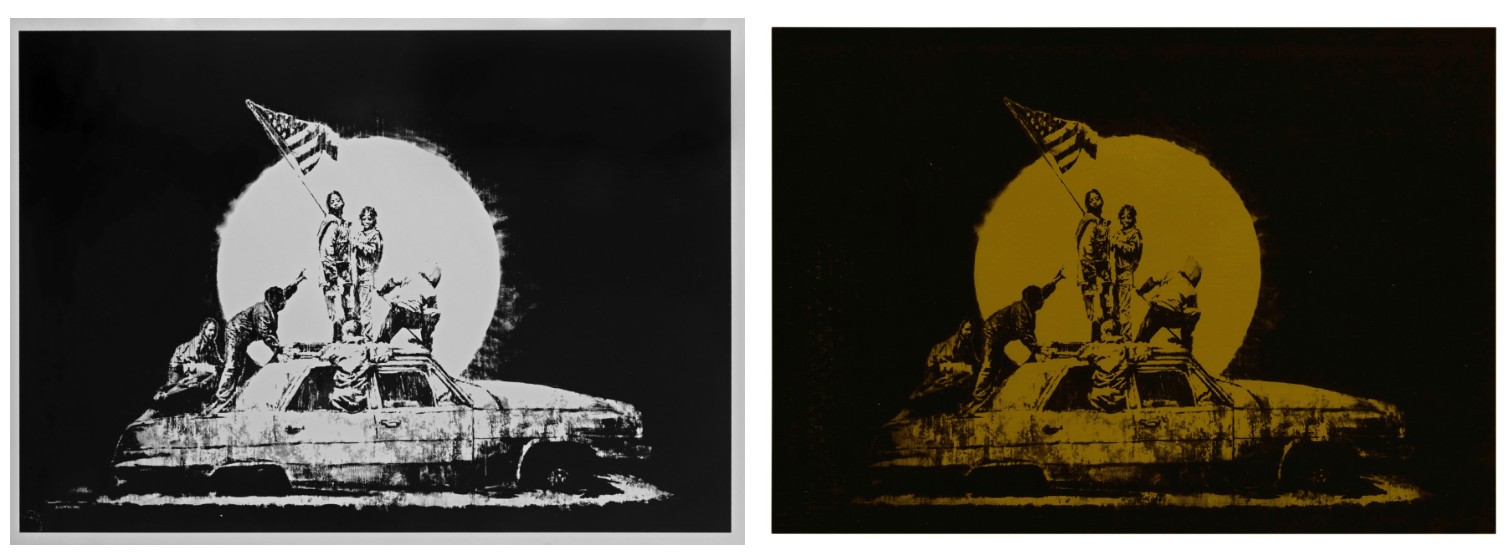
Flag (Silver)
Flag (Gold)
Editions
Flag (Silver): 1,000 unsigned
Flag (Silver on Formica): 20 signed
Flag (Gold): 112 signed
Flag (Gold on Formica): 23 signed
Flag (Gold AP): 20 signed AP given to the Ghetto Crew
With Flag, Banksy delivers one of his most complex and politically charged compositions. At first glance, the image evokes triumph: a group of children and young adults stand atop a burned-out car, raising the American flag in a gesture that recalls historical victory. Yet this apparent celebration is immediately undermined by its setting and protagonists. What unfolds is not a moment of glory, but a quiet, melancholic reflection on power, inequality, and the uncertain future of a generation.
The Fragile Promise of the American Dream
The composition presents a group of children and young adults standing on the wreckage of a burned-out car. Together, they raise an American flag in a pose that feels both familiar and deliberately staged. The figures are portrayed as disenfranchised urban youths, their environment marked by destruction and neglect.
Flag (Silver)

The scene is rendered almost entirely in black and white, reinforcing a sense of austerity and emotional restraint. Only one element breaks this monochrome discipline: a large circular form in the background, printed either in gold or silver depending on the edition. This element reads ambiguously as a sun or a moon, introducing a poetic yet distant atmosphere. The contrast is striking. The gesture suggests victory, yet the setting speaks of abandonment. The image holds itself in this tension without resolution.
A Victory Without Substance
At its core, Flag is built on a powerful visual reference to the historic photograph Raising the Flag on Iwo Jima by Joe Rosenthal, taken in 1945 during the Battle of Iwo Jima. Banksy reinterprets this composition with precision but replaces soldiers with children from marginalized urban environments. This substitution is decisive. The heroic narrative remains visually intact, yet its meaning shifts entirely.

The work opens itself to multiple readings. One interpretation suggests that these children embody America’s youth, still driven by ambition and belief in the American Dream, despite the conditions surrounding them. Another reading introduces a more critical perspective, pointing to the disparity between national expenditure on war and the neglect of vulnerable communities at home. The burned-out car becomes a symbol of that neglect, a quiet testimony to systemic imbalance.
The circular gold or silver element further complicates the image. It may evoke a distant sun, a cold moon, or even a subtle reference to the mythologies of conquest and exploration, such as the moon landing. In all cases, it reinforces a sense of distance between the ideal and the reality. Banksy does not impose a single interpretation. He constructs an image in which triumph and disillusion coexist.

Children are a recurring and essential motif in Banksy’s work, often used to represent both the future and the vulnerability of those most affected by systemic failures. In Flag, they occupy a position traditionally reserved for heroes. Yet their environment contradicts that role. They stand not on a battlefield, but on the remains of urban decay. Their gesture is powerful, but it lacks the structural support that would give it meaning. This duality is central to the work. The children are at once hopeful and exposed, elevated and abandoned. They embody a generation caught between inherited ideals and lived reality.
Raising the Flag on Iwo Jima
Raising the Flag on Iwo Jima by Joe Rosenthal was taken in 1945 during the Battle of Iwo Jima. That image, widely considered one of the most iconic representations of American triumph, became a symbol of unity, sacrifice, and national pride.

Raising the Flag on Iwo Jima depitcs six US Marines raising the U.S. flag atop Mount Suribachi during the Battle of Iwo Jima. The photograph, taken by Joe Rosenthal of the Associated Press was first published in Sunday newspapers and reprinted in thousands of publications. It was the only photograph to win the Pulitzer Prize for Photography in the same year as its publication and was later used for the construction of the Marine Corps War Memorial in 1954, which was dedicated to honor all Marines who died in service since 1775.
The Associated Press has relinquished its copyright to the photograph, placing it in the public domain.
The Lesson
Flag stands as one of Banksy’s most layered and visually ambitious prints. It combines historical reference, social commentary, and formal restraint into a single, cohesive image. Its relevance remains strong because it does not dictate meaning. Instead, it presents a condition. The viewer is left to navigate the space between aspiration and reality, between symbolic victory and material failure. Within Banksy’s oeuvre, it occupies a position of quiet gravity. It does not provoke through shock, but through recognition.
A group of children raises a flag. The gesture is familiar, almost heroic. But beneath them lies a burned-out car. Around them, nothing suggests victory. The image recalls triumph yet speaks of absence. Banksy does not deny the symbol. He relocates it. And in doing so, reveals a simple, unsettling truth: a flag can still be raised even when there is nothing left to stand on.
Release History
Banksy also released, in 2008, a version of Flag (Silver) printed on Formica, in an edition of 20 signed prints, and a version of Flag (Gold) printed on Formica in an edition of 23 signed prints.
You can’t imagine they’re resting any easier in their beds now Banksy’s made a screen-print of them on shiny paper, but never mind.
This is the gold run-out done at the same time as last year’s silver and looks rather smart.”
Auction Results
PLEASE CLICK BELOW FOR AUCTION RESULTS