Mosquito
Year: 2003
Medium: Acrylic and spray-paint stencil on canvas
Dimensions: 25.4 x 30.3 cm (10×12 inches)
Edition: 25
Dated and numbered /25 on the reverse
Stenciled “BANKSY” in red spray paint on the lateral edge
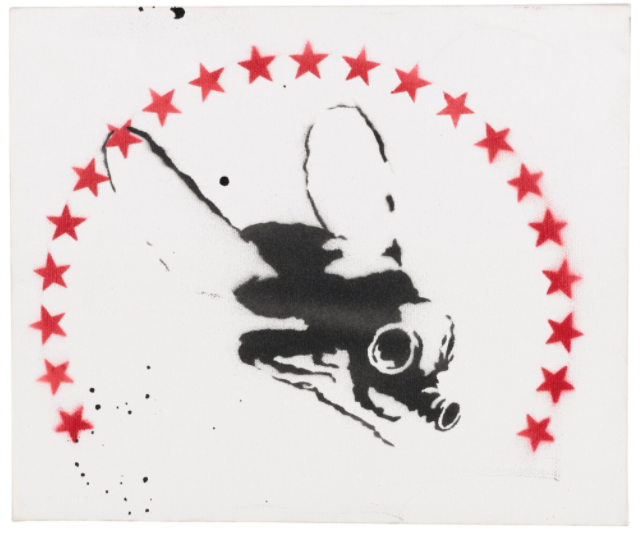
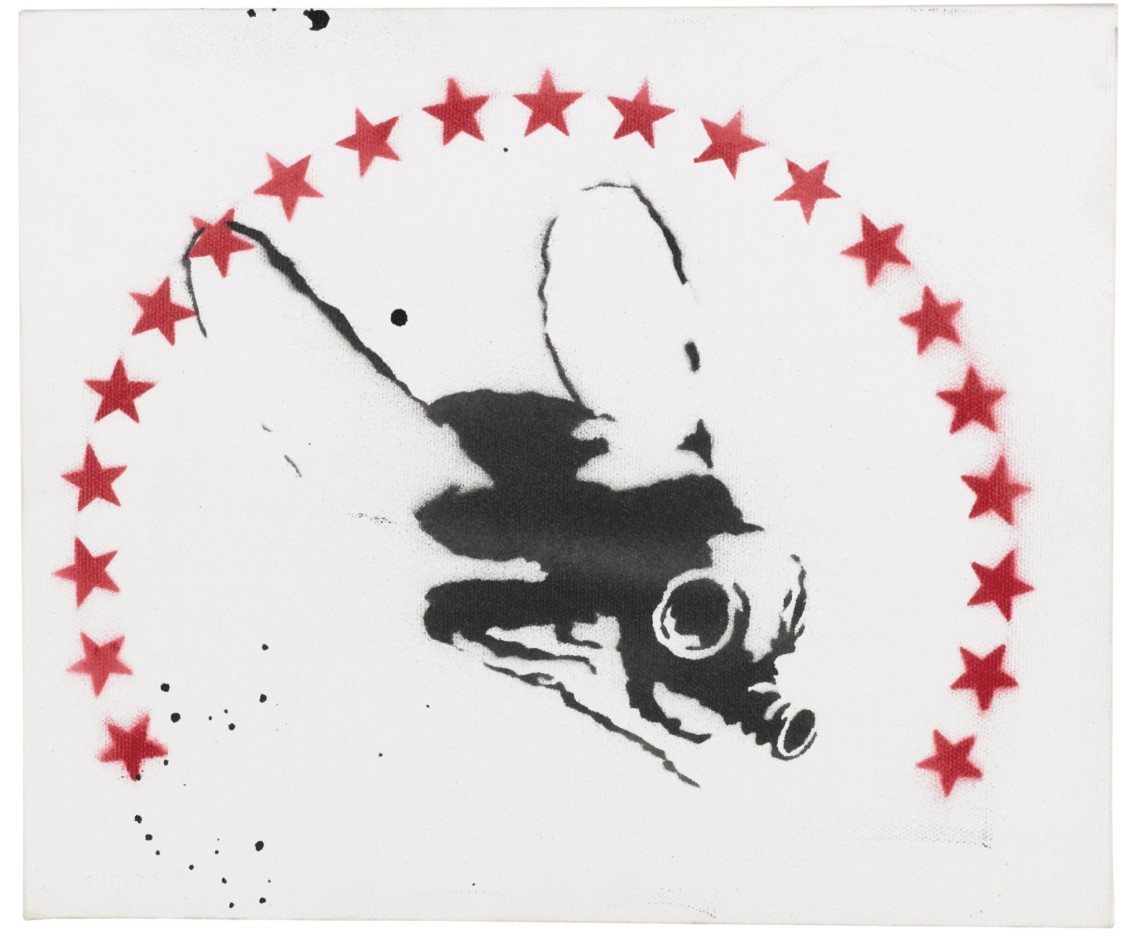
Created in 2003, Mosquito is one of Banksy’s most unusual early editions. Executed in acrylic and stencil spray paint on canvas, the work depicts an enlarged mosquito rendered in black stencil, surrounded by a semi-circle of bright red stars. Isolated against a white ground, the insect assumes an almost emblematic presence, resembling an official insignia or military crest rather than a simple representation of nature. Minimal in composition yet visually striking, the work transforms one of the world’s smallest creatures into an unexpectedly powerful symbol. Mosquitoes are among the most insignificant of animals in appearance, yet they have shaped human history more profoundly than almost any predator. Responsible for transmitting diseases that have claimed millions of lives, they embody the paradox of disproportionate power: tiny in scale, immense in consequence.
Banksy appears drawn to this contradiction. Rather than portraying violence through weapons or armies, he reminds us that some of the greatest threats arrive quietly, almost unnoticed. The surrounding ring of red stars elevates the insect to the status of an official emblem, suggesting admiration, authority or even celebration. The effect is deeply ironic. A creature universally regarded as a nuisance is presented almost as a decorated hero. As throughout Banksy’s work, the image encourages viewers to reconsider accepted hierarchies of power. Size, strength and visibility are not always the true measures of influence.


Although modest in scale, Mosquito captures one of Banksy’s most enduring artistic concerns: the imbalance between appearance and reality. By elevating a tiny insect to the status of an emblem, he challenges conventional ideas of power, importance and threat. Like many of Banksy’s finest images, the work succeeds because it resists a single definitive interpretation. It can be read as a meditation on disease, fear, authority or the hidden forces that shape contemporary life. More than twenty years after its creation, Mosquito continues to demonstrate that the most unsettling political images are often those that reveal how the smallest actors can leave the deepest mark.
Auction Results