PLEDGE ALLEGIANCE TO THE FLAG, 2008
Provenance
- The Aquarium Gallery, London, ArtBid4Ken, 6 March 2008, Lot 37 (donated by the artist)
- Acquired directly from the above by the present owner
Auction History
Prices are inclusive of buyer’s premium unless stated otherwise, as reported by the auction houses.
Catalogue Note
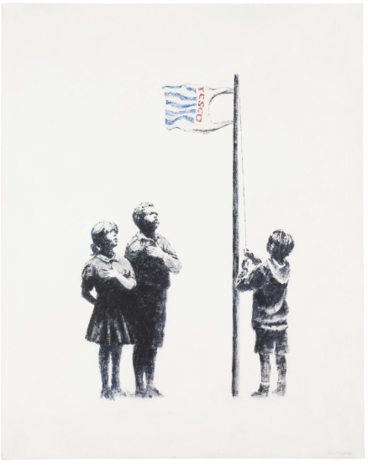
At first glance, Pledge Allegiance to the Flag resembles a familiar school ceremony. Three children stand respectfully before a flagpole. Two place their hands over their hearts while a third slowly raises what appears, from a distance, to be a national flag. Only upon closer inspection does the viewer discover the uncomfortable truth: the flag is nothing more than a Tesco plastic shopping bag fluttering in the wind.
The substitution is brilliantly economical. With a single visual gesture, Banksy transforms one of the oldest symbols of national identity into the logo of Britain’s largest supermarket chain. The effect is both humorous and deeply unsettling. The children are not pledging allegiance to their country but to a corporation. Patriotism has quietly become consumerism.
Tesco occupies a very particular place within British culture. During the 1990s and early 2000s, the supermarket expanded at an unprecedented rate, becoming almost omnipresent on British high streets and increasingly accused of forcing independent businesses to disappear. Banksy had already targeted the company in his celebrated print Very Little Helps, a sardonic inversion of Tesco’s advertising slogan “Every Little Helps.” Here, however, his criticism extends far beyond retail monopolies. Tesco becomes a symbol of multinational corporations whose influence now rivals that of governments themselves.
The composition recalls the ritual of the American Pledge of Allegiance, immediately evoking ideas of loyalty, patriotism and civic duty. Yet Banksy deliberately replaces political ideology with commercial branding. The implication is profound: modern societies no longer define themselves primarily through shared history, culture or democratic institutions, but increasingly through the global corporations whose products shape everyday life. Consumption has become a form of citizenship.
Children play a crucial role in this transformation. Throughout Banksy’s oeuvre they function as symbols of innocence, but also of social conditioning. Whether carrying balloons, embracing bombs or saluting shopping bags, they reveal how values are transmitted from one generation to the next. The children in Pledge Allegiance to the Flag perform the ceremony without hesitation or irony. Their unquestioning obedience becomes the real subject of the work. Banksy suggests that consumer culture is learned long before it is ever consciously chosen.
The stark simplicity of the composition reinforces its message. Suspended within a vast white field, the figures appear isolated, almost timeless. There are no buildings, no landscape and no distractions. The empty space strips away historical and geographical context, transforming the image into an allegory rather than a documentary scene. The viewer’s attention is drawn entirely toward the absurdity of the ritual itself.
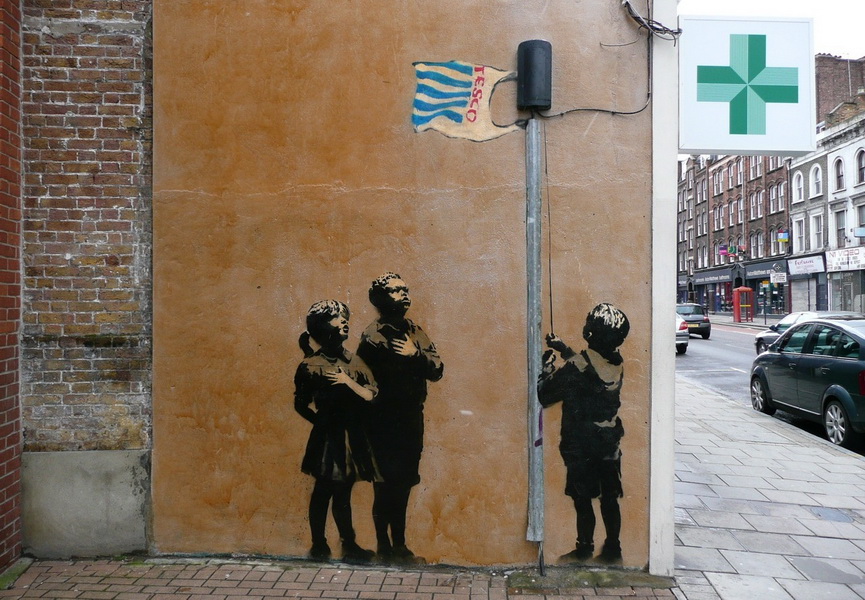
Within Banksy’s broader body of work, Pledge Allegiance to the Flag forms part of an extended critique of capitalism’s extraordinary ability to absorb every aspect of modern life. Works such as Festival, Morons, Destroy Capitalism, and Very Little Helps all expose the paradoxes of consumer society. Even those who believe themselves independent of the system often become willing participants in it. Banksy’s genius lies in revealing that capitalism rarely imposes itself through coercion. Instead, it succeeds because people voluntarily embrace its symbols, rituals and promises.
The irony is especially rich in light of Banksy’s own career. An artist who has repeatedly criticized commercialization has himself become one of the world’s most sought-after contemporary artists. Like Morons, this work acknowledges the uncomfortable reality that critique itself can become a commodity. Rather than attempting to resolve that contradiction, Banksy embraces it, allowing the paradox to become part of the artwork’s meaning.
The provenance further reinforces the spirit in which the work was created. Banksy donated the painting to ArtBid4Ken, a charity auction organized in 2008 to raise funds for Kenyan children. The gesture adds an additional layer of irony. A work criticizing the excesses of multinational consumer culture was itself used to support education and humanitarian aid, demonstrating Banksy’s enduring belief that art can function not only as criticism, but also as an instrument for tangible social good.
Ultimately, Pledge Allegiance to the Flag is less about Tesco than about the quiet transformation of modern identity. Nations once united around flags, constitutions and shared ideals. Today, Banksy suggests, many of us gather instead around brands, logos and shopping bags. The work asks a deceptively simple question that remains strikingly relevant: in the twenty-first century, to whom—or to what—do we truly pledge our allegiance?
STAY INFORMED
Receive the latest news, exhibitions, artworks and market updates on Banksy.