BANKSY
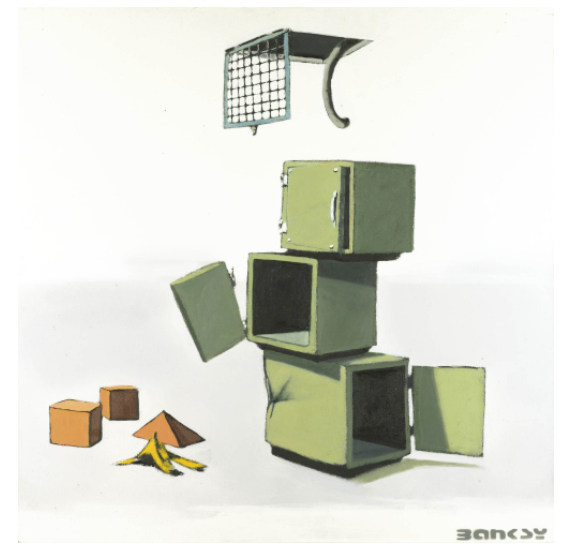
Simple Intelligence Testing, 2000
Oil on canvas laid onto board, in 5 parts
Each: 91.5 x 91.5 cm (36×36 inches)
Stencil-signed “BANKSY”, lower right, fifth canvas
Exhibited
Auction History
|
Sotheby’s London
28 February 2008
Est.: GBP 100,000 – 150,000 |
Price Realized GBP 635,500 / USD 1,262,145 (#327) Banksy |
Catalogue Note
Created around 2000, Simple Intelligence Testing in Dumb Animals is one of Banksy’s earliest and most conceptually intriguing monkey works. At first glance, the image appears almost absurd: a monkey sits before a table, confronted with two buttons beneath a sign that reads “Simple Intelligence Testing in Dumb Animals.” One button is labelled BANANA, the other SHOCK. Unsurprisingly, the monkey reaches for the banana.
The humor lies in its apparent simplicity. The monkey has passed the test by making the obvious choice. Yet, as is so often the case with Banksy, the real subject of the work is not the monkey at all. It is us.

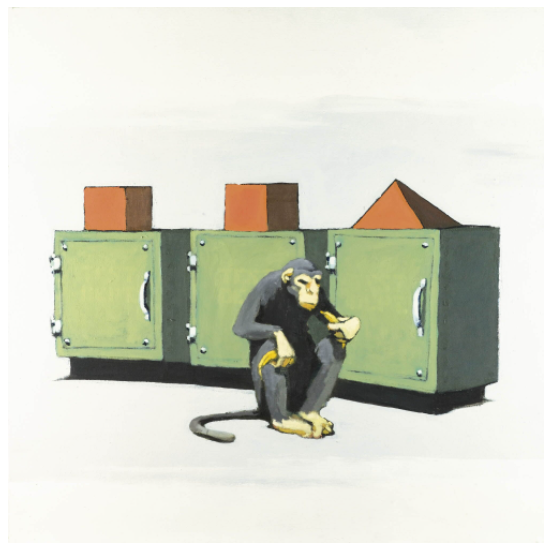


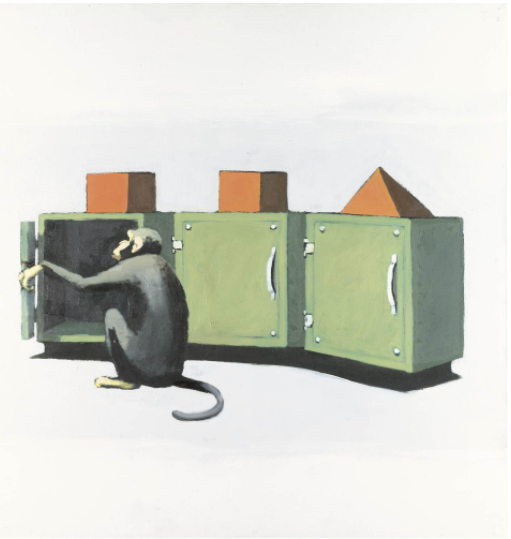
The title immediately introduces a delicious ambiguity. Who exactly are the “dumb animals”? Is the monkey being tested, or are the humans conducting the experiment revealing something about themselves? By turning the traditional laboratory experiment into a satirical image, Banksy invites the viewer to question the very notion of intelligence and the systems through which it is measured.
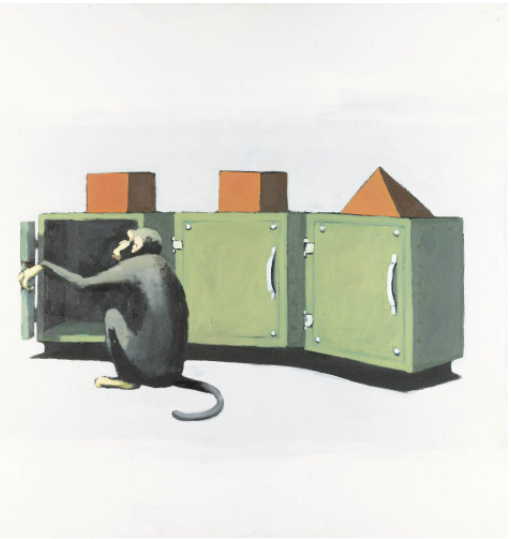
The composition also reflects one of the artist’s recurring concerns: conformity. The monkey succeeds because it follows instinct and chooses the expected answer. Human societies, however, often reward exactly the opposite. From an early age, we are taught to follow rules, pass examinations, obey authority, and repeat accepted ideas rather than question them. Intelligence is frequently confused with compliance. Banksy gently mocks this tendency, suggesting that modern society sometimes resembles one vast behavioral experiment in which success depends less on independent thought than on learning which button those in power expect us to press.
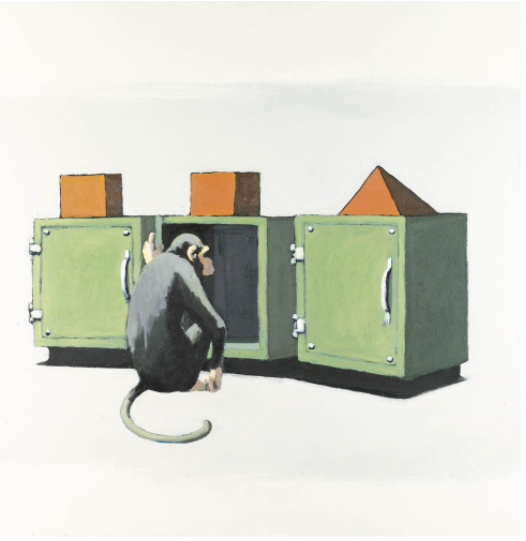
There is an unmistakable echo of the behavioral psychology experiments conducted throughout the twentieth century, particularly those involving conditioned responses and reward systems. Whether consciously or not, Banksy evokes the world of laboratory science, where animals were trained to associate specific actions with pleasure or punishment. By transplanting this imagery into the realm of social satire, he raises an uncomfortable question: are we fundamentally different? How many of our own daily decisions are genuinely free, and how many are simply conditioned responses to rewards, incentives, and social expectations?
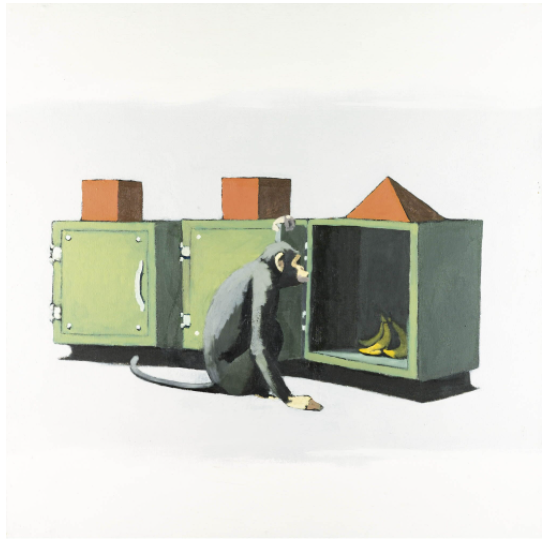
The monkey once again proves to be the perfect surrogate for humanity. Its presence softens what might otherwise be a harsh critique, allowing humor to disarm the viewer before the underlying message becomes apparent. We laugh at the obviousness of the monkey’s decision, only to realize that our own lives are often shaped by equally predictable mechanisms. Consumer culture, political discourse, education, advertising, and even social media all operate through systems of reward and reinforcement that subtly encourage conformity while creating the comforting illusion of choice.

In retrospect, Simple Intelligence Testing in Dumb Animals feels remarkably prescient. Created before the rise of smartphones, algorithms, and the attention economy, it anticipates many of the questions that dominate contemporary society. Every notification, recommendation, advertisement, and digital reward nudges us towards particular behaviours, transforming modern life into an endless series of carefully designed choices. We believe we are exercising free will, yet increasingly we respond to invisible systems not unlike the monkey responding to the promise of a banana.
Although less famous than Laugh Now or Monkey Queen, this early work introduces ideas that would resonate throughout Banksy’s career. Behind its deceptively playful composition lies a timeless reflection on intelligence, obedience, and the invisible mechanisms that shape human behavior. Once again, the monkey is not the object of satire. It is merely the mirror in which we recognize ourselves.