Flying Copper
Signed Edition: 150


Introduction
Flying Copper is one of Banksy’s earliest and most iconic images. As such, it is well known all around the world. Indeed, this visual is the perfect example of Banksy’s style featuring contrasting aesthetics: photo-realistic stencils combined with graphic features. Combining those features results in a striking visual that sticks in the mind of the viewer. The juxtaposition of opposing concepts compels the audience to reconcile the fact that the “smiley face” (happiness), on an individual outfitted with riot gear (fear and intimidation) are perhaps not as contradictory as we might naturally think.
“The Greatest Crimes in the world are not committed by people breaking the rules but by people following the rules.”
Flying Copper depicts a police officer rendered in stark, graphic clarity. The figure is fully equipped: riot gear, body armor, heavy boots, and an assault rifle held with professional rigidity. Everything about the body signals preparedness, discipline, and latent force. Yet the head disrupts the entire composition.
Instead of a human face, the officer wears a bright yellow smiley: flat, iconic, almost absurd in its simplicity. Small angel wings are affixed to his back, delicate and incongruous against the weight of his militarized silhouette. The result is immediate: a visual short circuit. The familiar language of control collides with symbols of innocence and levity. The figure becomes neither reassuring nor threatening but something far more ambiguous, and therefore more unsettling.
Few images capture the essence of Banksy’s early visual language with such clarity and force as Flying Copper. At once disarmingly simple and conceptually sharp, the work distills one of the artist’s central preoccupations: the uneasy relationship between authority and the public it claims to protect. Through a single, striking figure, Banksy constructs a visual paradox—one that continues to resonate with unsettling relevance.
Beneath The Mask of Benevolence
At its core, Flying Copper operates through contradiction. The smiley face, rooted in the visual culture of the late 20th century and popularized through acid house movements, suggests happiness, ease, and even naïveté. It is a symbol stripped of complexity, designed to reassure. By placing it over the face of a police officer, Banksy introduces the idea of institutional masking: the projection of friendliness as a veneer for authority.
The wings complicate this further. Traditionally associated with purity, protection, or divine presence, they elevate the figure into a kind of ironic guardian. But here, their fragility borders on parody. They do not redeem the figure: they expose the absurdity of the claim.

What emerges is a subtle but incisive critique: authority presents itself as protective, even benevolent, yet it remains structurally tied to control, enforcement, and violence Banksy does not resolve this contradiction. He stages it, and leaves the viewer suspended within it.

What Flying Copper ultimately exposes is not simply authority, but the performance of authority. The uniform, the weapon, the posture: these are theatrical elements as much as functional ones. By replacing the human face with a universal symbol and adding wings that verge on the decorative, Banksy strips the figure of individuality and transforms it into an emblem. It is no longer a person. It is a role. And like all roles, it depends on belief.
Flying Copper does not shout. It does something far more effective: it smiles. And in that smile lies the entire tension of the work: a disarming gesture that conceals, reveals, and ultimately questions the structures it represents. Banksy’s genius here is not in complexity, but in precision. A single figure, perfectly calibrated, capable of holding an entire political philosophy in suspension. Elegant, ironic, and quietly unsettling: it remains one of his most enduring statements.
Context and Origin
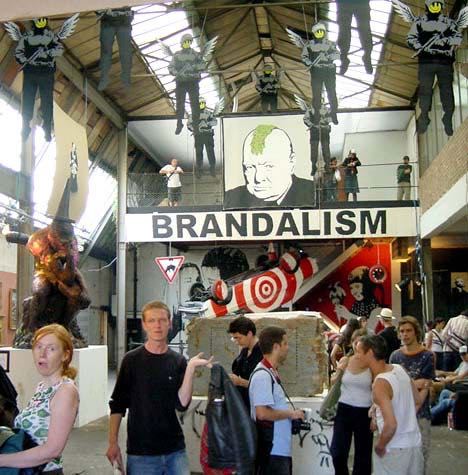
Flying Copper first appeared under a number of giant cut-out paintings suspended on cardboard from the ceiling at Turf War, Banksy’s first major exhibition in a warehouse in East London in 2003. The cut-outs were later spotted on the streets of Vienna and London, where the stencil appeared with a distinct red Banksy tag through the middle of it.
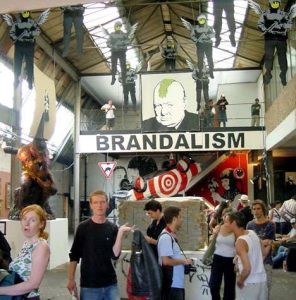
This was not merely a display; it was a declaration. Turf War marked Banksy’s transition from clandestine street interventions to orchestrated, immersive environments—without abandoning the raw political charge of his imagery.

Shortly thereafter, a series of Flying Copper figures appeared along Shoreditch Bridge. Installed in repetition, the image moved back into the public sphere, reclaiming the street as its natural habitat. In this setting, the work acquired an additional layer: it became part of the urban fabric it critiques, confronting passersby within the very system it questions.
“Deluxe and very large screenprint of flying pig.
Apparently popular with the boys in blue (actually true).”

Variations
As one of Banksy’s early and most distilled images, Flying Copper occupies a significant position within his market and cultural trajectory. Works from this period—especially those tied to Turf War and early London interventions—are increasingly recognized for their historical importance, marking the moment when Banksy’s visual language reached full conceptual maturity. More importantly, the image has achieved what few contemporary artworks manage: it has entered collective consciousness. Instantly legible, endlessly reproducible, and quietly subversive, Flying Copper continues to function as both critique and symbol.


Smiling Copper, 2003
Spray-paint and acrylic on cardboard
200×78 cm (78 3/4 x 30 3/4 inches)
From a series
Auction Results
PLEASE CLICK BELOW FOR AUCTION RESULTS