At auction
No 2026 median — fewer than three sales
Peak £63,400 (Jan 2021) · 16% retained
No 2026 median — fewer than three sales
Peak £58,685 (Jun 2022) · 41% retained
Hammer plus premium, in GBP, not adjusted for inflation. Standard editions only — proofs, colorways and variants excluded.
Hunting in the Age of Consumption
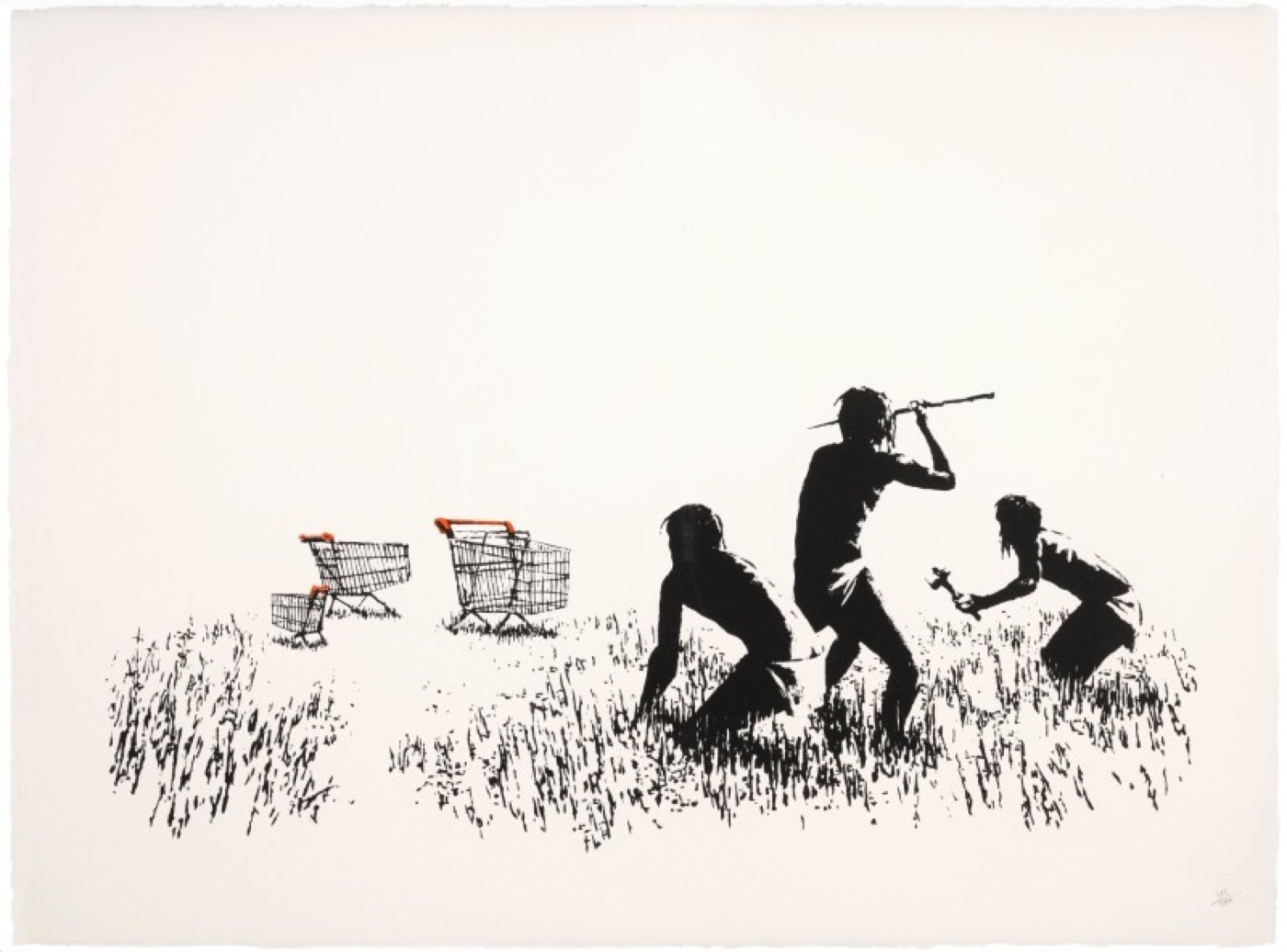
Created in 2006, Trolleys is one of Banksy's most distilled visual statements, an image so simple it almost escapes notice, yet precise enough to linger. Released as a screenprint in the wake of his Los Angeles exhibition Barely Legal, the work captures a fundamental shift: survival has not disappeared, it has merely been redirected.
Three prehistoric figures move in formation from left to right, their bodies reduced to stark silhouettes. Each carries a spear, their posture unified, suggesting coordination, instinct, and intent. Ahead of them stand three supermarket shopping carts. Empty. Still. Slightly out of place, yet undeniably the focus of the pursuit. The contrast is immediate. On one side, organic movement and primitive tools. On the other, rigid metal structures: symbols of a system far removed from necessity. The composition is stripped to black and white, leaving no room for distraction, only confrontation.
We can't do anything to change the world until capitalism crumbles. In the meantime we should all go shopping to console ourselves.
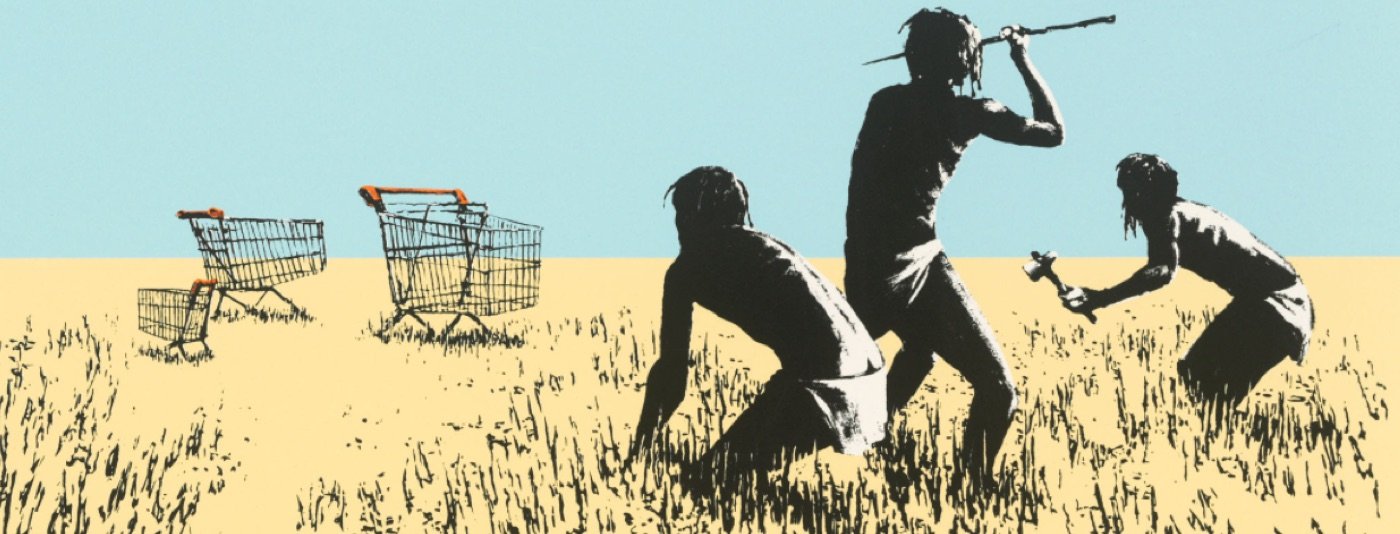
Trolley Hunters is the perfect incarnation of Banksy's distinctive marriage of street art, graffiti and satire. Featuring three prehistoric men in a desert, the atmosphere of Trolley Hunters is both eerie and lighthearted. Holding various weapons, the three men pictured are poised to attack. The targets of their attack are, in typical Banksy fashion, trolleys – or shopping carts. The poignancy of the resulting work is twofold; firstly in its timeless critique of capitalism, and secondly in its unique and unexpected resonance today. With Trolleys, Banksy offers the viewer a provoking satire about the impact of consumerism on the ability of modern men to provide for themselves. Trolleys cleverly mocks contemporary society by suggesting that, isolated in cities, with no way of growing or catching our own food, we depend on the products offered by giant supermarkets to survive.
What Are We Chasing?
Banksy constructs a collision rather than a narrative. The visual language borrows from textbook depictions of early human life: images designed to explain how we once survived. By inserting the shopping cart into this prehistoric setting, he folds time in on itself. The past is not replaced by the present; it is absorbed by it. The gesture recalls the appropriation strategies of Andy Warhol, yet where Pop Art often embraced neutrality, Banksy sharpens the blade. The object is not elevated: it is interrogated.
The figures do not hesitate. They know exactly what they are doing. That certainty is where the discomfort begins. Trolleys suggests that the instinct to hunt has not evolved: it has simply been reassigned. What once ensured survival now drives consumption. The collective effort remains, but its purpose has shifted from necessity to accumulation. And yet, the carts are empty. There is no reward waiting at the end of the pursuit, only the structure of the pursuit itself. The joke lands quietly, but it does not resolve.
Within Banksy's body of work, Trolleys stands as one of his most controlled critiques. There is no spectacle, no shock tactic: only a quiet displacement that reveals more than it declares. It is not a condemnation as much as a recognition. The system is not imposed; it is pursued. The figures move forward together, focused, determined, unchanged. Only the object has evolved. The instinct remains intact: steady, efficient, and perhaps, entirely misplaced.
The trolley, comic in its incongruity, nods to our consumer society's predilection for, and reliance on, highly processed, branded packaged food products, and our inability to fend for ourselves. Grouped like antelope in a field, the barren nature of the landscape in which we find these alien carts nods to our willingness to ship foods and other commodities all over the planet to be picked up whenever convenient by the consumer in the aisles of big chain supermarkets. With sardonic wit, Banksy juxtaposes his trolleys with a trio of Neanderthal hunter-gatherers, thereby shining a critical light on how far we as human beings have deviated from our base instincts, and abilities.
Barely Legal
Trolleys is inseparable from Barely Legal, Banksy's landmark 2006 exhibition in Los Angeles: a moment where the artist stepped into the institutional and commercial art world without relinquishing his outsider position. Set within a raw industrial space, the exhibition blended spectacle and critique. A live-painted elephant, installations referencing poverty and excess, and a sharp focus on American consumer culture defined the show. It was theatrical, confrontational, and carefully controlled.
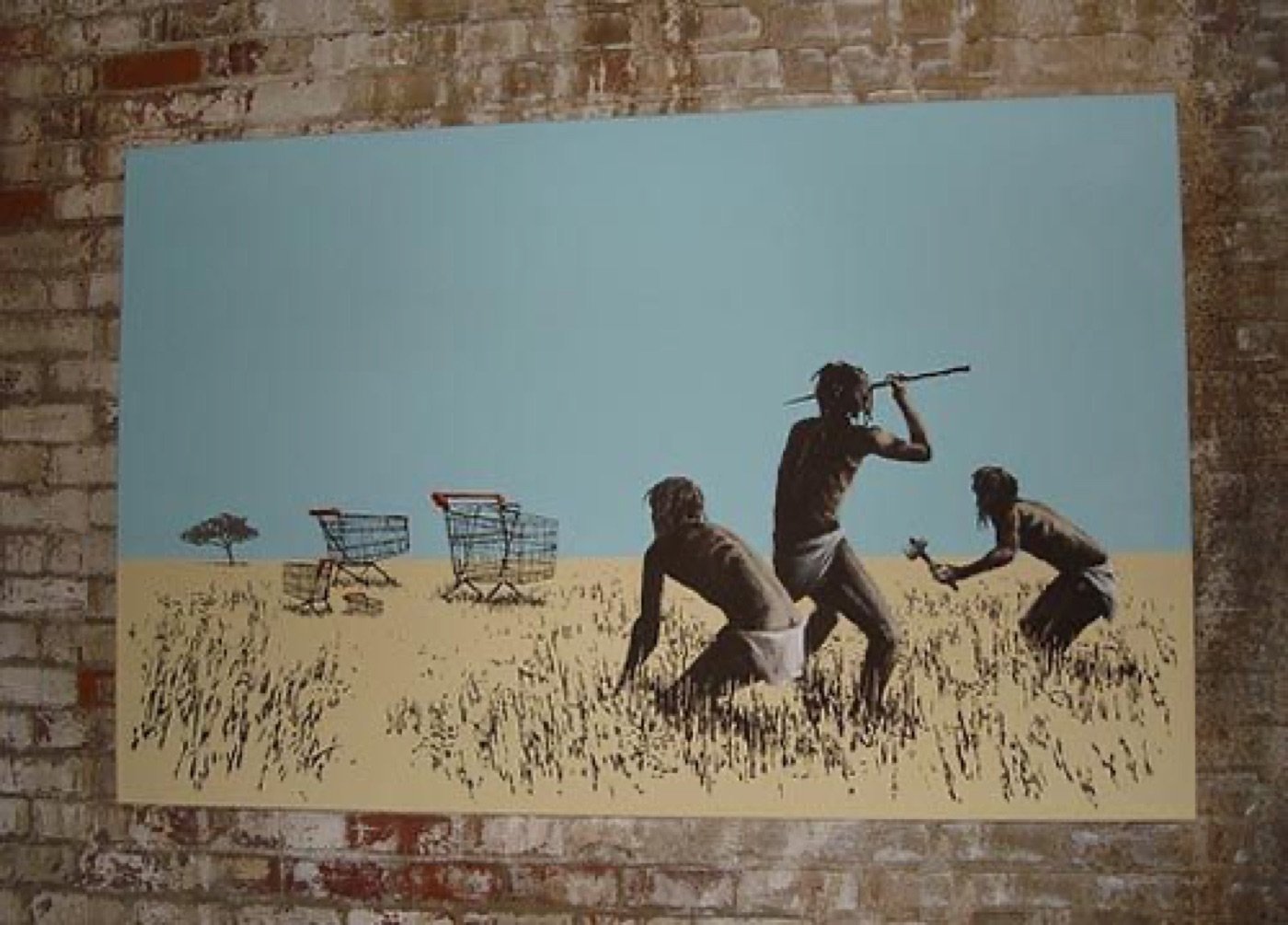
Within this environment, Trolleys operates almost like a compressed thesis. Where other works in the exhibition expanded outward, this one reduces everything to a single, legible idea. Los Angeles, with its deep entanglement in image, wealth, and consumption, was not incidental. It was the ideal stage.
Trolleys (Bethlehem Edition) is a special edition of 28 signed prints printed on end paper, the packaging that the proper art paper comes in (“sort of like when the kids play with the box instead of the toy.”).
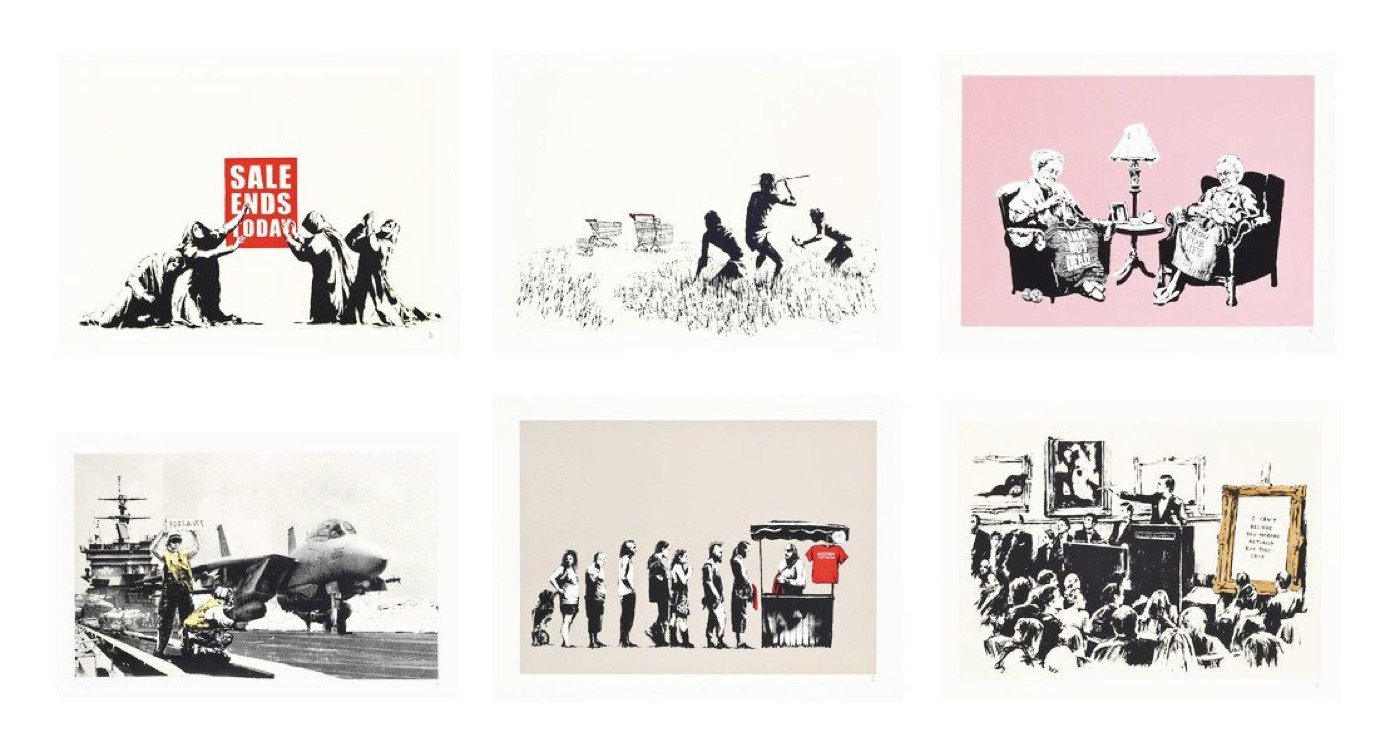
Banksy Originals with Trolleys
The original, shown at Barely Legal, later became one of the artist's most valuable works at auction.
Variations
STAY INFORMED
Receive the latest news, exhibitions, artworks and market updates on Banksy.