Weapons of Mass Distraction
A Curated Online Exhibition of Iconic Banksy Prints
In Partnership with
Banksy Explained is pleased to present Weapons of Mass Distraction, an online exhibit of Banksy’s iconic prints, curated by Banksy Explained, in partnership with Markowicz Fine Art.
Bringing together a selection of the artist’s most iconic prints, the exhibition is structured as a four-chapter journey exploring key mechanisms within Banksy’s work: resistance, authority, innocence, and consumption.
Through this framework, the exhibition offers a clear and focused perspective on an artist whose imagery remains both immediate and deeply layered. From the disarming gesture of Love Is In The Air to the incisive critique of Morons, the works on view reveal Banksy’s ability to transform familiar images into precise reflections of contemporary society. His visual language, direct, often humorous, operates with clarity, exposing the structures that shape perception and behavior.
Presented exclusively online, the exhibition reflects the accessibility and global reach that define Banksy’s practice. At the same time, it offers a carefully constructed narrative, guiding the viewer through a sequence of images that are as coherent as they are impactful.
This collaboration between Markowicz Fine Art and Banksy Explained reflects a shared commitment to providing clarity, context, and insight into one of the most significant bodies of work in contemporary printmaking.
All prints shown below are for sale, simply click on the picture to be directed to Markowicz Fine Art for any purchase inquiry. Please note the pictures used in this article are for illustration purpose only.
CHAPTER I: POETRY AS RESISTANCE
Banksy’s practice often begins with a simple but radical gesture: the transformation of violence into image. In these works, confrontation is displaced through wit, irony, and visual substitution. Weapons become flowers, threats dissolve into absurdity, and acts of aggression are reframed as poetic interventions. This is not a denial of conflict, but a reconfiguration of its language: where resistance operates not through force, but through clarity, humor, and symbolic inversion.
Love Is In The Air
xxxxxxxxxx
A masked protester, poised to throw, clutches not a Molotov cocktail but a bouquet of flowers. The force of the image lies in this substitution. Banksy retains the posture of aggression while replacing destruction with fragility, turning the work into a meditation on civil unrest, symbolic resistance, and the thin line between rage and hope.
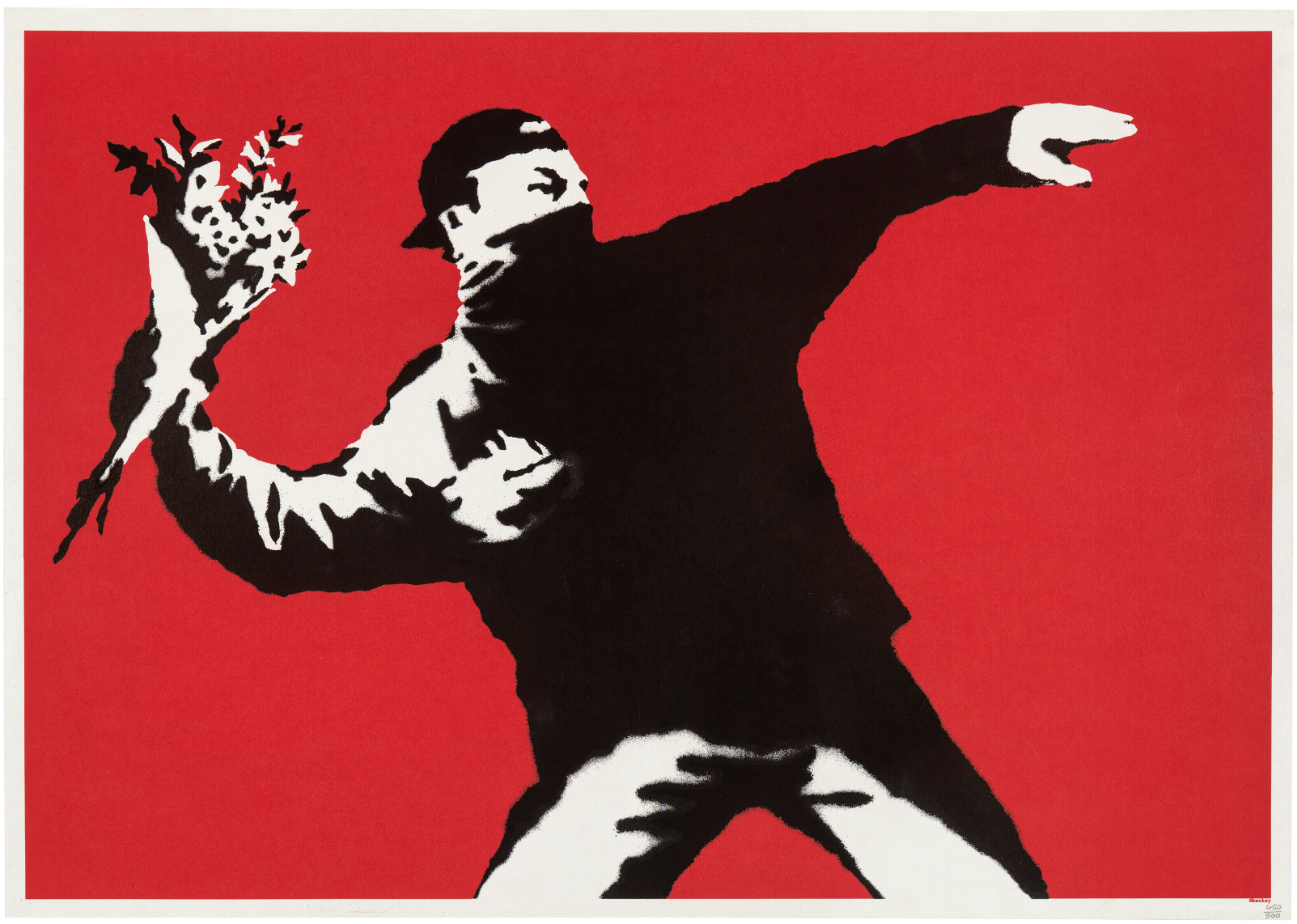
Love Is In The Air (unsigned), 2003
Numbered in pencil, from the edition of 500
Love Is in the Air stands among Banksy’s most important and enduring images. It has been reproduced extensively, referenced across popular culture, and exhibited globally. Its clarity and immediacy have made it one of the defining visual statements of early 21st-century street art.
Love Is In The Air was released in 2003 as an edition of 500, out of which approximately 50 are signed (not always in order).
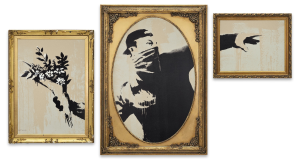
Flower Thrower Triptych
xxxxxxxxxx
By fragmenting one of his most celebrated images across three framed panels, Banksy transforms a street-born gesture into a consciously staged object. The triptych format slows the viewer down, isolating body, action, and projectile. Its gilded presentation adds a further irony: dissent is not neutralized by the frame but made more visible through the very conventions of display it appears to resist.
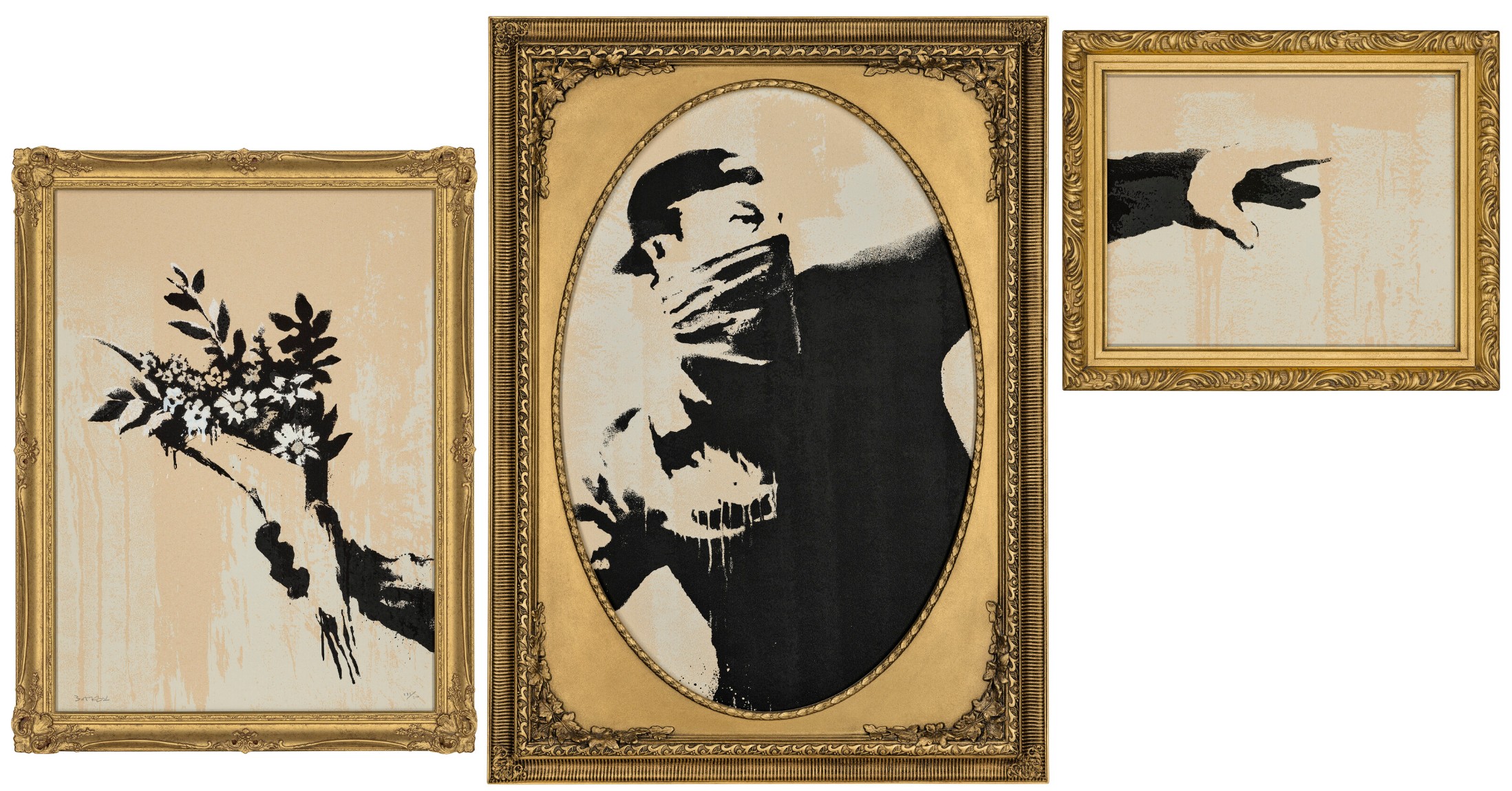
Flower Thrower Triptych, 2019
Signed and numbered from the edition of 300
With its classical stencil led style, the work also pays homage to Banksy’s origins as a street artist, whereby the stencil represents the quickest, most efficient way for the artist to insert his image into the urban environment without getting caught. Revisited and reconceived many times over the years by Banksy, Flower Thrower has become one of the most iconic images from the street art movement and is a motif he revisits often in the same way he does with rats and monkeys.
Pulp Fiction
xxxxxxxxxx
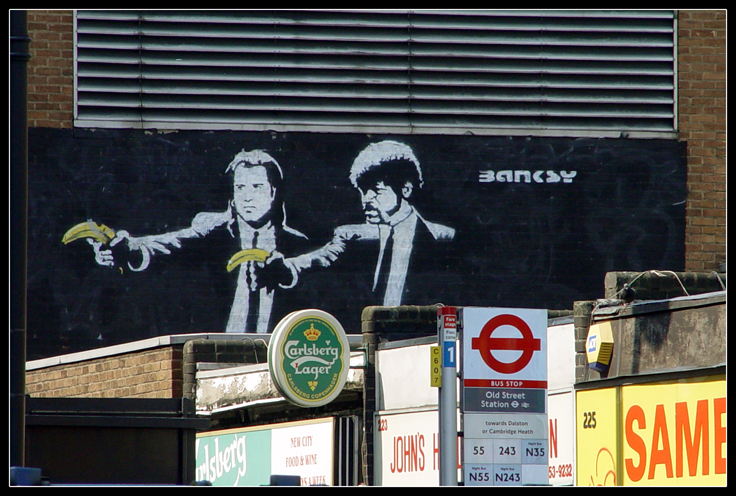
Banksy borrows the iconic scene from Pulp Fiction, replacing the guns with bananas. The tension remains, but its meaning collapses. By turning threat into absurdity, the work exposes how easily the language of violence can be dismantled, and how dependent it is on the symbols that sustain it.
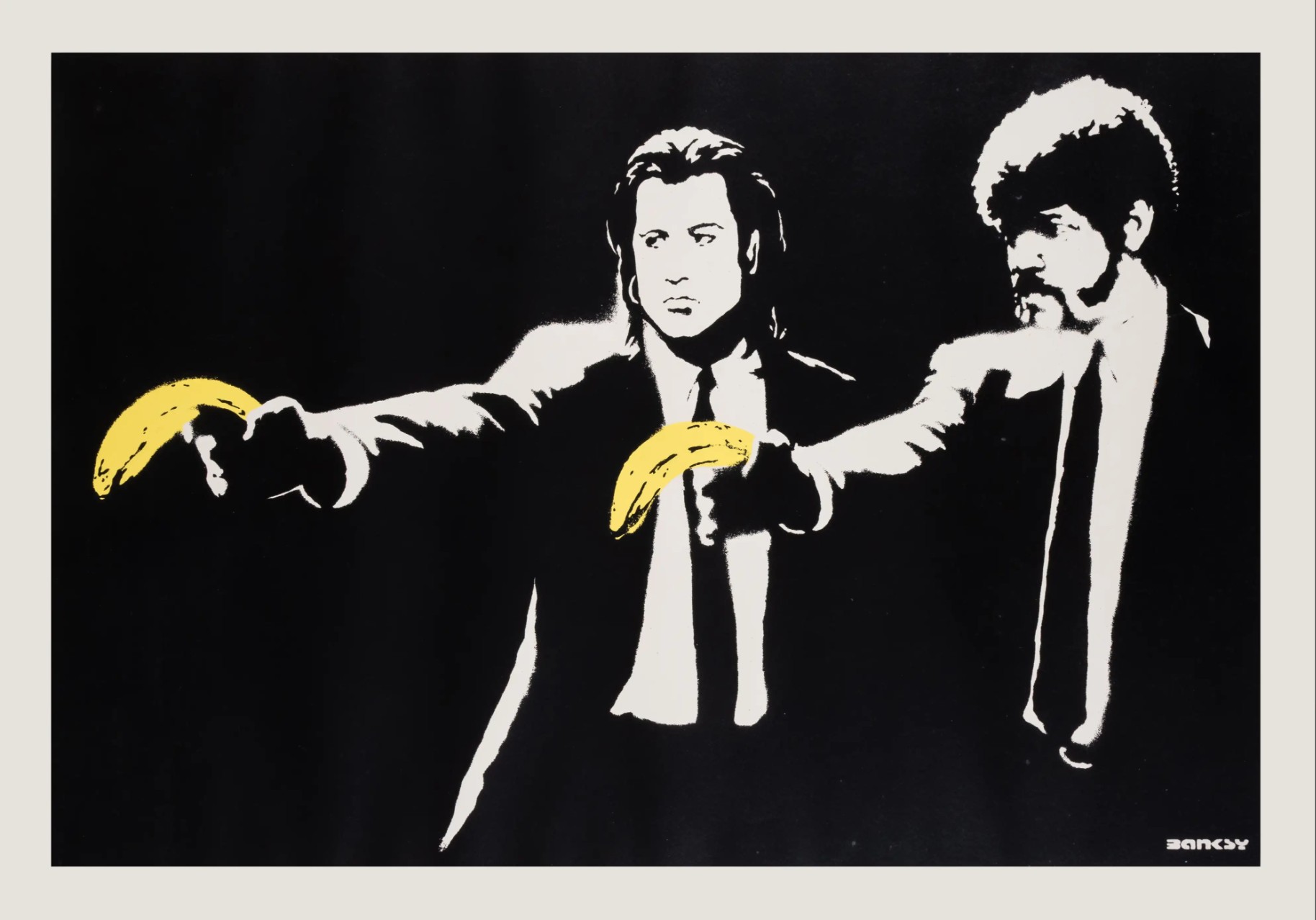
Pulp Fiction (unsigned), 2004
Numbered from the edition of 600
As with many of Banksy’s works, Pulp Fiction functions as a lesson in visual language. A single substitution is enough to shift the meaning of an entire image. Symbols, no matter how powerful, remain unstable. The banana becomes a tool of disruption, but also of translation, moving the image from cinema into the realm of art history, and from violence into irony. The humor in Pulp Fiction is immediate, yet highly controlled. The banana introduces a form of visual absurdity that disarms the scene without neutralizing its tension. This duality is essential. The viewer is caught between recognition and reinterpretation, between laughter and unease. The image does not resolve: it lingers in that instability.
Pulp Fiction was released in 2004 as an edition of 150 signed prints, and 600 unsigned prints.
Bomb Middle England
xxxxxxxxxx
Elderly women in sensible dress are shown not knitting or playing bowls but cheerfully carrying bombs. Banksy’s inversion is both comic and pointed. The work dismantles assumptions about innocence, respectability, and national identity, suggesting that the language of violence is never confined to those who visibly appear threatening.
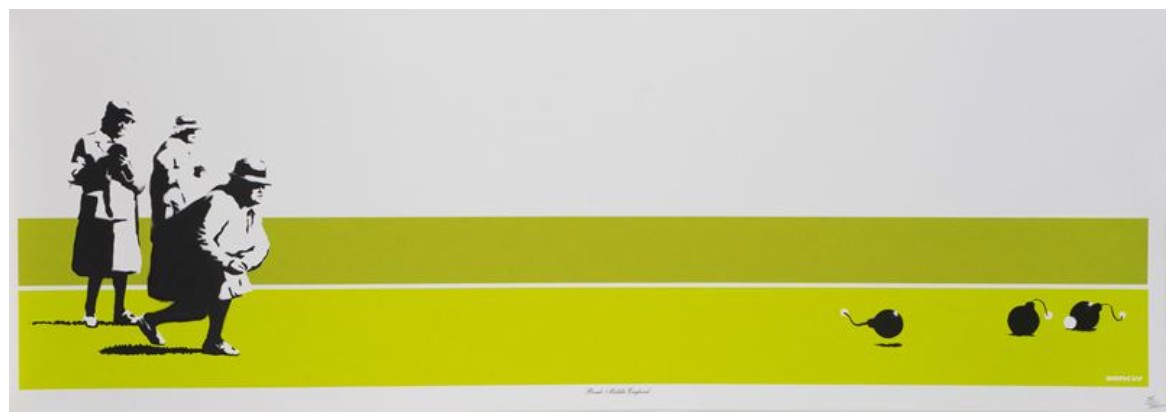
Bomb Middle England (signed AP), 2003
Signed and numbered from the edition of 31 signed AP
Bomb Middle England remains one of Banksy’s most refined and intellectually precise works. Its power lies not in overt shock, but in its ability to unsettle through understatement. More broadly, it exemplifies a key aspect of Banksy’s practice: the capacity to reveal profound truths through the simplest of visual interventions: transforming an ordinary scene into a powerful reflection on society’s relationship with violence.
CHAPTER II: AUTHORITY IN QUESTION
Authority in Banksy’s work is never stable. It appears uniformed, structured, and controlled, yet quickly reveals itself as theatrical, absurd, or quietly invasive. By shifting context rather than confronting power directly, these works expose how authority operates not only through force, but through routine, symbolism, and acceptance.
Flying Copper
xxxxxxxxxx
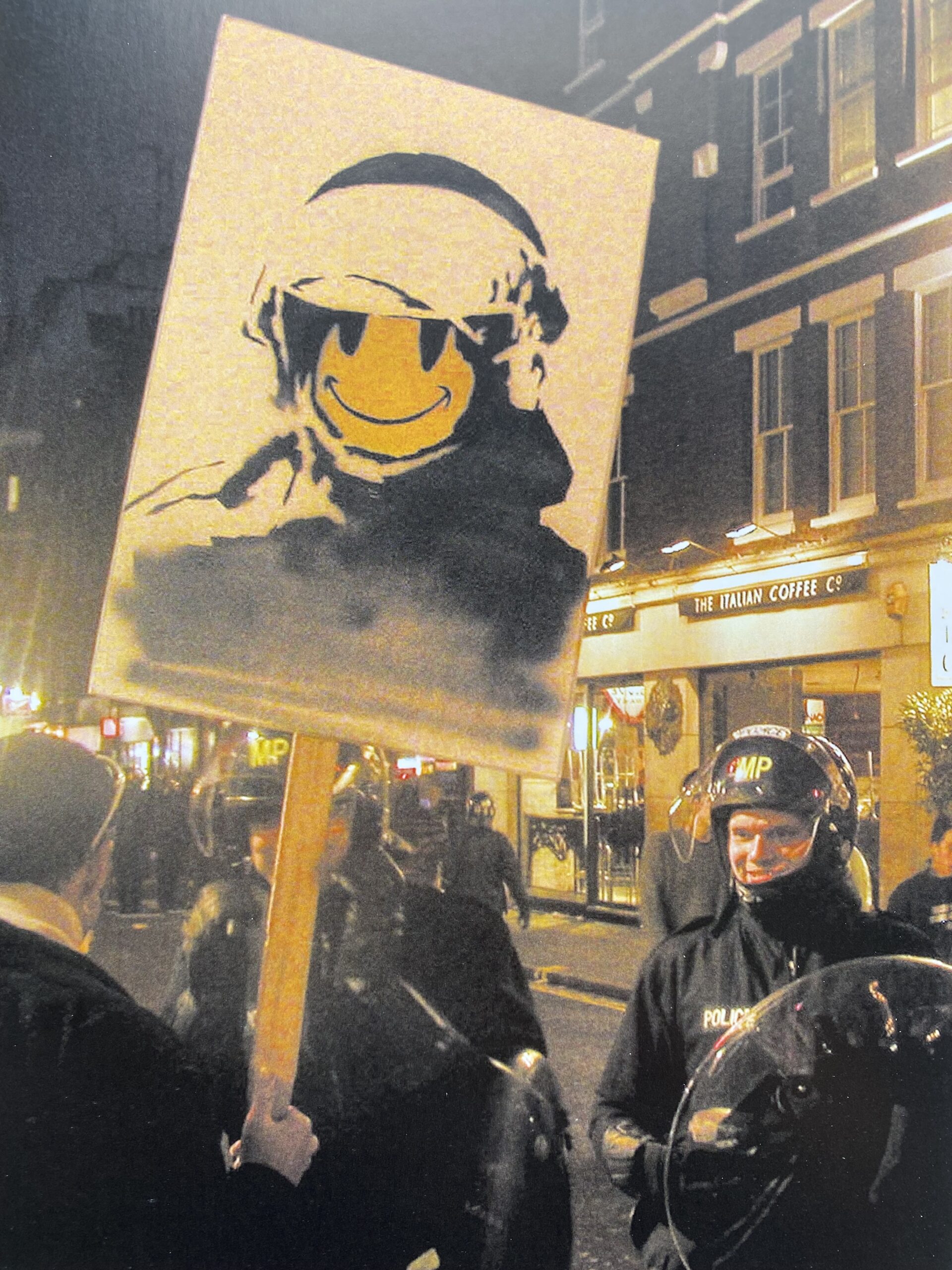
A heavily armed policeman is fitted with small wings and an acid-house smiley face, producing one of Banksy’s most memorable images of institutional absurdity. The work does not depict authority as invincible. It reveals it as a performance, armored yet hollow, smiling yet threatening, ridiculous yet still dangerous.
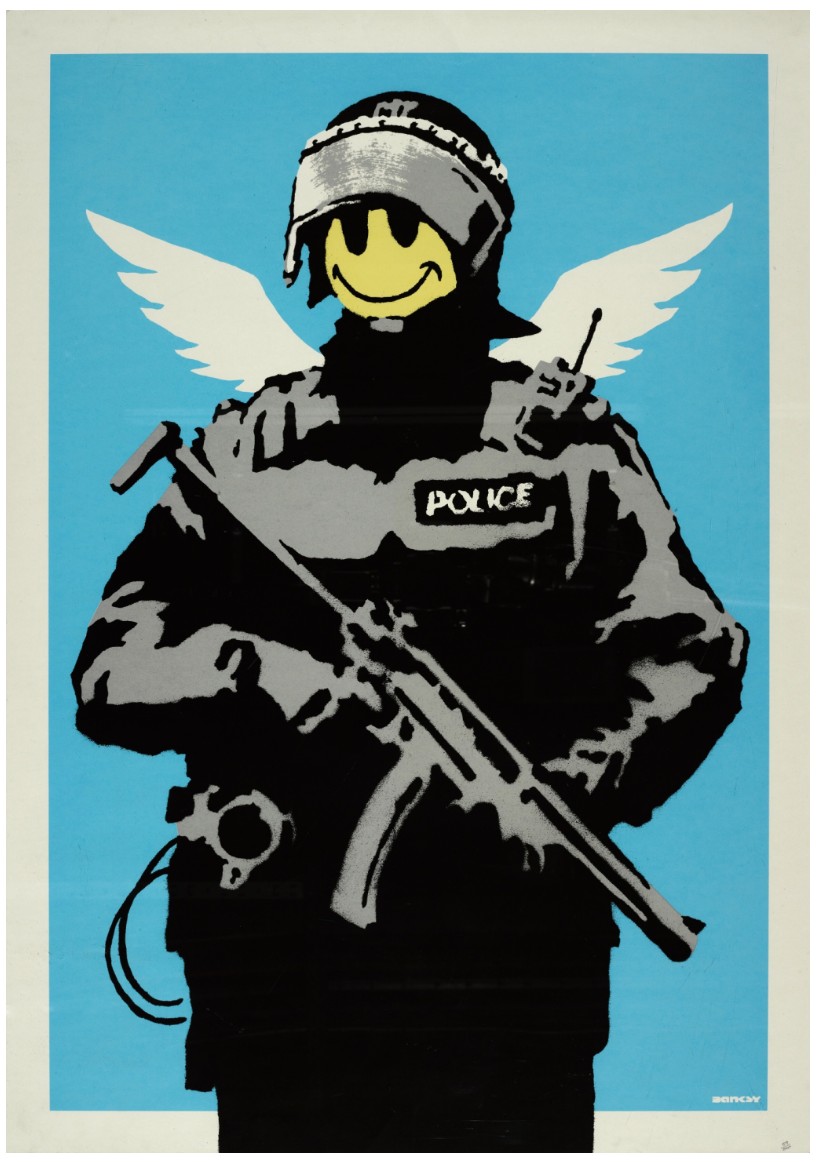
Flying Copper (unsigned), 2003
Numbered from the edition of 600
Flying Copper operates through contradiction. The smiley face, rooted in the visual culture of the late 20th century and popularized through acid house movements, suggests happiness, ease, and even naïveté. It is a symbol stripped of complexity, designed to reassure. By placing it over the face of a police officer, Banksy introduces the idea of institutional masking: the projection of friendliness as a veneer for authority. The wings complicate this further. Traditionally associated with purity, protection, or divine presence, they elevate the figure into a kind of ironic guardian. But here, their fragility borders on parody. They do not redeem the figure: they expose the absurdity of the claim.
Flying Copper was released in 2003 as an edition of 150 signed prints, and 600 unsigned prints.
Stop and Search
xxxxxxxxxx
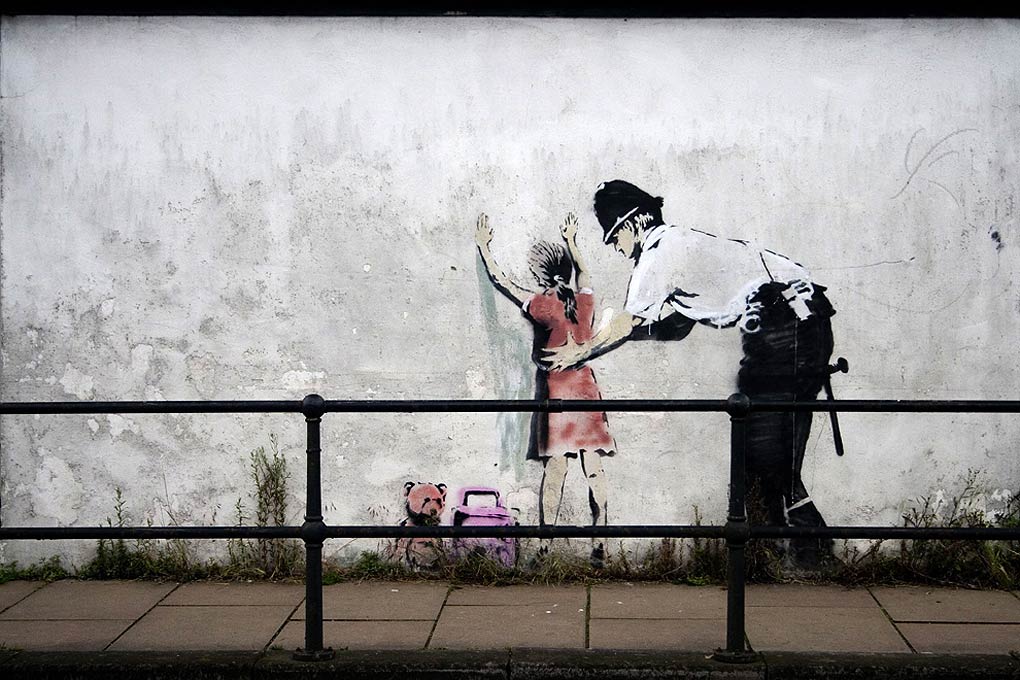
A police officer with blue latex gloves searches Dorothy’s small basket. The chromatic emphasis on the gloves heightens the invasive gesture and turns procedure itself into the focal point. Banksy places innocence, fantasy, and state control into one compressed image, transforming a familiar childhood figure into the subject of suspicion and reminding the viewer how casually surveillance can be normalized.
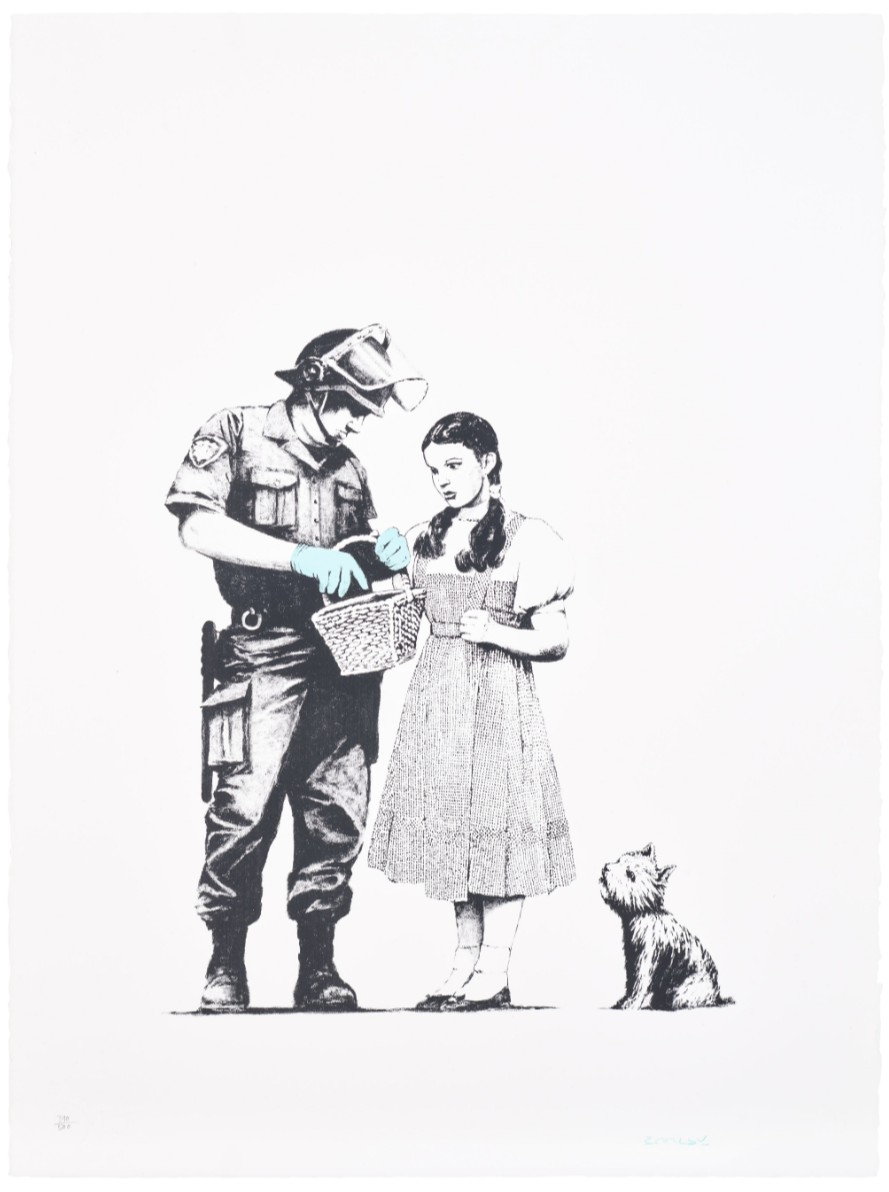
Stop and Search, 2007
Signed and numbered from the edition of 500
Stop and Search stands as one of Banksy’s most refined explorations of authority. Its strength lies in its restraint. There is no excess, no visual noise, no overt message. And yet, the image lingers. It resonates because it captures a shift that is difficult to articulate: the movement from justified authority to automatic suspicion, and the erosion of boundaries between protection and control. Within Banksy’s body of work, it marks a moment of precision—where critique is no longer shouted but quietly demonstrated.
Stop and Search was released in 2007 as an edition of 500 signed prints.
Donut (Chocolate)
xxxxxxxxxx
A police escort ceremonially accompanies an oversized doughnut as though it were a state object of great importance. The image is ludicrous by design, but its satire is precise. Banksy merges caricature, consumer cliché, and bureaucratic pomp to expose a culture in which spectacle and authority often validate one another.
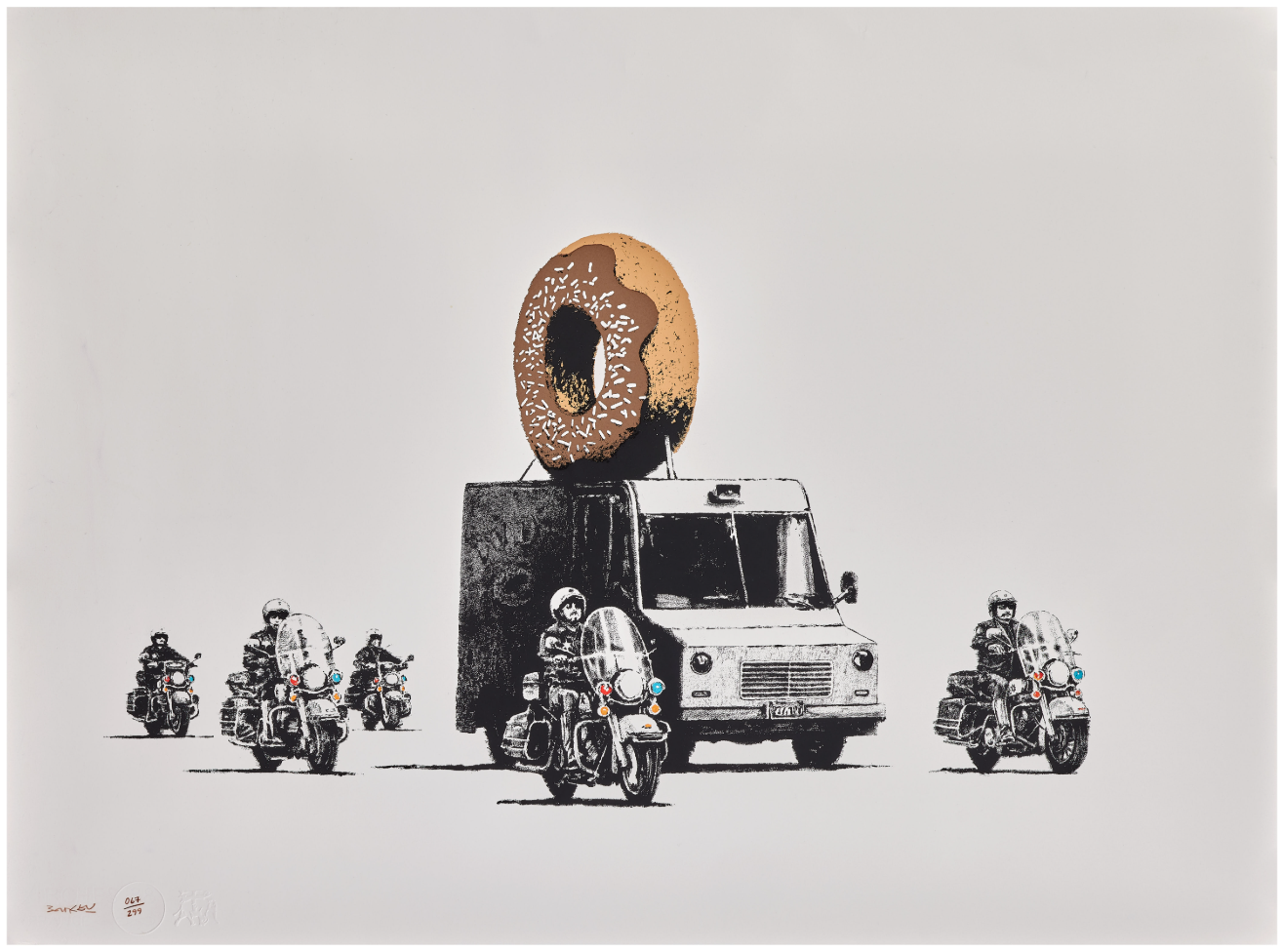
Donut (Chocolate), 2009
Signed and numbered from the edition of 299
Donut explores the disjunction between function and purpose. The police officers embody authority, structure, and institutional discipline. Their presence typically signals importance, danger, or necessity. In this work, however, that same authority is applied with complete rigor to an object that carries no real weight or consequence. The power of the image lies in this imbalance. The officers are not exaggerated or mocked. They are credible and composed, performing their task with professionalism. The absurdity emerges from the object itself. The donut, associated with indulgence and banality, becomes the center of a highly controlled operation.
Donut was released in 2009 in two different colorways: Chocolate and Strawberry, each as an edition of 299 signed prints.
Monkey Queen
xxxxxxxxxx
Here Banksy fuses political caricature with pop immediacy. The familiar format of royal portraiture remains intact, but the sovereign is replaced by a monkey, collapsing reverence into parody. The image is humorous on the surface, yet it also exposes how power often depends less on inherent dignity than on ritual, costume, and collective consent.
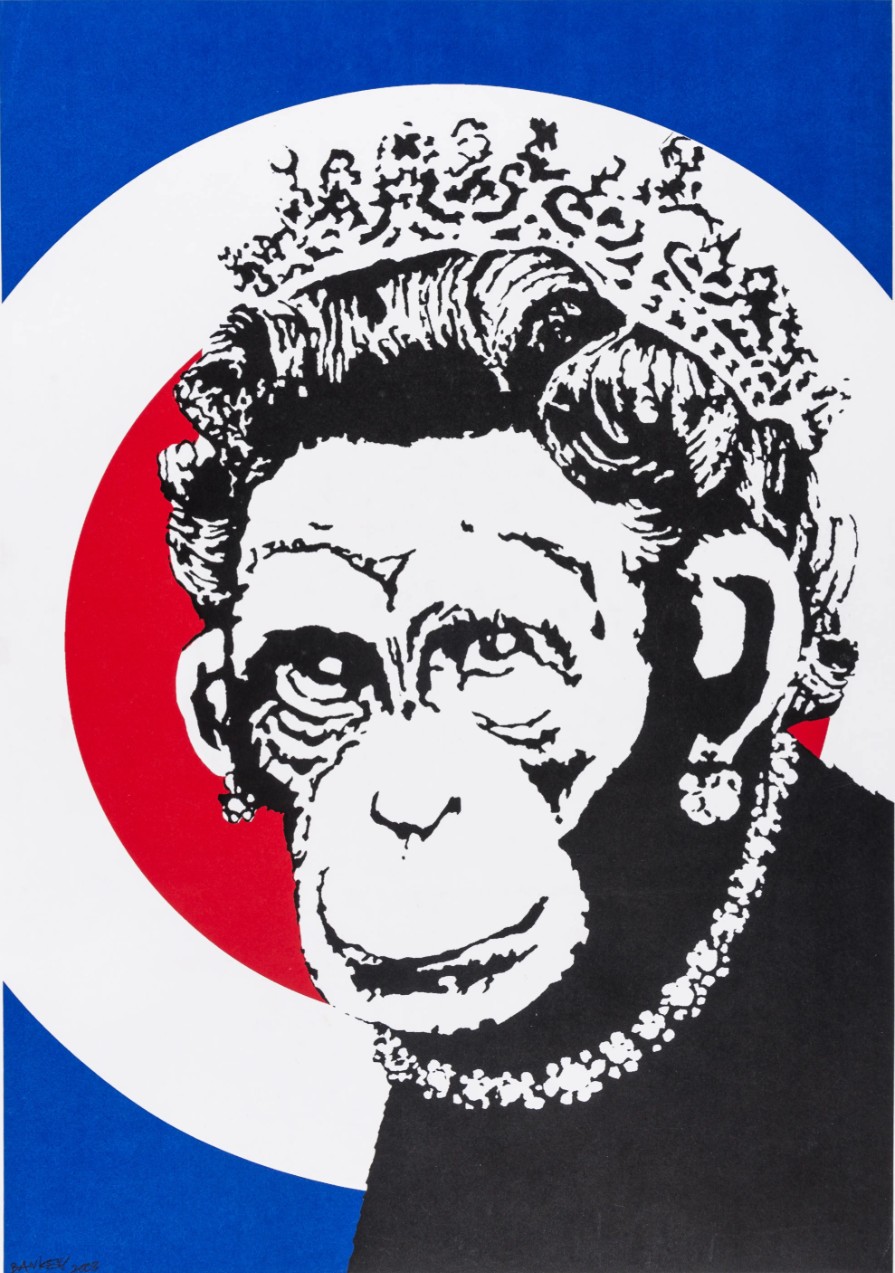
Monkey Queen (signed), 2003
Signed and numbered from the edition of 750
(only 150 were signed)
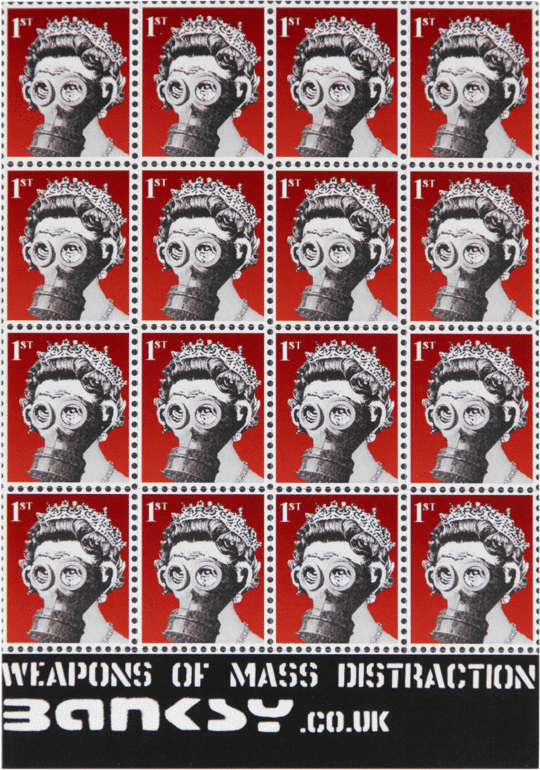
Monkey Queen has become one of Banksy’s most enduring and recognizable images, emblematic of his early exploration of authority and identity. Its clarity, humor, and immediacy have ensured its continued relevance, both within the art world and in broader popular culture. More broadly, Monkey Queen encapsulates a central aspect of Banksy’s practice: the ability to challenge powerful institutions not through confrontation, but through the precise and disarming use of satire.
Monkey Queen was released in 2003, as an edition of 750 prints, of which 150 only are signed.
CHAPTER III: INNOCENCE INTERRUPTED
Children occupy a central place in Banksy’s visual language, not as passive symbols of hope, but as figures caught within systems they do not control. Innocence appears here not as an ideal, but as a condition under pressure. Across these images, it is constrained, absorbed, exposed, and ultimately altered. What begins as fragile hope gives way to something more complex, where protection is uncertain and the boundaries between care and control begin to dissolve.
Toxic Mary
xxxxxxxxxx
In Toxic Mary, Banksy appropriates the visual language of devotional art only to corrupt it from within. The nurturing gesture traditionally associated with the Madonna and Child is transformed into an act of poisoning. The work unsettles because it does not merely parody religion; it suggests the contamination of care, belief, and moral authority within contemporary culture.
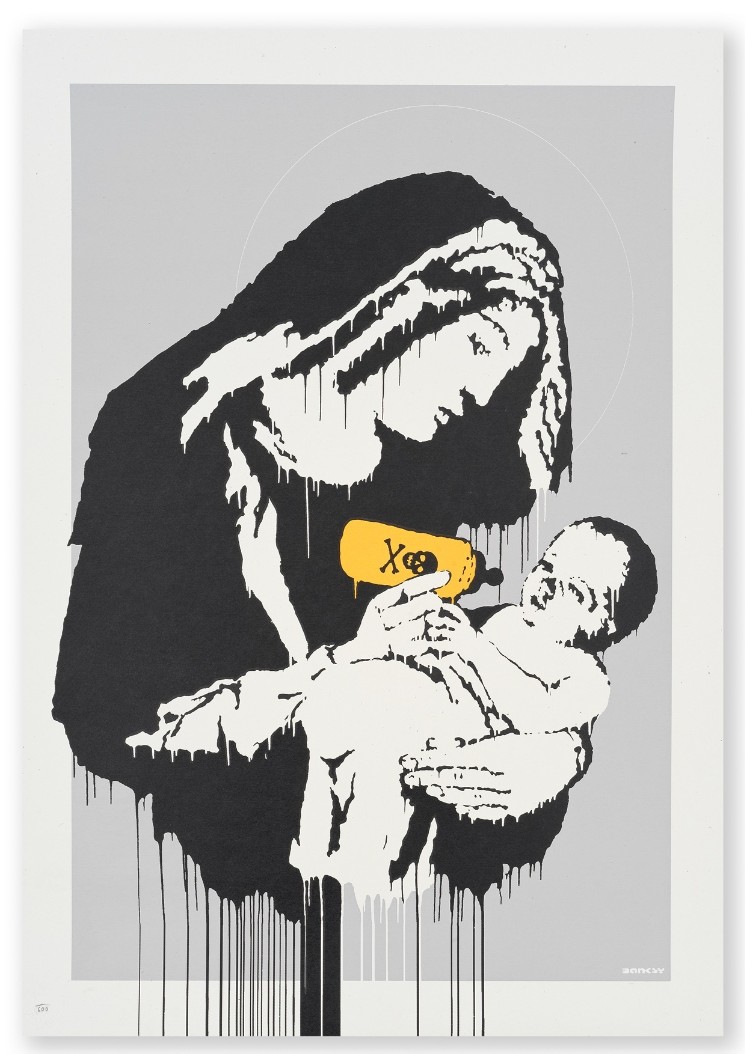
Toxic Mary (unsigned), 2003
Numbered from the edition of 600
Toxic Mary is not an isolated gesture. It belongs to a broader tendency within Banksy’s work to appropriate and destabilize established symbols. Religion, like authority, offers a visual language that is immediately legible and emotionally charged. By intervening in this language, Banksy creates instant recognition, followed by disruption. In Toxic Mary, the strategy is particularly effective: the composition is almost classical, the deviation is minimal, but decisive, the impact is immediate and lingering. Rather than rejecting the icon, Banksy inhabits it: and quietly rewrites its meaning.
Toxic Mary was released in 2003 as one edition of 150 signed prints, and an edition of 600 unsigned prints.
Napalm (Serpentine Edition)
xxxxxxxxxx
Among Banksy’s most severe images, Napalm confronts viewers with the collision between historical suffering and the polished surfaces of mass culture. The burned child from a defining photograph of the Vietnam War is held between Mickey Mouse and Ronald McDonald. No visual detour softens the impact. Entertainment, branding, and atrocity are forced into the same frame.
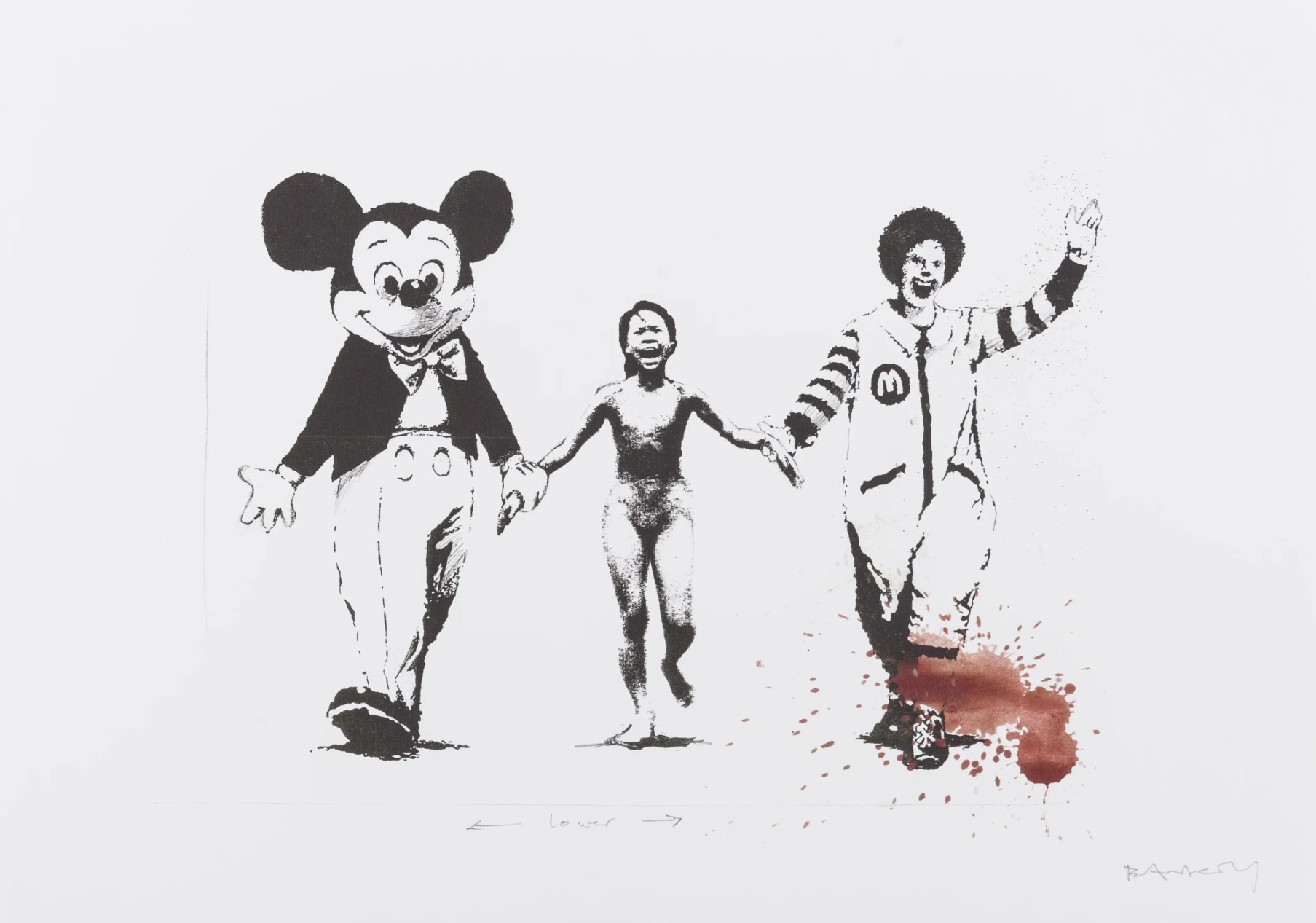
Napalm (Serpentine Edition), 2007
Signed and numbered from the edition of 50
The Serpentine Edition is a special release that coincided with a Damien Hirst exhibition at the Serpentine Gallery. As included in “In the Darkest Hour there May be Light”, co-published by the Serpentine Gallery and Other Criteria, London. Damien Hirst and Banksy are known to have great mutual respect for each other. They have collaborated at numerous occasions. Damien Hirst ended up acquiring the original Napalm painting.
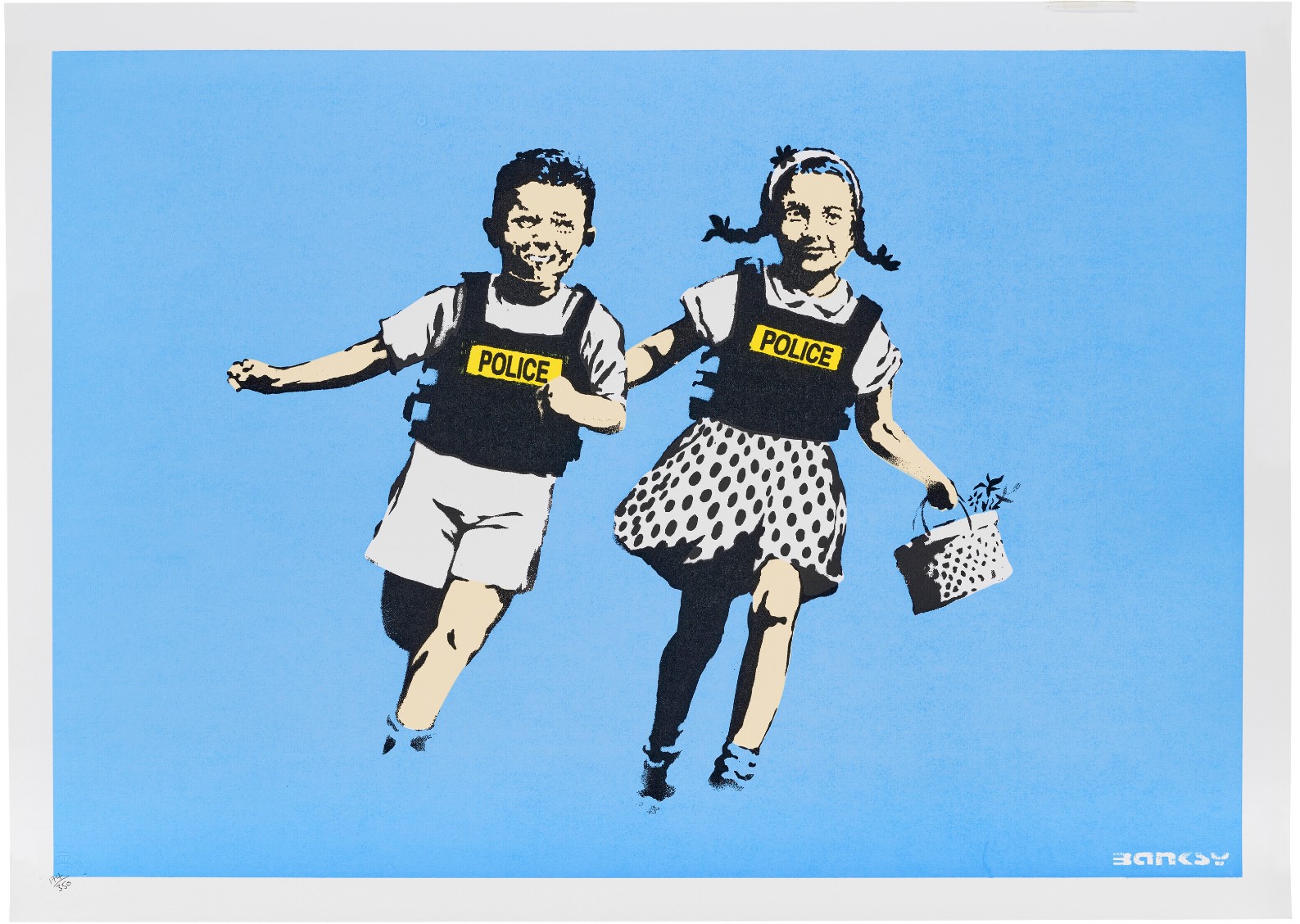
Jack & Jill
xxxxxxxxxx
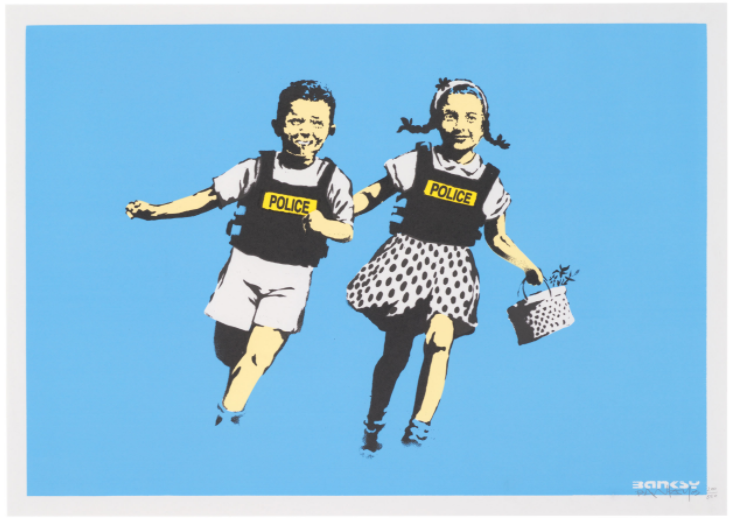
Two children wearing police helmets and carrying riot shields are rendered with a disarming lightness that only intensifies the critique. Banksy imagines authority as something absorbed early, almost playfully, through costume and imitation. The work is less about childhood innocence than about how systems of control reproduce themselves through normalization.
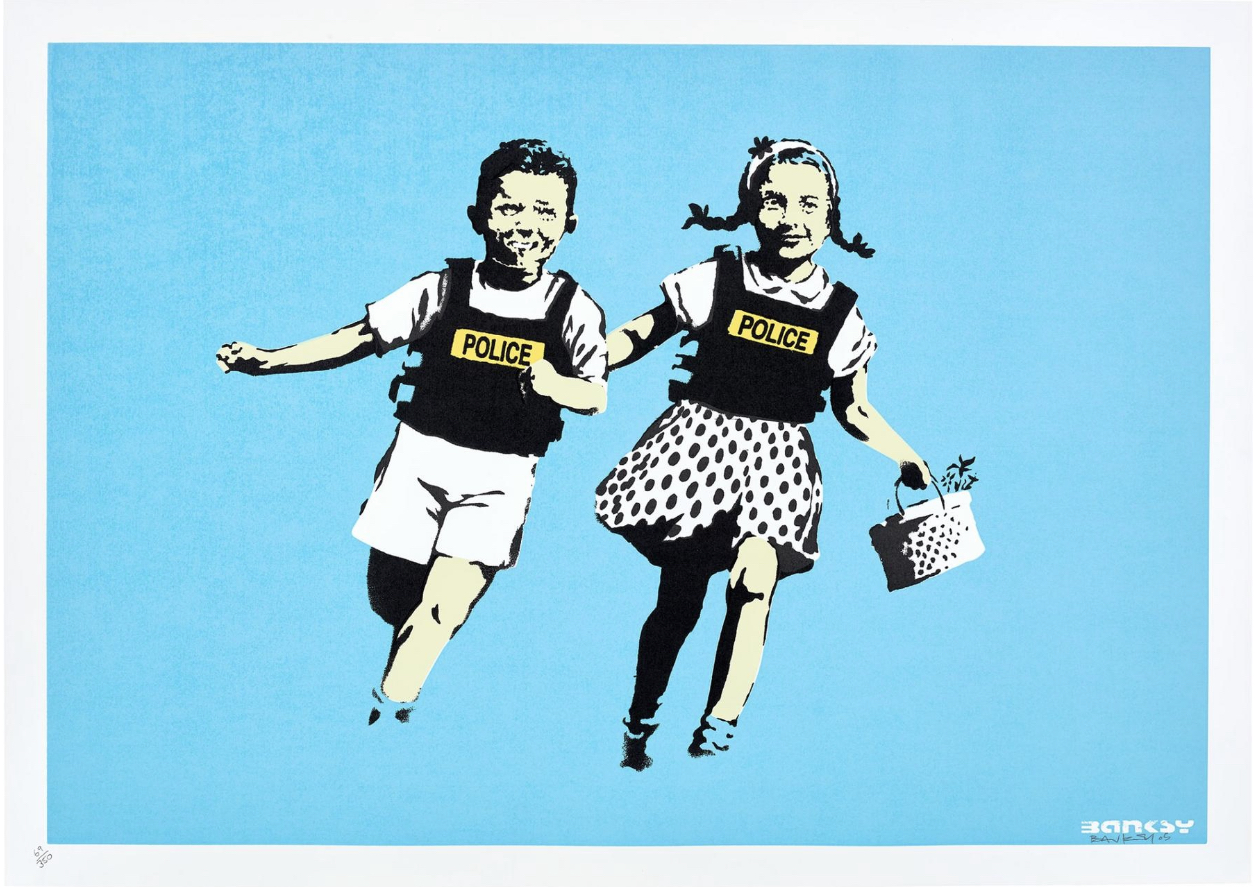
Jack and Jill (signed), 2005
Signed and numbered from the edition of 350
Jack and Jill is one of Banksy’s clearest demonstrations that the most effective critique does not always arrive through spectacle. Sometimes it arrives through two smiling children, a bright background, and one unbearable detail. They are running freely. They are dressed for danger. And between those two facts lies the whole unease of the image. Banksy does not tell us whether the vests are there to protect childhood or to announce its end. He simply makes sure we can no longer look at innocence without also seeing the systems that surround it.
Jack and Jill, also known as Police Kids, was released in 2005 in one edition of 350 signed prints, and one edition of 350 unsigned prints.
Grin Reaper
xxxxxxxxxx
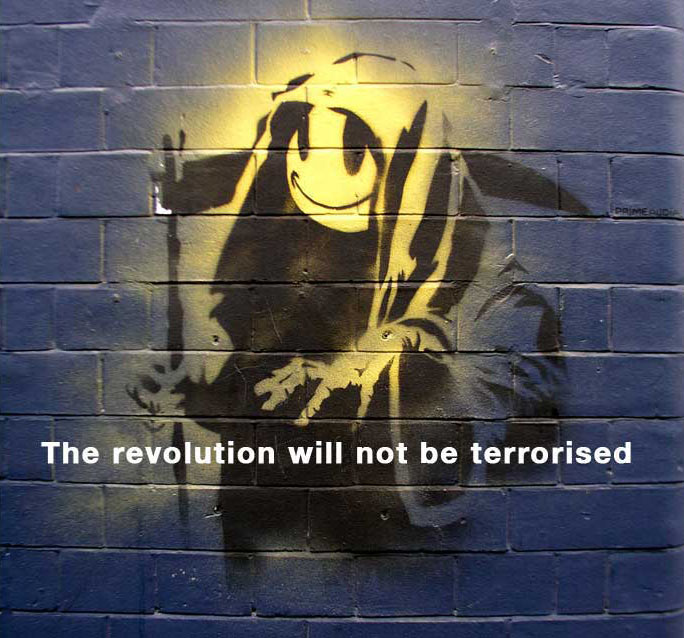
The Grim Reaper, universal emblem of mortality, is absurdly placed on a fairground dodgem beneath a yellow smiley face. The work fuses menace and amusement with unusual elegance. Death is not denied; it is staged as entertainment. In doing so, Banksy exposes a culture increasingly inclined to package dread as spectacle.
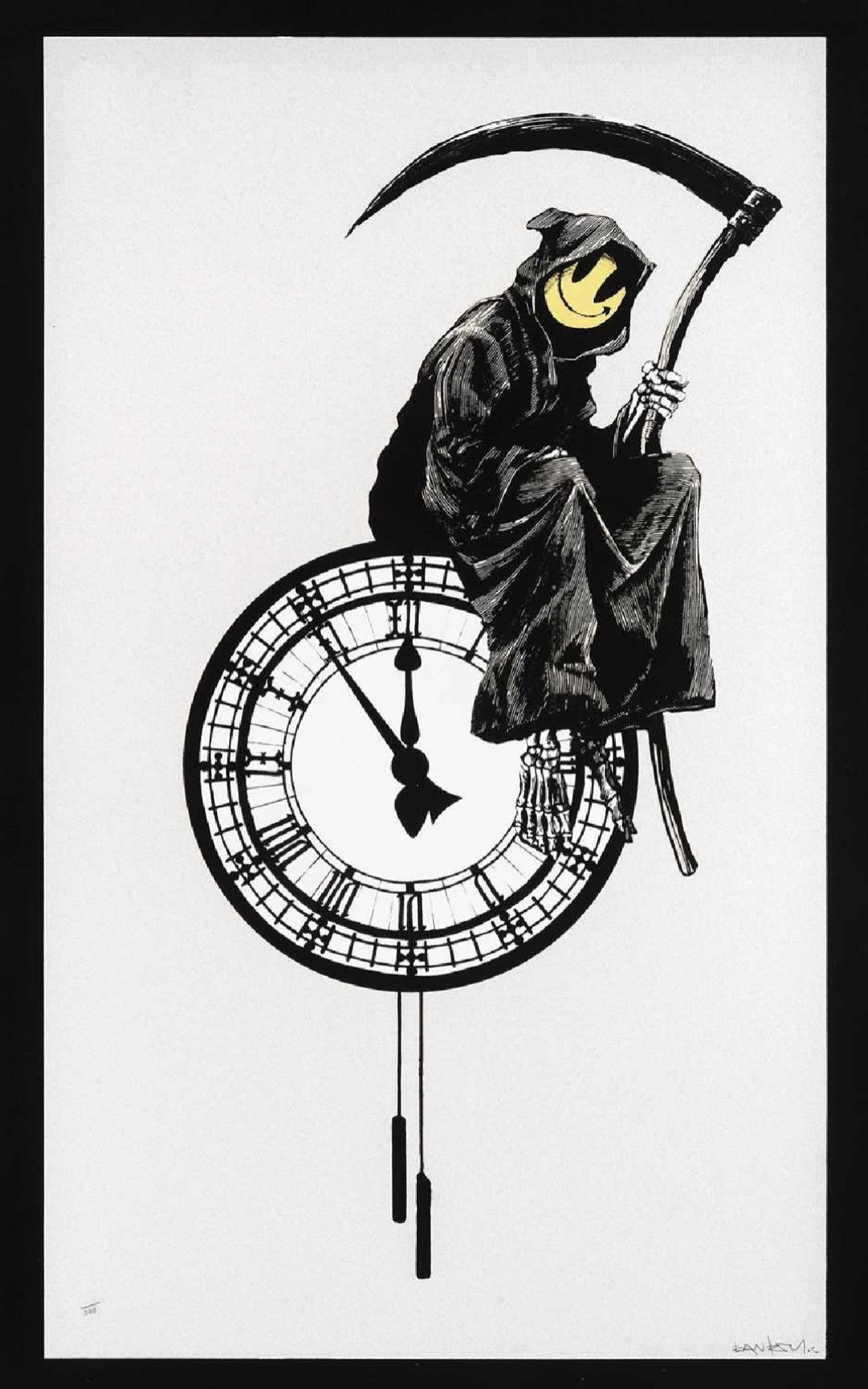
Grin Reaper, 2005
Signed and numbered from the edition of 300
Few images in Banksy’s oeuvre capture the tension between inevitability and denial as precisely as Grin Reaper. By merging the figure of death with the language of mass-produced happiness, the artist constructs a work that is at once humorous, unsettling, and quietly existential. Few images in Banksy’s oeuvre capture the tension between inevitability and denial as precisely as Grin Reaper. By merging the figure of death with the language of mass-produced happiness, the artist constructs a work that is at once humorous, unsettling, and quietly existential.
Grin Reaper was released in 2005 as an edition of 300 signed prints.
No Ball Games (Green)
xxxxxxxxxx
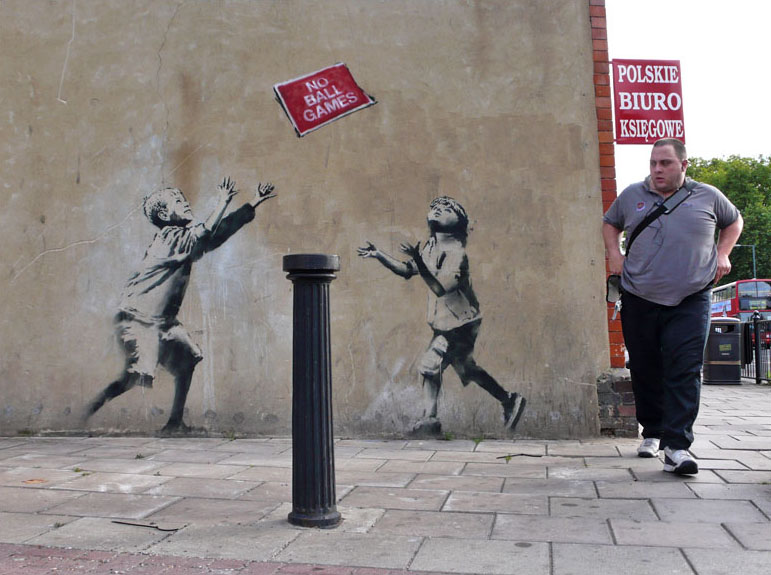
Two children play with the very sign that forbids them to play. The act is simple, mischievous, and quietly radical. Banksy suggests that authority can be resisted not only through confrontation, but through reinterpretation. Restriction becomes material for imagination.
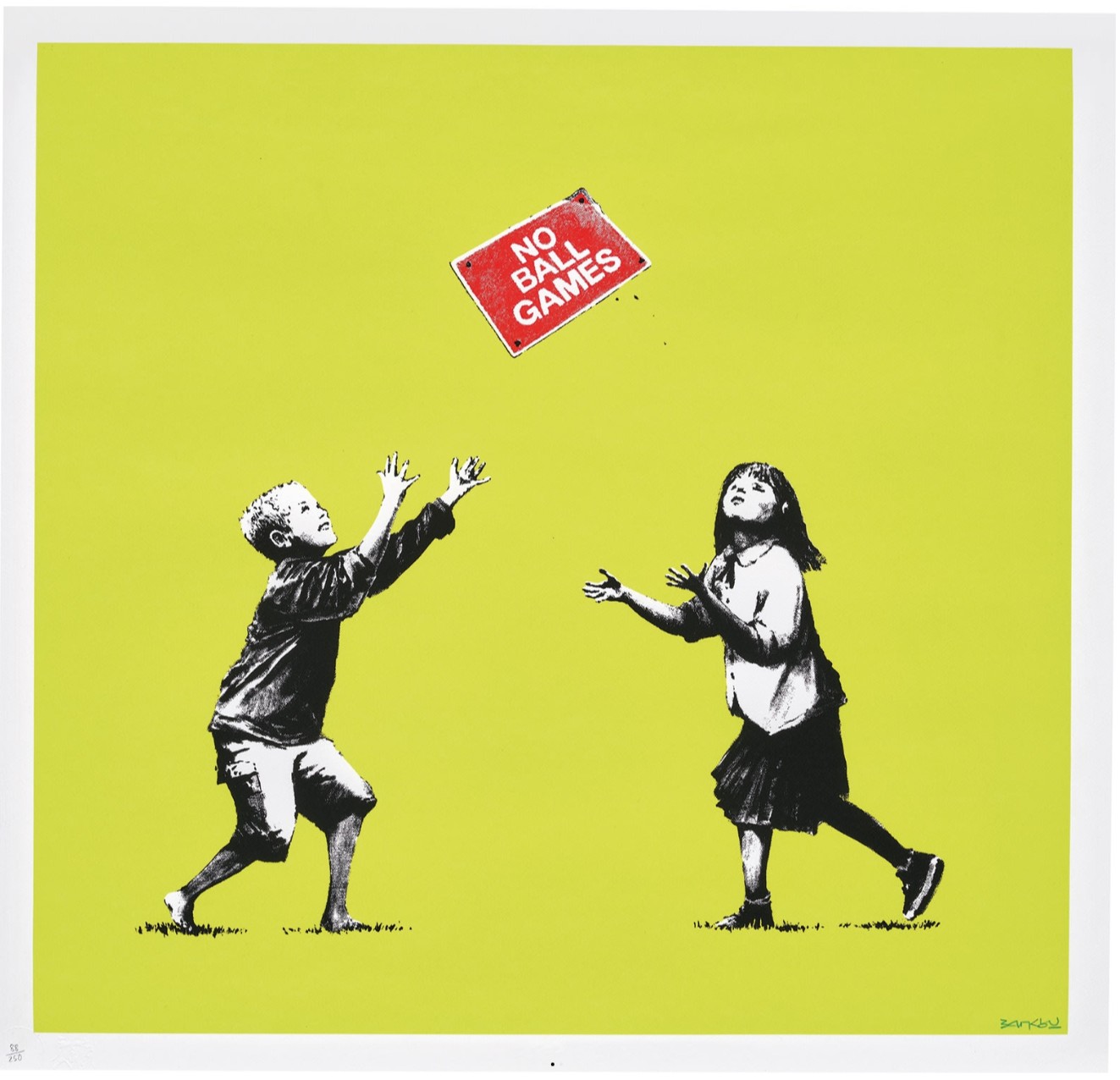
No Ball Games (Green), 2009
Signed and numbered from the edition of 250
No Ball Games explores the fragility of imposed authority when confronted with imagination. The sign represents a familiar form of control: urban regulations designed to restrict behavior, often in public or communal spaces. Its language is direct, impersonal, and absolute. It does not negotiate. It imposes. The children, by contrast, do not confront the rule directly. They do not protest or reject it. Instead, they reinterpret it. By turning the sign into a ball, they strip it of its authority without ever engaging in open defiance.
No Ball Games was released in 2009 in 2 colorways: Green and Grey, each as an edition of 250 signed prints.
Girl with Balloon
xxxxxxxxxx
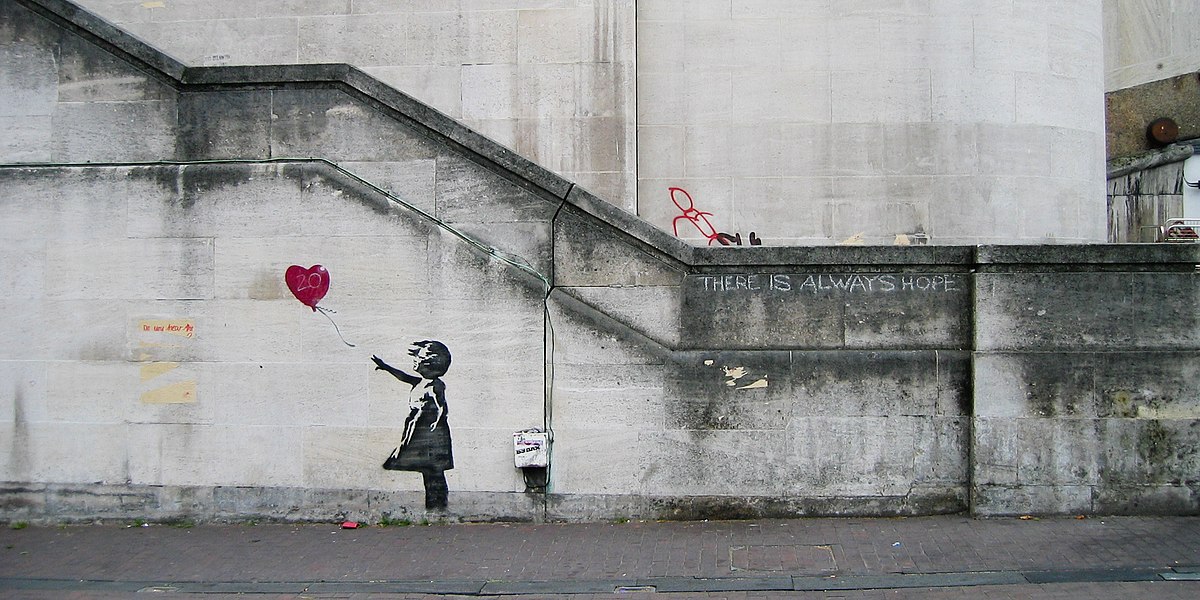
A young girl reaches toward a drifting heart-shaped balloon. Few contemporary images have achieved such immediate symbolic clarity. Yet the work remains powerful because it never settles into a single meaning. It can be read as loss, longing, tenderness, or hope. Its emotional economy is exactly what makes it so durable.
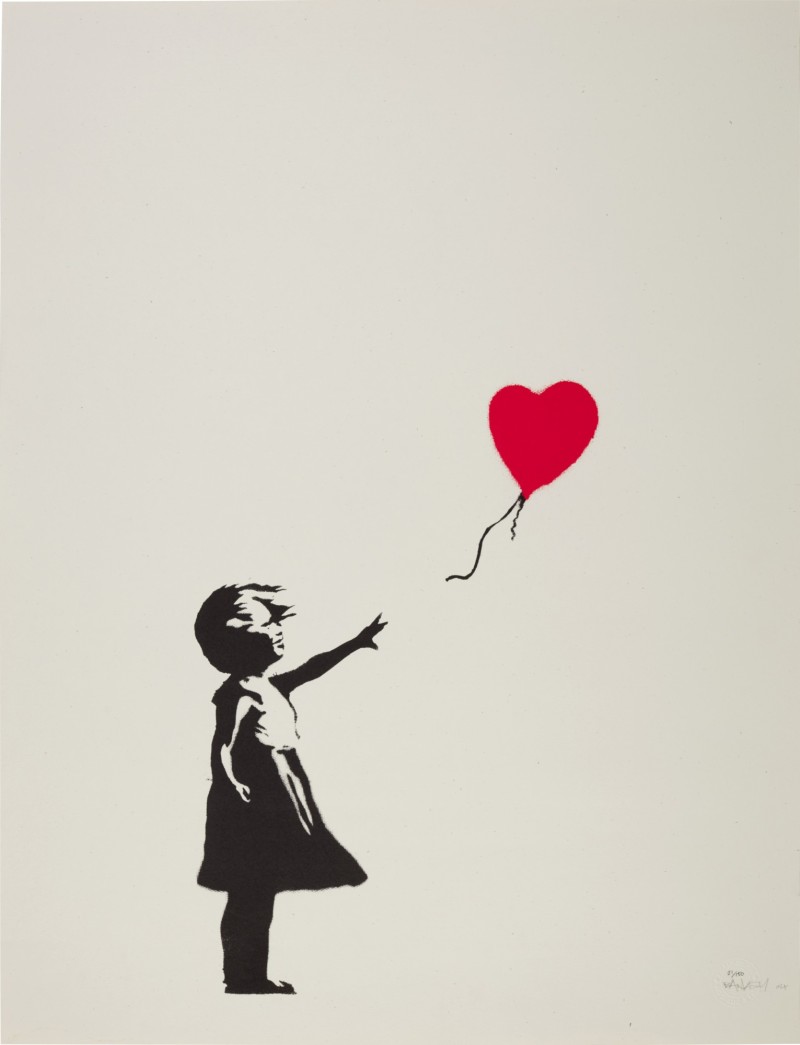
Girl with Balloon (signed), 2004
Signed and numbered from the edition of 150
Girl with Balloon is about the tension between hope and disappearance. The balloon, shaped like a heart, operates as a universal symbol: love, childhood, innocence, or even aspiration. Its movement away from the girl introduces ambiguity: is this a loss, or a release? Banksy’s addition of the phrase in the original mural “There is always hope” reframes the image. The work no longer depicts loss alone, but rather the persistence of hope precisely when something slips away.
CHAPTER IV: THE THEATER OF CONSUMPTION
In these works, Banksy turns his attention to the rituals of contemporary life, where consumption becomes performance, and value is constructed through spectacle. The act of buying, bidding, and desiring unfolds as a form of theatre, where meaning is less intrinsic than assigned. In this final chapter, the viewer is no longer outside the system but implicated within it. Consumption emerges not as a simple act, but as a ritual: constructed, repeated, and performed.
Golf Sale
xxxxxxxxxx
A lone figure stands beside a sign reading “GOLF SALE” as tanks advance across the image. Banksy collapses the language of commerce into the imagery of war, turning violence into something advertised, packaged, and absurdly available. The work is not about action, but about distance: conflict is present, yet framed with the cold detachment of a sales notice.
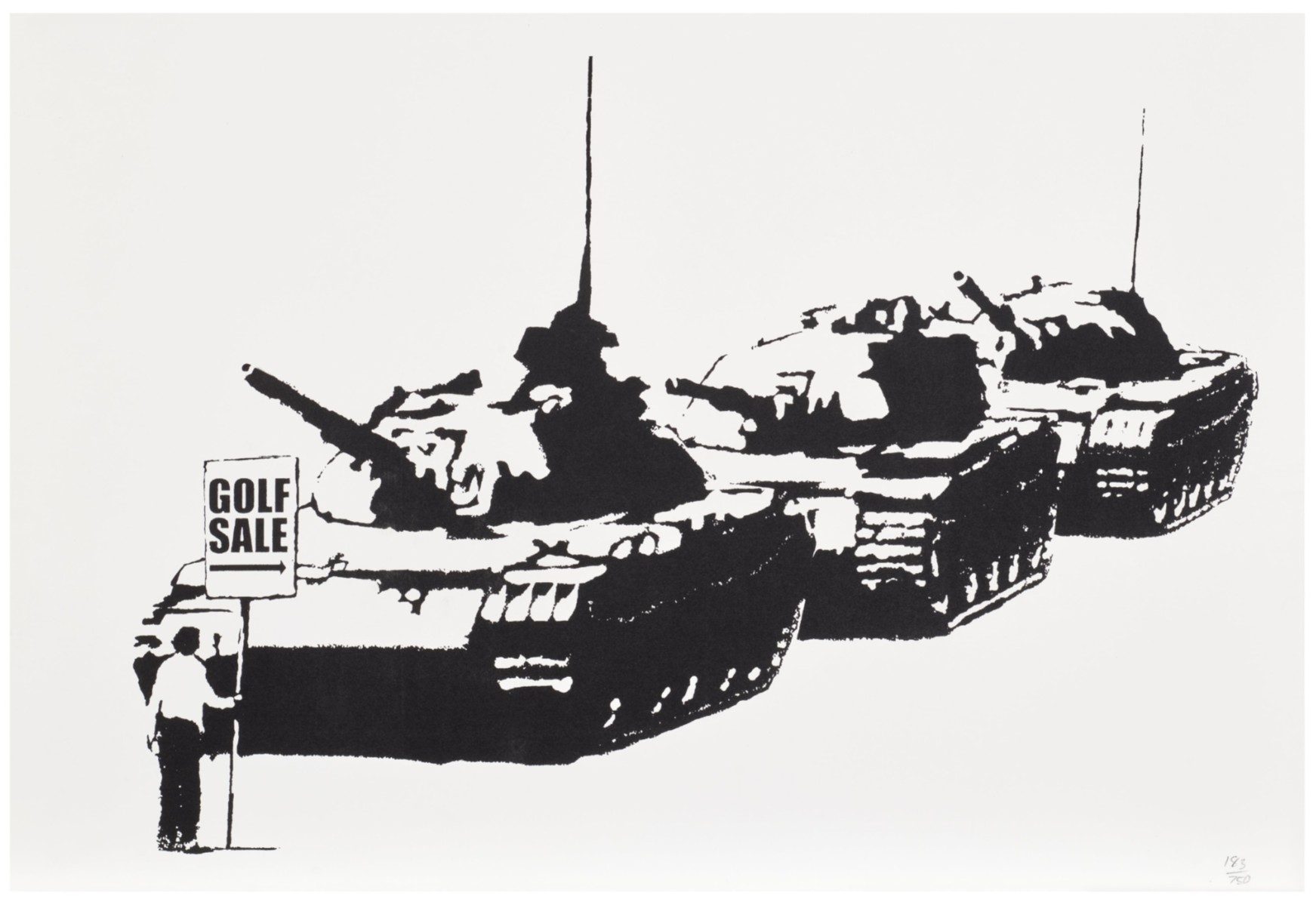
Golf Sale (unsigned), 2003
Numbered from the edition of 750
(only 150 were signed)
Golf Sale stands as one of Banksy’s most intellectually controlled appropriations. Its power lies not in visual complexity, but in conceptual clarity: a universally recognized image, with just a single, minimal alteration, leads to a complete transformation of meaning… Golf Sale does not mock the original act, it only displaces it. A man still stands before tanks. But the meaning of that gesture has shifted. And in that shift, Banksy reveals something profoundly unsettling: that even the most powerful symbols of resistance are not immune to being absorbed, diluted, and quietly rewritten.
Golf Sale was released in 2003 as an edition of 750 prints, of which only 150 were signed.
Trolleys (Black & White)
xxxxxxxxxx
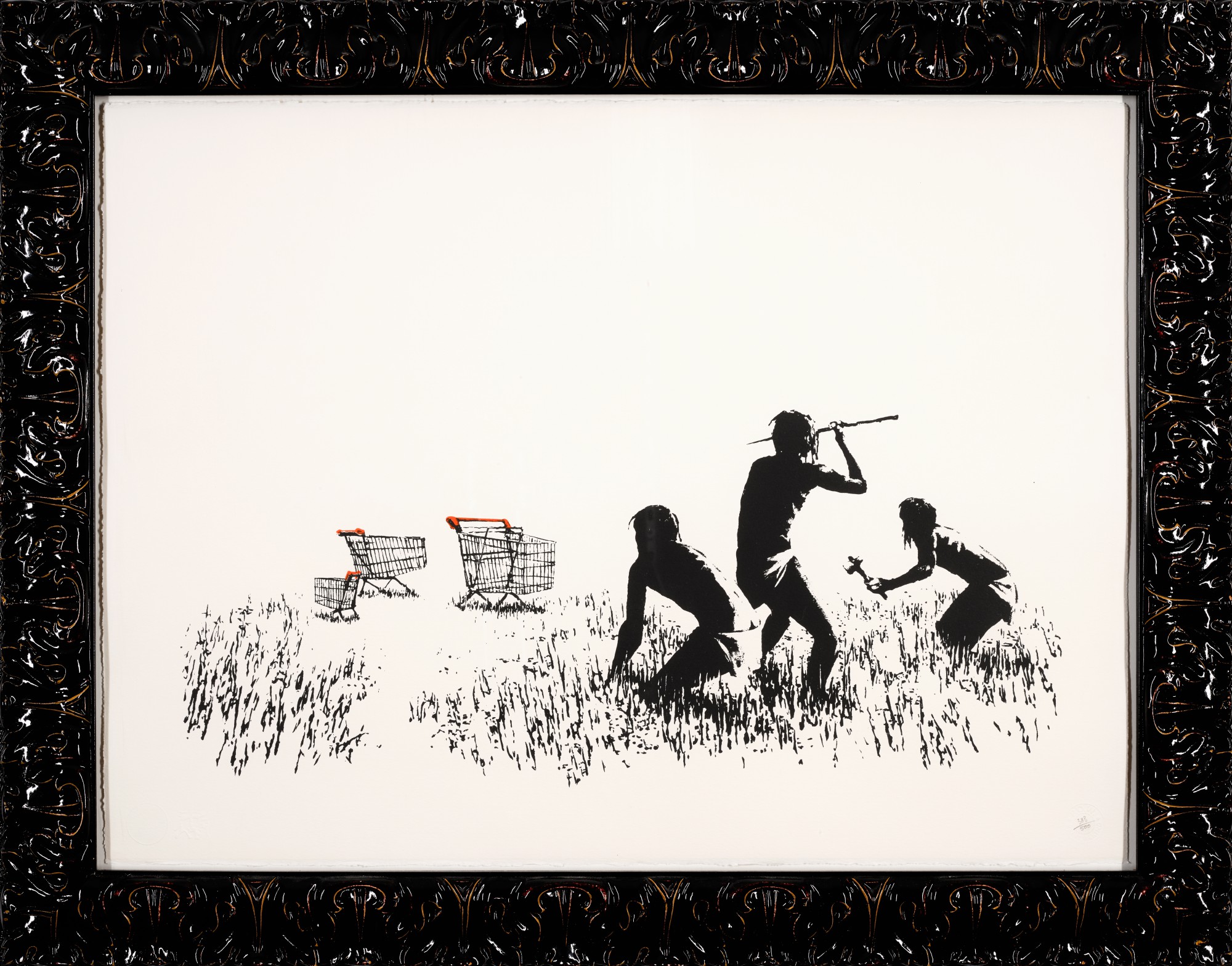
A group of prehistoric hunters charges across the surface, but their quarry is not animal life; it is a line of shopping carts. The image collapses millennia of human behavior into a single satirical proposition: survival has been replaced by consumption. What once sustained life has given way to what now organizes desire.
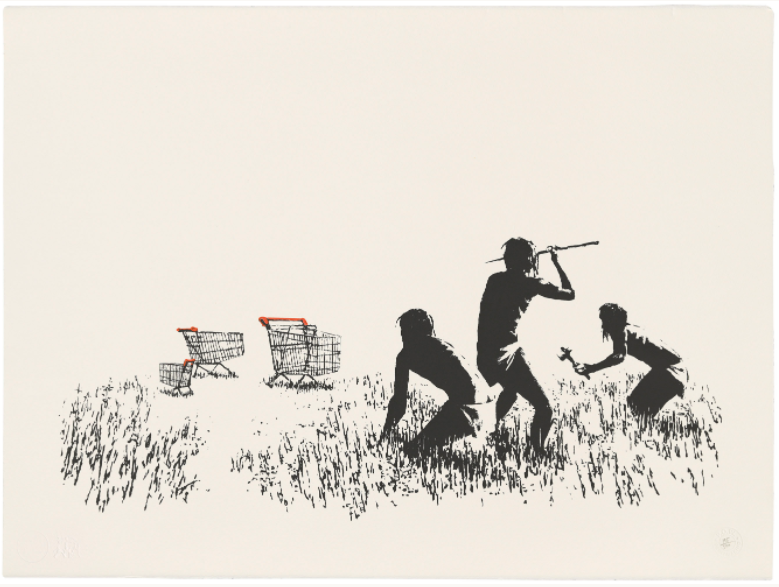
Trolleys (Black & White), 2006-2007
Numbered from the edition of 500
The trolley, comic in its incongruity, nods to our consumer society’s predilection for, and reliance on, highly processed, branded packaged food products, and our inability to fend for ourselves. Grouped like antelope in a field, the barren nature of the landscape in which we find these alien carts nods to our willingness to ship foods and other commodities all over the planet to be picked up whenever convenient by the consumer in the aisles of big chain supermarkets. With sardonic wit, Banksy juxtaposes his trolleys with a trio of Neanderthal hunter-gatherers, thereby shining a critical light on how far we as human beings have deviated from our base instincts, and abilities.
Trolleys (Color)
xxxxxxxxxx
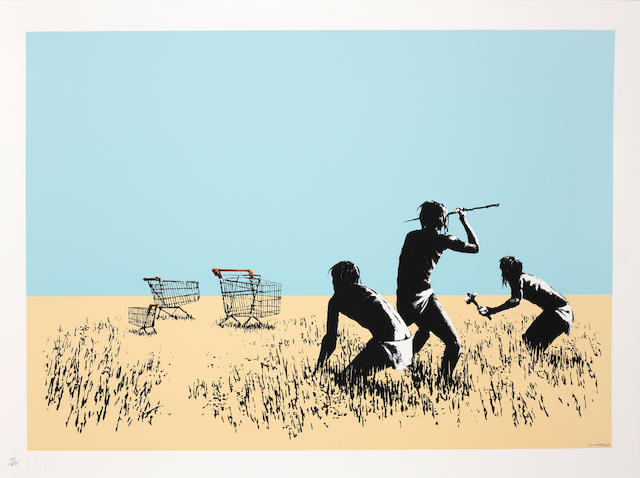
The colored variant intensifies the theatrical quality of the composition without altering its underlying satire. By giving greater visual seduction to the scene, Banksy sharpens the contradiction at its core. Consumer culture is not only absurd; it is vividly attractive, which is precisely why its grip proves so durable.
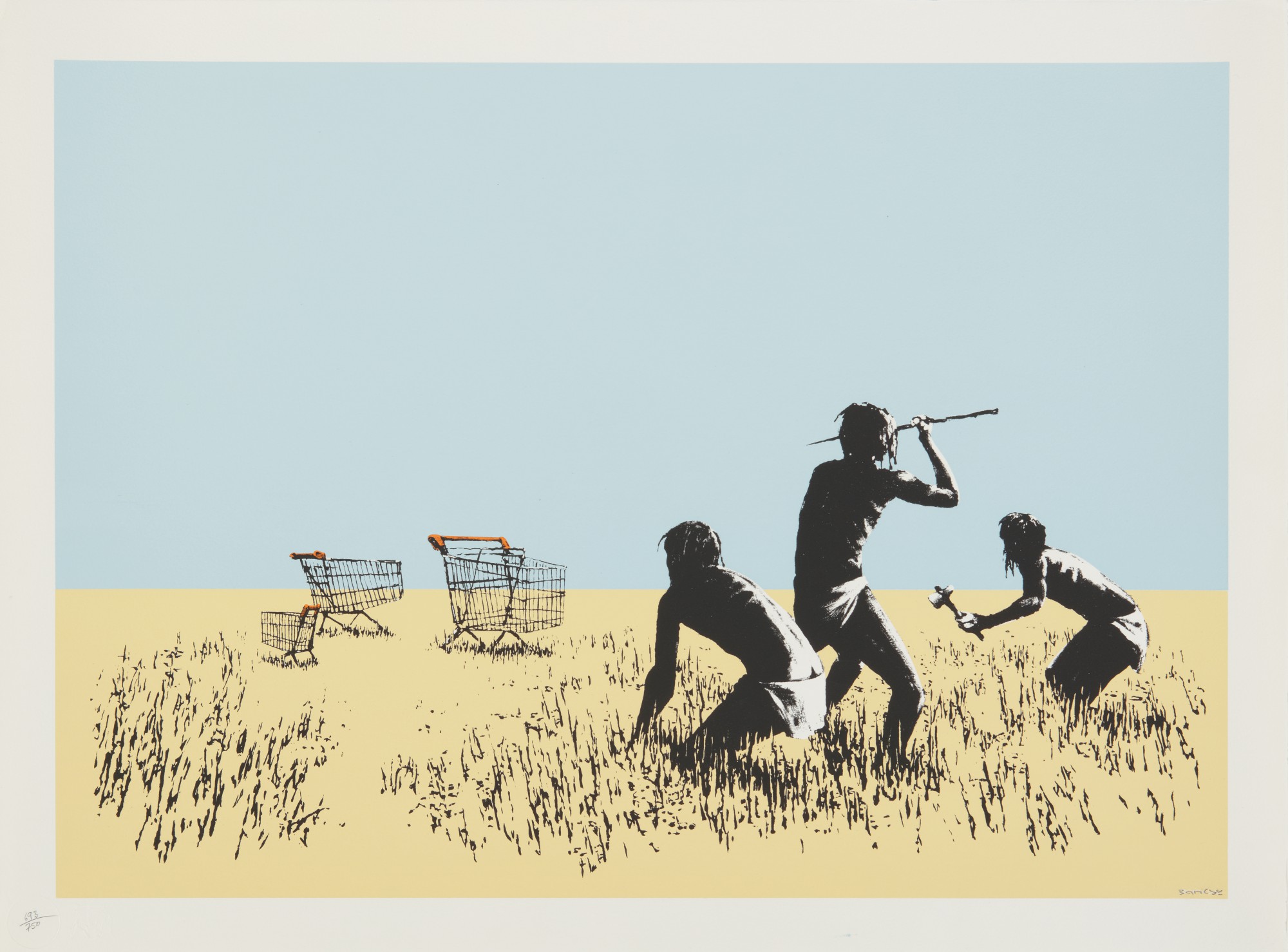
Trolleys (color), 2007
Signed and numbered from the edition of 750
Trolley Hunters is the perfect incarnation of Banksy’s distinctive marriage of street art, graffiti and satire. Featuring three prehistoric men in a desert, the atmosphere of Trolley Hunters is both eerie and lighthearted. Holding various weapons, the three men pictured are poised to attack. The targets of their attack are, in typical Banksy fashion, trolleys – or shopping carts. The poignancy of the resulting work is twofold; firstly in its timeless critique of capitalism, and secondly in its unique and unexpected resonance today. With Trolleys, Banksy offers the viewer a provoking satire about the impact of consumerism on the ability of modern men to provide for themselves. Trolleys cleverly mocks contemporary society by suggesting that, isolated in cities, with no way of growing or catching our own food, we depend on the products offered by giant supermarkets to survive.
Sale Ends (Version 2)
xxxxxxxxxx
A crowd kneels in devotion before a sign announcing a limited-time sale. Banksy’s message is blunt because bluntness is the point. The image treats consumerism as a secular religion, complete with ritual, urgency, and submission. It is a caustic late work, and a fitting reminder that the market can absorb almost anything, including dissent.
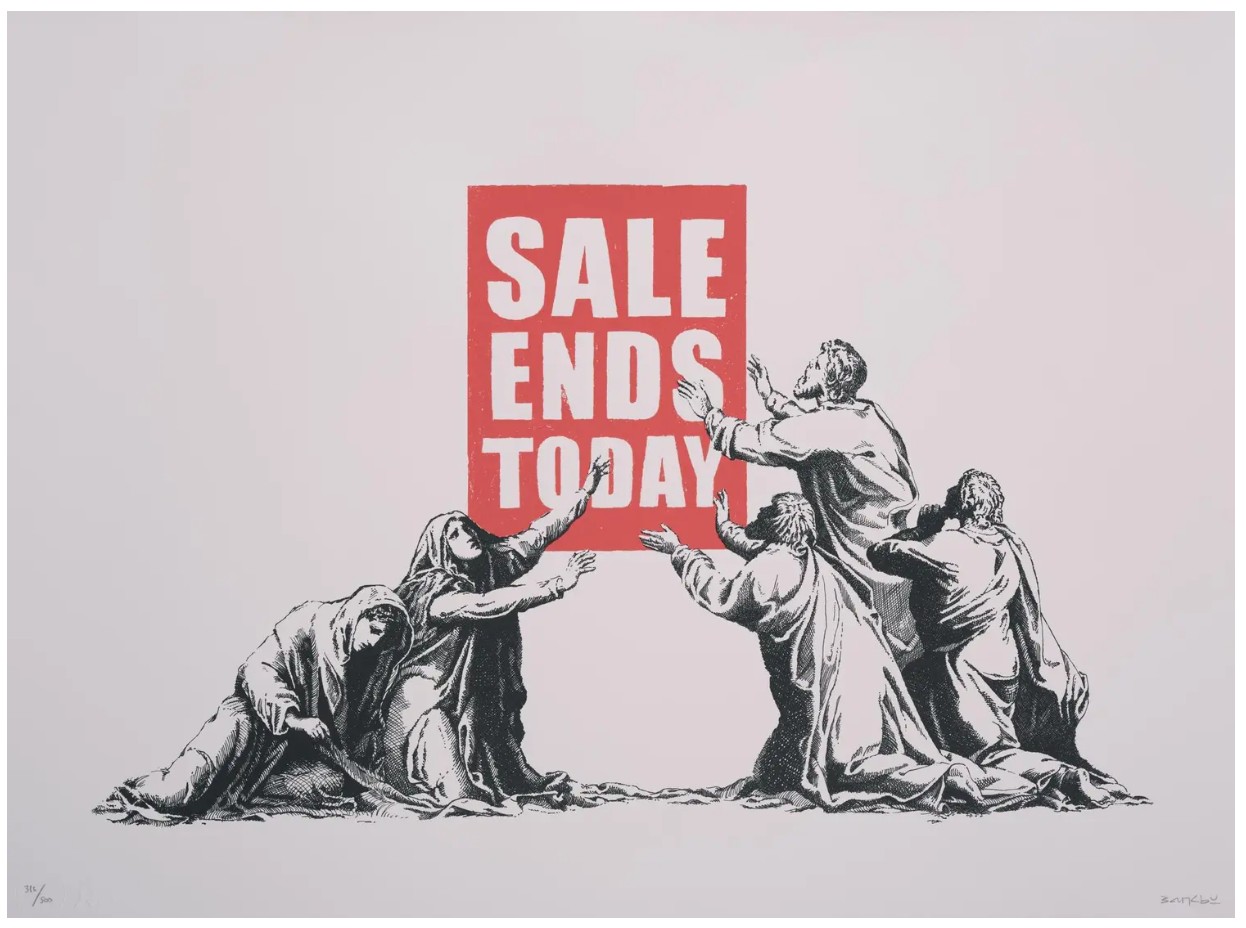
Sale Ends (Version 2), 2017
Signed and numbered from the edition of 500
In Sale Ends, Banksy constructs one of his most incisive and visually refined critiques—where the language of devotion is no longer directed toward the divine, but toward the marketplace. The result is both immediate and unsettling: a scene of worship without transcendence. First conceived in 2006 for the landmark Barely Legal exhibition in Los Angeles, Sale Ends translates the visual grammar of religious painting into a contemporary context dominated by consumption. Drawing directly from the iconography of Renaissance lamentation scenes, Banksy replaces the object of devotion with a commercial imperative, collapsing centuries of spiritual tradition into a single, stark image.
Morons (LA Edition)
xxxxxxxxxx
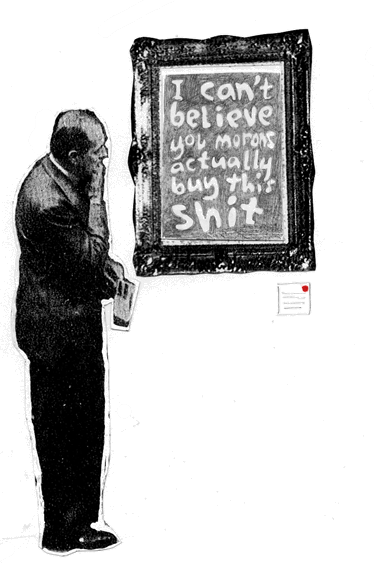
In Morons, Banksy depicts an auction scene where a framed canvas reads, “I can’t believe you morons actually buy this shit.” The bidders remain absorbed in the act of buying, seemingly indifferent to the message. By placing critique within the object itself, Banksy exposes value as a collective belief, while the work itself participates in the very system it questions, which is precisely what makes it so incisive.
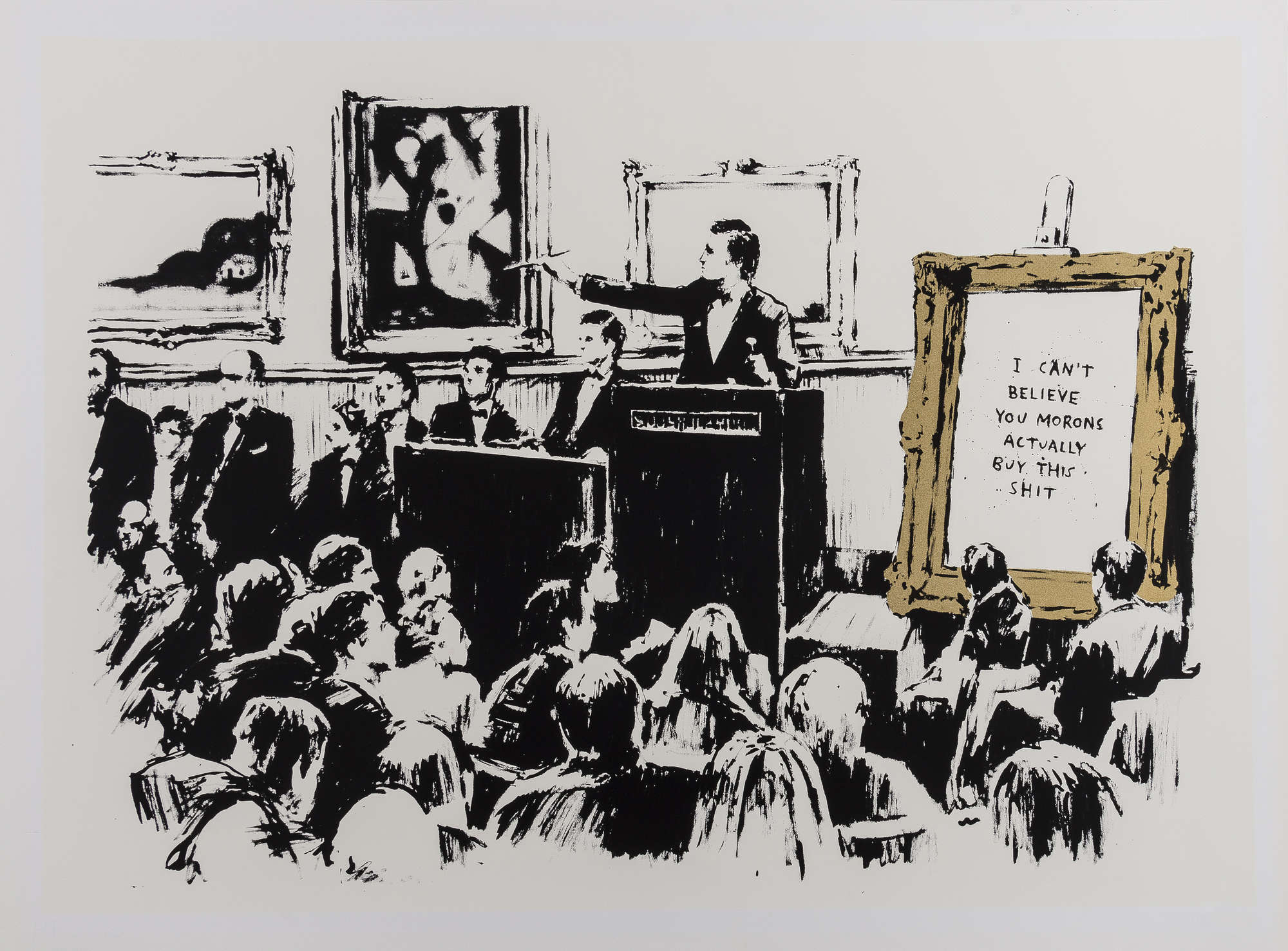
Morons (LA Edition) (unsigned), 2006
Numbered from the edition of 500
(only 100 were printed)
Morons endures because it refuses resolution. It does not offer a moral stance or a solution: only a mirror. Within Banksy’s practice, it remains one of the clearest articulations of his relationship to the art world: critical, complicit, and entirely aware. The room is full, the bids are rising, and the message hangs plainly on the wall. No one objects. The hammer falls anyway.